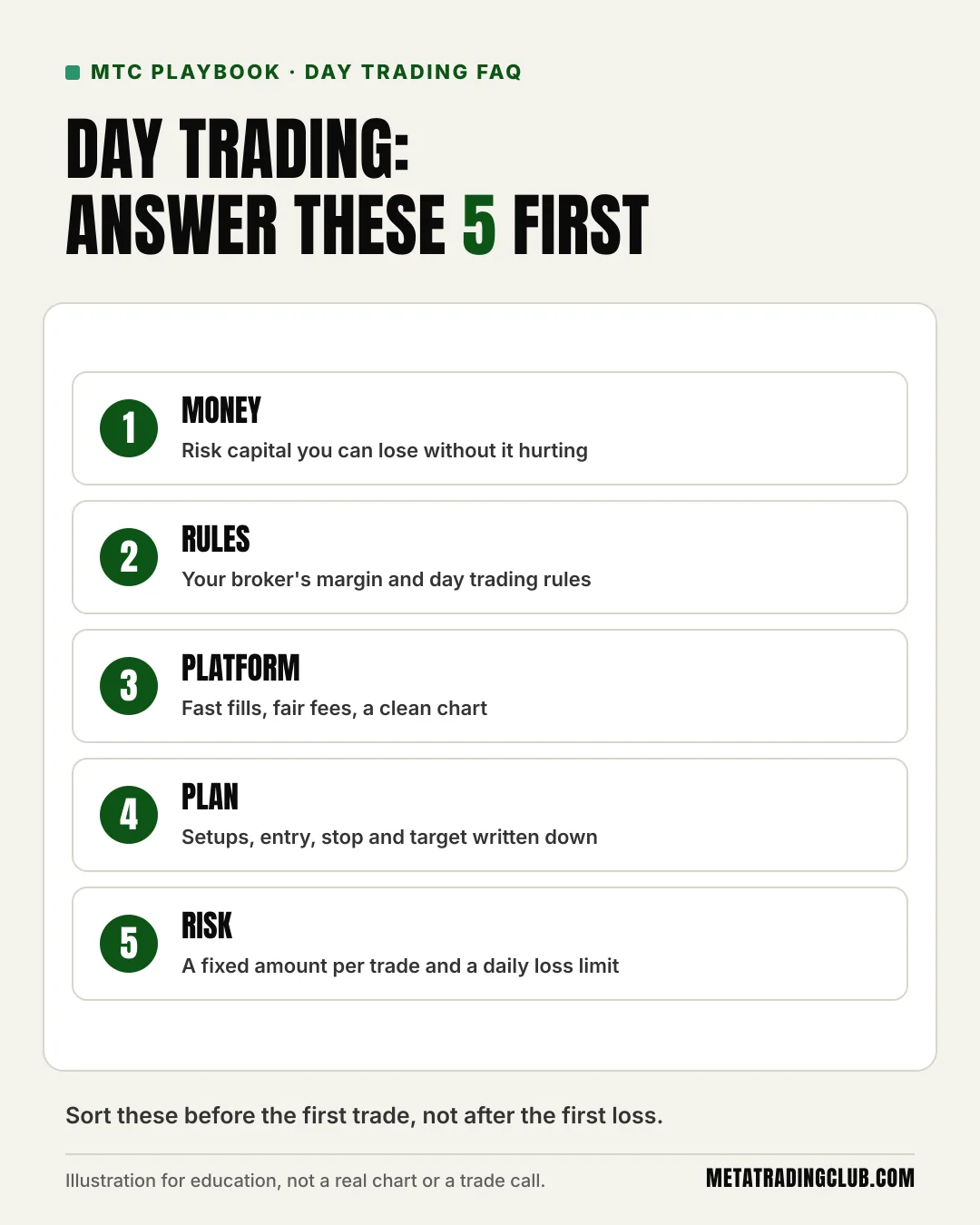
Day trading looks simple from the outside: buy, sell, close the laptop. The questions start the moment you try it. How much money do I need? Does the PDT rule apply to me? When should I trade? What happens at tax time?
Here are straight answers to the questions people actually search, for traders in Canada and the US. Each answer is short and links to the full guide. New to all of it? Start with what day trading is and how it works.
Jump to: Day trading basics · Rules and money · Execution · Risk and psychology · Taxes
Day trading basics
What is day trading?
Day trading means opening and closing a position within the same trading day, so you hold nothing overnight. Day traders aim to catch short moves in stocks, ETFs, options or futures, and manage risk trade by trade. It takes a plan, fast execution and strict risk rules. Full guide: what is day trading.
Is day trading legal in Canada?
Yes. Day trading is legal in Canada through any broker regulated by CIRO. Canadian brokers don’t apply the US pattern day trader rule, but they do have their own margin requirements. The bigger issue for Canadians is tax: frequent trading can be treated as business income. See day trading vs swing trading in Canada.
What counts as day trading in Canada?
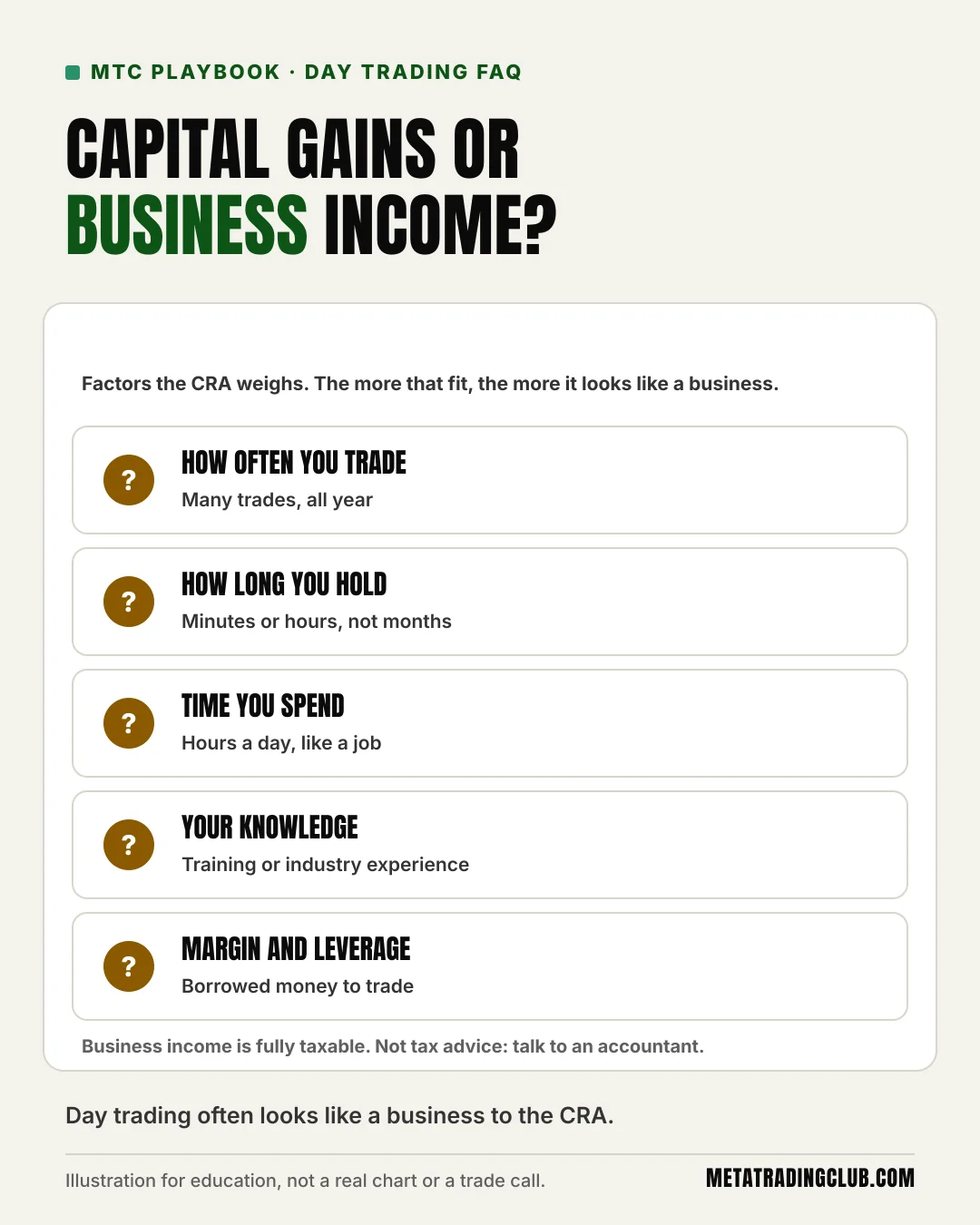
Any trade opened and closed on the same day is a day trade. For tax, the CRA looks at the overall pattern: how often you trade, how long you hold, the time you spend, your knowledge and whether you use margin. A busy, short-term pattern can make your profits business income. More in what is day trading.
Is day trading worth it?
It can be, for people who treat it as a skill with rules and give it time. It’s not worth it as a way to get rich fast, and most people who try it without a plan lose money. Start small, track every trade and judge yourself on process first. The honest take: is day trading worth it in Canada.
Day trading or swing trading: which is better?
Neither is better. They fit different lives. Day trading needs hours of screen time during market hours and fast decisions. Swing trading holds for days or weeks, so it fits around a full-time job and needs fewer trades. Pick the one your schedule supports. Compare them in swing trading vs day trading.
Rules and money
What is a pattern day trader?
Under FINRA rules, a pattern day trader is someone who makes four or more day trades within five business days in a US margin account. That label used to require $25,000 in the account. The SEC approved removing that minimum on April 14, 2026, effective June 4, 2026. Full explanation: what is a pattern day trader.
Does the PDT rule apply in Canada?
No, not at Canadian brokers. The PDT rule is a FINRA rule that applies to US broker-dealers. Canadian brokers regulated by CIRO follow their own margin rules instead. If you open an account with a US broker, its rules apply, and those are changing now that the $25,000 minimum has been approved for removal.
How much money do you need to start day trading?
There’s no legal minimum at Canadian brokers, and US brokers are moving off the old $25,000 PDT minimum. The real number depends on your risk per trade. If you risk 1% per trade, the account size decides how big your positions can be. Realistic numbers: how much money you need to day trade.
Can you day trade in a TFSA?
Technically yes, but it’s risky. If the CRA decides you’re carrying on a business of trading inside your TFSA, the profits can be taxed, which removes the reason to use a TFSA. Frequent short-term trading is exactly the pattern it looks for. Many day traders use a regular cash or margin account instead. Not tax advice.
What is intraday buying power?
Intraday buying power is how much a margin account lets you trade during the day, often more than your cash because of leverage. It resets based on your account equity and your broker’s rules. More buying power is not more safety: size by risk, not by what the broker allows. Explained in intraday buying power.
What is a margin call?
A margin call happens when your account equity drops below your broker’s maintenance requirement. You have to add money or close positions, and the broker can close them for you. For day traders it usually means position size got too big for the account. How to avoid one: what is a margin call.
Execution
What is the best time of day to day trade?
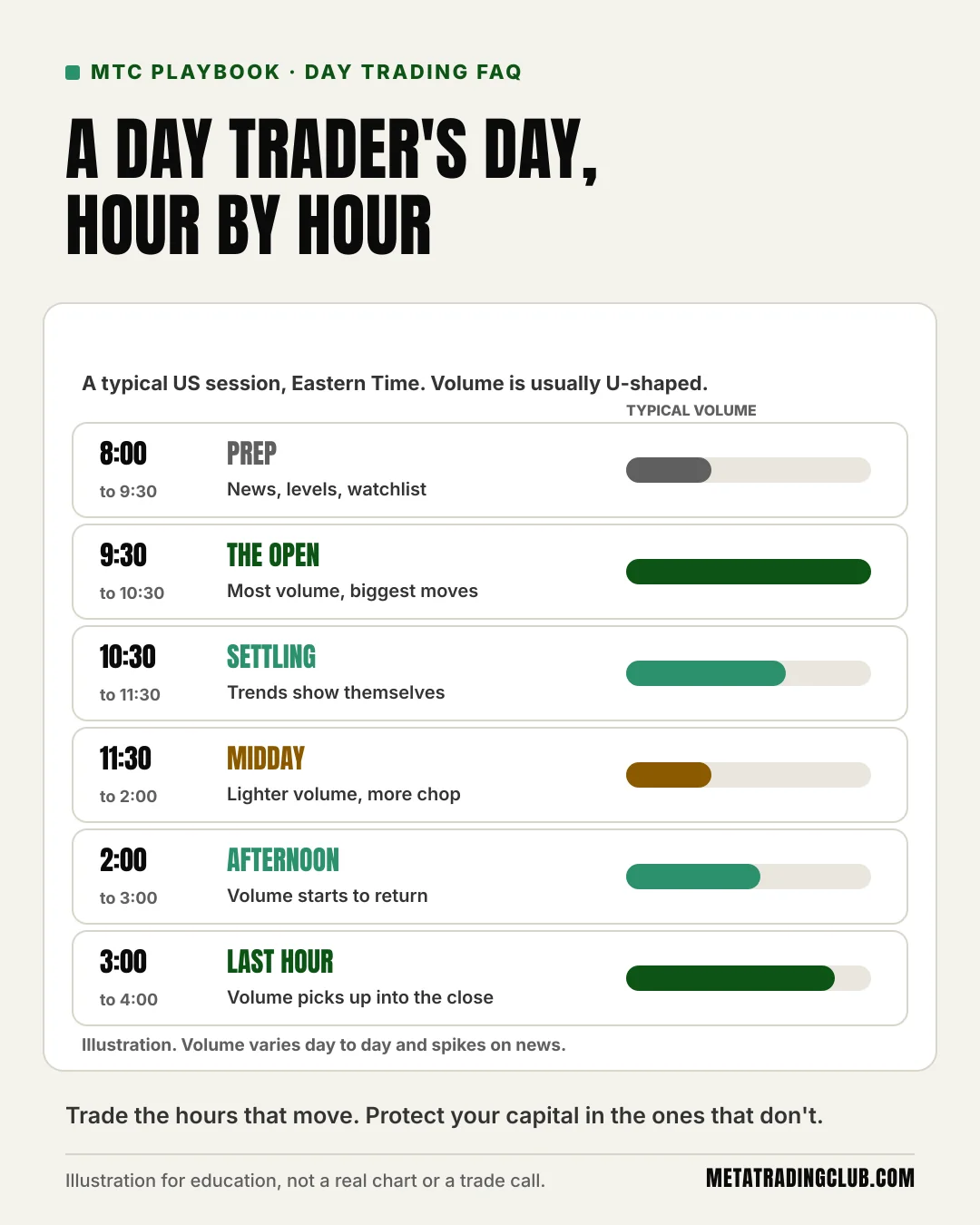
For US stocks, the first hour after the 9:30 a.m. ET open usually has the most volume and the biggest moves. Midday is often quieter and choppier, and volume tends to pick up again in the last hour. Many traders focus on the open and stop by late morning. More in how to trade the market open.
Should I use market or limit orders?
Market orders fill fast but at whatever price is available, which can cost you on fast or thin stocks. Limit orders control your price but may not fill. Most day traders use limits to enter and protective stop orders to exit. The difference, with examples: market order vs limit order.
What is slippage in day trading?
Slippage is the gap between the price you expected and the price you actually got. It happens in fast markets, around news and in stocks with wide spreads. A few cents per share adds up over hundreds of trades. How to reduce it: what is slippage in trading.
What is the best broker for day trading?
The best day trading broker gives you fast, reliable fills, low per-trade costs, good charts and hotkeys, and fair margin rates. For Canadians, also check USD handling. Don’t pick on the welcome bonus. Our comparison: best day trading brokers in 2026.
What is a good day trading strategy to start with?
Start with one simple, rules-based setup and learn it deeply. The opening range breakout is a common first strategy because the rules are clear: mark the first range, wait for a break, confirm, and manage the risk. Learn one setup before adding another. Step by step: opening range breakout strategy.
How should I prepare before the market opens?
Check overnight news and the economic calendar, mark the zones on your watchlist, and decide your bias before the bell. Write down which setups you’ll take and your max loss for the day. Preparation is what stops impulse trades at the open. Our routine: premarket routine for traders.
Risk and psychology
How much should I risk per day trade?
Many traders risk a small, fixed percentage of the account per trade, often 1% or less, and set a daily loss limit. Size the position from the stop distance, not from a gut feeling. That keeps any single trade or bad day from doing real damage. The math: position sizing for day trading.
Where should I put my stop loss?
Put your stop where the trade idea is proven wrong, usually just past the zone you entered from, not at a random dollar amount. Then size the position so that stop equals your planned risk. Moving the stop further away mid-trade is how small losses become big ones. Full guide: how to set a stop loss the right way.
How do I avoid emotional decisions in day trading?
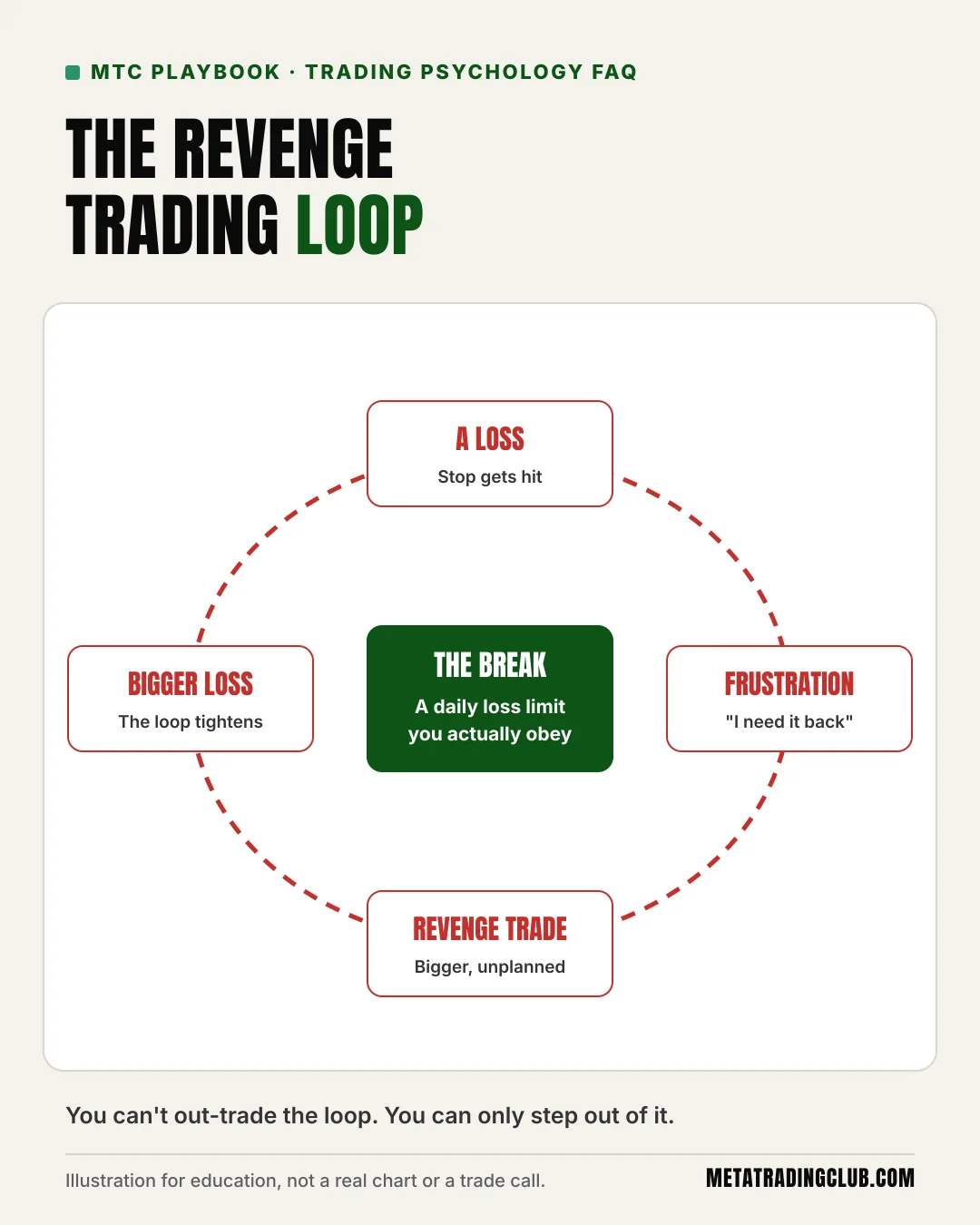
Decide everything before the trade: entry, stop, target and size. Use a daily loss limit, and step away after hitting it. Keep a journal of what you felt, not just what you traded. Rules made when calm protect you when the market isn’t. More in trading psychology.
How do I stop overtrading?
Overtrading usually comes from boredom, revenge after a loss or chasing a missed move. Fix it with a short list of allowed setups, a max number of trades per day and a hard stop time. If a trade isn’t on your plan, it isn’t a trade. Practical steps: how to stop overtrading.
Taxes
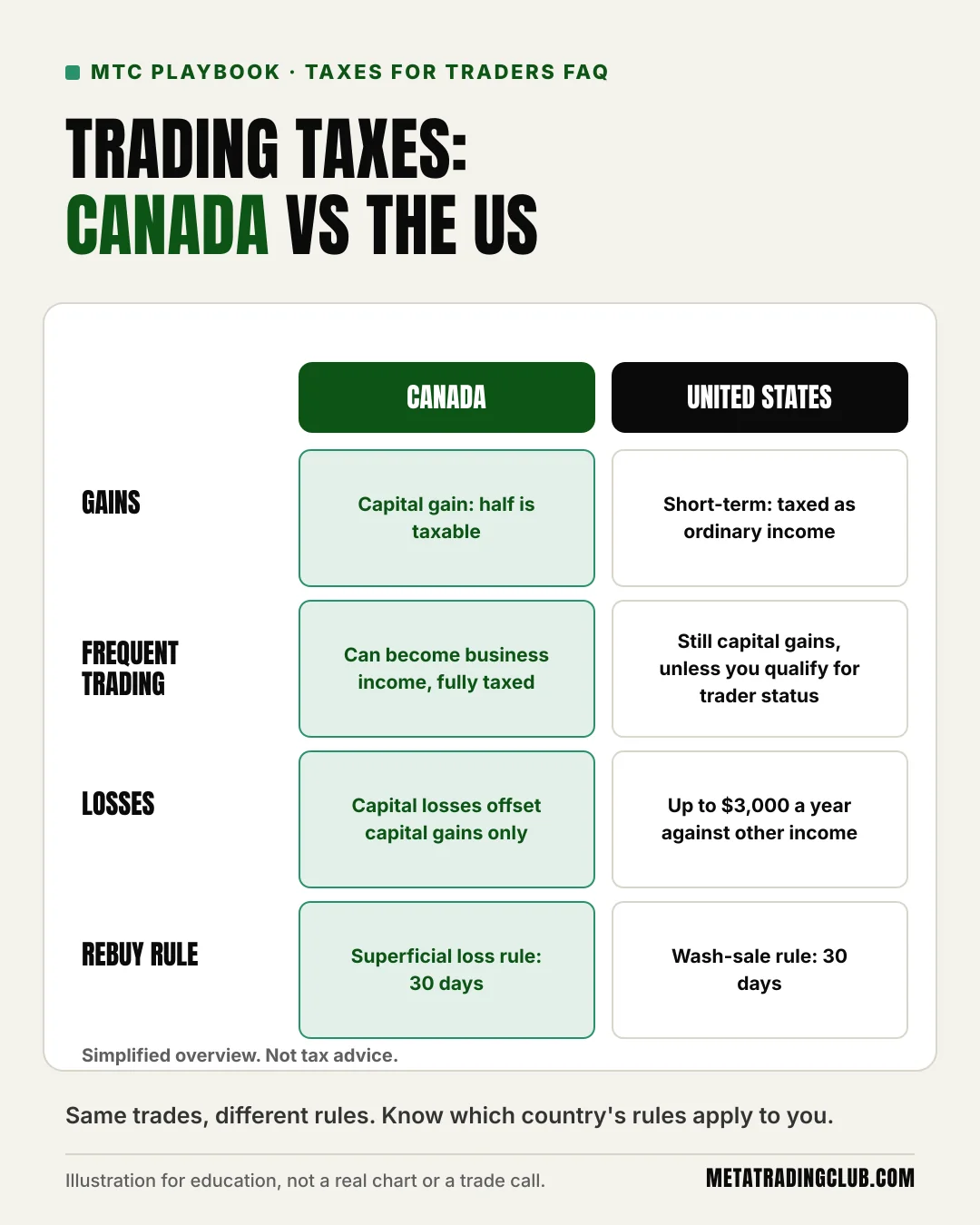
How is day trading taxed in Canada?
If the CRA sees your trading as a business, profits are business income and fully taxable, and losses can offset other income. If it’s investing, half of a net capital gain is taxable. Frequent, short-term trading often lands on the business side. Not tax advice: an accountant can tell you where you fall.
How is day trading taxed in the US?
In the US, day trading profits are usually short-term capital gains, taxed at your ordinary income rate. The wash-sale rule can delay losses, and some traders qualify for trader tax status. Full breakdown, with US rules only: day trading taxes explained.
Where to go next
Start with what day trading is, then read position sizing for day trading before you place a single trade. If you trade options too, our options trading FAQ for Canada answers the account and tax questions that come up next.
The process doesn’t change on short time frames: bias, zone, reaction, confirmation, then execution. Speed is not a reason to skip a step.