It’s one of the most searched questions in Canadian trading: is day trading worth it?
The honest answer isn’t a simple yes or no. And anyone who gives you a confident one-word answer is either trying to sell you something or hasn’t thought about it carefully enough.
‘Worth it’ depends entirely on what you’re asking for, what you’re willing to put in, and how clearly you understand what day trading actually is — not the social media version, but the real thing.
This post gives you the honest breakdown. What day trading actually requires, the tax reality that most Canadians don’t account for, when it genuinely makes sense to pursue it, when it doesn’t, and what a structured alternative looks like for people who want market exposure without turning their life into a screen-watching exercise.
No hype. No income promises. Just a clear-eyed look at whether this path makes sense for your situation.
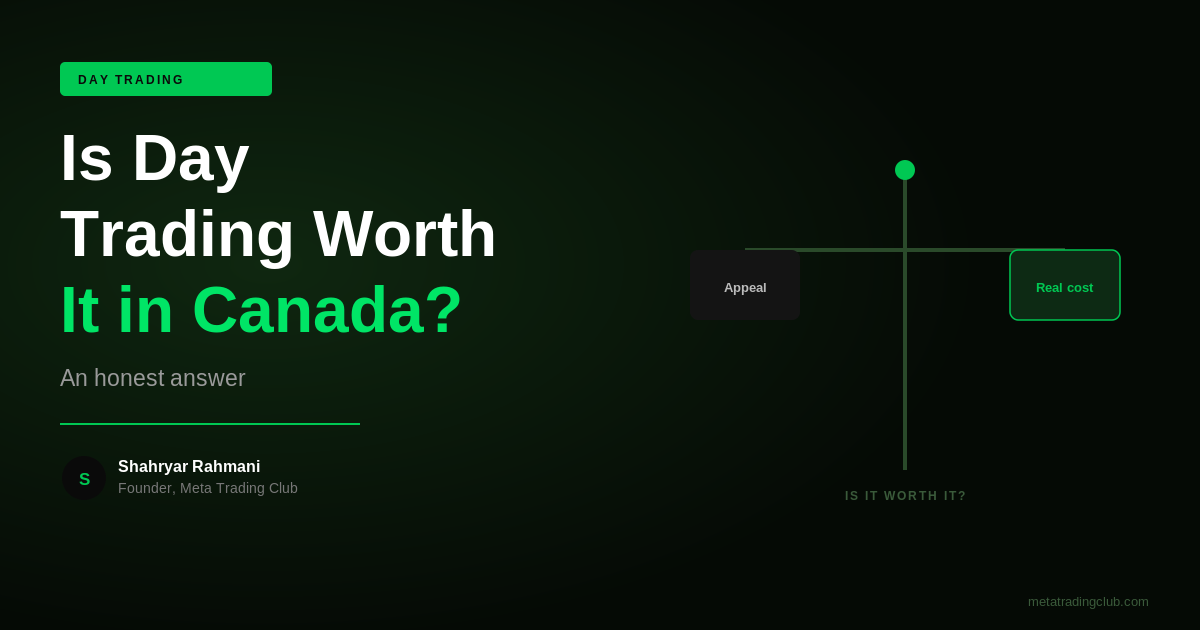
An honest answer
‘Is day trading worth it?’ depends on more than returns — time, taxes, and temperament all factor in. Here’s the real math.
What Day Trading Actually Is (vs What People Think It Is)
The social media version of day trading: wake up at 9 AM, sit down for a few hours, make money while everyone else is at work, and live freely.
The reality: day trading is one of the most demanding, capital-intensive, and psychologically challenging ways to participate in financial markets. It requires real-time decision-making under pressure, deep market knowledge, rigid discipline, a structured process, and a capitalization level that most people starting out don’t have.
Most people who get into day trading are attracted by the idea of financial independence and flexible hours. Both are theoretically possible. Both are also years of consistent work away for the vast majority of traders.
That’s not pessimism — that’s an accurate assessment of the skill gap between where most beginners start and where consistent profitability requires you to be. Acknowledging that gap is the first step toward closing it.
MTC Analysis
The Appeal vs. The Real Cost
‘Worth it’ is personal. For the disciplined few with the right temperament and a real process, yes — for most who skip the work, no.
What Day Trading Requires
Time Commitment
True day trading demands your full attention during market hours. That means being at your screen from before 9:30 AM Eastern through at least the morning session (and often longer). You can’t day trade effectively while managing other responsibilities simultaneously. The market doesn’t pause for meetings, phone calls, or family commitments.
For people with full-time jobs, families, or other obligations during market hours, traditional day trading isn’t practically feasible. The schedule doesn’t flex. If you’re not available and focused, you’re either missing setups or making worse decisions.
Capital
Proper capitalization matters for two reasons: risk management and PDT rules.
The Pattern Day Trader (PDT) rule in the US requires a minimum of $25,000 USD in a margin account to make more than 3 day trades per week. Canadian-registered brokers aren’t subject to this same rule, but capital is still critical for position sizing and surviving drawdowns without wiping out.
Undercapitalized day trading is extremely high-risk. When your account is too small relative to your position sizes, normal drawdowns become catastrophic. You need enough capital that a losing streak doesn’t end your trading career.
Emotional Discipline
Covered in-depth in other posts, but worth restating here: the psychological demands of day trading are severe. You’re making decisions in real time, under pressure, often multiple times a day. The losses are immediate and visceral. The feedback loop is fast, which amplifies both confidence and doubt.
Day trading without a structured psychological framework and defined process tends to result in emotional decision-making — which is expensive.
A Structured Process
There’s a difference between clicking buttons based on instinct and trading with a repeatable, criteria-based methodology. The former might work occasionally. The latter is what makes profitability sustainable.
A structured process means: defined setup criteria, a clear market framework, rules for entry and exit, defined maximum risk per trade, and a way to evaluate whether your decisions were process-driven or emotional.
The Tax Reality in Canada
This is the part most aspiring day traders skip over — and it matters enormously.
In Canada, if you’re actively trading with frequency and intention to profit, the CRA generally treats your trading gains as business income, not capital gains. That means:
- Fully taxable at your marginal income tax rate (not the 50% inclusion rate for capital gains)
- No TFSA protection for day trading activity — the CRA has rules against using a TFSA for what it deems ‘business-like’ trading activity
- You’re expected to file as a business, track expenses, and keep detailed records
The specific tax treatment depends on your individual circumstances — trading frequency, intention, capital employed, and whether you have other income. A tax professional who understands trading is essential if you’re trading actively.
For a detailed breakdown of how trading gains are taxed in Canada, this post on options trading tax in Canada covers the key considerations.
The bottom line: gains from active day trading in Canada are typically taxed at your full marginal rate. For someone in a higher tax bracket, a 30% pretax gain might be 18% after tax. That changes the math on what ‘worth it’ means.
Day Trading vs Swing Trading vs Options Strategies: A Brief Comparison
| Factor | Day Trading | Swing Trading | Options (Structured) |
|---|---|---|---|
| Time at Screen | Full market hours daily | 30–60 min per day for analysis | 30–60 min for prep + execution |
| Hold Duration | Minutes to hours, closed same day | Days to weeks | Days to months depending on strategy |
| Capital Requirement | Higher (PDT rules, margin) | Moderate | Moderate — can define max risk |
| Tax Treatment (Canada) | Business income (fully taxable) | May be capital gains if long enough | Depends on frequency and intention |
| Stress Level | High — constant decisions | Medium | Medium — defined risk helps |
| TFSA Compatible | Generally no, if active | Potentially, with longer holds | Potentially, with defined-risk strategies |
| Learning Curve | Very high | Moderate–High | High, but learnable systematically |
| Selectivity Required | Must trade frequently for income | More selective | Highly selective — wait for setups |
When Day Trading IS Worth It
Day trading makes sense for people who:
Have the time. Full availability during market hours, without other obligations that fragment your attention. If you can’t be fully present, the quality of decisions drops immediately.
Have proper capitalization. Enough capital to size positions appropriately, absorb a normal drawdown without crisis, and not need the money in the short term.
Have a defined process. Not a vague strategy — an actual, specific methodology with clear rules for when to enter, when to exit, how much to risk, and what constitutes a valid setup.
Have done the work before going live. Paper trading, backtesting, studying market structure — the people who do well have typically spent months in education before trading real money aggressively.
Treat it like a business. Track everything, analyze performance objectively, separate emotion from decisions, accept losses as part of the process.
For this person, day trading can become a legitimate professional pursuit. But this description fits a small percentage of the people who actually try it.
When Day Trading Is NOT Worth It
Day trading doesn’t make sense for people who:
Have limited availability during market hours. Trying to day trade between meetings or while managing other responsibilities is the worst of both worlds — you’re not fully present for either.
Are undercapitalized. Starting with $2,000–$5,000 and expecting to generate meaningful income is a setup for frustration. The math doesn’t work and the risk management is nearly impossible.
Don’t have a methodology. ‘I’ll learn as I go’ is fine for low-stakes activities. For day trading with real money, the learning costs are direct financial losses.
Need the money. Trading with money you can’t afford to lose changes your psychology in ways that almost universally make performance worse. Desperation and discipline don’t coexist.
Are expecting passive income. Day trading is the opposite of passive. It demands active engagement, continuous learning, and real mental energy.
If you fall into any of these categories, that doesn’t mean you can’t or shouldn’t trade. It means day trading in the traditional sense may not be the right approach — at least not yet, and not in that specific format.
The Alternative Most People Don’t Consider
A lot of people assume trading means sitting in front of charts all day, making rapid decisions. That’s one way to trade. It’s not the only way — and for most people’s lives, it’s not the most sustainable way.
Options trading with a structured, selective approach is fundamentally different from what most people picture as ‘day trading.’
Instead of making dozens of trades per day, you’re looking for a small number of high-quality setups per week — entries at key levels, with defined risk, in the direction the market structure supports. You can do thorough analysis in the morning, take your trades, and manage them without being glued to a screen all day.
This approach:
- Requires significantly less screen time
- Allows for tighter risk management through defined-risk strategies
- Is more compatible with other life responsibilities
- Can work in a TFSA or RRSP (depending on strategy and broker, which should be verified)
- Rewards discipline and patience over speed and reaction time
It’s not passive. It still requires real skill, real preparation, and a real process. But the lifestyle demands are very different from traditional day trading.
This is a big part of what we teach at Meta Trading Club — not activity for the sake of activity, but structured execution when genuine setups appear. The question we ask every morning isn’t ‘what can I trade today?’ It’s ‘is there a high-quality setup that fits the framework today?’ Sometimes the answer is no. That’s a valid outcome.
What MTC Actually Teaches
We’re not a day trading signals service. We don’t send alerts telling people what to buy. We don’t promise specific results or imply that trading is easy.
What MTC is: a live trading education community with daily premarket sessions, live execution, and the MTC Alignment Engine framework that gives members a structured, repeatable process for identifying and trading setups.
Members develop their own process. They learn to read market structure, identify key levels, wait for confirmation, and execute with defined risk. Some of them trade more actively. Some make 5–10 trades per week. The approach varies by individual. What’s consistent is the framework.
Understanding why most traders lose money is an important part of the conversation — it’s not about market difficulty, it’s about the patterns that drive poor decision-making. That post covers it honestly.
Build a Process Worth Following
Whether you want to trade more actively or take a selective, structured approach, the starting point is the same: a real process, a sound framework, and an environment that supports learning.
At Meta Trading Club, we build exactly that. Daily premarket sessions, live execution, a structured framework, and a community that takes trading seriously without the hype.
Join the MTC Community — 7-day free trial, $99/month
Come see what structured trading actually looks like in practice.
Proprietary Framework
The MTC Alignment Engine™ — Applied Every Live Session
Every trade runs the same five checkpoints — consistency over gut reaction. Inside the MTC Incubator, members build their own system on top of this framework.
Frequently Asked Questions
Is day trading legal in Canada?
Yes, day trading is legal in Canada for retail investors. There are no laws preventing Canadian residents from actively trading stocks or options. Canadian traders are not subject to the US Pattern Day Trader (PDT) rule that requires $25,000 USD minimum in US margin accounts. However, active day traders in Canada may have their gains treated as business income by the CRA, which means different tax treatment than capital gains. As with any trading activity, consulting a tax professional is advisable.
How much money do you need to start day trading in Canada?
There’s no regulatory minimum for Canadian accounts, but practically speaking, starting with less than $10,000–$25,000 makes risk management very difficult. Position sizing that limits risk to 1–2% per trade — the standard framework — requires enough capital to make those percentages meaningful. Starting with very small accounts often leads to oversized risk relative to account size, which makes normal drawdowns account-threatening. It’s generally better to spend more time in education, save more capital, and start with a realistic base.
Is day trading income taxed in Canada?
In Canada, the CRA’s treatment of trading income depends on factors including trading frequency, intention, and whether trading is conducted in a business-like manner. Active day traders are generally taxed on trading profits as business income — fully taxable at the marginal rate — rather than as capital gains (which have a 50% inclusion rate). This is a significant difference and has major implications for net returns. You should work with a tax professional who understands trading to ensure you’re filing correctly. More on this topic is covered in our options trading tax in Canada post.
What is the failure rate of day traders in Canada?
Studies on retail trading broadly — not specific to Canada — consistently show that the majority of active day traders lose money over time. Estimates suggest 70–90% of retail day traders underperform or lose. The causes are well-documented: lack of structured process, undercapitalization, poor risk management, and emotional decision-making. This doesn’t mean day trading is impossible to do well — it means that doing it well requires a level of preparation, discipline, and structured methodology that most people who start don’t have.
Is day trading or swing trading better for Canadians?
It depends on your lifestyle, capital, and goals. Day trading requires full availability during market hours, typically generates business income (fully taxable), and demands constant active engagement. Swing trading can be done with less time at the screen, and depending on hold duration and intention, may be treated as capital gains by the CRA (though this should be confirmed with a tax advisor). For most people with jobs, families, and other commitments, swing trading or structured options trading with a selective approach is more compatible with their actual lifestyle.
Can you make a living day trading in Canada?
Yes, but the percentage of people who do so consistently and sustainably is small. Making a living trading requires: sufficient capitalization (typically six figures or more), a fully developed and proven methodology, disciplined risk management, psychological stability, and the ability to withstand income variance month to month. It’s a legitimate professional pursuit for people who have put in the work — but it takes years to build to that level, not months. Anyone suggesting otherwise is not being honest about the realities of the profession.
Meta Trading Club Community
Start Your 7-Day Free Trial
Daily live sessions. Real-time market prep — not signals. The MTC Alignment Engine™ applied in front of you. Trade alongside Shahryar from day one.
Cancel anytime. No contracts. Built for Canadian traders.
Already trading and want to build your own system?
The MTC Incubator is an application-based mentorship — 1-on-1 work building a personalized system on the Alignment Engine™.