Related reading
Almost every blown account has the same cause: not the entries, the exits. Specifically, the missing or badly-placed stop loss. A stop loss is the single most important risk tool you have, and most traders either don’t use one or set it in the worst possible place — right where the market is most likely to hit it before reversing.
Setting a stop loss the right way isn’t about a magic percentage. It’s about deciding, before you enter, exactly where your trade idea is proven wrong, and sizing the position so that being wrong costs you a small, survivable amount.
The exits, not the entries
Almost every blown account dies the same way: a missing or badly placed stop. A stop isn’t an admission of failure. It’s the cost of doing business — and the only thing that matters is being wrong small.
What a Stop Loss Actually Is
A stop loss is a predefined price where you exit a losing trade, no questions asked. Its job isn’t to predict the bottom. Its job is to cap the damage so one bad trade can’t take out a week of good ones.
The mental shift that separates consistent traders from gamblers: a stop loss is not an admission of failure. It’s the cost of doing business. You will be wrong often. The only thing that matters is being wrong small.
MTC Analysis
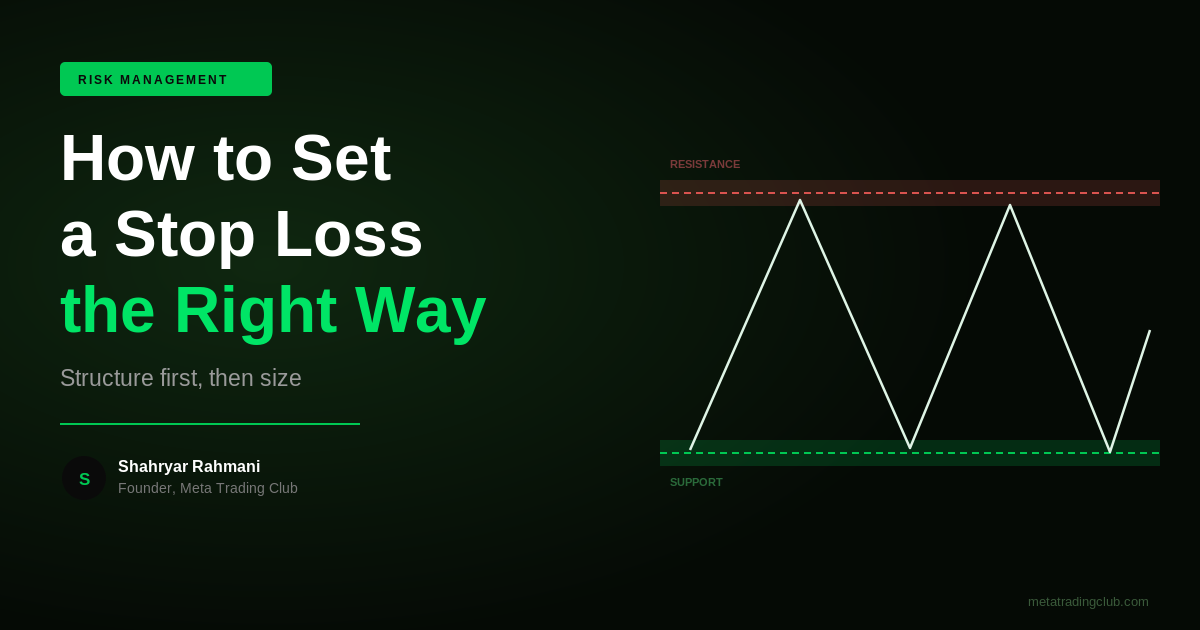
Place the Stop Beyond Structure, Not At It
Price reacts at zones, not exact lines. Put the stop beyond the level with a buffer for noise, then size the position to that distance.
The Mistake: Setting Stops Based on Dollars
Most beginners set stops based on how much they’re willing to lose in dollars — ‘I’ll get out if I’m down $100.’ The market doesn’t know or care about your $100. Price moves based on structure, not your account balance.
When you set a stop based on a round dollar amount, you usually end up placing it at a random price that has no meaning — often inside the normal noise of the move. You get stopped out, the trade reverses, and you conclude the market is rigged. It isn’t. Your stop was just in the wrong place.
The Right Way: Structure First, Then Size
Setting a stop correctly is a two-step process, and the order matters.
Step 1: Find Where You’re Wrong (Structure)
Look at the chart and ask: where would price have to go to prove this trade idea is invalid? For a long, that’s usually below a recent swing low or a support level. For a short, above a swing high or resistance. That level — plus a small buffer for noise — is your stop. Not a dollar amount. A place on the chart where your thesis breaks.
Step 2: Size the Position to the Stop (Risk)
Now measure the distance from your entry to that stop. That distance is your risk per share or per contract. Decide how much of your account you’re willing to lose on this trade — most consistent traders use 1–2%. Then size your position so that if price hits your stop, you lose exactly that amount.
This is the part beginners skip, and it’s the whole game. The stop location comes from the chart. The position size comes from the stop. When you do it in this order, a wide stop just means a smaller position — your risk stays constant either way.
Where to Actually Place the Stop
A few practical rules that keep you out of the noise:
Place stops beyond structure, not at it. If support is at $100, don’t put your stop at $100 — everyone’s stop is there, and price often pokes through before reversing. Give it room: below the level plus a buffer based on the stock’s normal range.
Use the average range of the stock, not a fixed percentage. A volatile tech name needs more room than a slow utility. A stop that’s appropriate for one will be far too tight for the other.
Never move a stop further away to avoid being stopped out. Moving a stop down on a long because ‘it’ll come back’ is how small losses become account-ending ones. You can move a stop in your favor to lock in gains — never against you.
The Stop Is Part of the Plan, Not an Afterthought
The traders who survive decide their stop before they enter — it’s part of the setup, the same way the entry and target are. If you can’t define where you’re wrong before you click buy, you don’t have a trade. You have a hope.
At Meta Trading Club, every live trade is walked through with the stop defined first — where’s the structure, how much is at risk, what’s the size. Watching it done in real time, every market day, is how the habit actually sticks.
Proprietary Framework
The MTC Alignment Engine™ — Applied Every Live Session
Every trade runs the same five checkpoints — consistency over gut reaction. Inside the MTC Incubator, members build their own system on top of this framework.
Frequently Asked Questions
Where should I place my stop loss?
Place it just beyond a structural level — below a swing low or support for a long, above a swing high or resistance for a short — with a small buffer for normal price noise. Avoid placing it at a round number or based purely on a dollar amount, since those locations have no meaning to the market and often sit inside the normal range of the move.
What percentage should a stop loss be?
There’s no universal percentage. The stop distance should come from the chart’s structure, not a fixed percent. What you keep constant is your risk per trade — usually 1–2% of your account. A wider stop simply means a smaller position so the dollar risk stays the same.
Why do I keep getting stopped out right before the move?
Almost always because your stop is too tight or placed exactly at an obvious level where everyone else’s stops sit. Price often pokes through those levels to trigger stops before reversing. Giving the stop a buffer beyond structure, sized using the stock’s normal range, usually fixes this.
Should I use a hard stop or a mental stop?
Beginners should use a hard stop order in the market. Mental stops require discipline most traders don’t have under pressure, and they tend to turn into ‘I’ll give it a little more room’ — the exact behavior that blows up accounts. As you gain experience, some traders use mental stops on specific setups, but a hard stop is the safer default.
Can a stop loss guarantee I won’t lose more than planned?
Mostly, but not always. A standard stop becomes a market order when triggered, so in a fast gap or illiquid market you can be filled worse than your stop price (slippage). Defined-risk options strategies and trading liquid instruments reduce this risk. A stop dramatically limits losses, but it isn’t a perfect guarantee.
Should I move my stop loss as the trade goes my way?
You can move a stop in your favor to lock in profit — for example, trailing it up under new higher lows on a long. You should never move a stop further away to avoid being stopped out. Tightening in your favor is risk management; loosening against you is how small losses become large ones.
Meta Trading Club Community
Start Your 7-Day Free Trial
Daily live sessions. Real-time market prep — not signals. The MTC Alignment Engine™ applied in front of you. Trade alongside Shahryar from day one.
Cancel anytime. No contracts. Built for Canadian traders.
Already trading and want to build your own system?
The MTC Incubator is an application-based mentorship — 1-on-1 work building a personalized system on the Alignment Engine™.
Related reading
- How to Develop Your Own Trading System From Scratch
- Trading Psychology: How to Control Your Emotions and Trade With Discipline
Want to learn this live? Trade alongside us inside the MTC community — start your 7-day free trial.