Tax is the part of trading most people ignore until April, and it’s the part that decides how much of your profit you actually keep. The rules are different in Canada and the US, and a few of them catch active traders every year.
Below are straight answers to the tax questions traders search most, split by country. This is general education, not tax advice. Your situation is specific, so confirm with an accountant before you file.
Jump to: Trading taxes in Canada · Trading taxes in the US · Records and planning
Trading taxes in Canada
How are trading profits taxed in Canada?
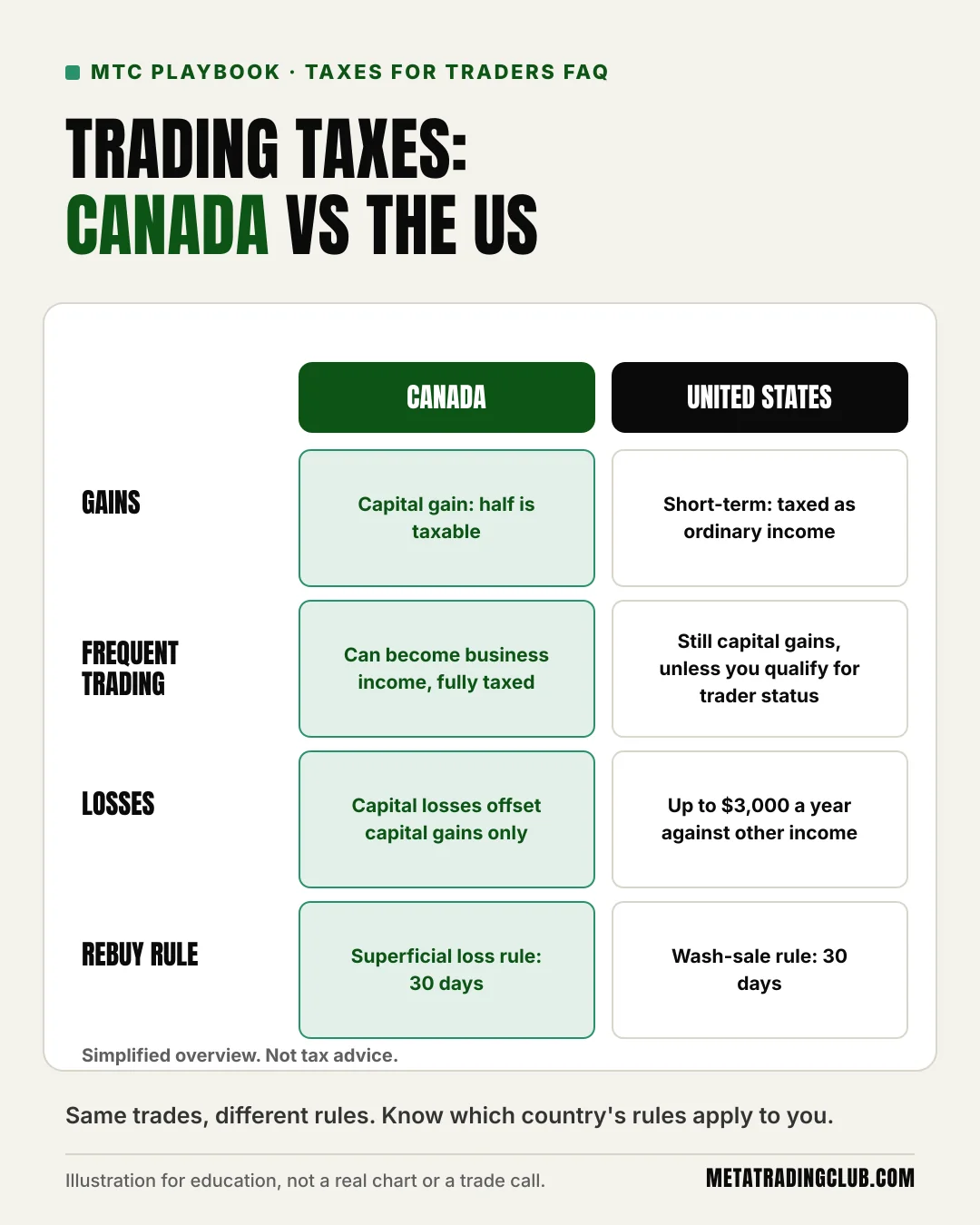
It depends on whether the CRA sees your trading as investing or as a business. Investing profits are capital gains, and half of a net capital gain is taxable. Business income is fully taxable at your marginal rate. How you trade, not what you call it, decides which. Options-specific detail: options trading tax in Canada.
Is day trading in Canada capital gains or business income?
Often business income. The CRA looks at how often you trade, how long you hold, the time you spend, your knowledge and whether you use margin. Frequent, short-term trading fits the business profile. The upside is that business losses can offset other income. Not tax advice. Background: day trading FAQ.
What is the capital gains inclusion rate in Canada?
Half of a net capital gain is included in your taxable income. A proposed increase to two-thirds was cancelled in March 2025, so the 50% rate still applies. That means a $1,000 capital gain adds $500 to your taxable income, taxed at your marginal rate.
What is the superficial loss rule?
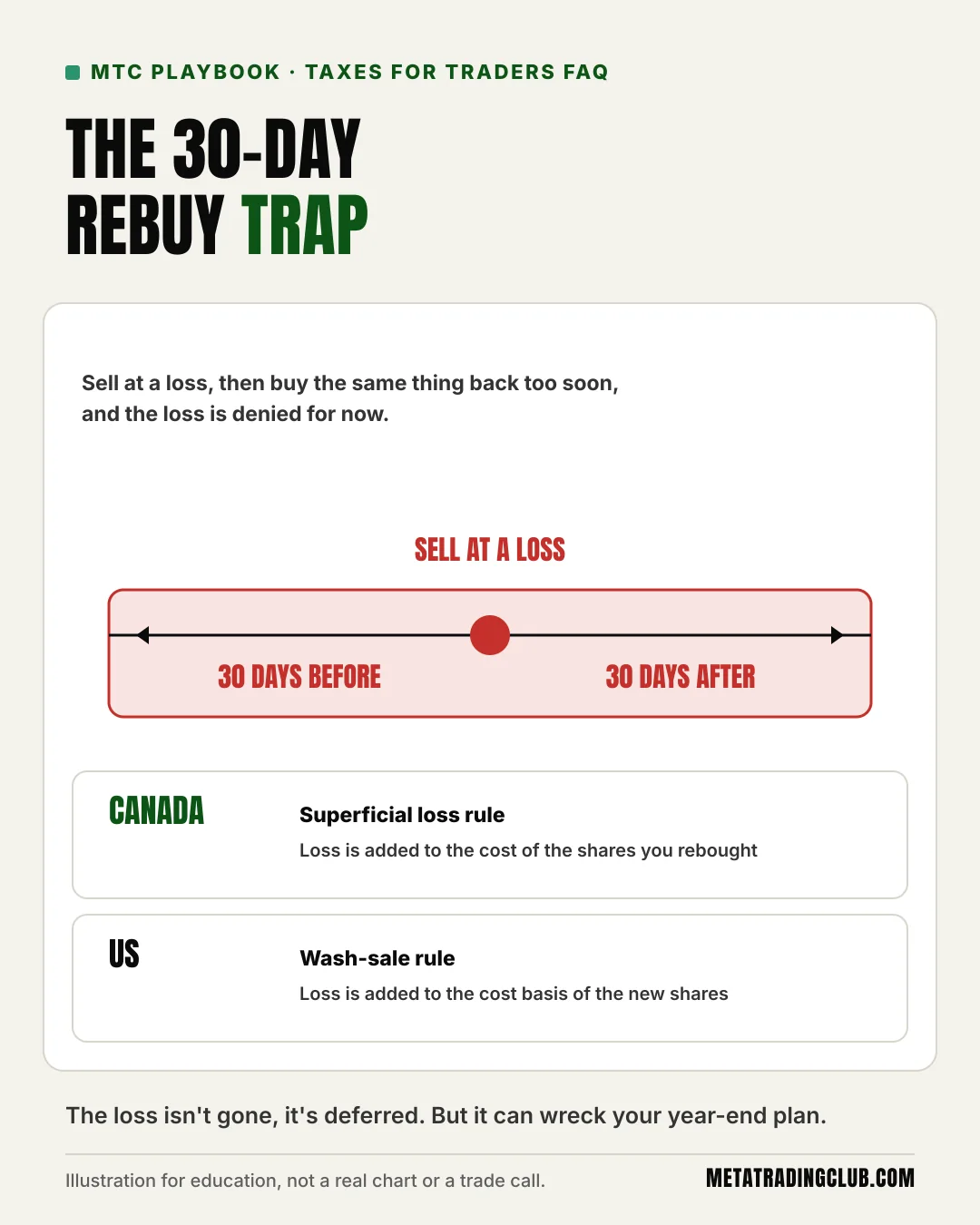
If you sell at a loss and you, or someone affiliated with you, buy the same or an identical security within 30 days before or after the sale and still hold it 30 days after, the loss is denied. It’s added to the cost of the shares you hold instead, so it’s deferred, not gone.
Can I deduct trading losses in Canada?
Yes. Capital losses can offset capital gains in the same year. Unused net capital losses can be carried back three years or forward indefinitely, but only against capital gains. If your trading is a business, losses are business losses and can offset other income. Keep clean records either way.
Can you get taxed on trading in a TFSA?
Yes, if the CRA decides you’re carrying on a business of trading inside it. Then the profits can be taxed as business income, which defeats the purpose of a TFSA. Very frequent, short-term trading is what draws attention. Holding and occasional trades are the normal use. TFSA options rules: options trading FAQ for Canada.
How do Canadians report US stock and options trades?
You report them in Canadian dollars. Convert each purchase and sale at the exchange rate for that day, usually the Bank of Canada rate, so currency moves become part of your gain or loss. Your broker’s T5008 slip helps, but check the cost figures yourself. Full guide: options trading tax in Canada.
Are prop firm payouts taxable in Canada?
Yes. Prop firm payouts are taxable, and because they’re payments for active trading performance, they’re often treated as business income. Challenge fees and related costs may be deductible. Keep every receipt and payout record from day one. Not tax advice. Full guide: prop firm payout taxes in Canada.
Trading taxes in the US
How are trading profits taxed in the US?
Gains on positions held one year or less are short-term capital gains, taxed at your ordinary income rate. Held longer than a year, they’re long-term gains, taxed at lower rates. Most active traders deal almost entirely in short-term gains. Breakdown: short-term vs long-term capital gains.
Are trading losses tax deductible in the US?
Yes. Capital losses first offset capital gains. If losses are bigger, you can deduct up to $3,000 a year against other income, or $1,500 if married filing separately, and carry the rest forward to future years. Details and examples: are trading losses tax deductible.
What is the wash-sale rule?
If you sell a security at a loss and buy the same or a substantially identical one within 30 days before or after the sale, the loss is disallowed for now. It’s added to the cost basis of the new position. Active traders trip it constantly. How it works: what is the wash-sale rule.
How is day trading taxed in the US?
Most day trading profits are short-term capital gains taxed at ordinary income rates, with the $3,000 loss limit and the wash-sale rule applying. Traders who qualify for trader tax status can deduct business expenses, and with a mark-to-market election, avoid both limits. Full guide: day trading taxes explained.
What is trader tax status?
Trader tax status is an IRS classification for people who trade substantially, regularly and continuously, as a business. It lets you deduct trading expenses. There’s no fixed number of trades that qualifies you, so it’s judged on the facts. Explained: trader tax status and mark-to-market.
What is the mark-to-market (475f) election?
Traders with trader tax status can elect Section 475(f) mark-to-market. Open positions are treated as sold at year-end, gains and losses become ordinary, the wash-sale rule stops applying and the $3,000 loss limit goes away. The election has strict deadlines. Details: trader tax status and mark-to-market.
How are futures and index options taxed in the US?
Regulated futures and broad-based index options, like SPX, are Section 1256 contracts. Gains and losses are treated as 60% long-term and 40% short-term, no matter how long you held them, and open positions are marked to market at year-end. That blended rate is often lower than short-term rates. More in short-term vs long-term capital gains.
Do traders need to pay estimated quarterly taxes?
If trading profits mean you’ll owe tax that isn’t withheld, the IRS generally expects quarterly estimated payments. Paying too little during the year can lead to an underpayment penalty, even if you pay in full at filing. Due dates and safe harbors: estimated quarterly taxes for traders.
How do I report day trading on my US taxes?
Your broker sends Form 1099-B with your sales. Trades go on Form 8949 and the totals on Schedule D, unless you’ve made a mark-to-market election, which uses Form 4797. Check that wash-sale adjustments and cost basis match your records. Step by step: how to report day trading taxes.

Records and planning
What records should traders keep for taxes?
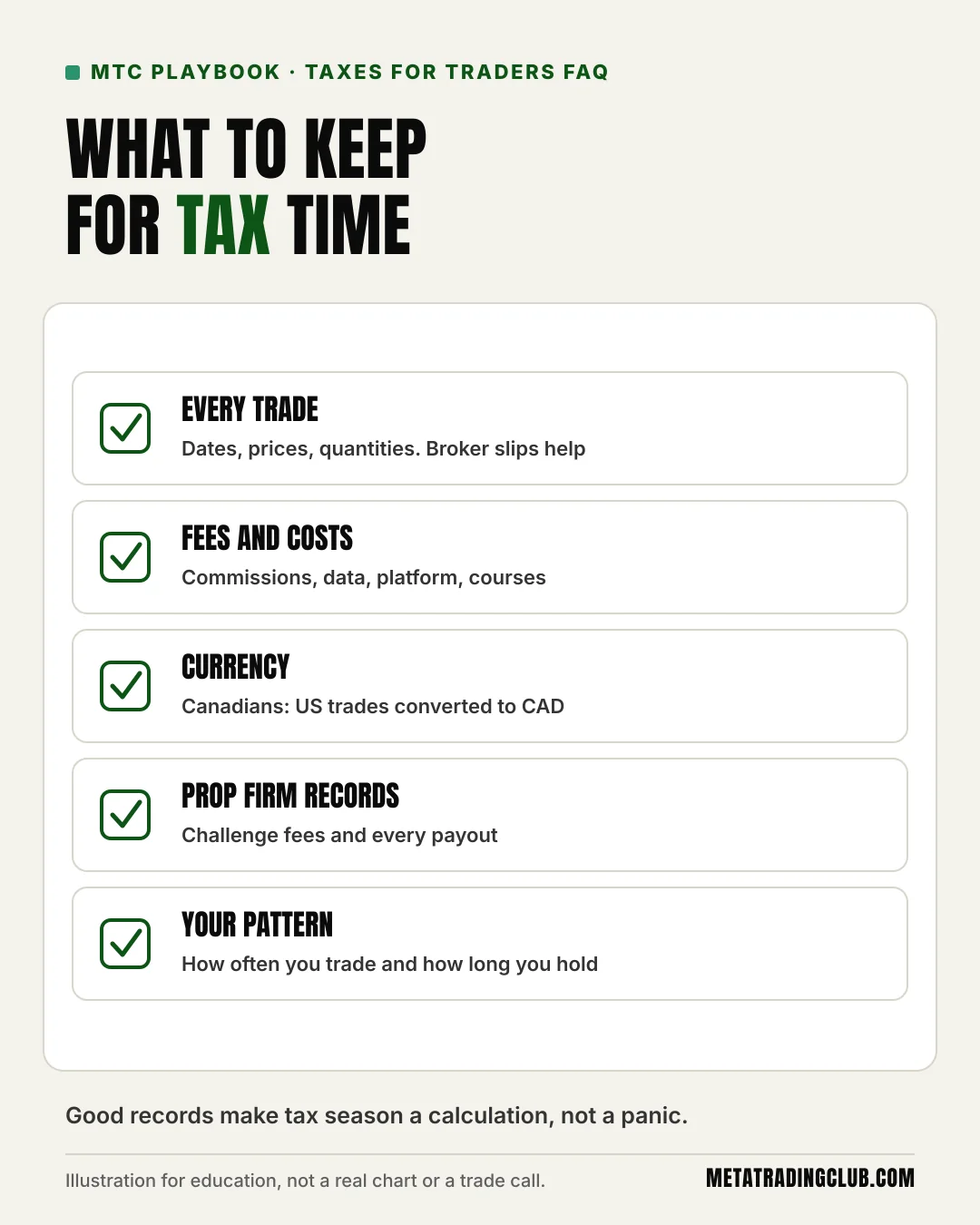
Keep every trade confirmation and year-end slip, a list of fees, data and platform costs, and for Canadians, the exchange rates used on US trades. If you trade a funded account, keep challenge receipts and payout records. Good records turn tax season into a calculation instead of a panic.
When should a trader talk to an accountant?
Before you file your first year of active trading, and any time you start trading much more often, trade a prop firm account or trade across Canada and the US. A tax professional who works with traders can tell you how your activity is likely to be treated and what to track.
Does tax change how I should trade?
Tax shouldn’t pick your trades, but it should shape your planning. Know which account you’re trading in, watch the 30-day rebuy rules near year-end and set money aside for tax on profitable years. The trade comes first. Tax is part of the plan around it.
Where to go next
In Canada, start with options trading tax in Canada, and read prop firm payout taxes if you trade a funded account. In the US, start with day trading taxes explained and the wash-sale rule.
This page is general education, not tax, legal or accounting advice. Rules change, and your situation is specific, so confirm with a qualified professional.