
Most people who want to trade options in Canada get stuck on the same handful of questions. Can I do it in my TFSA? How do I get approved? Which platform? What happens to my taxes?
This page answers the questions Canadians actually search, in plain language. Each answer is short and links to the full guide when you want the detail. If you’re starting from zero, begin with how to start options trading in Canada.
Jump to: Getting started in Canada · Platforms and costs · Options basics · Risk, strategy and taxes
Getting started in Canada
Is it legal to trade options in Canada?
Yes. Canadians can trade listed options through brokers regulated by CIRO and the provincial securities commissions. Canadian stock and ETF options trade on the Montreal Exchange, and most Canadian brokers also give you access to US-listed options. You need an options-approved account first. The full walkthrough is in how to start options trading in Canada.
How do I start trading options in Canada?
Open an account with a Canadian broker, apply for options approval, fund it, then learn the basics before your first order: calls, puts, the options chain and your maximum risk. Start small, with defined-risk trades, and write the plan down first. Here is how to make your first options trade, step by step.
How do I get approved for options trading in Canada?
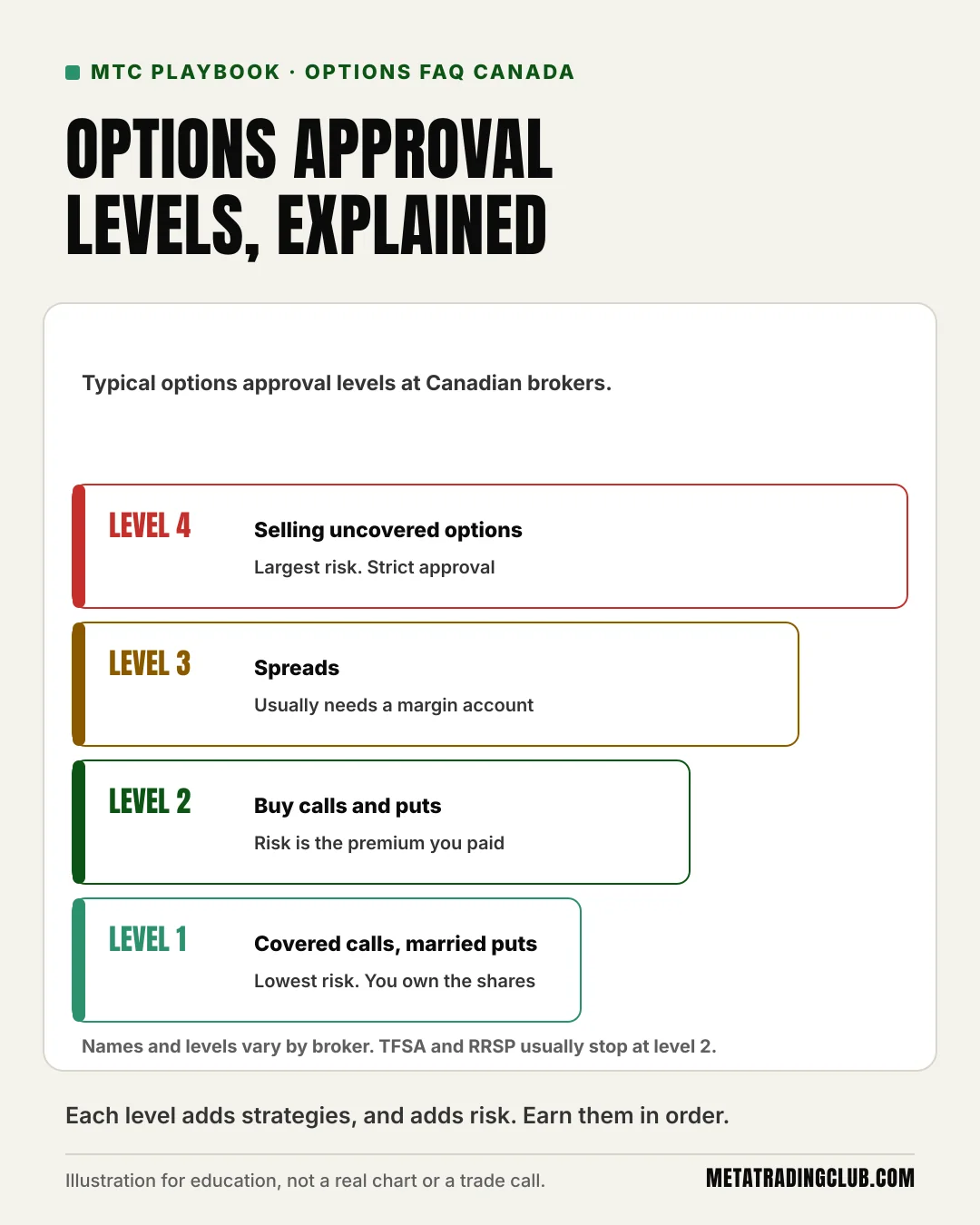
You apply through your broker. They ask about your experience, income, net worth and goals, then assign an options level. Lower levels allow buying calls and puts and covered calls. Spreads and selling uncovered options need higher levels and a margin account. Answer honestly: the level exists to match risk to experience.
How much money do you need to start trading options in Canada?
There’s no legal minimum. One contract controls 100 shares, so a cheap option can cost under $100 plus fees. The real question is how much you can risk per trade without one loss hurting the account. We break down realistic starting amounts in how much money you need to start options trading in Canada.
Can you trade options in a TFSA?
Yes, with limits. Most brokers allow buying calls and puts, covered calls and married puts in a TFSA. Some also allow cash-secured puts. Spreads and uncovered selling usually need a margin account. Very frequent trading in a TFSA can also draw CRA attention as business income. See the account comparison in best trading platforms in Canada.
Can you trade options in an RRSP?
Yes, under the same kind of limits as a TFSA. You can usually buy calls and puts and write covered calls, but you can’t use margin. Gains grow tax-deferred until you withdraw, and losses inside an RRSP can’t be claimed. Permissions vary by broker, so check your broker’s list before you plan a strategy.
Can Canadians trade US options?
Yes. Most Canadian brokers offer US-listed options on stocks and ETFs like SPY and QQQ. They trade in US dollars, so check whether your broker lets you hold USD or converts every trade, because conversion fees add up fast. The full setup is covered in how to trade options in Canada.
Does the pattern day trader rule apply in Canada?
Not at Canadian brokers. The PDT rule was a FINRA rule for US brokers’ margin accounts. It has also changed: on April 14, 2026 the SEC approved removing the $25,000 minimum, effective June 4, 2026, with a new intraday margin framework replacing it. Details in what is a pattern day trader.
Platforms and costs
What is the best options trading platform in Canada?
There isn’t one best platform, only the best fit. Questrade suits traders who want simple, low per-contract fees. IBKR suits active traders who want pro tools and easy USD. Bank brokers suit people who want everything in one place. Compare them side by side in best trading platforms in Canada.
Questrade or Interactive Brokers for options?
Questrade is simpler and charges no ticket fee on options, just a per-contract fee. IBKR has cheaper USD conversion, deeper tools and tiered pricing that rewards volume. If you trade US options often, IBKR’s currency handling matters a lot. Our full breakdown: Questrade vs IBKR for Canadian options traders.
Can Canadians use tastytrade?
No, not anymore. tastytrade stopped serving Canadian residents in 2025 and is no longer a CIRO member. Canadians who liked its options tools usually look at IBKR or Questrade instead. We compare tastytrade and thinkorswim, and what each means for Canadians, in tastytrade vs thinkorswim for options.
Options basics
What is the difference between a call and a put?
A call gives you the right to buy 100 shares at the strike price before expiration. A put gives you the right to sell them. Buyers of calls want the price to rise, and buyers of puts want it to fall. Both cost a premium up front. The simple version: call vs put options explained.
What is a long call?
A long call means you bought a call option. You pay the premium, and that premium is your maximum loss. If the stock rises above the strike plus the premium by expiration, the trade makes money. It’s the most common first options trade. Full breakdown with examples: what is a long call.
What is a long put?
A long put means you bought a put option. It gains value when the stock falls, and your maximum loss is the premium you paid. Traders use it to profit from a drop or to protect shares they already own. See how it works with numbers in what is a long put.
What is intrinsic vs extrinsic value?
Intrinsic value is what the option would be worth if exercised right now. Extrinsic value is everything else in the price: time left and implied volatility. Extrinsic value shrinks as expiration gets closer, which is why buyers fight the clock. Worked examples in intrinsic vs extrinsic value.
What is the difference between American and European options?
American options can be exercised any time before expiration. European options can only be exercised at expiration. Most stock and ETF options in Canada and the US are American style, including equity options on the Montreal Exchange. Many index options, like SPX, are European. Start with the options trading basics guide.
How do you read an options chain?
Calls sit on one side, puts on the other, and strikes run down the middle. For each strike you’ll see the bid, ask, volume, open interest and usually the Greeks. Focus on tight bid-ask spreads and real open interest first. Here’s a visual walkthrough of how to read an options chain.
What are the option Greeks?
The Greeks measure what moves an option’s price. Delta is the move per $1 in the stock, gamma is how fast delta changes, theta is time decay per day, vega is sensitivity to implied volatility, and rho is sensitivity to interest rates. Each one is explained with diagrams in option Greeks explained.
Risk, strategy and taxes
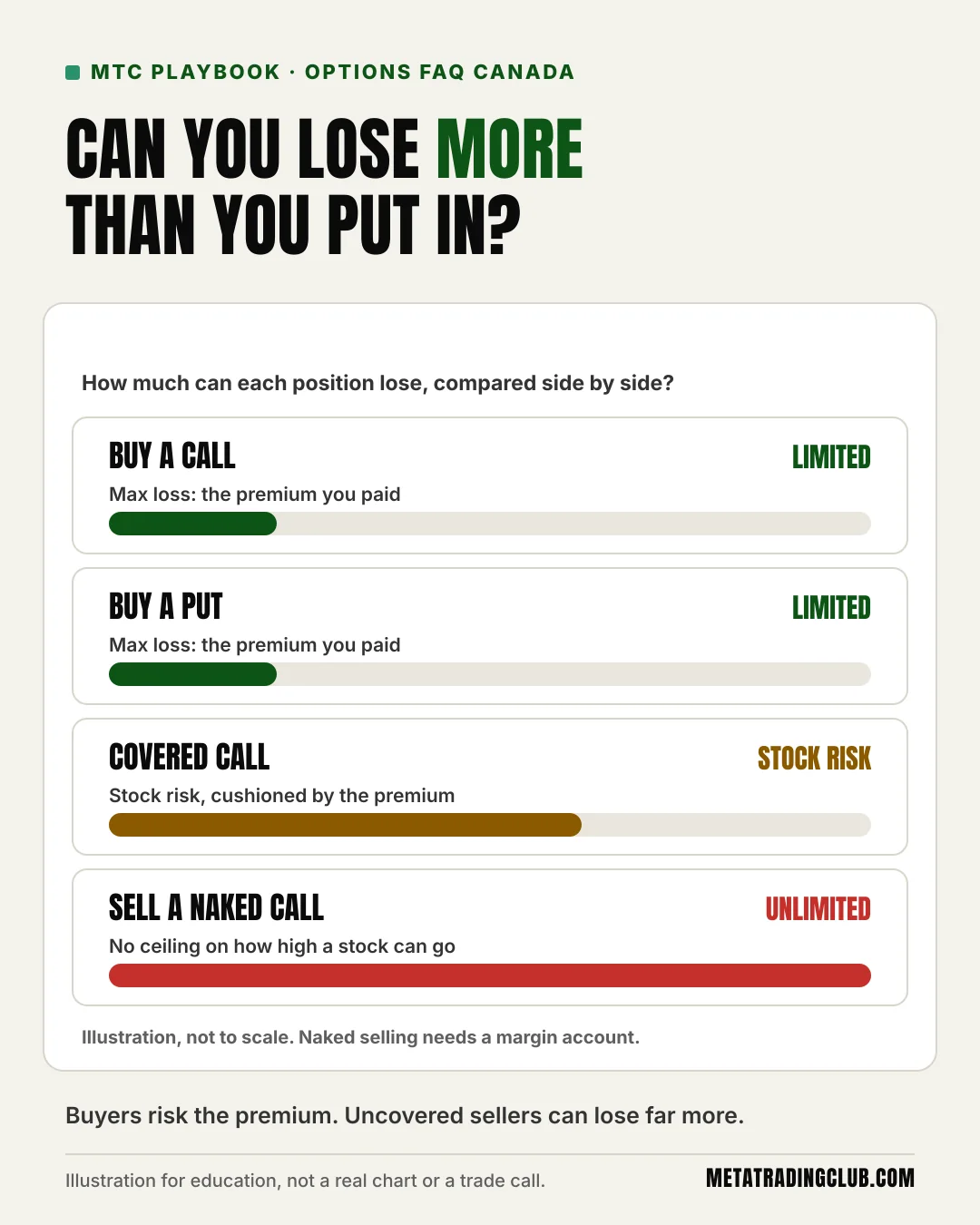
Can you lose more than you invest with options?
When you buy calls or puts, your maximum loss is the premium you paid. When you sell options without owning the shares or holding cash to cover them, losses can be much larger than the premium, and in theory unlimited on a naked call. That’s why brokers restrict uncovered selling. See options strategies ranked by risk level.
What is IV crush?
IV crush is the drop in an option’s implied volatility right after an expected event like earnings. Even if the stock moves your way, the option can lose value because the uncertainty premium disappears. It hits buyers who hold through events. How to plan around it: what is IV crush and how to avoid it.
Is SPY or QQQ better for options trading?
Both are very liquid, with tight spreads and daily expirations. SPY tracks the S&P 500 and moves more steadily. QQQ tracks the Nasdaq-100, leans tech and swings more, so its options usually cost more. Pick the one that matches the market you read best. Full comparison: SPY vs QQQ options.
How are options taxed in Canada?
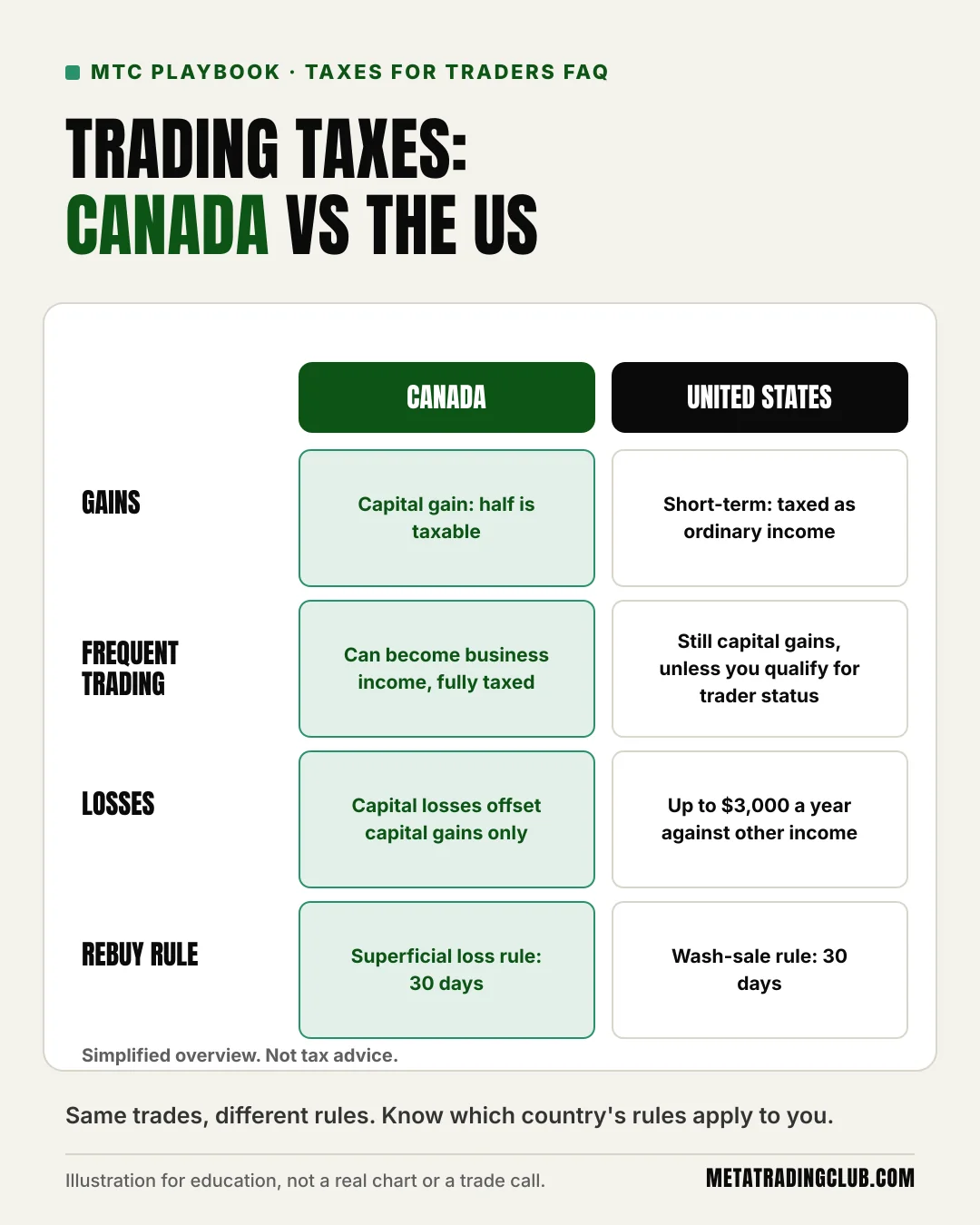
For most investors, options gains and losses are capital gains, and half of a net capital gain is taxable. If you trade very frequently or it looks like a business, the CRA can treat profits as fully taxable business income. Watch the superficial loss rule too. Not tax advice. Details in options trading tax in Canada.
Is options trading worth it?
It can be, if you treat it as a skill with rules, not a shortcut. Options give you leverage and defined-risk choices, but most people lose by oversizing and trading without a plan. The honest answer, with what has to be true first, is in is options trading worth it.
Where to go next
If you’re brand new, read how to start options trading in Canada end to end, then learn how to read an options chain. If you already trade, the option Greeks and IV crush guides will change how you pick contracts.
Whatever you trade, the order doesn’t change: bias, zone, reaction, confirmation, then execution. Options are just the tool you use at the end of that process.