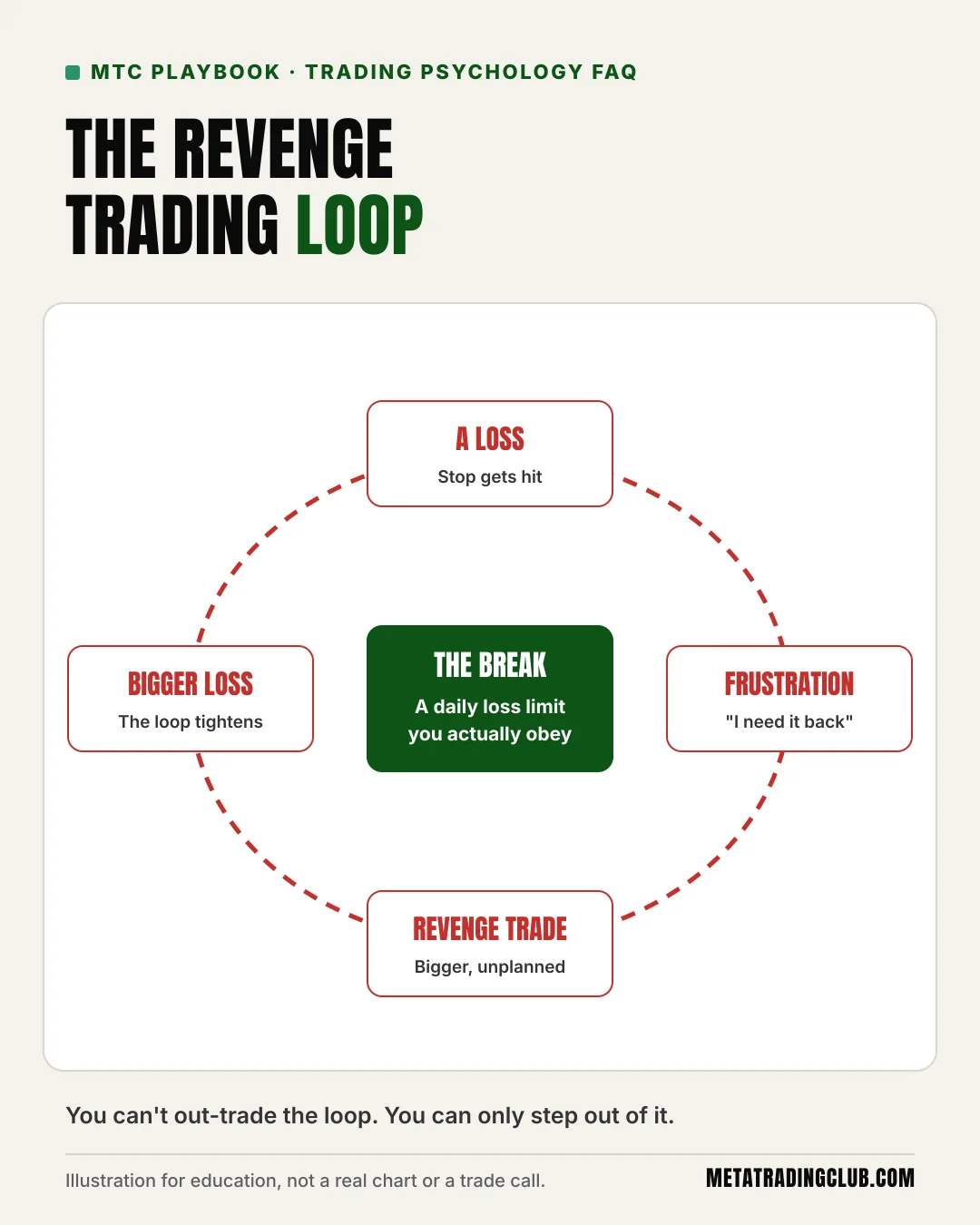
The revenge trading loop: a loss leads to frustration, a revenge trade and a bigger loss, broken by a daily loss limit

Trading Psychology FAQ: 18 Questions About Emotions and Discipline

Most traders don’t lose because they can’t read a chart. They lose because they know the rule and break it anyway: the stop gets moved, the winner gets cut, the loss gets chased. That’s trading psychology, and it’s a skill you can train like any other.

Here are the psychology questions traders search most, with practical answers and a link to the full guide for each. The foundation is in trading psychology: the complete guide.

Jump to: Emotions in trading · Discipline and consistency · Journaling and review

Emotions in trading
What is trading psychology?

Trading psychology is how your emotions and habits affect your trading decisions: fear, greed, frustration, overconfidence and the urge to act. It’s why two traders with the same strategy get different results. You don’t remove emotions. You build rules and routines so they don’t make the decisions. Full guide: trading psychology.

How do emotions ruin trading?

Emotions push you to act on how you feel instead of what the chart shows. Fear makes you exit early or skip good setups. Greed makes you oversize. Frustration after a loss makes you force the next trade. Each one turns a sound plan into a random one. Examples: how emotions can ruin your trading.

How do I stop revenge trading?

Set a daily loss limit before the session and stop when you hit it, no exceptions. After any loss, take a short break before the next trade, and only take setups on your written plan. Revenge trading feeds on the urge to win it back now. Remove the chance to act on it. More in trading psychology.

Why do I exit winning trades too early?

Because a small sure gain feels better than a bigger uncertain one, so your brain grabs it. The fix is deciding your exit before the entry, at the next zone, and letting a rule move your stop instead of your nerves. Some traders take partial profit to ease the pressure. Pre-set exits: pre-set exit rules.

Why do I hold losing trades too long?

Because closing a loser makes the loss real, so you wait for it to come back. Moving the stop or removing it is the most expensive form of hope. Put the stop where the idea is wrong, size the trade to that stop and let the order do the job. How: pre-set exit rules.

How do I deal with FOMO in trading?

FOMO comes from watching a move happen without you. Chasing it usually means a late entry, a wide stop and a bad trade location. Remind yourself that another setup always comes. If price has already left the zone, the trade is gone. Wait for the next one. Related: the biggest mistakes new traders make.

Why am I scared to pull the trigger?

Usually because the risk isn’t defined or the setup isn’t clear enough. When you know exactly where your stop is and the loss is small enough not to hurt, entering gets much easier. Start with smaller size until following your plan feels normal. More in you got the nerves to start trading.

How do I stop overtrading?

Limit yourself to a short list of setups, set a maximum number of trades per day and a hard stop time. Overtrading usually comes from boredom, frustration or the feeling you have to be in the market. No setup is a valid outcome for the day. Steps: how to stop overtrading.

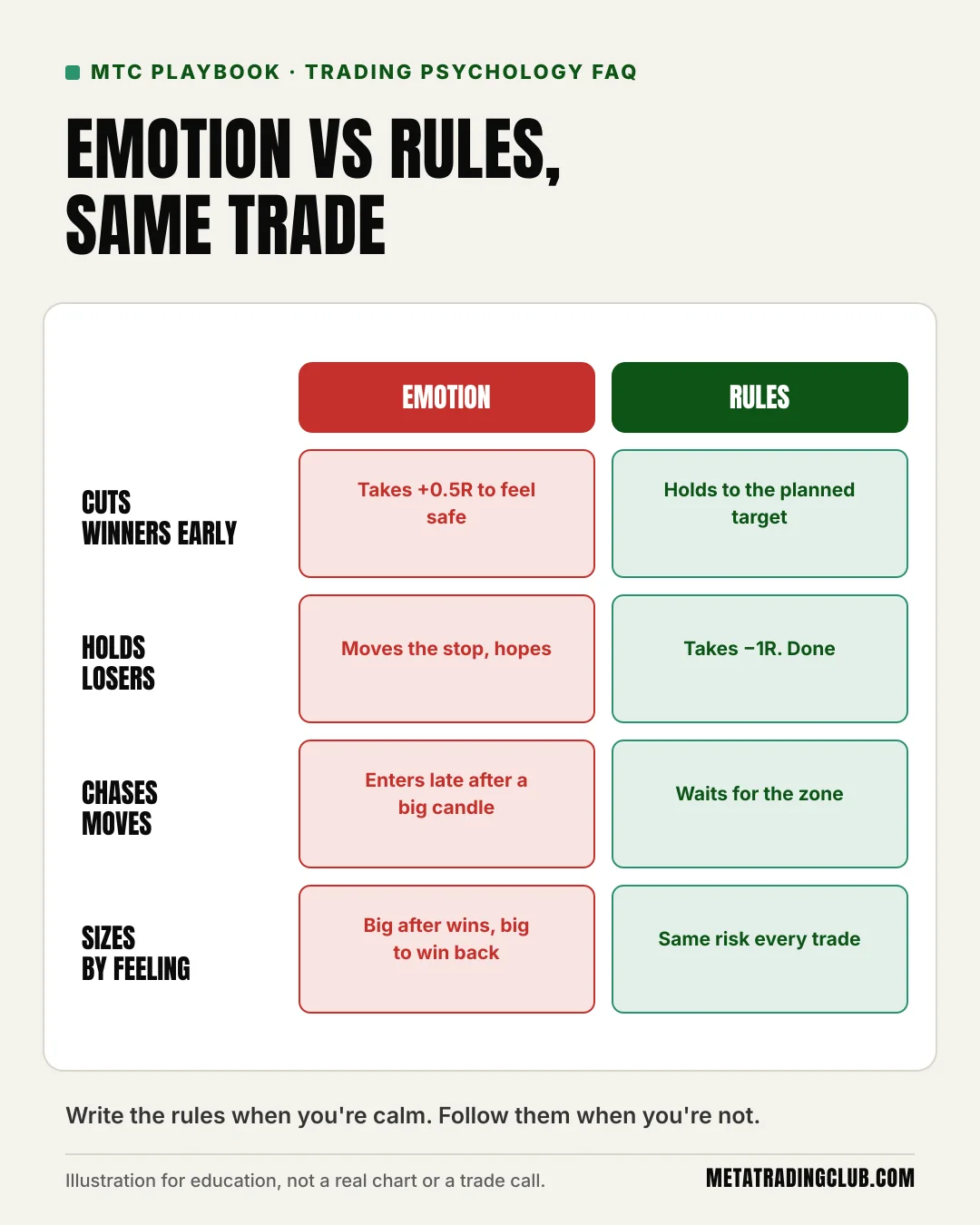
Emotion vs rules on the same trade: cutting winners early, holding losers, chasing moves and sizing by feeling
The same trade, run by emotion or by rules. Write the rules when you’re calm.

Discipline and consistency

How do I stay disciplined in trading?

Make discipline easier by deciding in advance: a written plan, fixed risk per trade, a daily limit and a checklist before every entry. Then review whether you followed the rules, not just whether you made money. Discipline is a habit you repeat, not a mood. Weekly routine: how to plan your trading week.

How do I build confidence in trading?

Confidence comes from evidence. Trade small, follow your rules and track the results until you have enough trades to trust the process. Confidence built on a few big wins disappears after a few losses. Confidence built on a journal doesn’t. Practical steps: how to build confidence in trading.

Do I need a trading plan?

Yes. A trading plan answers the questions you shouldn’t decide in the moment: what you trade, which setups you take, how you enter and exit, and how much you risk. Without one, every decision is emotional by default. Template inside: how to write a trading plan.

What is an A+ setup?

An A+ setup is a trade where every part of your checklist lines up: market bias, a clear zone, a reaction, confirmation and room to the target. Trading only A+ setups means fewer trades but better ones. It’s one of the simplest ways to cut emotional trades. More in what is an A+ setup.

What does it take to become a consistent trader?

Consistency comes from repeating the same process: same setups, same risk, same review. It doesn’t mean winning every week. It means your decisions are repeatable, so your results start to reflect your edge. It takes time and honest review. What actually changes: from losing trader to consistent trader.

Why do most traders lose money?

Most losing traders share the same habits: no written plan, oversized positions, moving stops, overtrading and quitting before they’ve reviewed enough trades to learn anything. None of these are about intelligence. They’re process problems, and process problems can be fixed. The full answer: why most traders lose money.

Do trading signal groups work?

Signal groups rarely build lasting results because you’re copying entries without the reasoning, the risk plan or the exit logic. When the signals stop, so does your skill. Learning to qualify trades yourself is slower but it’s yours. Why they fail: why signal groups fail.

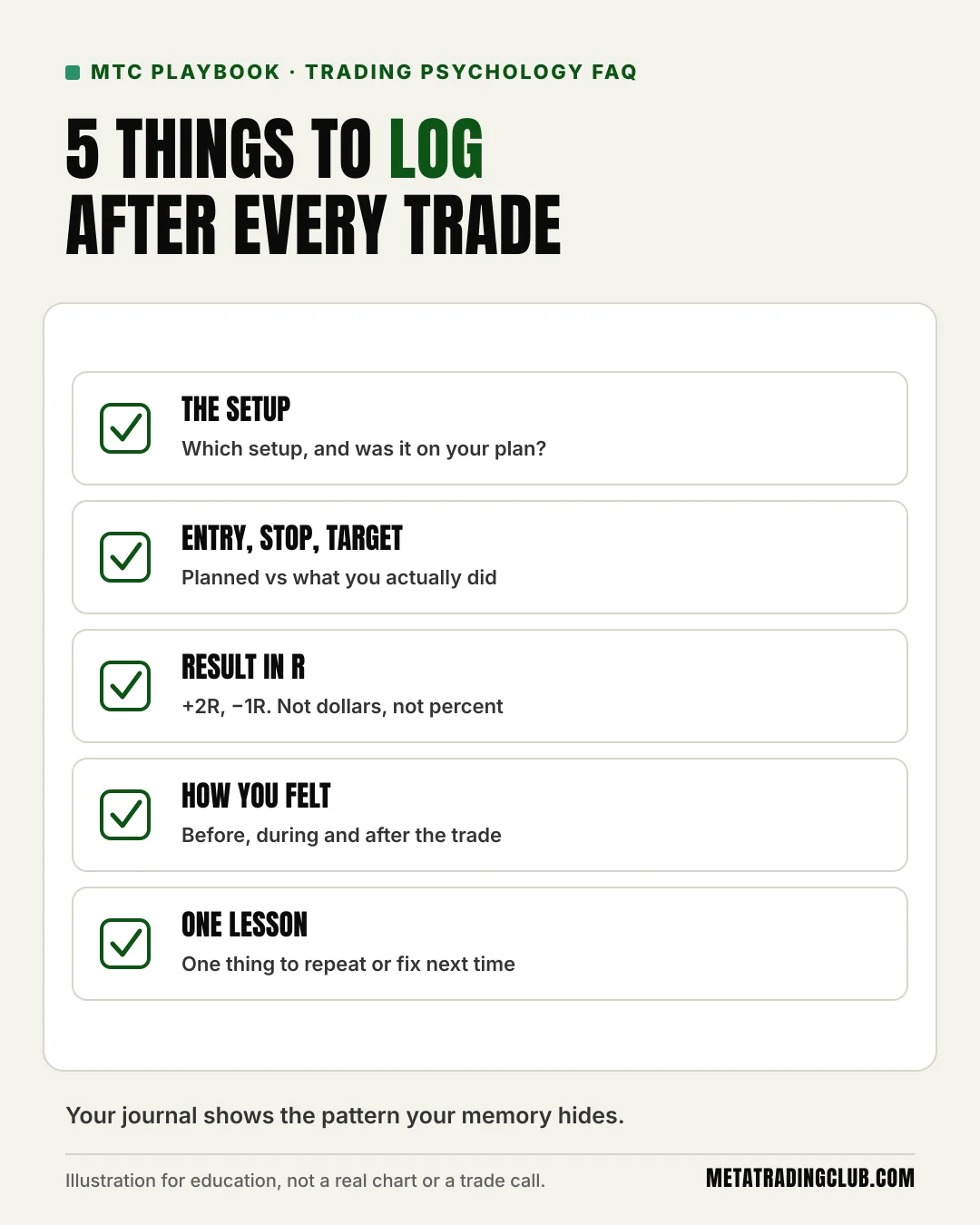
Five things to log after every trade: the setup, entry stop and target, result in R, how you felt, one lesson
Five lines per trade is enough to see your patterns within a few weeks.

Journaling and review

How do I journal my trades?

After each trade, log the setup, your planned entry, stop and target, what you actually did, the result in R, how you felt and one lesson. Keep it short so you do it every time. Review it weekly to find your patterns. What to track: how to journal your trades.

How should I review my trading performance?

Review weekly: results in R, how often you followed your rules, your best and worst setups, and the mistakes that cost the most. Separate bad trades from good trades that lost. Then pick one thing to fix next week. Step by step: how to track and review your trading performance.

Is trading the right career for me?

It can be for people who enjoy process, can handle uncertainty and are willing to treat it like a skill that takes time. It’s a poor fit for anyone who needs steady income soon or wants quick results. Start part-time and let your track record decide. Honest take: is trading the perfect job for you.

Where to go next

Start with trading psychology, then set up a trading journal this week. If losses are the trigger, the risk management FAQ shows how to size trades so one loss can’t take over your day.

At MTC we call it qualification: bias, zone, reaction, confirmation, then execution. A checklist you follow is the best answer to emotion there is.


Picture of Shahryar Rahmani
Shahryar Rahmani

CEO and Co-Founder

Related Post