Most traders spend the majority of their learning time on technical analysis. Charts, indicators, options strategies, entry patterns. The technical side feels concrete, learnable, quantifiable.
Psychology gets treated as a footnote. Something you acknowledge exists, vaguely try to work on, and mostly ignore until it costs you.
That’s backwards.
Talk to any trader who’s been doing this for years and they’ll tell you the same thing: the technical side is the easier part. Understanding a chart pattern, identifying a level, constructing an options trade — those things can be learned relatively quickly. Controlling your behaviour under pressure, in real time, with real money — that’s where people spend years.
This isn’t to say technical knowledge doesn’t matter. It does. But technical knowledge without psychological discipline is a car with no brakes. You can drive it — until you can’t.
This post is an honest look at what trading psychology actually involves: the specific patterns that hurt traders most, how to identify them in yourself, and what actually helps. Not generic motivation. Not ‘just be disciplined.’ Concrete frameworks for the real mental challenges of trading.
The real edge
Two traders, same strategy, different results. The gap is almost always psychology — and it’s trainable.
Why Psychology Is Harder to Master Than Technical Analysis
Technical analysis has rules. Chart patterns either form or they don’t. An indicator either gives a signal or it doesn’t. You can backtest it, study it, and get a relatively objective read on whether a setup has historical edge.
Psychology has no such clarity. The same emotion — fear — can make you exit a winner too early or hold a loser too long depending on the situation. The same confidence that helps you pull the trigger on a clean setup can morph into overconfidence that leads you to overtrade.
The challenge is that your psychology is invisible to you in the moment. In hindsight, you can see the revenge trade for what it was. While you’re making it, your brain is generating a perfectly reasonable-sounding justification.
This is why studying psychology academically only goes so far. Reading about FOMO doesn’t prevent it. The work happens through deliberate self-observation over hundreds of trading sessions — and through having a structured process that reduces the number of decisions you make on pure emotion.
MTC Analysis
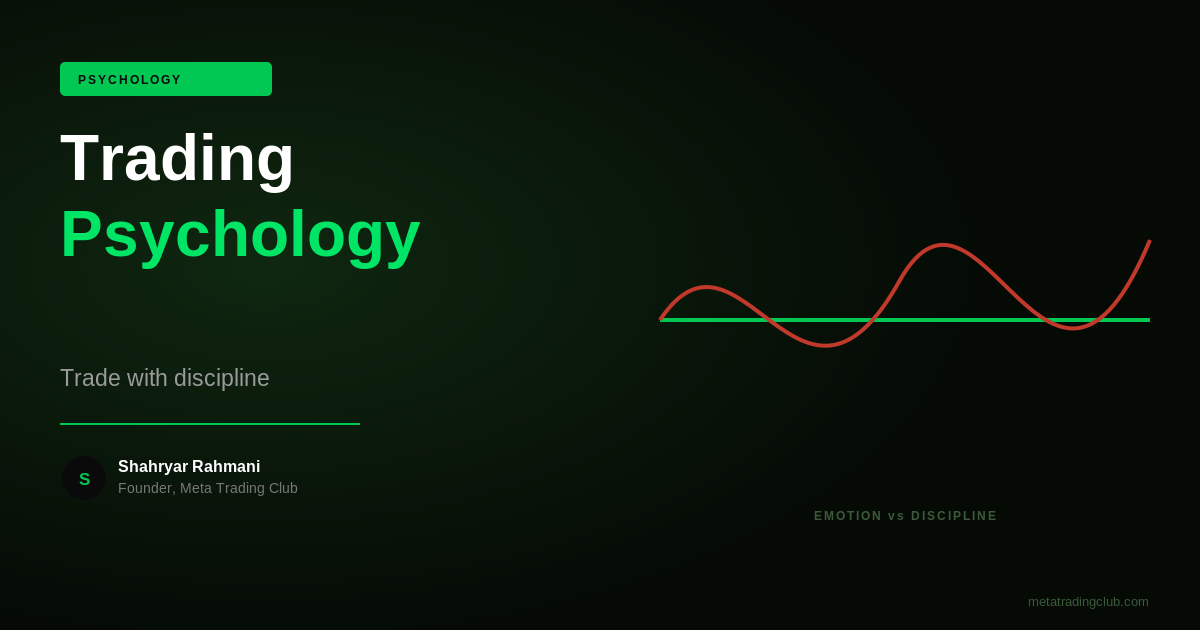
Emotional Trading vs. a Disciplined Process
The emotional trader rides every swing of fear and greed. The disciplined trader follows a process — and flattens the curve.
The Most Common Psychological Traps in Trading
FOMO — Fear of Missing Out
FOMO shows up when price makes a big move and you weren’t in it. The impulse is to chase — to enter after the move has already happened because you’re afraid there’s more to go.
The problem: chasing means entering at a worse price, often near exhaustion. You’re entering where other traders are exiting. Your stop is too far away because the entry wasn’t at a logical location. The move that triggered your FOMO often reverses shortly after you enter.
FOMO is powered by the misbelief that every move you missed was a missed opportunity. It wasn’t. Most of them weren’t your setup. The cure for FOMO is a clear criteria-based process — when you define exactly what a valid setup looks like, you can objectively evaluate whether you missed a real opportunity (your setup appeared and you didn’t take it) versus just watching a move you weren’t supposed to be in.
Revenge Trading
Revenge trading is what happens after a loss. The position closes red, and immediately the urge is to get back in — to recover the loss, to prove the original idea right, or to just do something instead of sitting with the discomfort.
Revenge trades are almost always worse than the initial loss. They’re taken from an emotional state, often in deteriorating market conditions, without the structure that defines a valid setup. A $300 loss becomes a $700 loss, or worse.
The pattern to recognize: if you feel a strong urge to enter a trade immediately after closing a losing position, that’s a red flag. The impulse is emotional, not analytical.
Overconfidence After a Winning Streak
Winning builds confidence — which is healthy up to a point. Past that point it becomes complacency or arrogance.
After a run of winning trades, risk management often gets looser. Position sizes creep up. Setup criteria get relaxed (‘it’s close enough’). The market feels controllable in a way it never actually is. Then one bad session undoes a week of gains.
The market doesn’t reward you for past performance. Each setup is independent. The trader who ran hot for two weeks has the same edge on the next trade as the trader who ran cold — no more, no less.
Hesitation After Losses
The flip side of overconfidence: after a string of losses, valid setups get skipped. The setup forms, all your criteria are met, and you don’t take it — because you’re afraid. The last three trades were losers. What if this one is too?
This hesitation is costly in a different way. You miss the good setup. Then when you do finally get back in, it’s often on a lower-quality entry because the frustration of watching a good setup work without you is its own form of FOMO.
Holding Losers Too Long
Losses feel different from gains neurologically — they’re roughly twice as painful as equivalent gains are pleasurable. That asymmetry is why traders hold losers longer than they should.
The internal narrative is usually: ‘It’ll come back.’ ‘I’ll wait for it to recover.’ ‘If I close it, the loss becomes real.’
The loss is already real. The position is already down. The question isn’t about what already happened — it’s about whether holding this position from here makes sense given current conditions. Most of the time when you’re hoping rather than reasoning, the answer is no.
The Psychology of a Losing Streak
Losing streaks are inevitable. Every trader, at every level, goes through them. What separates traders who recover from losing streaks from those who blow up or quit is how they respond.
The worst response to a losing streak is to make larger bets to recover faster. The desperation compounds the problem.
A more productive response:
Reduce size. Not quit — reduce. Trading smaller lets you keep making decisions without the financial pressure that clouds judgment.
Review the trades, not the results. Did you follow your process on each trade? If yes, and the losses are still within the range of normal variability, that’s a statistical rough patch — not evidence that your process is broken. If you didn’t follow your process, that’s the issue to address.
Take a one-day break if needed. Not a week, not permanently — but sometimes 24 hours away from the screen resets your emotional state enough to come back clearly.
Write it down. The trading journal is one of the most powerful psychological tools available, and one of the most underused.
The Role of a Trading Journal in Psychology
A trading journal forces you to confront your behaviour in writing, which is categorically different from thinking about it in your head.
A complete journal entry includes: the setup criteria that led to entry, the entry and exit details, the result — and critically, the emotional state before, during, and after the trade. Was there hesitation? Impatience? Did you exit early because of discomfort rather than logic? Did you hold too long hoping it would turn?
Over time, patterns emerge. You start to see that you consistently overtrade on Mondays, or that you take worse trades in the first 15 minutes of the open, or that your win rate drops sharply when you’re trading in the afternoon. This data is specific to you — no blog post or trading book can give it to you.
The journal turns subjective experience into objective data. That data is what makes improvement actually possible.
How a Structured Process Reduces Emotional Decisions
This is one of the most important and under-appreciated benefits of having a defined trading process.
Every decision point that is pre-determined removes one moment where emotion can override logic.
When you have a rule that says ‘I only enter after seeing confirmation on the 15-minute timeframe,’ you don’t have to fight the urge to enter early. The rule handles it. When you have a rule that says ‘my stop is at this specific level,’ you don’t have to debate holding a loser. The rule handles it.
The MTC Alignment Engine is designed around this principle. The five-step process — Market Bias → Key Level → Reaction → Confirmation → Execution — isn’t just a technical framework. It’s a psychological guardrail. It forces you to check five criteria before entering, which eliminates the reflexive, impulsive entries that cause the most psychological damage.
Checklist-based trading doesn’t remove emotion entirely. But it significantly reduces the number of moments where raw emotion is the only thing guiding the decision.
How Community Helps With Trading Psychology
One underestimated antidote to poor trading psychology is community.
Trading alone amplifies every psychological challenge. Losses feel bigger. Wins feel more fragile. There’s no one to reflect your behaviour back to you. No one to remind you that a three-trade losing streak is normal. No one to ask ‘did that trade actually fit your criteria or were you chasing?’
Being part of a structured trading community normalizes the experience. You see other experienced traders take losses and respond methodically. You see the same psychological patterns playing out across different people, which helps you recognize them in yourself with less judgment and more objectivity.
Accountability also matters. When you know you’re going to walk through your trades in a community context, you trade more carefully — not because you’re showing off, but because articulating your reasoning out loud forces more rigorous thinking.
This is part of what makes being part of a trading community genuinely valuable — not just for technical knowledge, but for the psychological environment it creates.
Comparison: Emotional Trading vs Process-Based Trading
| Factor | Emotional Trading | Process-Based Trading |
|---|---|---|
| Entry Decisions | Impulse, FOMO, gut feeling | Criteria-based — all conditions must be met |
| Exit Decisions | Hoping, panic, emotional stops | Pre-planned levels, defined invalidation |
| Response to Losses | Revenge trading, size increase | Review process, reduce size, reset |
| Response to Wins | Overconfidence, looser criteria | Maintain structure regardless of streak |
| Self-Awareness | Low — emotion is invisible in the moment | Higher — journaling creates pattern recognition |
| Long-Term Results | Inconsistent, variance-driven | More consistent, process-driven |
| Community Support | Trading in isolation | Accountability, normalized experience |
What MTC Teaches About Psychology
At Meta Trading Club, we don’t treat psychology as a separate topic from trading. It’s embedded in how we approach every session.
The MTC Alignment Engine is a structured filter specifically designed to reduce emotional decision-making. The daily premarket sessions aren’t just technical preparation — they’re a psychological ritual. They ground you before the open, give you context, and remove the ‘I don’t know what’s happening’ anxiety that leads to reactive decisions.
Members trade their own accounts. We’re not making decisions for anyone. What we provide is structure, education, and a community environment where the psychological realities of trading are treated seriously and openly.
If you want to understand the deeper reasons why most traders struggle, this post on why 90% of traders lose money covers a lot of the same territory with a broader lens.
Build the Structure That Makes Discipline Easier
You can’t think your way out of emotional trading. You need a process that makes the disciplined decision the default.
At Meta Trading Club, our daily premarket sessions, live trade execution, and the MTC Alignment Engine framework are all built around exactly that. Members develop structure, self-awareness, and discipline through repetition — not motivation.
Join the MTC Community — 7-day free trial, $99/month
Show up every day with a process. Everything else follows.
Proprietary Framework
The MTC Alignment Engine™ — Applied Every Live Session
Every trade runs the same five checkpoints — consistency over gut reaction. Inside the MTC Incubator, members build their own system on top of this framework.
Frequently Asked Questions
What is trading psychology and why does it matter?
Trading psychology refers to the mental and emotional aspects of trading — how fear, greed, impatience, overconfidence, and discipline influence your decisions. It matters because the market is designed to exploit emotional responses. Prices move in ways that trigger panic at lows and greed at highs. Traders who have strong technical knowledge but poor psychological control will still make irrational decisions that cost them. Psychology is arguably the deciding factor between a trader who is consistently profitable and one who is technically competent but behaviourally inconsistent.
What is FOMO in trading and how do you overcome it?
FOMO (Fear of Missing Out) is the urge to enter a trade after price has already moved, out of fear that you’ll miss the rest of the move. It’s one of the most common causes of chasing entries and poor timing. The most effective way to overcome it is to have a clearly defined set of criteria for what makes a valid setup. When a setup doesn’t meet your criteria — including where price is relative to your ideal entry — you have a concrete reason to stay out, rather than fighting an emotional pull. Over time, this builds the understanding that not every move is your trade, and that missed moves are part of the process.
What is revenge trading and how do you stop it?
Revenge trading is entering a new trade immediately after a loss with the emotional goal of recovering the money, rather than a rational reason to enter. It typically results in a worse loss than the original because the decision is emotionally driven and the conditions are often no longer ideal. The most effective prevention is a rule: after a losing trade, step away from the screen for a minimum amount of time (even 15 minutes) before evaluating the next opportunity. If you feel a strong urge to get back in immediately, that’s a sign the impulse is emotional, not analytical.
How does a trading journal help with psychology?
A trading journal creates an objective record of your behaviour over time. By writing down not just trade details but your emotional state — before, during, and after each trade — you begin to identify patterns that aren’t visible in the moment. You might discover you consistently make worse decisions on days after large losses, or that you overtrade during low-volatility periods. That self-knowledge is the foundation of behavioural improvement in trading. Without the journal, you’re relying on memory and self-perception, both of which are unreliable.
How do you deal with a losing streak in trading?
The key steps: reduce position size (not quit, but smaller), review your trades to assess whether you followed your process (not just whether results were good), and take a short break if you’re in an emotionally reactive state. A losing streak is only a crisis if you respond to it by abandoning your process or taking oversized risks to recover. If your process is sound and you followed it, a streak of losses is within the range of normal statistical variance. If you didn’t follow your process, the streak is feedback — improve the execution, not the position size.
Can trading psychology be learned or is it innate?
It can absolutely be learned and improved — but it takes deliberate, consistent practice over time. The core tools are: a structured process that reduces the number of emotion-dependent decisions, a trading journal that builds self-awareness, and a community that normalizes the experience and provides accountability. Raw discipline is not the answer — most people don’t have the willpower to override emotion through sheer force. Systems and structure that reduce the moments where emotion is the deciding factor are far more sustainable.
Meta Trading Club Community
Start Your 7-Day Free Trial
Daily live sessions. Real-time market prep — not signals. The MTC Alignment Engine™ applied in front of you. Trade alongside Shahryar from day one.
Cancel anytime. No contracts. Built for Canadian traders.
Already trading and want to build your own system?
The MTC Incubator is an application-based mentorship — 1-on-1 work building a personalized system on the Alignment Engine™.