‘Should I day trade or swing trade?’ is one of the most common questions new Canadian traders ask, and most answers online are useless because they pretend one is universally better. Neither is. They’re different jobs with different demands on your time, capital, temperament, and — importantly in Canada — your taxes. The right answer depends entirely on your situation, not on which one looks more exciting on social media.
Here’s an honest breakdown to help you choose the style that fits your actual life.
Different jobs, not better or worse
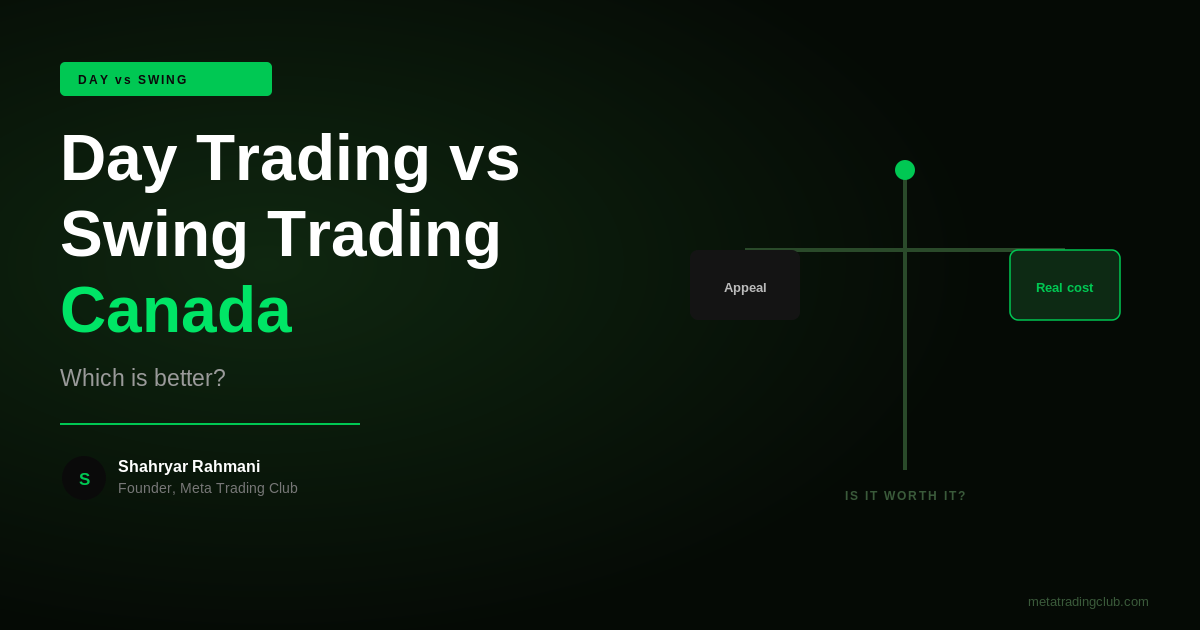
Day trading and swing trading aren’t a ranking — they’re different demands on your time, capital, and in Canada, your taxes.
The Core Difference: Holding Time
Day trading means opening and closing positions within the same day — you hold for minutes to hours and end the day flat, with no overnight exposure. Swing trading means holding positions for days to weeks, riding larger moves and accepting overnight and weekend risk.
That single difference cascades into everything else: how much screen time you need, how much capital, how the stress feels, and how the CRA is likely to treat your gains.
MTC Analysis
Day Trading vs Swing Trading
For most working Canadians, swing trading is the realistic starting point. The underlying skills — structure, risk, execution — are the same for both.
Time Commitment
Day trading is, functionally, a job. You need to be at the screen during market hours, focused and reacting in real time. For most Canadians with a 9-to-5, that’s incompatible — the US market is open 9:30am to 4:00pm Eastern, which is mid-workday across most of the country.
Swing trading fits a normal life. You can analyze setups in the evening, place orders with stops and targets, and check in periodically. It’s the realistic choice for anyone with a full-time job, which is most beginners. This alone steers a lot of Canadians toward swing trading whether they admit it or not.
Capital and the Pattern Day Trader Rule
Here’s a key Canadian advantage: the US Pattern Day Trader rule, which requires US traders to keep $25,000 to day trade frequently, does not apply to Canadian-based accounts at Canadian brokers in the same way. Canadians trading through Canadian entities aren’t bound by the PDT minimum, which lowers the capital barrier to active trading compared to US retail traders. That said, day trading still rewards more capital, and undercapitalized day trading pushes people into oversized risk.
Taxes: The Part Canadians Underestimate
This is where it gets specifically Canadian. The CRA may treat your trading gains as capital gains (50% included in income) or as business income (fully taxable), depending on factors like frequency, holding period, intent, and time spent. Frequent day trading looks a lot like business activity and is more likely to be taxed as business income — fully taxable, though losses and expenses may also be deductible. Swing trading with longer holds is more often treated as capital gains. This isn’t tax advice, and the determination is nuanced, so confirm your situation with a Canadian tax professional — but understand that your style choice has real tax consequences here.
Temperament and Stress
Day trading is intense and emotionally demanding — fast decisions, constant focus, no time to deliberate. It suits people who thrive under pressure and can detach emotionally. Swing trading is slower and more analytical, but it asks you to hold through overnight gaps and resist checking positions obsessively. Some people can’t sleep holding overnight risk; others can’t handle the minute-to-minute intensity of day trading. Know which one you are.
How to Choose
Be honest about three things: your available time, your capital, and your temperament. If you have a full-time job, swing trading is almost certainly the realistic starting point. If you can commit to market hours, have adequate capital, and handle intensity, day trading is viable. Many traders end up doing both — swing trading their core capital while day trading a smaller portion. There’s no rule that says you must pick one forever.
Whichever you choose, the underlying skills — reading structure, managing risk, executing a plan — are the same. At Meta Trading Club, the MTC Alignment Engine applies across both timeframes, and members trade alongside a full-time trader who day trades live while teaching a process that works whether you hold for minutes or weeks. If you want one-on-one help matching a style and system to your specific life and capital, that’s exactly what the MTC Incubator is built for.
Proprietary Framework
The MTC Alignment Engine™ — Applied Every Live Session
Every trade runs the same five checkpoints — consistency over gut reaction. Inside the MTC Incubator, members build their own system on top of this framework.
Frequently Asked Questions
Is day trading or swing trading better for beginners in Canada?
For most Canadian beginners, especially those with a full-time job, swing trading is the more realistic starting point because it doesn’t require being at the screen during market hours. Day trading demands full focus during the trading day, which is mid-workday across most of Canada. The ‘better’ choice depends on your time, capital, and temperament.
Does the Pattern Day Trader $25,000 rule apply in Canada?
The US Pattern Day Trader rule that requires $25,000 to day trade frequently does not apply to Canadian-based accounts at Canadian brokers the way it does to US retail accounts. This gives Canadian traders more flexibility to trade actively with less capital, though day trading still rewards adequate capital and disciplined risk management.
How are day trading and swing trading taxed in Canada?
The CRA may treat gains as capital gains (50% taxable) or business income (fully taxable) depending on frequency, holding period, intent, and time spent. Frequent day trading is more likely to be considered business income, while longer-hold swing trading is more often capital gains. This is nuanced — consult a Canadian tax professional for your situation.
Can I swing trade with a full-time job?
Yes — swing trading is well suited to people with full-time jobs. You can analyze setups in the evening, place orders with predefined stops and targets, and check in periodically rather than watching the screen all day. This is a major reason many working Canadians choose swing trading over day trading.
Which is more profitable, day trading or swing trading?
Neither is inherently more profitable — both can work and both can lose money. Profitability comes from skill, risk management, and consistency, not the timeframe. Day trading offers more opportunities but demands more time and discipline; swing trading captures larger moves with less screen time. The right one is the one that fits your life well enough to execute consistently.
Do I need different skills for day trading vs swing trading?
The core skills are the same: reading market structure, managing risk, and executing a plan. The main differences are pace and the need to manage overnight risk in swing trading. A solid framework like the MTC Alignment Engine applies across both timeframes, so learning to trade well transfers between styles.
Related reading
Meta Trading Club Community
Start Your 7-Day Free Trial
Daily live sessions. Real-time market prep — not signals. The MTC Alignment Engine™ applied in front of you. Trade alongside Shahryar from day one.
Cancel anytime. No contracts. Built for Canadian traders.
Already trading and want to build your own system?
The MTC Incubator is an application-based mentorship — 1-on-1 work building a personalized system on the Alignment Engine™.