Most trading accounts don’t die from one bad idea. They die from a good idea traded too big, a stop that got moved, or a losing streak nobody planned for. Risk management is the part of trading that decides whether you’re still here next year.
These are the risk questions traders ask most, answered in plain language with the math where it helps. Each one links to a full guide. Start with position sizing if you only read one.
Jump to: Risk per trade and position sizing · Stops and targets · Drawdowns and losing streaks · Leverage, volatility and hedging
Risk per trade and position sizing
What is risk management in trading?
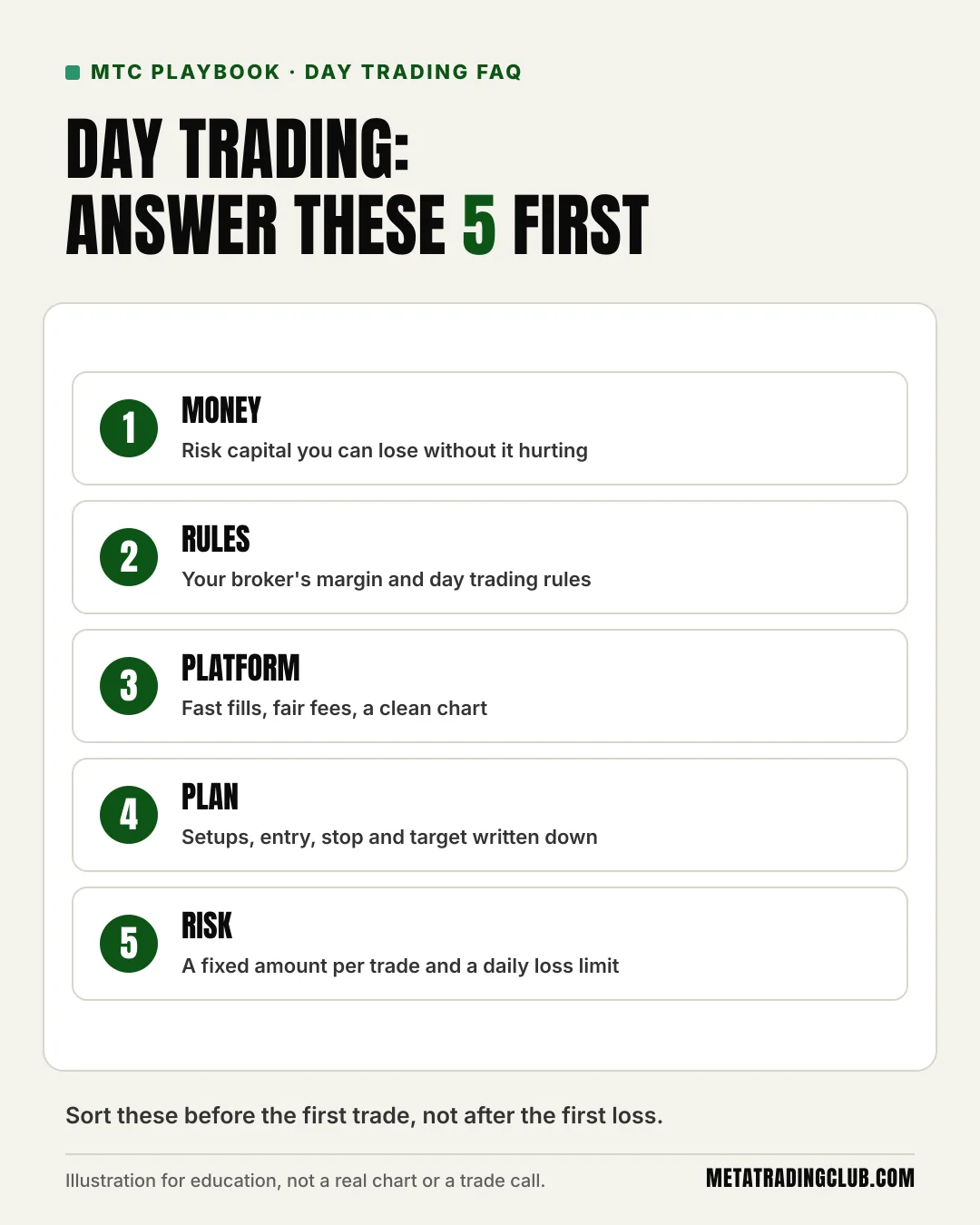
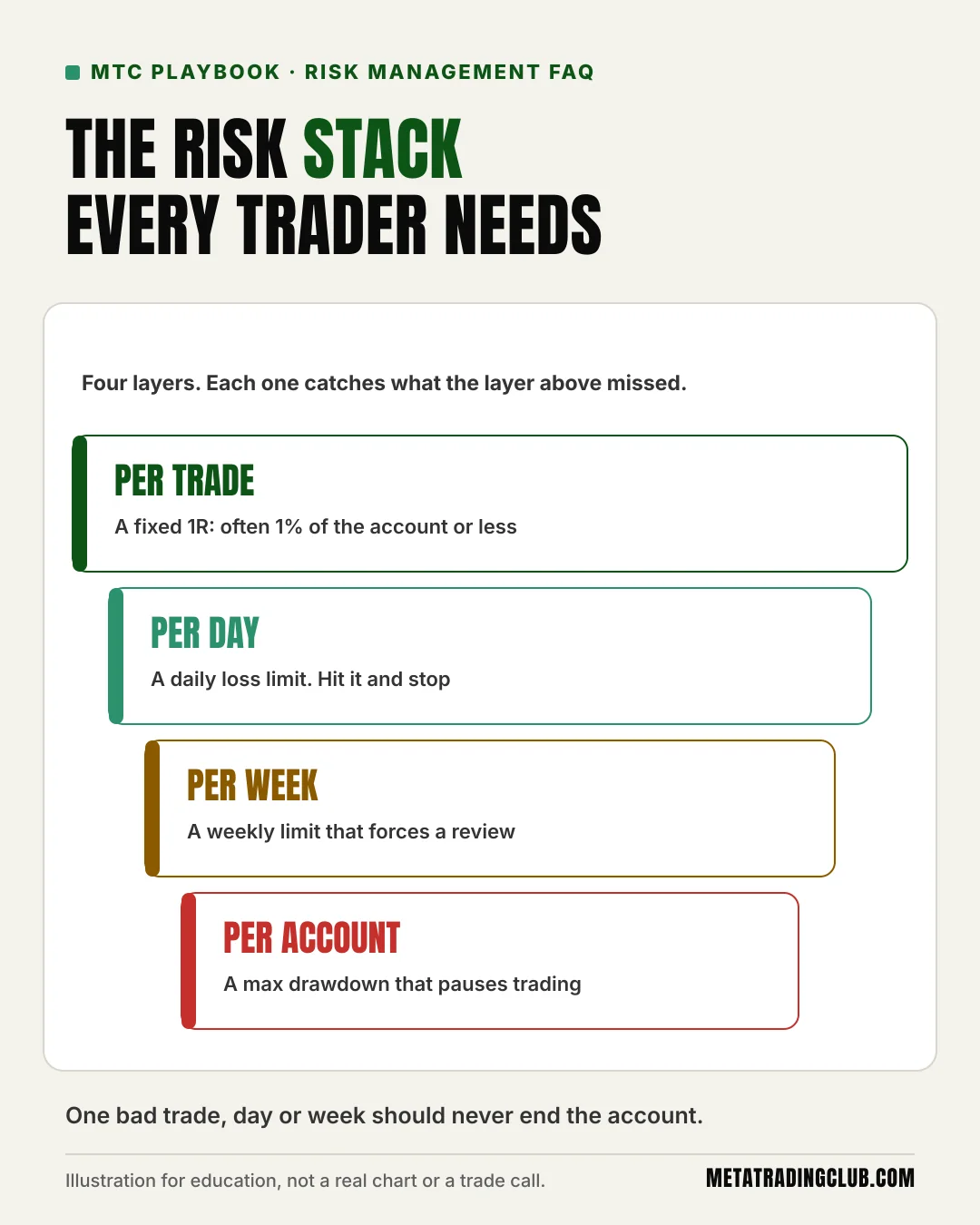
Risk management is the set of rules that limits how much you can lose: per trade, per day and across the account. It covers position size, stop placement, daily loss limits and leverage. Good risk management doesn’t pick winners. It keeps losers small enough that your edge has time to work. Core rules: the 5 risk management rules.
How much should I risk per trade?
Many traders risk 1% of the account per trade or less, and some use 0.5% while they’re still learning. The exact number matters less than keeping it fixed, so one loss never feels like a disaster and a streak of losses doesn’t end the account. See the 1% rule worked through: position sizing math.
What does 1R mean in trading?
1R is the amount you risk on a trade: the distance from entry to stop, times your position size. Measuring results in R lets you compare trades of different sizes. A trade that makes twice what you risked is +2R, and a full stop-out is −1R. Example in reward-to-risk ratio.
What is position sizing?
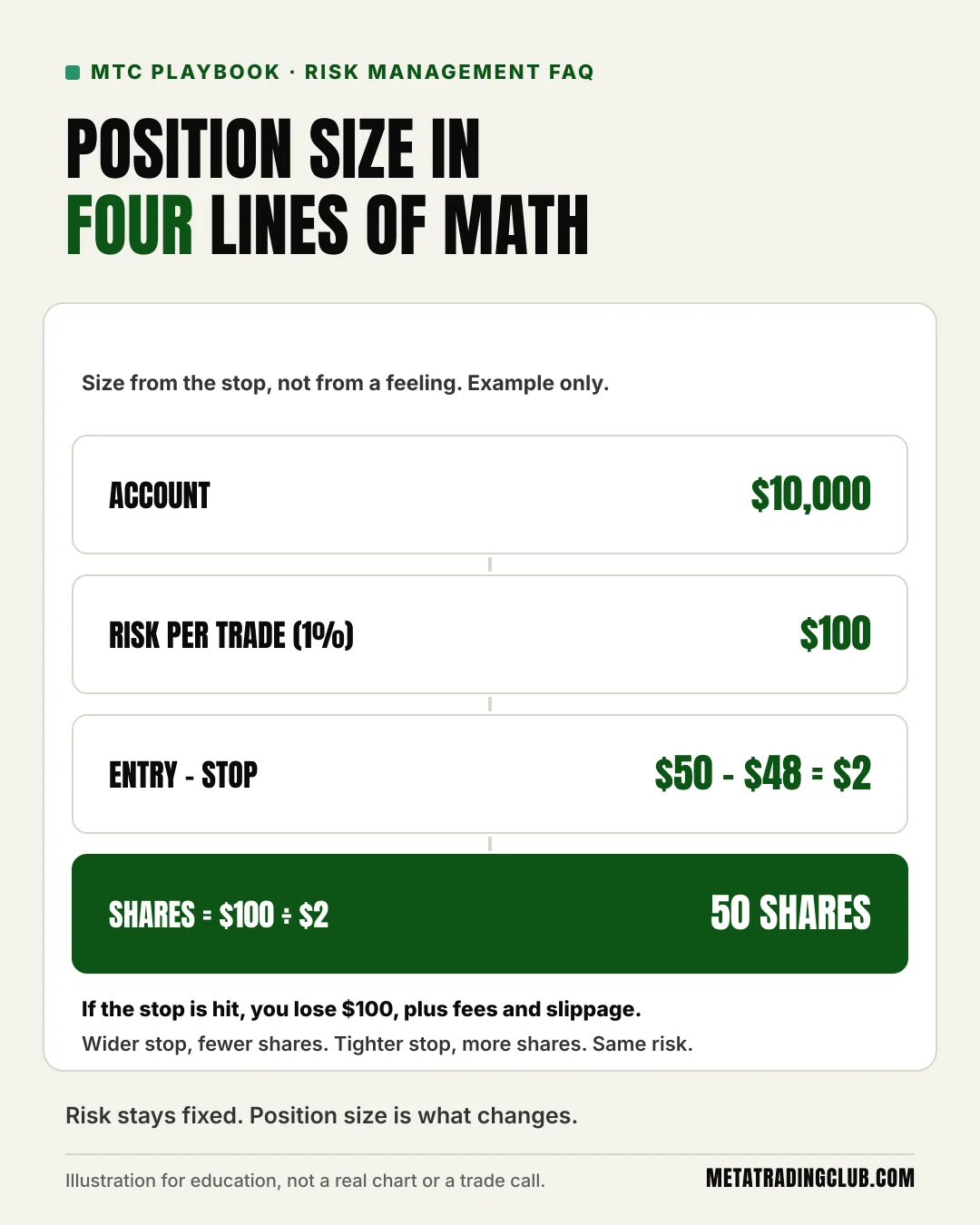
Position sizing is deciding how many shares or contracts to trade so that, if your stop is hit, you lose exactly your planned risk. It’s the link between your stop and your account size. Same risk every trade, different share counts. Strategies compared: position sizing strategies.
How do you calculate position size?
Divide your dollar risk by your risk per share. With a $10,000 account risking 1%, that’s $100. If entry is $50 and the stop is $48, you risk $2 a share, so you buy 50 shares. A wider stop means fewer shares. Skip the math with our position size calculator.
Stops and targets
What is a stop loss?
A stop loss is an order that closes your position at a set price to cap the loss. It turns ‘I’ll get out if it goes wrong’ into a rule the platform follows for you. Without one, a small loss can quietly become a big one. Types and examples: what is a stop loss.
Where should I put my stop loss?
Put it where the trade idea is proven wrong, usually just beyond the zone you entered from, plus a little room for normal noise. Don’t place it at a round dollar amount you’re comfortable losing. Then size the position to fit the stop. Full method: how to set a stop loss the right way.
Should I move my stop to breakeven?
Only when the chart gives you a reason, like price clearing the next zone, not just because the trade is green. Moving to breakeven too early gets you stopped out on normal pullbacks before the move happens. Many traders move the stop after taking partial profit. Scaling out step by step: profit target strategies.
What is a good reward-to-risk ratio?
Many traders look for at least 2R, meaning the target is twice the distance of the stop. A higher ratio means you need fewer winners to stay profitable. But the target must be somewhere the chart has room to reach, usually the next zone. Examples: reward-to-risk ratio strategies.
How do I set a profit target?
Set it at the next zone where price is likely to react, then check that the distance is worth your risk. If the next zone is closer than your stop, skip the trade. Some traders take part off at the first target and trail the rest. Seven ways to do it: profit target strategies.

Drawdowns and losing streaks
What is a drawdown in trading?
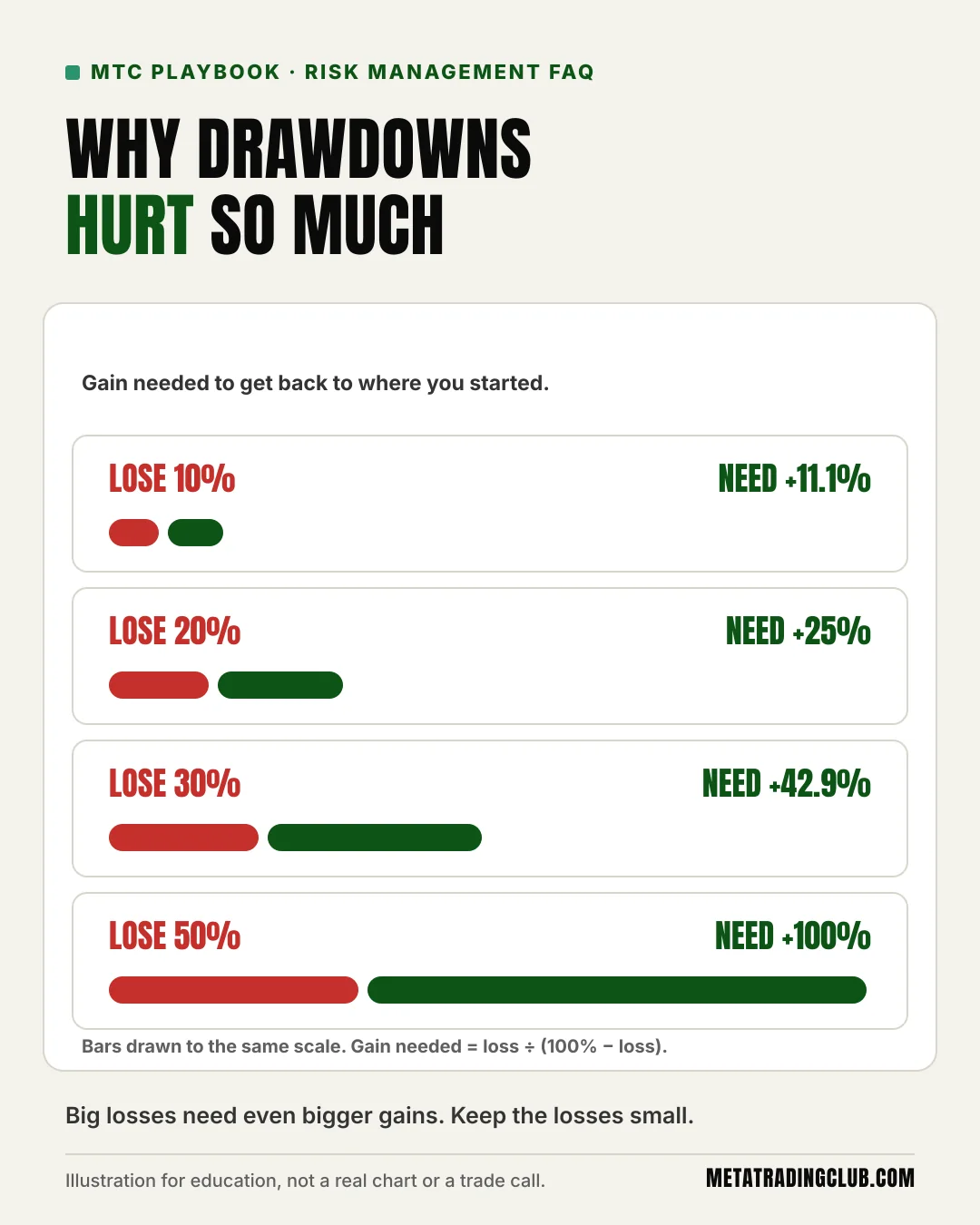
A drawdown is the drop from your account’s highest point to its lowest point before it recovers. It’s normal: every strategy has them. What matters is keeping them small, because a 50% drawdown needs a 100% gain just to get back to even. How to handle one: drawdowns explained.
How do I survive a losing streak?
Plan for it before it happens. Keep risk per trade small, cut size after a set number of losses, and stop for the day at your daily limit. Then review whether you followed your rules or the market just didn’t cooperate. Those need different fixes. More in drawdowns explained.
What is a daily loss limit?
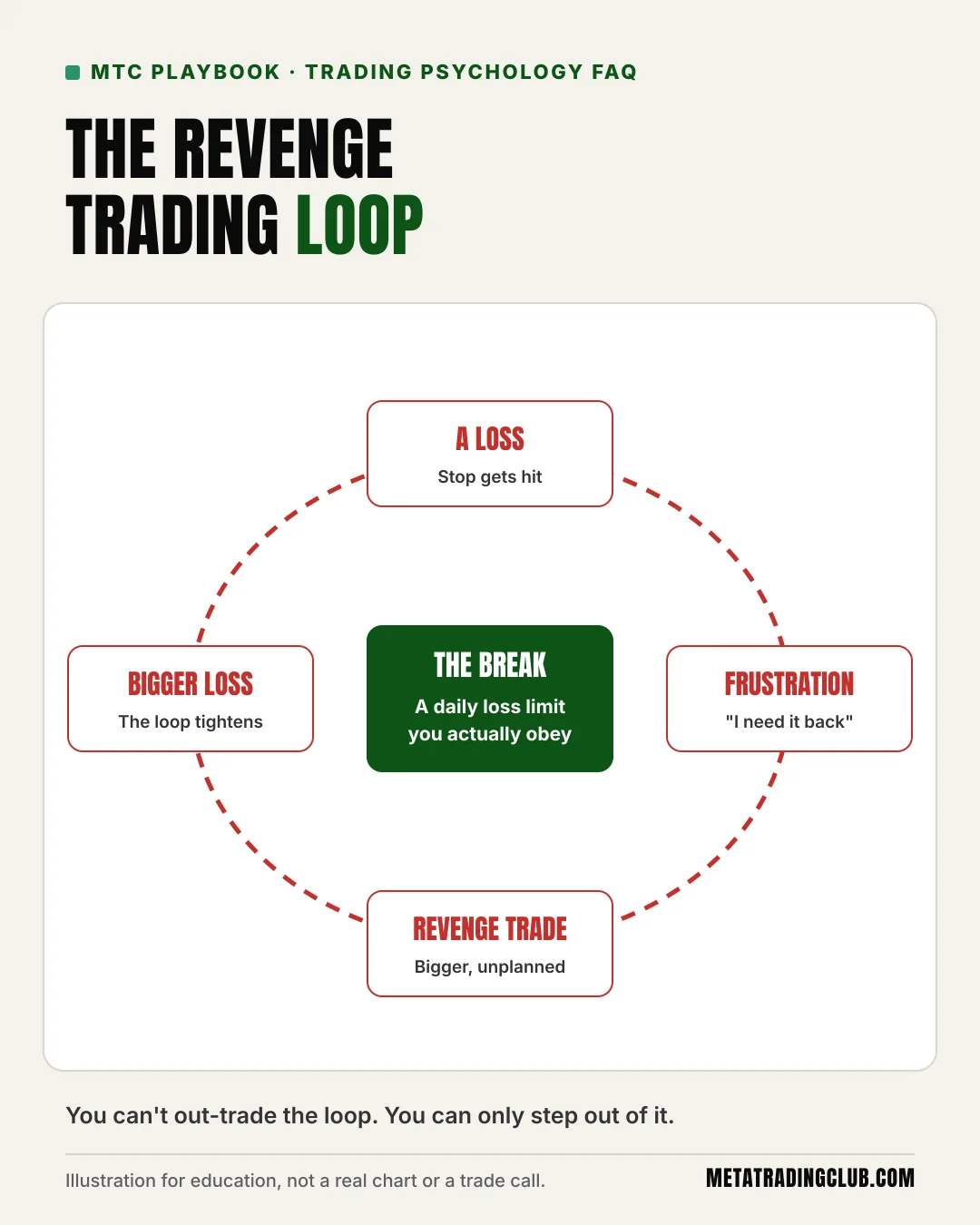
A daily loss limit is the most you’ll allow yourself to lose in one day before you stop trading. Many traders set it at two or three times their normal risk per trade. It stops one bad morning from turning into revenge trading and a blown week. It’s one of the 5 risk management rules.
What is trading expectancy?
Expectancy is the average amount you win or lose per trade over many trades, often measured in R. It combines how often you win with how big your wins and losses are. Positive expectancy means your process makes money over time. How to calculate yours: trading expectancy explained.
Why is compounding small gains better than big wins?
Because losses hurt more than gains help. Small, steady gains compound, while one big loss can wipe out months of progress and take far longer to recover. Traders who survive long enough to compound usually win by not losing big. The math: compounding vs blowing up.
Leverage, volatility and hedging
Is leverage bad in trading?
Leverage isn’t bad on its own. It’s a multiplier. It makes gains and losses bigger, so it amplifies whatever your process already is. Used with fixed risk per trade, it can be a tool. Used to make bigger bets, it’s the fastest way to a margin call. Explained: leverage and margin trading.
What is a margin call?
A margin call happens when your account falls below the broker’s maintenance requirement. You have to add funds or reduce positions, and the broker can close them for you at bad prices. The usual cause is position size that was too big for the account. How to avoid one: what is a margin call.
How do I trade volatile stocks without blowing up?
Use wider stops to match the volatility, then cut the position size so your dollar risk stays the same. Avoid market orders in fast moves, and expect more slippage. Volatile stocks need the same risk with smaller size, never bigger size. Practical rules: how to trade volatile stocks.
What is hedging in trading?
Hedging means opening a position that gains when your main position loses, like buying a put on a stock you own. It reduces risk in exchange for a cost, such as the option premium or capped upside. Often, a smaller position is the cheapest hedge. Basics: what is hedging in trading.
How do I grow a small trading account?
Slowly, with fixed risk. Trying to grow a small account fast leads to oversizing, and oversizing is how small accounts disappear. Focus on executing your process, keep risk per trade small and add money from income instead of forcing returns. Realistic plan: how to grow a small trading account.
Where to go next
Read position sizing math and how to set a stop loss, then use the position size calculator on your next trade. If you trade a funded account, the prop firm FAQ covers how these rules work under a firm’s limits.
In the MTC process, risk is decided before execution, never after. Bias, zone, reaction, confirmation, then a size that fits the stop.