Search
The prop firm path: pay for the challenge, hit the profit target, get funded, take payouts

Prop Firm FAQ: 19 Questions About Funded Accounts, Answered

Prop firms sell a simple promise: pass a challenge, trade their money, keep most of the profit. The fine print is where traders get hurt. Trailing drawdowns, daily loss limits, consistency rules and payout schedules decide who actually gets paid.

This page answers the prop firm questions traders search most, in plain language. Each answer links to a full guide. For the big picture first, read what separates a good prop firm from a trap.

Jump to: Prop firm basics · The rules that end accounts · Passing the challenge · Payouts and taxes

Prop firm basics
What is a prop firm?

A prop firm, short for proprietary trading firm, gives traders access to its capital in exchange for a share of the profits. Most retail prop firms today charge a fee for an evaluation, then let you trade a funded account under strict rules. How to tell a solid firm from a bad one: best prop firms in 2026.

What is a funded trading account?

A funded account is an account a prop firm lets you trade after you pass its evaluation. You trade under its rules, and you get paid a share of the profits you make. You don’t put your own capital at risk beyond the fee. Plain-English guide: what is a funded trading account.

Is a funded account real money?

Often not. Many retail prop firms run funded accounts in a simulated environment and pay your share of profits from their own funds. Some move consistent traders to live capital later. What matters to you is whether the firm pays reliably and its rules are clear. More in what is a funded trading account.

Can Canadians use prop firms?

Yes. Many prop firms accept traders from Canada, especially futures and forex firms. Check each firm’s list of supported countries, how it pays out to Canadians and in what currency before you buy a challenge. Then plan for tax, because payouts are taxable income. The Canadian angle: are funded trading accounts worth it in Canada.

Why can’t you trade stocks with most funded accounts?

Most prop firms focus on futures, forex and CFDs, because those markets are easier to simulate, trade nearly around the clock and come with built-in leverage. Stock-focused prop firms exist, but there are fewer of them and the rules differ. Know what instruments you trade before you pick a firm. Background: what is a funded trading account.

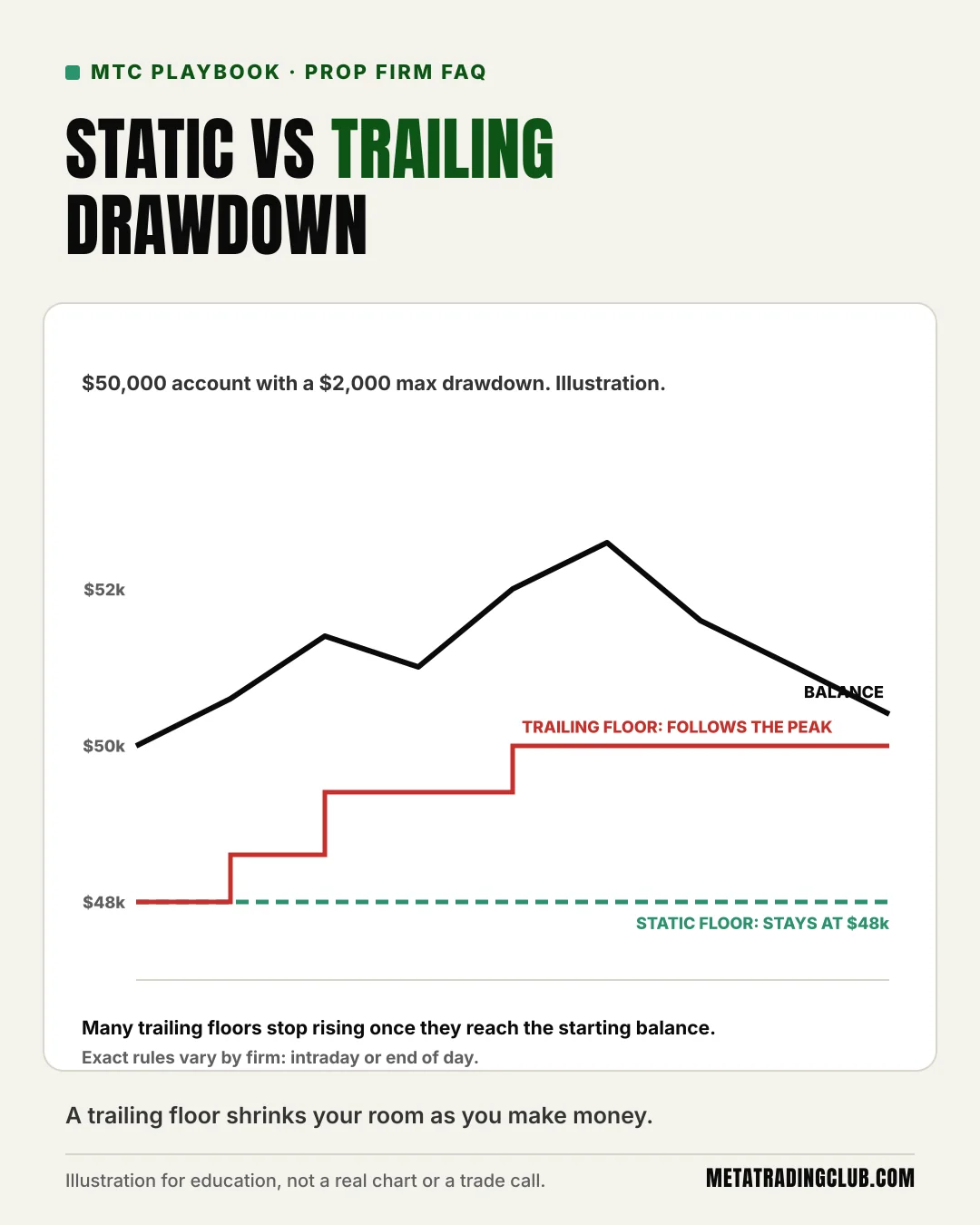
Static drawdown floor stays fixed while a trailing drawdown floor follows the account's peak balance
A trailing floor follows your peak, so your room shrinks as you make money.

The rules that end accounts

What is a daily loss limit?

A daily loss limit is the most you can lose in one trading day before the account is breached or paused. It’s often measured on open and closed P&L together, so an open trade can trigger it. This rule ends more accounts than any other. Every rule explained: funded account rules explained.

What is the difference between static and trailing drawdown?

A static drawdown sets a fixed floor below your starting balance that never moves. A trailing drawdown follows your highest balance up, so the room you have shrinks as you make money, until it often locks at the starting balance. Know which one you have, intraday or end of day. Details: funded account rules explained.

What is a consistency rule?

A consistency rule limits how much of your total profit can come from one day. It stops traders from passing on a single lucky trade. If your best day is too large a share of profits, you may need to keep trading before you pass or get paid. More in funded account rules explained.

What is a profit target in a prop firm challenge?

The profit target is the gain you must reach to pass a challenge phase, set as a percentage or dollar amount of the account. It’s the rule everyone focuses on, yet it’s the easiest one. The loss limits are what fail most traders. Approach: how to pass a prop firm challenge.

Do prop firms have minimum trading days?

Many do. A minimum trading days rule means you must trade on a set number of separate days before you pass or request a payout. It’s there to stop one-session passes. Plan your trading so you can meet it without forcing low-quality trades. Rules overview: funded account rules explained.

Can you hold trades overnight or trade the news with a funded account?

It depends on the firm and the account type. Some ban holding over the weekend, some restrict trading around major news releases, and some allow both. Breaking one of these rules can void profits or end the account. Read the rules page before your first trade. Common restrictions: funded account rules explained.

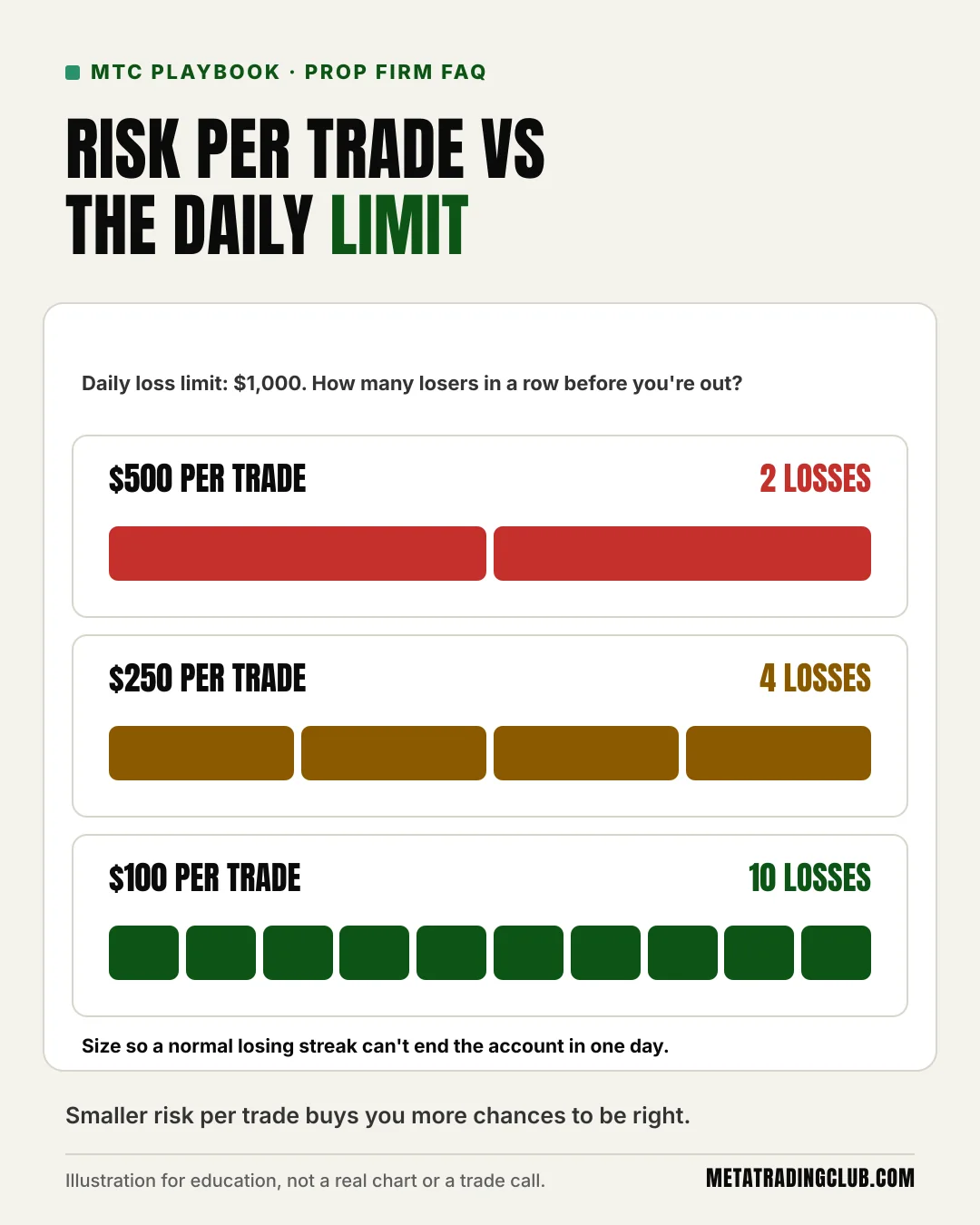
With a $1,000 daily loss limit, risking $500 per trade allows 2 losses, $250 allows 4, $100 allows 10
Smaller risk per trade means a normal losing streak can’t end the day, or the account.

Passing the challenge

How do you pass a prop firm challenge?

Treat it like a risk test, not a profit race. Trade one tested setup, risk a small fixed amount per trade, stop for the day well before the daily limit and let the target come over time. Most failures come from forcing trades to hit the target fast. Step by step: how to pass a prop firm challenge.

How much should I risk per trade in a prop firm challenge?

Size every trade so that a normal losing streak can’t hit your daily loss limit in one day. If the daily limit is $1,000, risking $250 a trade gives you four losers before you’re out. Risking $500 gives you two. Smaller risk buys more chances. The math: position sizing and the 1% rule.

Why do most traders fail prop firm challenges?

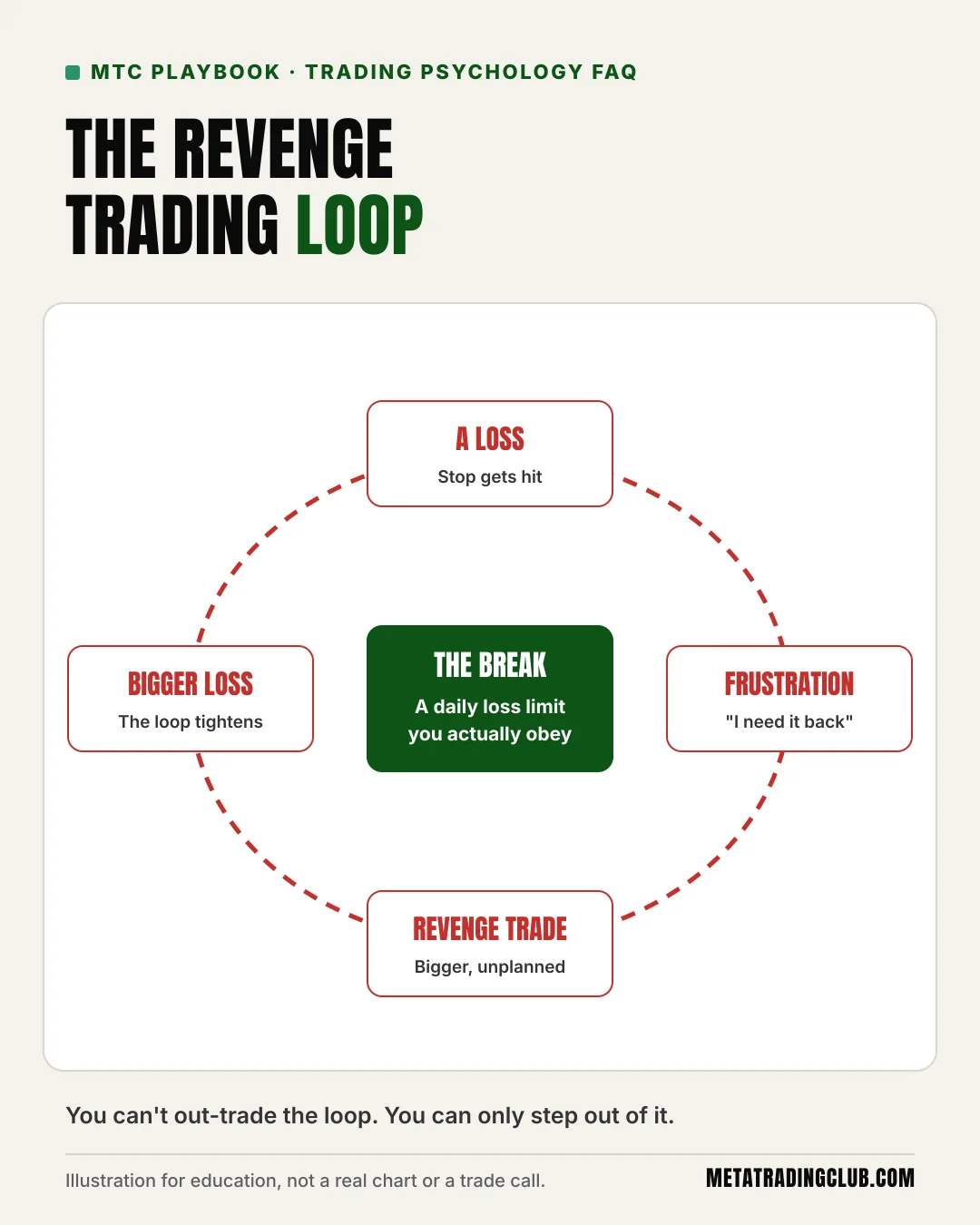
Oversizing, rushing the profit target, revenge trading after a loss and not understanding the drawdown rule. Most failed accounts are breached by a loss rule, not by missing the target. A written plan with a daily stop fixes most of it. How to survive losing streaks: drawdowns explained.

Should you buy another challenge after you fail?

Only after you know why you failed. If a rule breach came from oversizing or emotion, a new challenge just repeats the same mistake for another fee. Review your journal, fix one thing and prove it on a small account or simulator first. Track it properly: how to review your trading performance.

Payouts and taxes

How do prop firm payouts work?

Once funded, you request withdrawals of your share of the profits, often a profit split like 80 to 90% to the trader. Firms set payout schedules, minimum trading days and sometimes buffers you must keep in the account. Read the payout terms before you buy, not after you profit. Basics: what is a funded trading account.

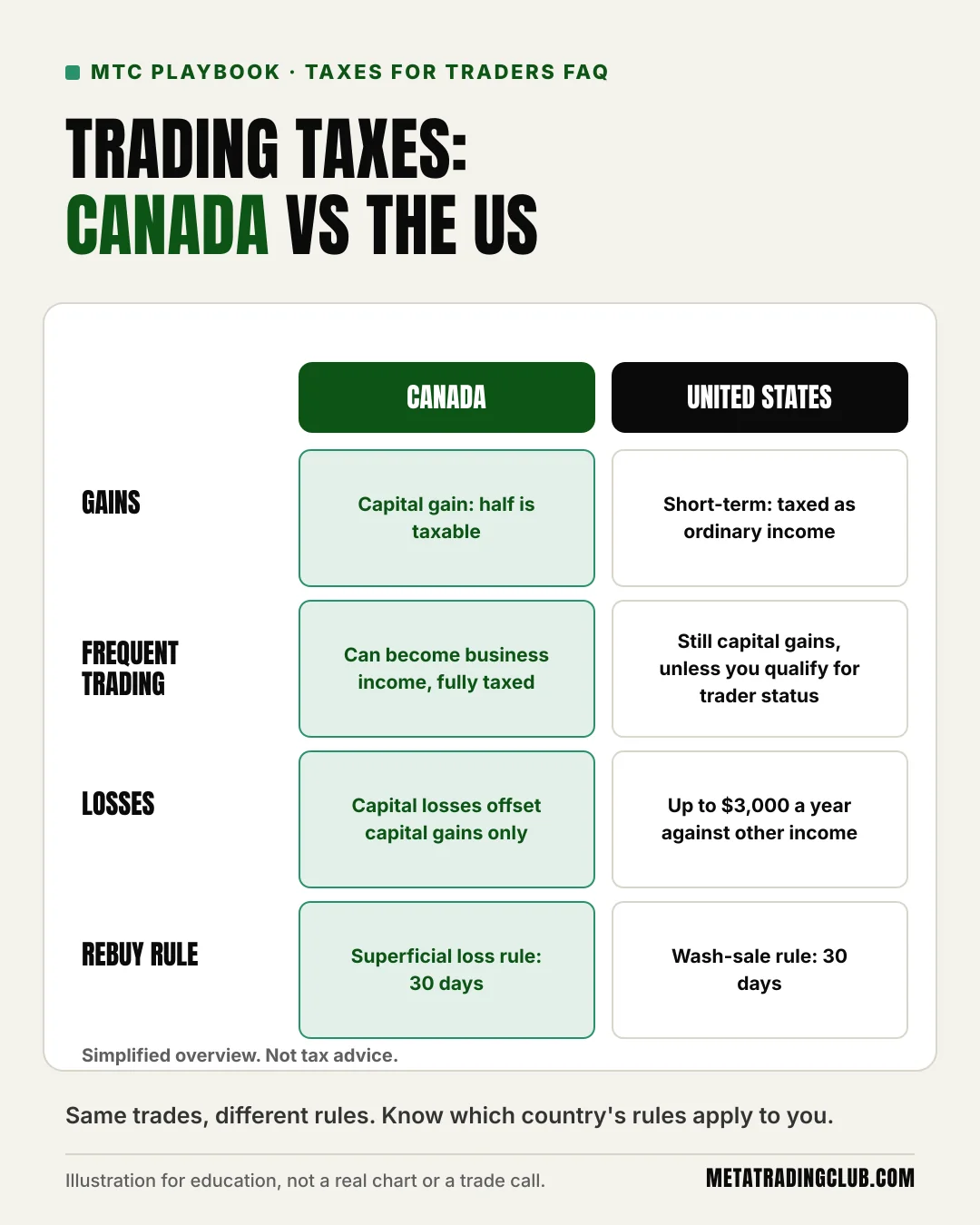
Do I need to pay taxes on prop firm payouts in Canada?

Yes. Prop firm payouts are taxable in Canada, and because they’re performance payments for active trading, they’re often treated as business income, fully taxed at your marginal rate. Challenge fees and trading costs may be deductible expenses. Keep records from day one. Not tax advice. Full guide: prop firm payout taxes in Canada.

Is a prop firm better than trading your own money?

A prop firm limits your downside to the fee and gives you more buying power, but you trade under rules that can end the account fast. Your own account has no outside rules, but every loss is yours. Many traders use both. The honest comparison: are funded trading accounts worth it.

Are funded trading accounts worth it?

They can be for traders who already have a tested process and strict risk rules. For people still learning, challenge fees usually become an expensive way to practise. Build the skill first, then use the firm’s capital to scale it. More in are funded trading accounts worth it in Canada.

Where to go next

Read funded account rules explained before you buy anything, then how to pass a prop firm challenge. If you’re in Canada, read how prop firm payouts are taxed before your first payout, not after.

A prop firm doesn’t change what makes a trade good. Bias, zone, reaction, confirmation, then execution, at a size the rules can survive.


Picture of Shahryar Rahmani
Shahryar Rahmani

CEO and Co-Founder

Related Post