There are two ways to think about a trading account. One is the home-run mindset: swing big, get rich fast, and accept that you might blow up. The other is the compounding mindset: protect the account, grow it steadily, and let time do the heavy lifting.
These two paths look similar for a few weeks. Over months and years they diverge completely — one quietly compounds, the other ends in a reset to zero. Understanding why is the difference between a hobby and a craft.
The whole game
Get-rich-quick and stay-in-the-game are opposite strategies. You cannot compound an account you’ve blown up — survival is the precondition for everything else.
Two Mindsets, Two Outcomes
The home-run trader optimizes for the best possible week. The compounding trader optimizes for being here in five years. The first treats large risk as the price of large reward; the second treats capital preservation as the thing that makes reward possible at all.
MTC Analysis
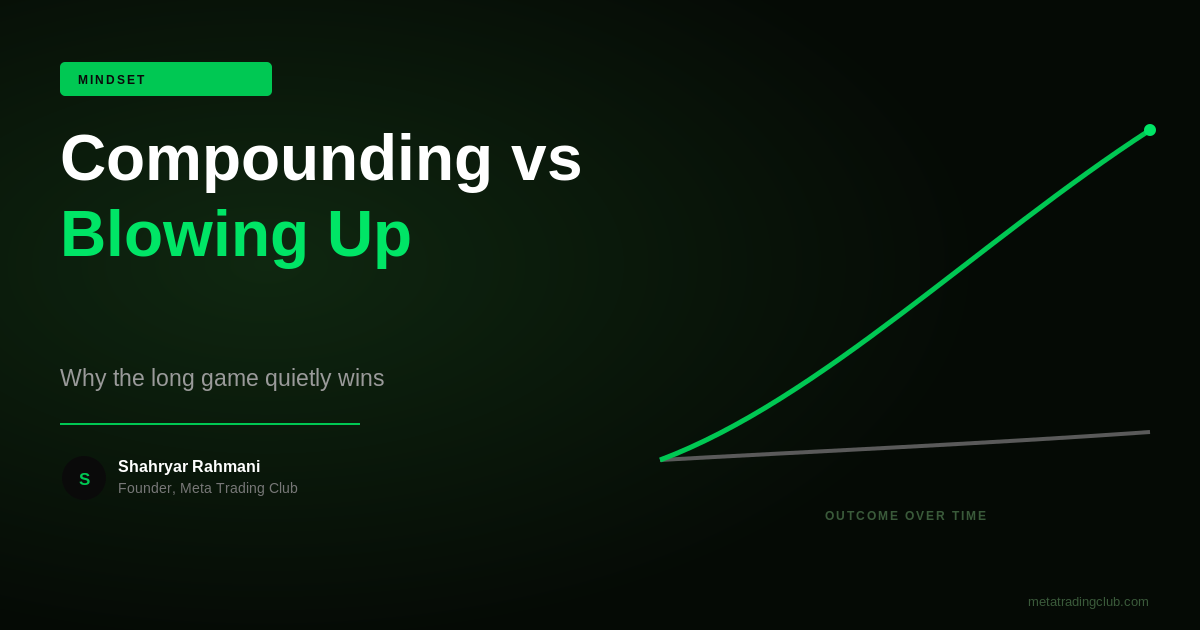
Steady Compounding vs. The Blow-Up
Two accounts, same starting point. The steady curve climbs slowly and survives; the reckless curve spikes and then resets. Time rewards the survivor.
Why Big Risk Loses the Long Game
Large position sizing can win spectacularly for a while — which is exactly the trap. A run of luck on oversized trades feels like skill, right up until the inevitable losing streak arrives and the same large size that built the gains erases them. High risk doesn’t just raise volatility; it raises the probability of a permanent, unrecoverable loss.
MTC Analysis
Probability of a Catastrophic Loss by Risk Level
Illustrative: as risk per trade climbs, the odds that a normal losing streak becomes account-ending rise sharply. Big size doesn’t just feel risky — it is.
The Quiet Power of Small, Repeatable Gains
Compounding is unglamorous and that’s its strength. Modest, consistent gains on a protected account stack on top of each other, and the base keeps growing. There are no viral screenshots in this approach — just an account that’s still here, still growing, while flashier traders have reset to zero and started over.
| Approach | Good month | Bad month | Long-run path |
|---|---|---|---|
| Reckless / big size | Huge | Catastrophic | Spikes, then zero |
| Compounding / small size | Modest | Contained | Slow, durable growth |
How to Actually Play the Long Game
Playing the long game is mostly about what you refuse to do: refuse to over-size, refuse to chase losses, refuse to mistake a lucky streak for skill. Keep risk small and constant, focus on process over any single outcome, and treat survival as the non-negotiable that makes compounding possible.
- Treat capital preservation as priority one
- Keep risk per trade small and constant
- Judge yourself on process, not single-trade outcomes
- Distrust streaks that came from over-sizing
- Aim to still be trading in five years
Proprietary Framework
The MTC Alignment Engine™ — Applied Every Live Session
Every trade runs the same five checkpoints — consistency over gut reaction. Inside the MTC Incubator, members build their own system on top of this framework.
Frequently Asked Questions
Why is compounding important in trading?
Because steady, repeatable gains on a protected account stack over time, and the growing base accelerates future growth. The catch is that compounding only works if you don’t blow up — a single catastrophic loss resets the process to zero, erasing years of progress.
Why do high-risk traders eventually blow up?
Large position sizing can win for a while, which feels like skill, but it sharply raises the odds that a normal losing streak becomes unrecoverable. The same big size that builds fast gains erases them just as fast when variance turns against you.
Is slow, steady trading really better than swinging big?
Over the long run, usually yes. Big-size trading may produce spectacular short stretches, but it carries a high probability of eventual ruin. Steady, small-risk trading grows more slowly but survives the losing streaks that end aggressive accounts.
How much should I risk to compound safely?
Keeping risk per trade small and constant — many traders use around 1% — means no single trade or streak can take you out, allowing gains to compound across time. The exact figure matters less than keeping it small, consistent, and mechanical.
What’s the biggest threat to compounding?
A single catastrophic loss. Because recovery math is asymmetric, deep drawdowns require enormous gains just to break even. Avoiding the account-ending loss — through small, consistent risk — protects the compounding process more than any winning strategy adds to it.
Related reading
Meta Trading Club Community
Start Your 7-Day Free Trial
Daily live sessions. Real-time market prep — not signals. The MTC Alignment Engine™ applied in front of you. Trade alongside Shahryar from day one.
Cancel anytime. No contracts. Built for Canadian traders.
Already trading and want to build your own system?
The MTC Incubator is an application-based mentorship — 1-on-1 work building a personalized system on the Alignment Engine™.