
Yes. Listed options are qualified investments for a TFSA, so you can hold and trade them. The limits come from your broker and from the fact that a TFSA can’t use margin. Most brokers allow buying calls and puts and selling covered calls. Trade too often, though, and the CRA can tax your TFSA as a business.
This page covers the TFSA side only. For accounts, approval levels, brokers and taxes in general, start with our guide to options trading in Canada.
Why options are allowed in a TFSA
A TFSA can hold “qualified investments”. That list includes most securities listed on a designated stock exchange, and listed options are on it. So the CRA does not ban options in a TFSA.
The limits you run into come from two other places: your broker’s rules and the fact that a TFSA can’t use margin. A third limit is a tax one: how you trade can turn the TFSA into a business in the CRA’s eyes. We cover each below.
Which strategies brokers typically allow in a TFSA
Brokers approve options separately and give you a level. Registered accounts are capped low. At Questrade and Qtrade, a TFSA can only go up to Level 2. In practice that usually means:
- Buying calls and puts. Your risk is the premium you pay. See what a long call is.
- Selling covered calls on shares you already hold in the TFSA. See what a covered call is.
- Protective puts at some brokers, and cash-secured puts at a few (Questrade allows them, with some exceptions).
| Broker | What its TFSA allows (per its own pages) |
|---|---|
| Questrade | Up to options Level 2: long calls and puts, covered calls, cash-secured puts (with some exceptions) |
| Interactive Brokers Canada | Long calls and puts, covered calls, protective puts |
| Wealthsimple | Long calls and puts; covered calls in registered accounts |
| Qtrade | Options Levels 1 or 2 in registered accounts |
Source: each broker’s own help or account pages, checked October 2026. Rules change, so confirm with your broker before you trade.
No margin: what it rules out
Everything in a TFSA is paid in full. You can’t borrow. That is why these are usually off the table:
- Naked (uncovered) calls or puts. Losses can be large, and the broker has no margin to hold against them.
- Spreads that need margin treatment, such as credit spreads and most multi-leg trades.
- Short selling stock.
If a strategy needs margin, it belongs in a margin account, not a TFSA.
The real risk: the CRA can tax your TFSA as a business
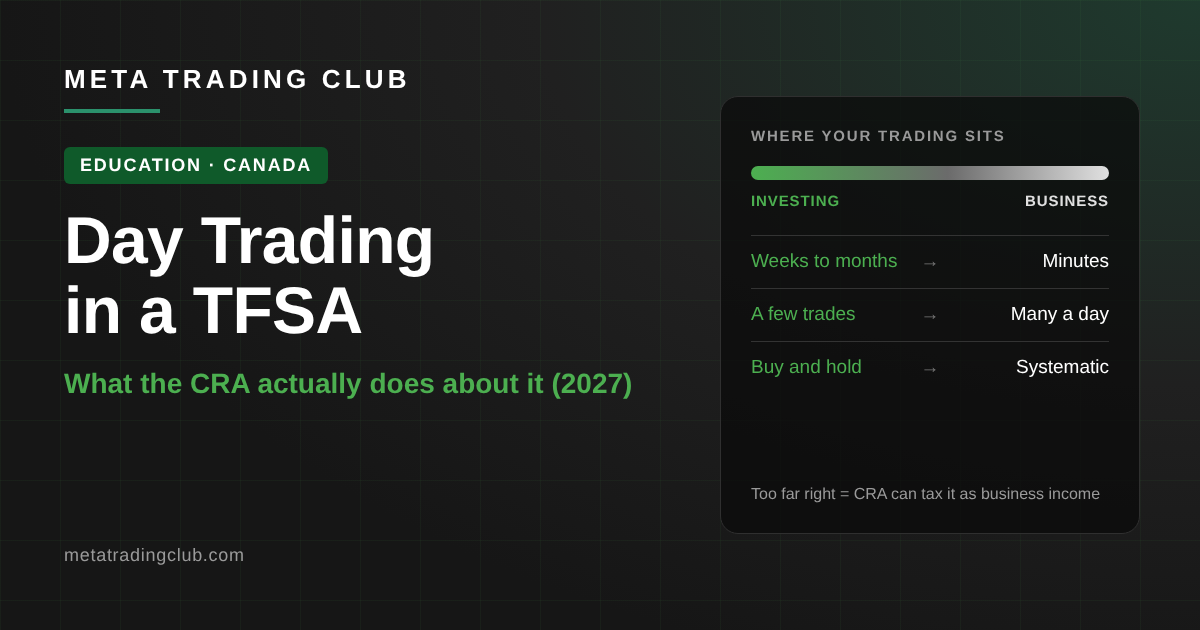
Gains in a TFSA are normally tax-free. But if the CRA decides your TFSA is carrying on a business, the income from that business is taxable. Business income is fully taxable, not half like a capital gain.
There is no fixed formula. The CRA looks at factors such as how often you trade, how long you hold, your knowledge and experience, the time you spend on it, and whether you use borrowed money. Rolling options every week, very short holding periods and intraday management look more like a business than investing. Writing uncovered options in a registered plan can also be treated as carrying on a business.
Our take: a TFSA is a poor fit for high-frequency options trading. If you trade options often, talk to a tax professional about which account to use. General information, not tax advice.
For how options are taxed outside a TFSA, read our guide to options trading tax in Canada.
Losses in a TFSA can’t be claimed, and they cost you room
This is the part most people miss. Two rules work against you when an options trade loses money in a TFSA:
- No tax deduction. You can’t use a TFSA loss to offset taxable capital gains outside the TFSA.
- No room back. Only withdrawals are added back to your contribution room, on January 1 of the next year. Losses don’t increase or restore your room.
Options that expire worthless are a common way to lose money. In a TFSA, that loss also burns tax-free room you can’t get back except through new annual room.
US-listed options in a TFSA: currency and withholding
US-listed options trade in US dollars, and brokers charge a fee to convert CAD and USD. Some, like Questrade, let you hold USD in the account. We compare costs in the Canadian vs US-listed options section of the pillar guide.
If you hold US shares in your TFSA, for example under a covered call, US dividends usually have 15% US tax withheld. A TFSA can’t recover it. An RRSP is usually exempt under the Canada-US tax treaty. General information, not tax advice.
Treat options in a TFSA like a plan, not a lottery ticket
Buying cheap out-of-the-money contracts and hoping is not trading. In a TFSA it is worse: each loss also costs you room. The traders who last use options as a precise tool inside a plan. They have a Zone, a reason to be in, and an exit set in advance.
New to options? Our step-by-step guide to options trading in Canada covers getting approved, picking a broker and a process for every trade.
Frequently asked questions
Can you trade options in a TFSA?
Yes. Listed options are qualified investments, so a TFSA can hold them. Your broker decides which strategies you can use, and because a TFSA has no margin, most brokers allow only buying calls and puts and selling covered calls.
Can you sell covered calls in a TFSA?
Usually, yes. A covered call is backed by shares you already own in the account, so brokers such as Questrade, Interactive Brokers Canada and Wealthsimple allow it in registered accounts.
Can you trade spreads or sell naked options in a TFSA?
Generally no. Naked options and spreads that need margin are restricted because a TFSA can’t borrow. Writing uncovered options in a registered plan can also be treated as carrying on a business.
Can the CRA tax options trading in a TFSA?
Yes, if it decides the TFSA is carrying on a business. Then that business income is taxable. Frequent trading, short holding periods and specialist knowledge are among the factors it looks at. General information, not tax advice.
Can you claim a loss on options in a TFSA?
No. Losses inside a TFSA can’t be used against taxable capital gains elsewhere, and they don’t restore your contribution room. Only the amount you withdraw is added back, on January 1 of the next year.
Sources (checked October 2026)
- CRA: TFSA Guide for Issuers (RC4477)
- CRA: Before you contribute to a TFSA
- CRA: Transactions in securities (IT-479R, archived)
- Questrade: TFSA options trading
- Questrade: Options levels
- Questrade: TFSA day trading and CRA rules
- Questrade: TFSA withdrawals
- Questrade: US stocks in a TFSA
- Interactive Brokers Canada: RRSP and TFSA information
- Wealthsimple: Options strategies by account
- Wealthsimple: Covered calls
- Wealthsimple: Tax for Canadian options traders
- Qtrade: Options trading resources
- moomoo Canada: TFSA options trading
- moomoo Canada: US stocks in a TFSA or RRSP
- RBC Direct Investing: TFSA FAQs
- TD: TFSA contribution room and withdrawal rules
- TaxTips.ca: Qualified investments (quotes CRA Folio S3-F10-C1)
Some links in this post are referral links. If you sign up through them, we may get a reward at no cost to you.
Education only. Not financial advice. General information, not tax advice. Broker rules change; confirm with your broker before trading.