Two tickers dominate most options trading conversations: SPY and QQQ.
If you’ve spent any time in trading communities, watched YouTube breakdowns, or sat through a premarket session, you’ve heard these names constantly. And if you’re relatively new to options, you might be wondering why everyone gravitates to these two — and which one you should actually focus on.
The honest answer: both have a place. But they’re not interchangeable. They move differently, attract different types of setups, and serve different purposes depending on your style and experience level.
This breakdown covers exactly what SPY and QQQ are, how they differ, and how to think about using each one as a Canadian options trader — without overcomplicating it.
Before you pick one
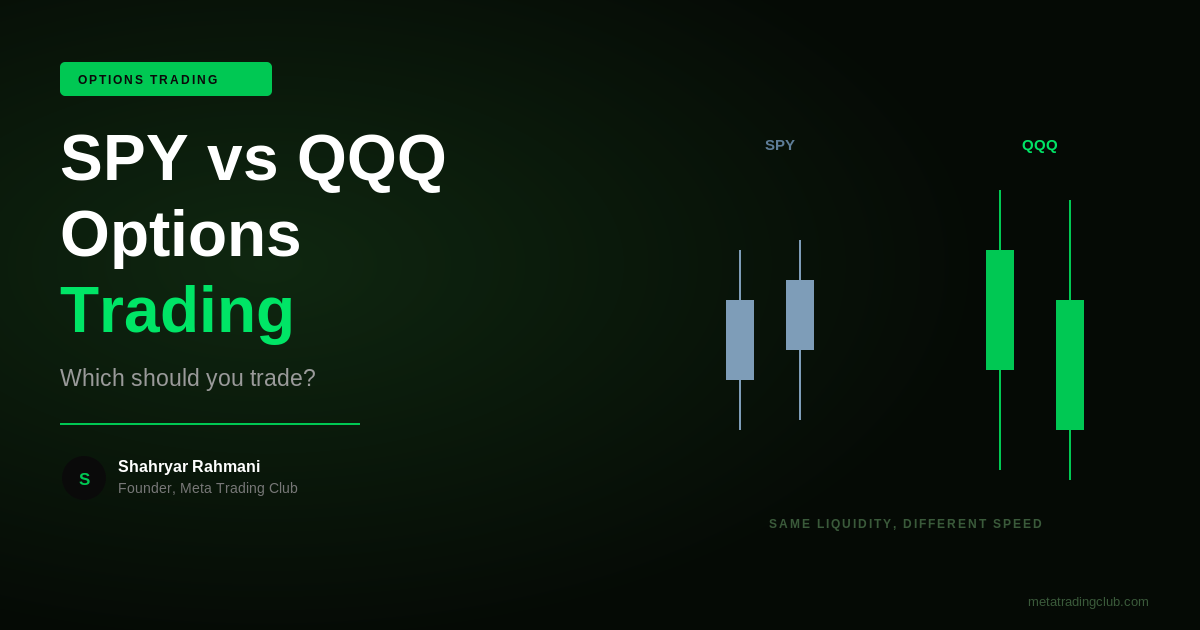
SPY and QQQ aren’t interchangeable. Both are deeply liquid — so liquidity isn’t the deciding factor. Volatility and concentration are.
What Are SPY and QQQ?
Before getting into options strategy, let’s make sure the foundation is clear.
SPY — The S&P 500 ETF
SPY is the SPDR S&P 500 ETF Trust. It tracks the S&P 500 index, which holds 500 of the largest publicly traded companies in the United States. That includes companies across all major sectors — technology, healthcare, financials, energy, consumer goods, industrials.
Because it’s broadly diversified, SPY tends to be a relatively balanced representation of overall US market health. When people say ‘the market is up today,’ they’re often referring to the S&P 500 — which means they’re referring to what SPY tracks.
SPY is one of the most traded securities on the planet. Its options market is extraordinarily liquid, with millions of contracts traded daily.
QQQ — The Nasdaq 100 ETF
QQQ is the Invesco QQQ Trust, tracking the Nasdaq 100 — the 100 largest non-financial companies listed on the Nasdaq exchange. The key word there is non-financial. QQQ is heavily weighted toward technology and growth-oriented companies.
The top holdings in QQQ are names like Apple, Microsoft, NVIDIA, Amazon, Meta, Tesla, and Alphabet. Together, tech and tech-adjacent sectors make up the vast majority of its weight. This makes QQQ more concentrated and more volatile than SPY — it moves faster in both directions.
MTC Analysis
SPY vs. QQQ — How They Actually Differ
Both are deeply liquid — that’s not the deciding factor. QQQ is more volatile and tech-concentrated; SPY is broader and steadier. Your style decides which fits.
Why Canadian Traders Focus on US ETF Options
This is worth addressing directly because it’s a common question.
If you’re a Canadian trader, why not just trade TSX-listed options? Why are SPY and QQQ the default instruments for so many Canadian options traders?
The answer is liquidity. Options trading requires volume — tight bid-ask spreads, fast fills, high open interest on strikes you actually want to trade. The US options market, particularly on major ETFs like SPY and QQQ, has liquidity that Canadian-listed options simply can’t match at scale.
SPY and QQQ also have weekly (and even daily) expirations, which gives options traders significantly more flexibility in structuring trades around specific events, catalysts, or short-term setups. TSX-listed options typically have monthly expirations and much wider spreads — both of which increase cost and reduce precision.
For Canadian traders, this means opening a USD options account (IBKR Canada and Questrade both support this), managing currency exposure, and learning to trade in the US market structure. The liquidity advantage is worth it.
SPY vs QQQ: Full Comparison
| Feature | SPY | QQQ |
|---|---|---|
| Index tracked | S&P 500 (500 companies) | Nasdaq 100 (100 companies) |
| Sector composition | Broadly diversified | Tech-heavy (~50%+ technology) |
| Typical daily range | Moderate | Higher — more volatile |
| Options liquidity | Extremely high | Very high |
| Bid-ask spread | Extremely tight | Very tight |
| Daily options available | Yes | Yes |
| Average premium (ATM) | Lower relative to QQQ | Higher — reflects volatility |
| Sensitivity to tech news | Moderate | Very high |
| Best for beginners | Yes — more predictable | Better after foundational experience |
| Best for momentum plays | Moderate | Strong — especially tech rallies/selloffs |
| Best for range/structure plays | Yes | Yes |
| Macro sensitivity | High | High, especially Fed/rate decisions |
The Key Differences That Actually Matter for Options Trading
The comparison table gives you the overview. But here’s how these differences play out in practice.
Volatility and Premium
QQQ moves faster. On a volatile day in tech, QQQ might move 1.5-2x what SPY moves in percentage terms. That’s a function of its concentration — when NVDA, AAPL, and MSFT all move together, QQQ feels it more acutely.
For options traders, more volatility means higher premiums — and higher potential moves in both directions. That’s attractive if you know what you’re doing. It’s expensive if you don’t, because the same volatility that creates big winners also creates big losers if your timing is off.
Macro vs. Sector Catalysts
SPY responds more to broad macro events — Fed rate decisions, GDP data, jobs reports, geopolitical developments. Because it holds companies across all sectors, it distributes the impact of any single sector or company event.
QQQ responds sharply to anything tech-specific — earnings from Apple, Microsoft, or NVIDIA; AI developments; interest rate changes that disproportionately affect growth stocks. When the Fed signals rate hikes, QQQ tends to react faster and more severely than SPY because high-growth, high-multiple tech companies are more rate-sensitive.
Understanding which catalyst is driving the market on a given day helps you decide which instrument aligns better with the setup.
Strike Selection and Delta Behavior
Because SPY has lower volatility, its options have tighter ranges — strikes don’t need to be as far OTM to be ‘safe’ or as far ITM to have meaningful delta. QQQ’s wider daily range means strikes that look OTM can move into the money faster on big moves.
This isn’t necessarily better or worse — but it changes how you select strikes and manage risk. For beginners, SPY’s tighter behavior makes strike selection more intuitive while you’re learning.
Which One Should You Start With?
For most beginners, SPY is the better starting point.
Here’s why: SPY moves with more structure and less noise. Because it tracks 500 companies across all sectors, it doesn’t gap violently on a single earnings report or a tweet from a tech CEO. It respects technical levels more consistently, which makes it easier to build pattern recognition early.
QQQ is excellent — but its volatility and tech-concentration mean you’ll see more erratic moves around single stock events. That’s manageable once you understand what’s driving the move. As a beginner, that context is harder to read.
Once you’re comfortable with SPY — you understand how to identify market structure, read confirmation, manage risk — layering in QQQ makes a lot of sense. The two instruments complement each other well and often diverge in interesting ways that create additional opportunities.
How MTC Covers Both in Live Sessions
At Meta Trading Club, both SPY and QQQ are analyzed daily in premarket sessions.
The framework used is the MTC Alignment Engine — a 5-step process that starts with market bias (is the overall structure bullish, bearish, or in consolidation?), identifies key levels on both instruments, and then walks through what type of reaction or confirmation would justify an entry.
The reason MTC covers both is simple: on many days, one instrument gives a cleaner setup than the other. SPY might be consolidating near a support level while QQQ is approaching a clean resistance with tech earnings acting as a catalyst. Understanding both gives you more options (no pun intended) and teaches you to read market context rather than just one ticker.
New members often ask whether to start with SPY or QQQ. The answer is usually SPY — learn the structure first, then expand. The process is the same; the instrument just adds a layer of complexity.
If you’re just getting started, check out How to Start Options Trading in Canada and the full Options Trading Canada Beginners Guide for foundational context.
Trade with Structure, Not Guesswork
Whether you focus on SPY, QQQ, or both — the instrument doesn’t make the trader. The process does.
MTC Community is built around teaching you how to read either instrument through a consistent, structured framework. Daily live sessions, real-time market analysis, and a methodology you can apply independently — regardless of what the market does.
Start your 7-day free trial at MTC Community →
Learn the process. Then the instrument becomes a tool, not a guessing game.
Understanding Correlation — and When They Diverge
SPY and QQQ are correlated — they often move in the same direction on the same days. But they don’t move identically, and the divergences are often where the most useful information lives.
On days driven by broad macro news (a Fed announcement, a jobs report, a geopolitical event), SPY and QQQ tend to move together because the catalyst affects all stocks similarly. On days driven by tech-specific news — an NVIDIA earnings beat, a semiconductor sector catalyst, a tech regulation headline — QQQ will outperform or underperform SPY noticeably.
Watching both instruments simultaneously helps you read what kind of day it is. If QQQ is leading to the upside while SPY lags, tech is driving the session. If they’re moving in near-perfect lockstep, the catalyst is macro. That context informs which instrument offers the cleaner setup on that particular day — and helps you avoid trading the wrong instrument for the right thesis.
Experienced traders at MTC learn to read the relationship between these two instruments as part of their daily market analysis. It adds a layer of context that single-instrument traders miss entirely.
Proprietary Framework
The MTC Alignment Engine™ — Applied Every Live Session
Every trade runs the same five checkpoints — consistency over gut reaction. Inside the MTC Incubator, members build their own system on top of this framework.
Frequently Asked Questions
What is the difference between SPY and QQQ options?
SPY tracks the S&P 500 (500 large US companies across all sectors) while QQQ tracks the Nasdaq 100 (100 large non-financial companies, heavily weighted toward technology). SPY options tend to be less volatile and more responsive to broad macro events. QQQ options are more volatile, carry higher premiums, and react more sharply to tech-sector news and earnings.
Which is better for beginners — SPY or QQQ options?
SPY is generally better for beginners. It tracks a broader index, has more predictable technical behavior, and doesn’t gap as violently around individual stock events. QQQ’s higher volatility can create bigger moves, but it also requires more experience to manage. Start with SPY, build your process, then incorporate QQQ as your skill level grows.
Do Canadian traders need a special account to trade SPY and QQQ options?
Canadian traders need a USD options account to trade US-listed ETF options. Brokers like Interactive Brokers Canada (IBKR) and Questrade support US options trading in registered and non-registered accounts. There are currency conversion considerations, but the liquidity advantage of US options markets makes this worthwhile for most active options traders.
Why does QQQ move more than SPY?
QQQ’s higher volatility comes from its concentration in technology stocks. Because a large portion of QQQ is held in 10-15 mega-cap tech companies, when those companies move together — driven by earnings, AI news, or rate expectations — the index amplifies those moves. SPY’s broader diversification smooths out single-sector swings.
Can you trade both SPY and QQQ at the same time?
Yes, and many experienced traders do. Because SPY and QQQ are correlated but not identical, they sometimes provide different technical setups on the same day. One might be at a key resistance level while the other is consolidating in a range. Analyzing both gives you more context for overall market direction and more optionality in finding clean setups.
Which has better liquidity — SPY or QQQ options?
Both have exceptional liquidity. SPY edges out QQQ in raw volume and is often considered the single most liquid options market in the world. Both have extremely tight bid-ask spreads and high open interest across many strikes and expirations, including daily options. For practical purposes, the liquidity difference between the two is minimal for most retail traders.
Meta Trading Club Community
Start Your 7-Day Free Trial
Daily live sessions. Real-time market prep — not signals. The MTC Alignment Engine™ applied in front of you. Trade alongside Shahryar from day one.
Cancel anytime. No contracts. Built for Canadian traders.
Already trading and want to build your own system?
The MTC Incubator is an application-based mentorship — 1-on-1 work building a personalized system on the Alignment Engine™.