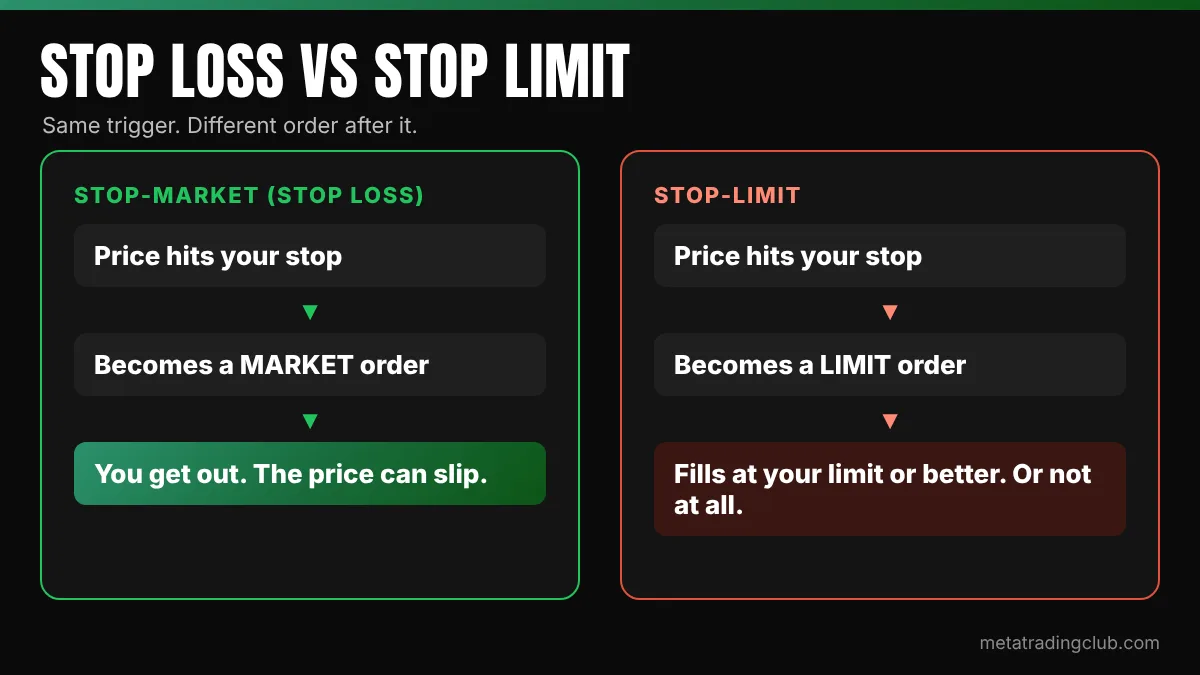
Stop loss vs stop limit comes down to one trade-off. A stop loss (stop-market) order becomes a market order when your stop price is hit, so you get out, but maybe at a worse price. A stop-limit order becomes a limit order, so you control the price, but you might not get out at all.
The difference shows up on the worst days: a gap down at the open, a fast market after news, a halted stock. Here’s how each order behaves, what it can cost you in R, and how we at Meta Trading Club choose.
Key takeaways
- A stop-market order gives you certainty of exit. The fill price can be well below your stop.
- A stop-limit order gives you certainty of price. If the market jumps past your limit, the order can sit there unfilled while you’re still in the trade.
- On a gap through your stop, a stop-market caps the damage at “wherever it opens”. A stop-limit can leave the loss open-ended.
- Brokers differ on triggers, time in force and extended hours. Schwab and Fidelity both limit what you can use outside regular hours.
- For protecting a position, we default to a stop-market placed on the far side of the Zone, and we size the position from that stop.
What is a stop loss order?
When traders say “stop loss”, they usually mean a plain stop order, also called a stop-market order. You pick a stop price. While price stays on the right side of it, nothing happens. Once price reaches it, the order turns into a market order and fills at the next available price.
Investor.gov, the SEC’s investor site, is blunt about the catch: the stop price is not the price you are promised, and the fill “can deviate significantly from the stop price.” Fidelity’s help pages say the same.
If you’re new to the idea of a pre-set exit, start with our pillar guide, What Is a Stop Loss?, then come back here for the order-type details.
What is a stop-limit order?
A stop-limit order has two prices. The stop price wakes the order up. The limit price is the worst price you’ll accept. Once the stop is hit, it becomes a limit order, and a limit order only fills at your limit price or better.
Investor.gov gives a simple example: a sell stop-limit with a stop at $3.00 and a limit at $2.50 becomes active at $3.00 but can only fill at $2.50 or better. Fidelity adds that a stop-limit “may be filled in whole, in part, or not at all,” depending on the shares available at your price.
That’s the whole story: a stop-limit protects your price, not your exit. For the trade-off underneath it, read Market Order vs Limit Order.
Stop loss vs stop limit: what’s the real difference?
Both orders trigger at the same moment. The difference is what they become next.
| Stop-market (stop loss) | Stop-limit | |
|---|---|---|
| Prices you set | One: the stop price | Two: stop price and limit price |
| After the trigger | Becomes a market order | Becomes a limit order |
| What you’re sure of | Getting out (in a normal, trading market) | The worst price you’ll get |
| What you risk | A fill well below your stop (slippage) | No fill, or a partial fill, while price keeps moving |
| On a gap through the stop | Fills near the open price | Usually doesn’t fill if the open is past the limit |
| Best fit | Protecting an open position | Entries on a breakout, thin stocks, cases where price matters more than the fill |
When does a stop-limit order not fill?
When price moves past your limit faster than anyone will trade at your number. Three situations cause most of it:
- A gap. News comes out after the close or before the open, and the stock opens below your limit. Your stop triggers, but nobody is buying at your limit.
- A fast market. Price drops through your stop and limit in a few seconds. A stop-market fills wherever the market is, which Investor.gov says can deviate significantly from the stop price. The stop-limit version just stays unfilled instead.
- A trading halt. A halt pauses trading in the stock, so a resting stop has nothing to trigger on until trading resumes. If the reopening price is far from the last trade, you are back in the gap case.
Schwab’s own learning page walks through this exact case: a stock that gapped down from more than $34 to around $32. A $34 sell stop would have filled near $32. A stop-limit with a $34 stop and a $33 limit triggers at the open but can’t fill at $32; the trader has to wait and hope the stock recovers to $33.
MTC Analysis · Hypothetical example
A gap down through the stop, in R
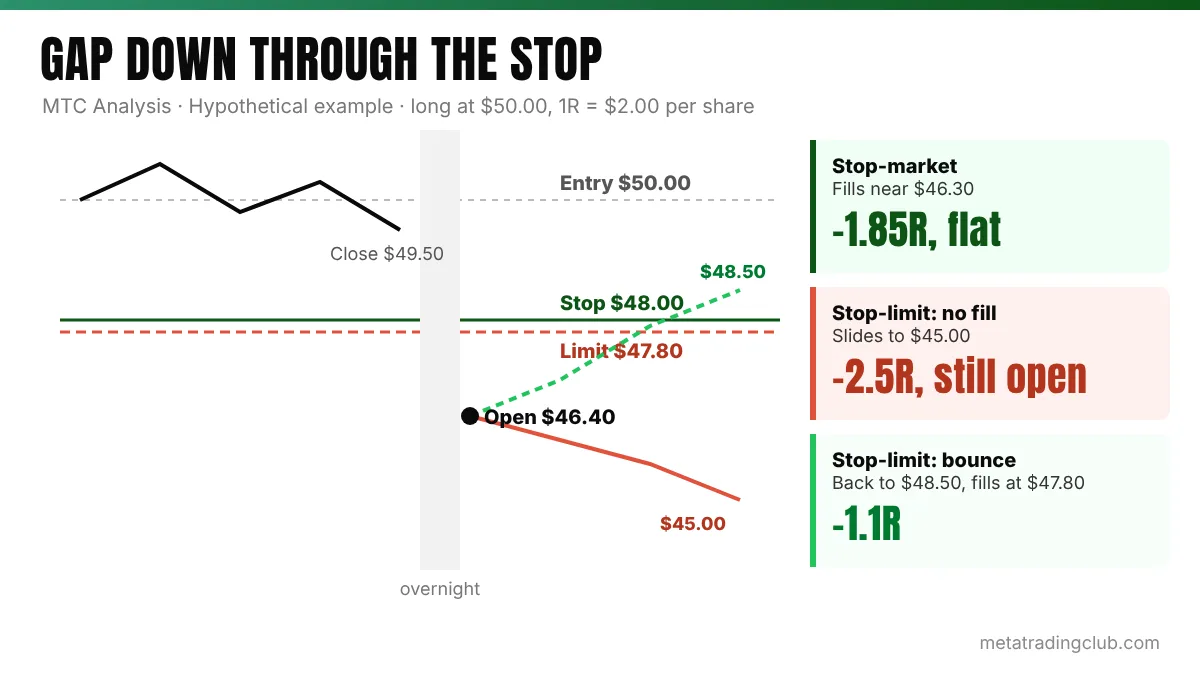
You are long a stock at $50.00. Your Zone sits just above $48, so the stop goes on the far side of it at $48.00. Risk per share is $50.00 − $48.00 = $2.00 = 1R. Shares are sized so that $2.00 per share equals your planned 1R.
The stock closes at $49.50. Overnight news hits, and it opens at $46.40, well under your stop.
- Stop-market at $48.00: it triggers on the open and fills near the open, say $46.30. Loss = $50.00 − $46.30 = $3.70 per share. $3.70 ÷ $2.00 = 1.85R. Painful, but you’re flat and the number is known.
- Stop-limit, stop $48.00, limit $47.80: it triggers on the open, but $46.40 is below your $47.80 limit. No fill. You are still long.
- If the stock slides to $45.00 by midday, the open loss is $5.00 per share = 2.5R, and still counting.
- If it bounces back to $48.50, your limit fills at $47.80 or better. Loss = at most $2.20 per share = 1.1R.
The stop-limit might come out ahead, but you don’t get to choose the branch. The stop-market turns a bad day into a known 1.85R. The stop-limit leaves it open with no floor.
Which should you use: stop-market or stop-limit?
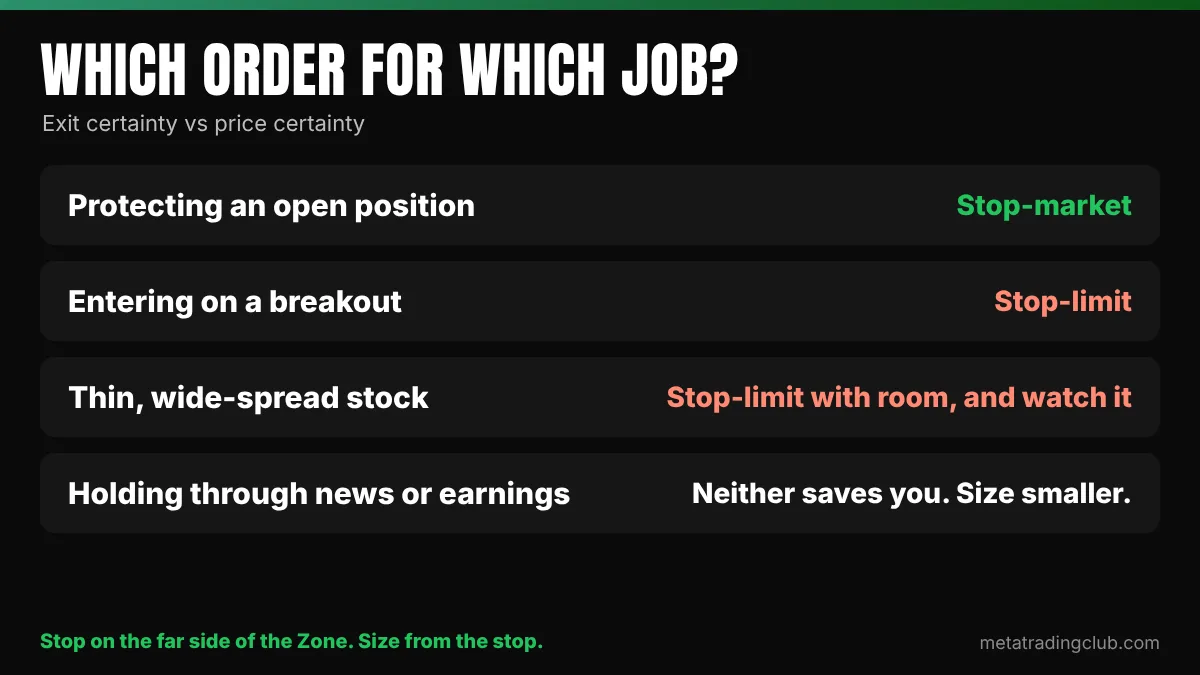
- Protecting an open position: stop-market. The job is to get out. A worse fill is a cost; staying in a falling trade can cost far more.
- Entering on a breakout (a buy stop above price): a stop-limit can stop you from chasing a spike. If it doesn’t fill, you simply don’t have the trade, which is usually fine.
- Thin, wide-spread stocks: a stop-market can fill far away from the last trade. A stop-limit with a sensible gap between stop and limit is one way to cap that, as long as you accept the no-fill risk and watch the position.
- Holding through earnings or overnight news: neither order protects you from a gap. The real control is position size, or not holding through the event.
If you use a stop-limit to protect a position, give the limit room below the stop and plan what you’ll do if it doesn’t fill.
How do brokers handle stop orders?
The order names are standard; the plumbing isn’t. Check these four things on your platform (checked November 2026; they can change):
- What triggers the stop. Investor.gov notes that some firms trigger stops off the last sale price and others off quotes. Fidelity says its equity stops trigger off a round-lot trade of 100 shares or more, or a print in the security.
- Time in force. A day order expires at the end of the session. Good-’til-canceled (GTC) orders last longer, but not forever: Schwab and Fidelity both put GTC at up to 180 calendar days. A stop that quietly expired is no stop.
- Extended hours. Schwab says only limit orders are accepted in its extended-hours sessions; market and stop orders are not. Fidelity says it accepts limit orders in extended hours, that all other order types are ineligible there, and that not all sessions are eligible for stop orders. In practice, a regular-hours stop usually waits for the open.
- Whether the order is accepted at all. Investor.gov points out that stop and stop-limit orders may not be available at every firm, and Fidelity notes that specialists and market makers can refuse stop orders under certain market conditions.
That third point matters most for gap risk: the stock can trade far below your stop in premarket while your stop waits for the opening bell.
The part most traders skip
The order type decides how you exit. Your position size decides how much it hurts when the exit is ugly.
A gap that costs 1.85R is survivable when 1R is a small slice of the account. Fix the size first, then pick the order.
Where should the stop go in the first place?
Picking the order type is the second question. The first is where the stop belongs. We teach stop placement inside the Alignment Engine, our 5-step process:
- Bias sets the direction we’re willing to trade.
- Zone marks the area where we expect buyers or sellers to show up.
- Reaction is what price actually does when it reaches the Zone.
- Confirmation is the evidence that the reaction is real.
- Execution is the entry, the stop and the size, decided together.
The stop goes on the far side of the Zone. For a long, that’s below it. If price trades through the whole Zone, the idea behind the trade is wrong, and that’s the honest place to be out. A stop inside the Zone gets hit by noise. Our guide on how to set a stop loss the right way goes deeper on this.
Then we size from the stop, never the other way around: shares = planned risk ÷ (entry − stop). The position size calculator does this math for you, and position sizing for day trading explains why it matters.
How we handle stops at Meta Trading Club
I’ve been trading for 8+ years, and since we founded Meta Trading Club in Toronto in November 2021 we’ve trained 600+ traders. The stop is one of the first things we fix.
In our premarket prep every market day, we mark the Zones before the open, so the stop location is known before any order is placed. In our live trading sessions (Monday, Tuesday, Thursday and Friday), the stop is part of Execution, not an afterthought. Setups that pass all 5 steps get a Qualification grade (A+, A or B), and that grade sets how much we risk on the trade. Results go into our track record in R, where 1R = 2% account risk, so a gap that costs 1.85R shows up as exactly that.
For more answers on this topic, our risk management FAQ covers 20 common questions.
No alignment, no trade.
Frequently asked questions
Sources: Investor.gov (SEC), Investor Bulletin: Stop, Stop-Limit, and Trailing Stop Orders; Charles Schwab, 3 Order Types: Market, Limit, and Stop Orders; Fidelity, General order types and Trading FAQs: Placing Orders. Broker rules checked November 2026.
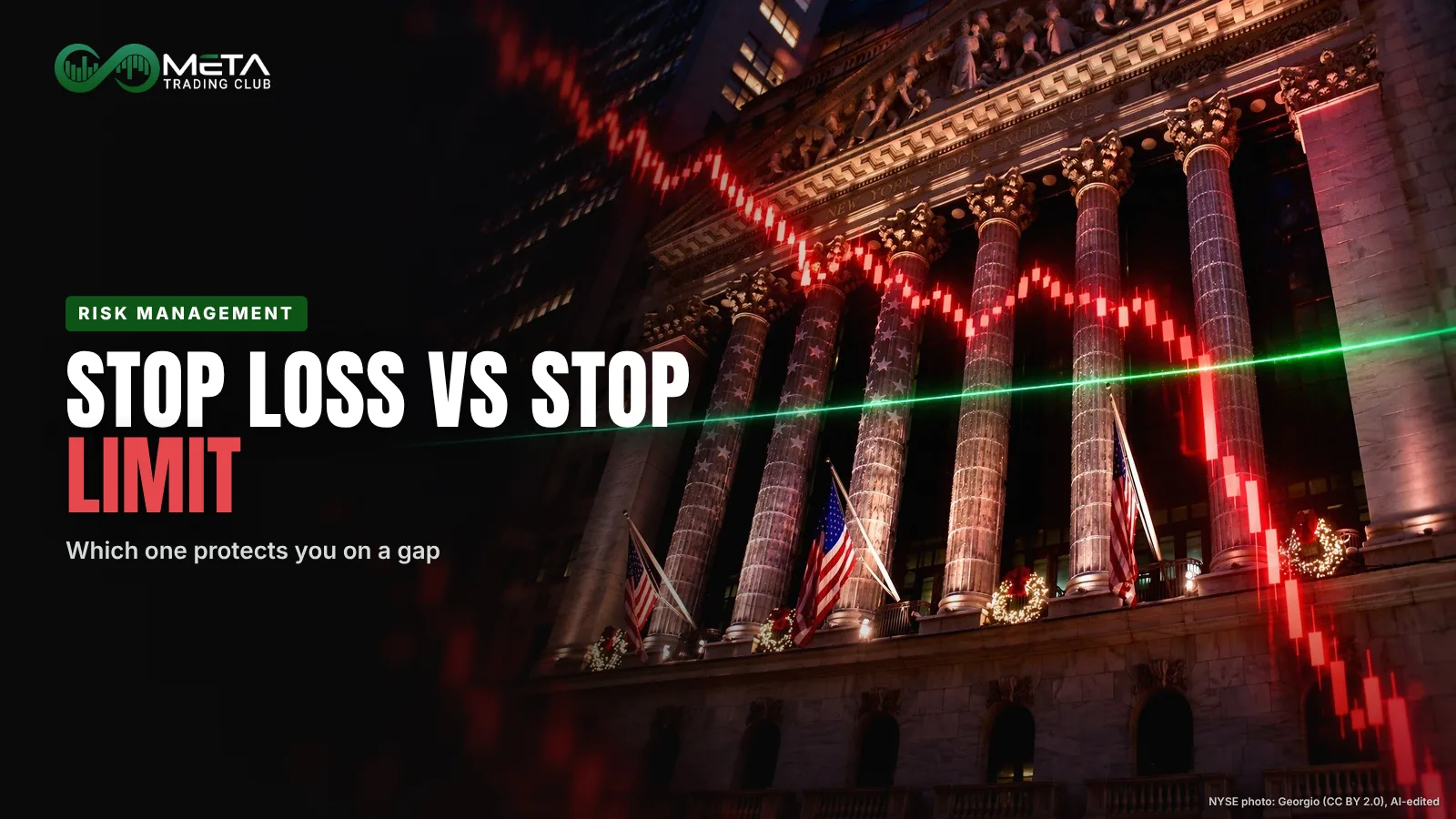
Featured image: AI-edited from a photo of the New York Stock Exchange at night by Georgio (Wikimedia Commons, CC BY 2.0).
Education only. Not financial advice.