
Futures vs options comes down to obligation versus right. A futures contract obligates both sides, and every point moves your P&L by the same dollars. An option gives the buyer a right, costs a premium up front, and pays in a curve. For a small active trader, contract size usually decides it.
Key takeaways
- Futures are an obligation with a straight-line payoff. Long options are a right with a capped loss (the premium) and a curved payoff.
- On the S&P 500, a 10-point move is worth $50 on one Micro E-mini and $500 on one E-mini. Options depend on delta.
- Futures were never under the pattern day trader rule. For securities margin accounts, FINRA replaced that rule effective June 4, 2026, with firms phasing in until October 20, 2027.
- In the US, regulated futures and broad-based index options like SPX can get 60/40 tax treatment under Section 1256. SPY options don’t.
Below: real contract specs, then a hypothetical example you can redo with your own numbers.
Futures vs options: what’s the actual difference?
A futures contract is an agreement to buy or sell something at a set price on a set date. Both sides are locked in. If you’re long one contract and the market drops, you lose on every point until you close it. There’s no premium to pay. Instead you post margin, a good-faith deposit your broker holds while the trade is open.
An option is a contract that gives the buyer the right, but not the obligation, to buy (a call) or sell (a put) at the strike price. The buyer pays a premium, and as the Options Industry Council puts it, the holder’s potential loss “is limited to the initial premium paid” (OIC). The seller takes the other side and is obligated if assigned. That’s where the open-ended risk sits.
Three differences matter most for a day trader:
- Payoff shape. Futures are linear. Long options are non-linear: small dollars per point far from the strike, more as the option goes in the money.
- Cost to enter. Futures need margin, not a purchase price. Long options cost the full premium, and that premium is the most you can lose on the trade.
- Time. A futures contract has no time decay in the option sense, though its price converges to the index as expiry nears. An option’s time value shrinks every day.
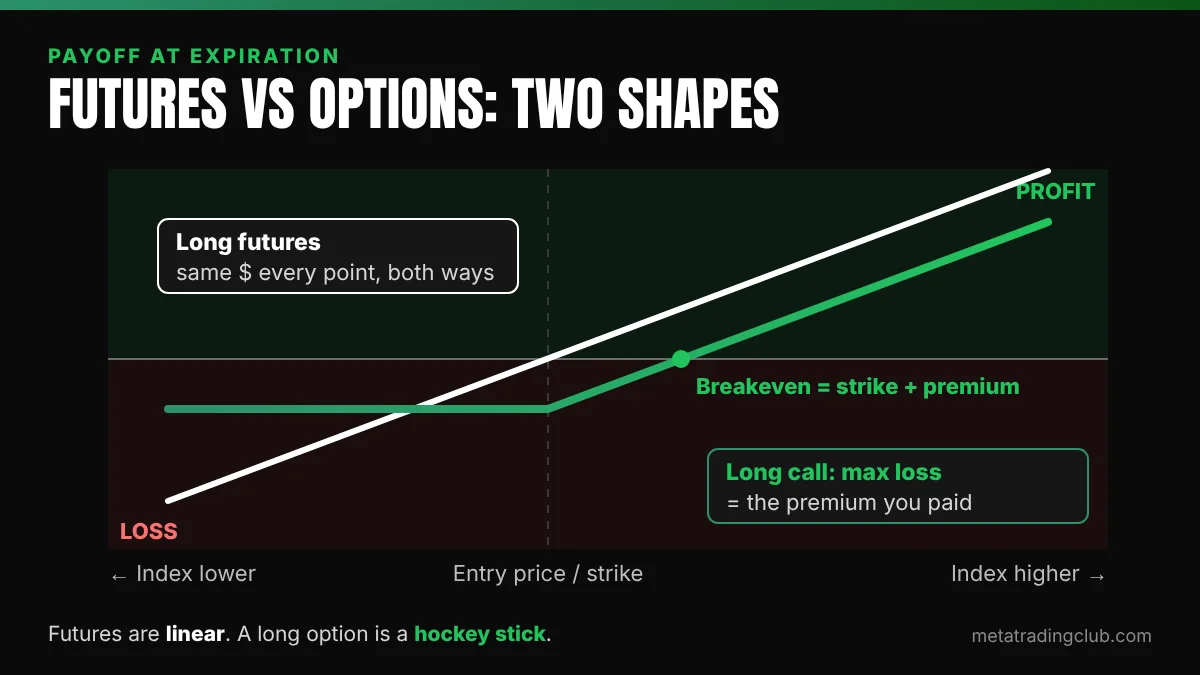
Below the strike, the long call is flat: you lose the premium and no more. Above it, the line rises, but the move has to cover the premium first. The futures line is a straight diagonal, both ways.
How do futures and options compare side by side?
Here’s the full picture, using S&P 500 products.
| Futures | Options (long or short) | |
|---|---|---|
| What you hold | A contract to buy or sell the index at a set price on a set date | The right to buy (call) or sell (put) at the strike price |
| Obligation | Both sides are obligated | Buyer has a right, not an obligation; the seller is obligated if assigned |
| Cost to get in | Performance margin (a good-faith deposit), not a purchase price | Buyer pays the full premium up front |
| Payoff shape | Linear: every point is worth the same dollars | Non-linear: dollars per point change as the option moves (delta) |
| Max loss | Not capped at your deposit; a fast move can cost more than the margin | Buyer: the premium paid. Seller: can be much larger |
| Time decay | None in the option sense; contracts expire and get rolled | Time value shrinks every day, which works against the buyer |
| Leverage | High: a small deposit controls the full contract value | Built in, and it changes with the strike, time left and price |
| Trading hours | Sunday to Friday, 5:00 p.m. to 4:00 p.m. CT, daily halt 4:00 to 5:00 p.m. CT | SPX: 9:30 a.m. to 4:15 p.m. ET, plus global hours 8:15 p.m. to 9:25 a.m. ET |
| Day-trading rules | Never under FINRA’s pattern day trader rule | Securities margin accounts: PDT rule replaced by an intraday margin standard (see below) |
| Contract size (S&P 500) | Micro E-mini: $5 × index. E-mini: $50 × index | SPX: $100 × index. SPY: 100 shares, about 1/10 of SPX |
| US tax note | Regulated futures: Section 1256, 60/40 | SPX: Section 1256, 60/40. SPY options: standard capital gains rules |
Checked November 2026. Futures specs and hours: CME Group’s Micro E-mini FAQ and equity index futures page. SPX specs and hours: Cboe’s SPX specifications and SPX fact sheet. SPY vs SPX: Cboe’s S&P 500 product comparison. Hours and specs can change, so confirm on the exchange page before you trade.
SPX and SPY options are not the same product. SPX is cash-settled and European-style (exercise only at expiration) (Cboe). SPY options are American-style and settle in shares. The OCC confirms index options settle for cash at $100 times the index level (OCC).
How much does a 10-point S&P 500 move pay on each contract?
This is the part that decides it for most small accounts. CME Group lists the Micro E-mini S&P 500 at $5 × the index and the E-mini at $50 × the index, with Micros at 1/10 the size of their E-mini counterparts (CME Group FAQ; CME Group). A Micro moves in 0.25-point ticks worth $1.25 each. SPX options use a $100 multiplier, and one SPY contract is about 1/10 the size of one SPX contract (Cboe).
MTC Analysis · Hypothetical example
The same 10-point move on four contracts
Assumptions (made up for illustration): the S&P 500 sits at 6,000 and moves 10 points, to 6,010. SPY is treated as roughly 1/10 of the index, so about $600, moving about $1. For the options, we assume an at-the-money call with a delta of 0.50, which means it moves about half as much as the underlying.
- Micro E-mini (MES): 10 points × $5 = $50. Contract value: $30,000.
- E-mini (ES): 10 points × $50 = $500. Contract value: $300,000.
- One SPY call: about $1 × 100 shares = $100 of exposure; at a 0.50 delta, about $50.
- One SPX call: 10 points × $100 = $1,000 of exposure; at a 0.50 delta, about $500.
In R terms: say your plan puts the stop 10 points away. On MES, that stop costs $50 per contract, so you can size up or down in $50 steps until the loss at the stop equals 1R. On ES, the smallest possible step is $500. If your 1R is smaller than that, one ES contract is already too big for the setup.
The option numbers are rough. Delta changes as price moves, and time decay keeps working against the buyer, so a real option won’t track these figures exactly.
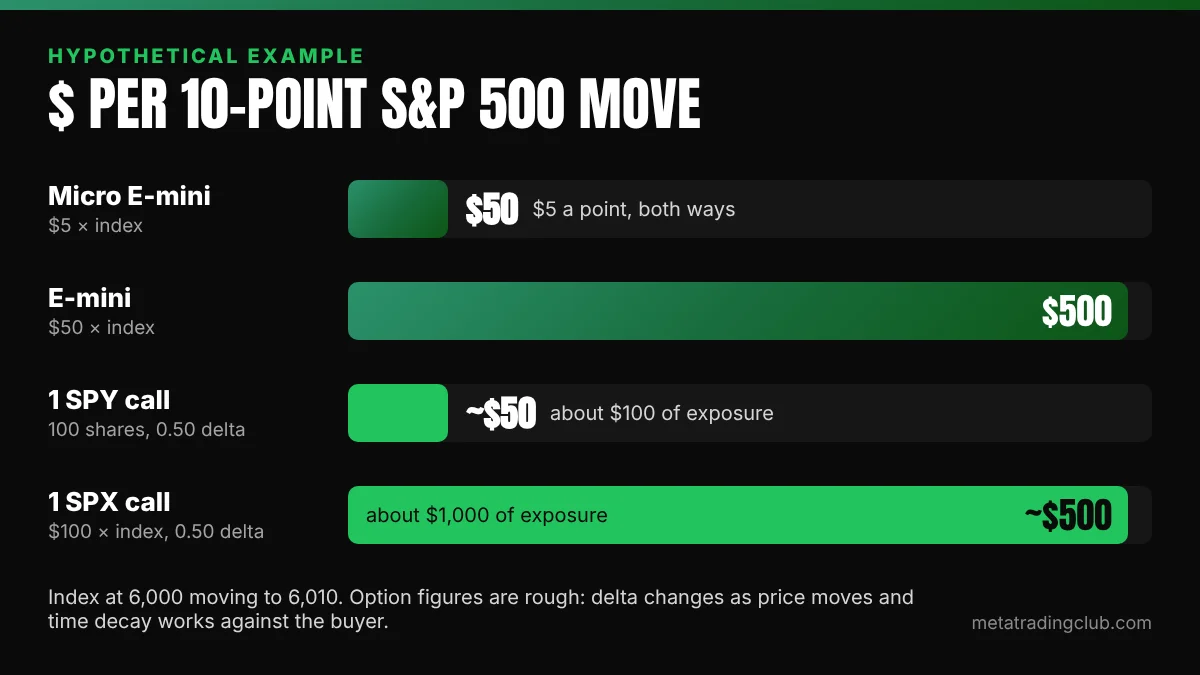
MES and one SPY call land close here. The difference: MES keeps paying or costing $5 a point with no cap, while the SPY call can’t lose more than its premium but bleeds value as time passes.
If you want to work the contract count from your own stop distance, our position sizing guide for day traders walks through the math step by step.
Does the pattern day trader rule apply to futures or options?
Futures never fell under the pattern day trader (PDT) rule. That rule sat in FINRA Rule 4210, the margin rule for securities accounts at broker-dealers. Futures accounts run on exchange-set performance margin.
Options in a securities margin account were covered. FINRA Regulatory Notice 26-10 amended Rule 4210 to remove the day trading margin requirements, including the pattern day trader designation and its $25,000 minimum equity, and replaced them with a new intraday margin standard. In FINRA’s words, the new rule “replaces the outdated requirements in their entirety.” It took effect June 4, 2026, and firms that need more time can phase it in until October 20, 2027 (FINRA Notice 26-10). Ask your broker which rules apply to your account today.
Canadian brokers aren’t FINRA members, so the US rule doesn’t bind them directly. For the full history and what the change means in practice, read our pattern day trader rule explainer.
How are futures and options taxed?
US traders: Section 1256 of the tax code treats gains and losses on regulated futures contracts and “nonequity options” as 60% long-term and 40% short-term, no matter how long you held them (26 U.S.C. § 1256). Broad-based index options like SPX can qualify, and Cboe notes that SPX gains and losses may get this 60/40 treatment (Cboe). You report them on IRS Form 6781. SPY options fall under the standard short- and long-term rules instead (Cboe). General information, not tax advice.
Canadian traders: none of that applies; the CRA has its own rules, covered in our guide to day trading taxes in Canada.
Which one fits a small active trader?
Here’s how I’d think it through:
- If you want simple, linear risk and long trading hours, Micro E-mini futures fit well. $5 per point, clean stop math, no time decay. The catch: losses aren’t capped at your deposit.
- If you want a hard cap on what any single trade can cost, long options give you that. The premium is the max loss; you pay for it with time decay.
- Trading from Canada? Our guide to trading options in Canada, including inside a TFSA covers which accounts allow what.
New to futures entirely? Start with our futures starter guide before you put money on a Micro contract.
Does the Alignment Engine change between futures and options?
Same chart, different math
We read the S&P 500 the same way whether the trade ends up in MES or an SPX option. The Alignment Engine runs in five steps, in this order:
- Bias: which way is the bigger picture leaning?
- Zone: where on the chart do we expect a reaction?
- Reaction: does price actually respond there?
- Confirmation: does the follow-through agree with the bias?
- Execution: now, and only now, pick the instrument and size it.
The Zone and the Confirmation don’t change. Step five does. With futures, Execution means stop distance × $ per point × contracts = 1R. With a long option, it means the premium you pay is your risk, and you also need the move before time decay eats the trade.
How we teach this at Meta Trading Club
We at Meta Trading Club have trained 600+ traders since we started in Toronto in November 2021. I’ve been trading for 8+ years.
Our answer is always the same: the setup comes first. In our premarket prep every market day, we mark the Zones on the index before anyone talks about contracts. In our live trading sessions (Monday, Tuesday, Thursday and Friday), setups that pass all five steps get a Qualification grade of A+, A, B and so on, and the grade sets how much risk the trade is allowed. Only then do we convert that risk into contracts. We log the track record in R: 1R on MES and 1R on an SPX option are the same 1R.
If you want to see how the five steps fit together first, our free lesson is a good starting point.
Frequently asked questions
Sources: CME Group, Micro E-mini Equity Index Futures FAQ; CME Group, S&P 500 and Nasdaq-100 futures; Cboe, SPX options specifications; Cboe, SPX fact sheet; Cboe, S&P 500 index options product comparison; OCC, index options; Options Industry Council, options basics; FINRA Regulatory Notice 26-10; IRS Form 6781; 26 U.S.C. § 1256 (Cornell LII). Checked November 2026.
Featured image: AI-edited from “Chicago Board of Trade Building” by Ken Lund (CC BY-SA 2.0, Wikimedia Commons); the edit is shared under CC BY-SA 2.0.
Education only. Not financial advice. General information, not tax advice.