
Prop firm drawdown rules decide more evaluations than any strategy ever will. Understand how static, trailing, and daily limits actually calculate — and the math stops ending your account.
Most people who fail an evaluation never truly understood the prop firm drawdown rules they agreed to. They saw a profit target and traded toward it, while the limit that actually ended their account — the maximum loss line — moved in ways they didn’t expect. The drawdown rule is the single most important number in any funded program, and it comes in a few distinct flavors that behave very differently. Get the mechanics right and you trade with a clear, fixed boundary. Get them wrong and the account closes on a trade you thought was fine.
What Are Prop Firm Drawdown Rules?
A drawdown rule is the maximum amount your account is allowed to lose before the firm shuts it down. It’s how a prop firm caps its own risk while letting you trade their capital. There are two layers almost every program uses: a maximum (overall) drawdown that governs the whole account, and a daily drawdown that limits how much you can lose in a single day. Break either one, even by a dollar, and the evaluation is usually over instantly. The prop firm drawdown rules are not a suggestion or a soft warning — they are a hard, automated line. That’s exactly why they deserve more study than your entry strategy does. For the wider picture of how these fit alongside profit targets, consistency, and payout rules, start with funded account rules explained.
Got a quick question? Our Prop Firm FAQ answers 19 common questions on funded accounts, drawdown rules, payouts and taxes.
Static vs Trailing Drawdown: The Difference That Trips Everyone
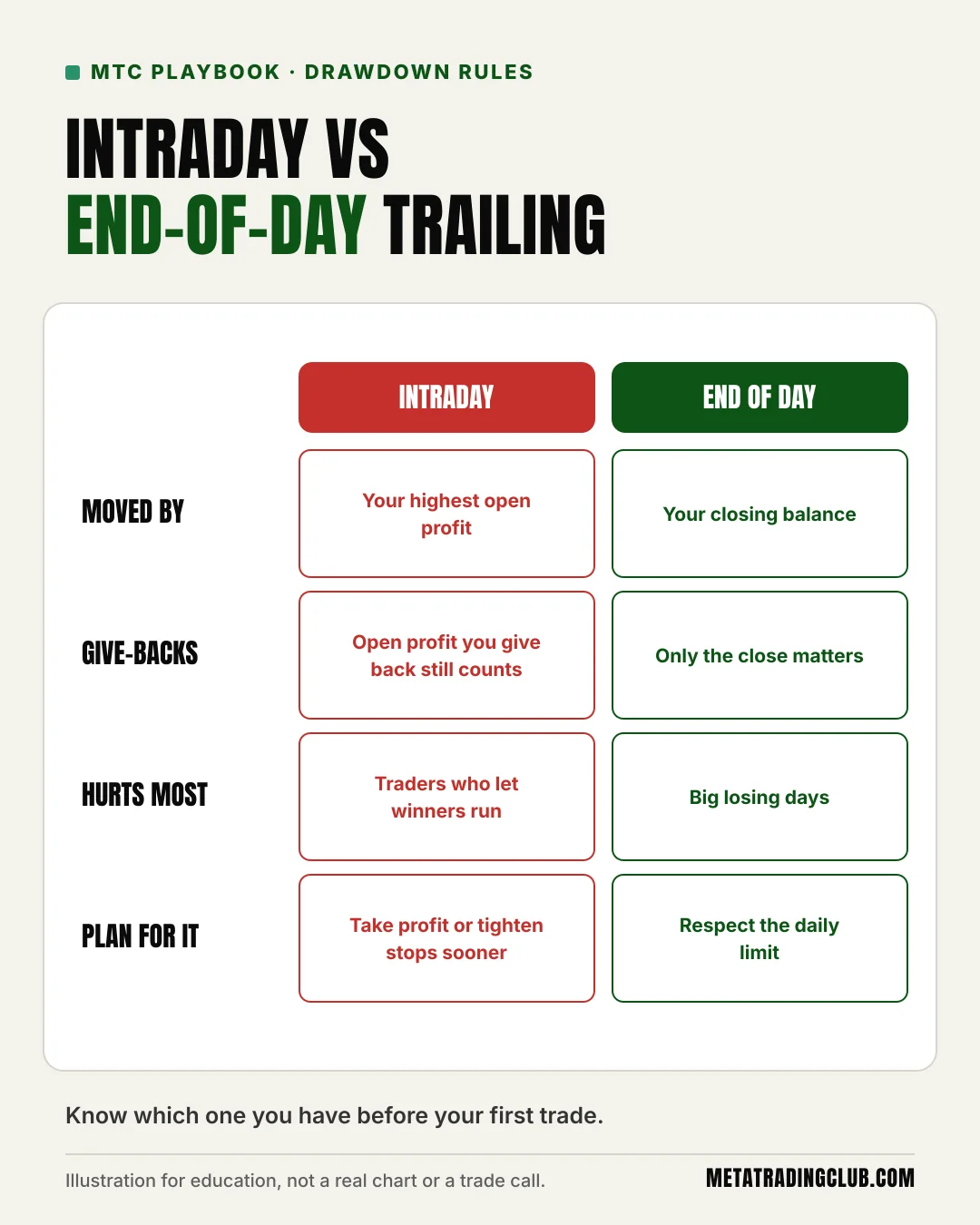
The biggest source of blown accounts isn’t the size of the drawdown — it’s not knowing whether it’s static or trailing. A static drawdown sets the loss line at a fixed dollar amount below your starting balance and never moves it. A trailing drawdown follows your account equity upward as you make profit, which means the line that ends your account rises with every new high — and in some programs, it trails your peak unrealized equity, not just your closed balance. Two traders with the same strategy can have completely different outcomes purely because one understood which model applied and one didn’t.
| Drawdown type | How the line moves | What catches people out |
|---|---|---|
| Static | Fixed below starting balance, never moves | Simplest, but gives no buffer once in profit |
| Trailing (closed balance) | Rises with your closed, realized balance | Giving back profit can still breach it |
| Trailing (intraday equity) | Follows your highest unrealized equity peak | An open winner you let pull back can breach it |
| Daily loss limit | Resets each day from that day’s start | Stacks on top of max drawdown — both apply |
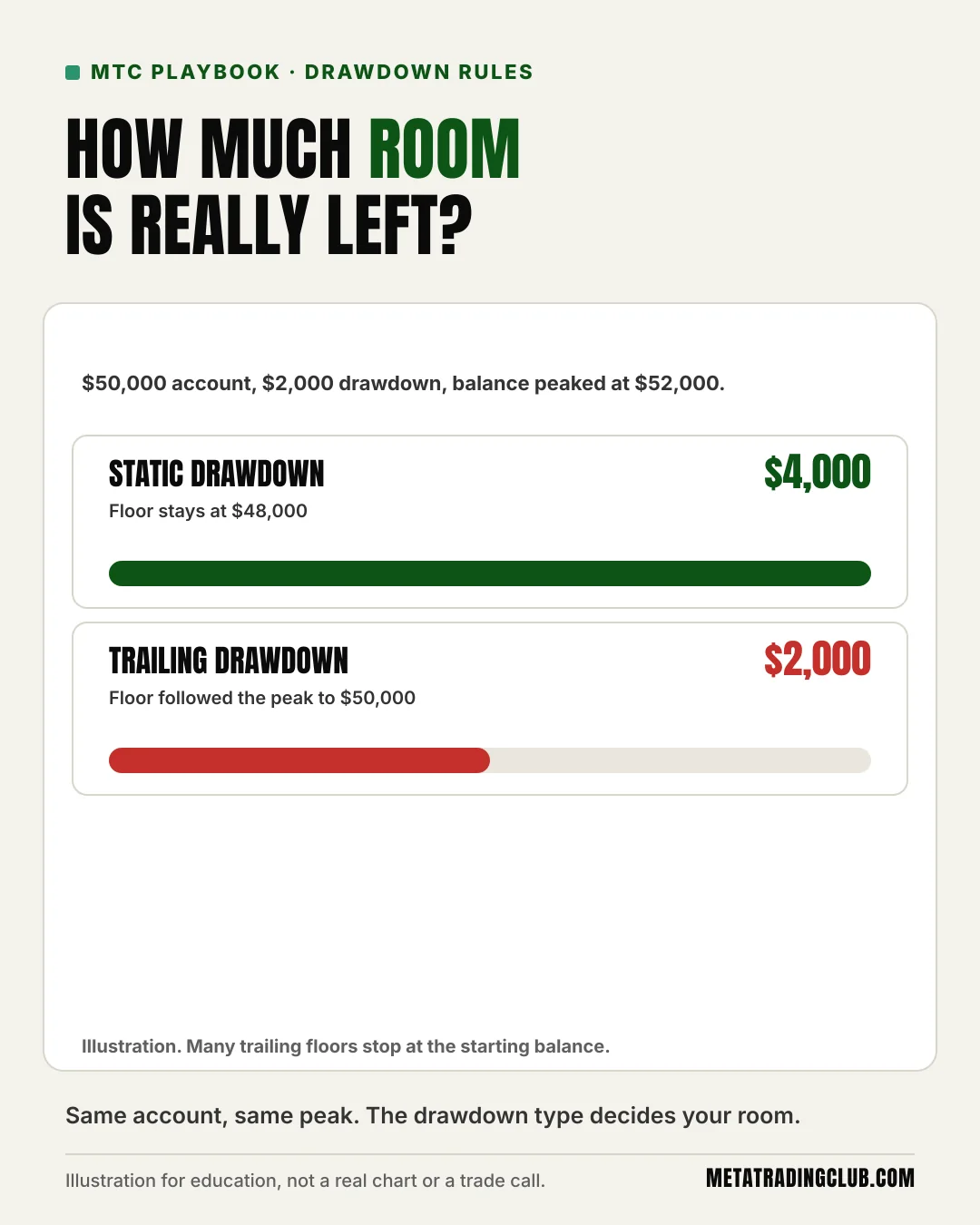
Here’s a concrete example. Say you have a $50,000 account with a $2,000 maximum drawdown. Under a static rule, your account closes if the balance ever hits $48,000 — full stop, no matter how high you climb first. Under a trailing rule, if you grow the account to $53,000, the loss line has trailed up to $51,000, so you now only have room to fall $2,000 from the new peak before breaching. That’s the trap: traders feel ‘up $3,000, I have plenty of room,’ when in reality a trailing rule has quietly tightened the leash. The intraday version is harsher still — it can trail an open position’s unrealized high, so a winner you let round-trip back to breakeven can end the account even though your closed balance never dropped.
MTC Analysis
Static vs Trailing on a $50K Account
The trader ‘up $3,000’ under a trailing rule has less cushion than when they started, not more. That mismatch between feeling and math is where accounts die.
Daily Loss Limits and Consistency Rules
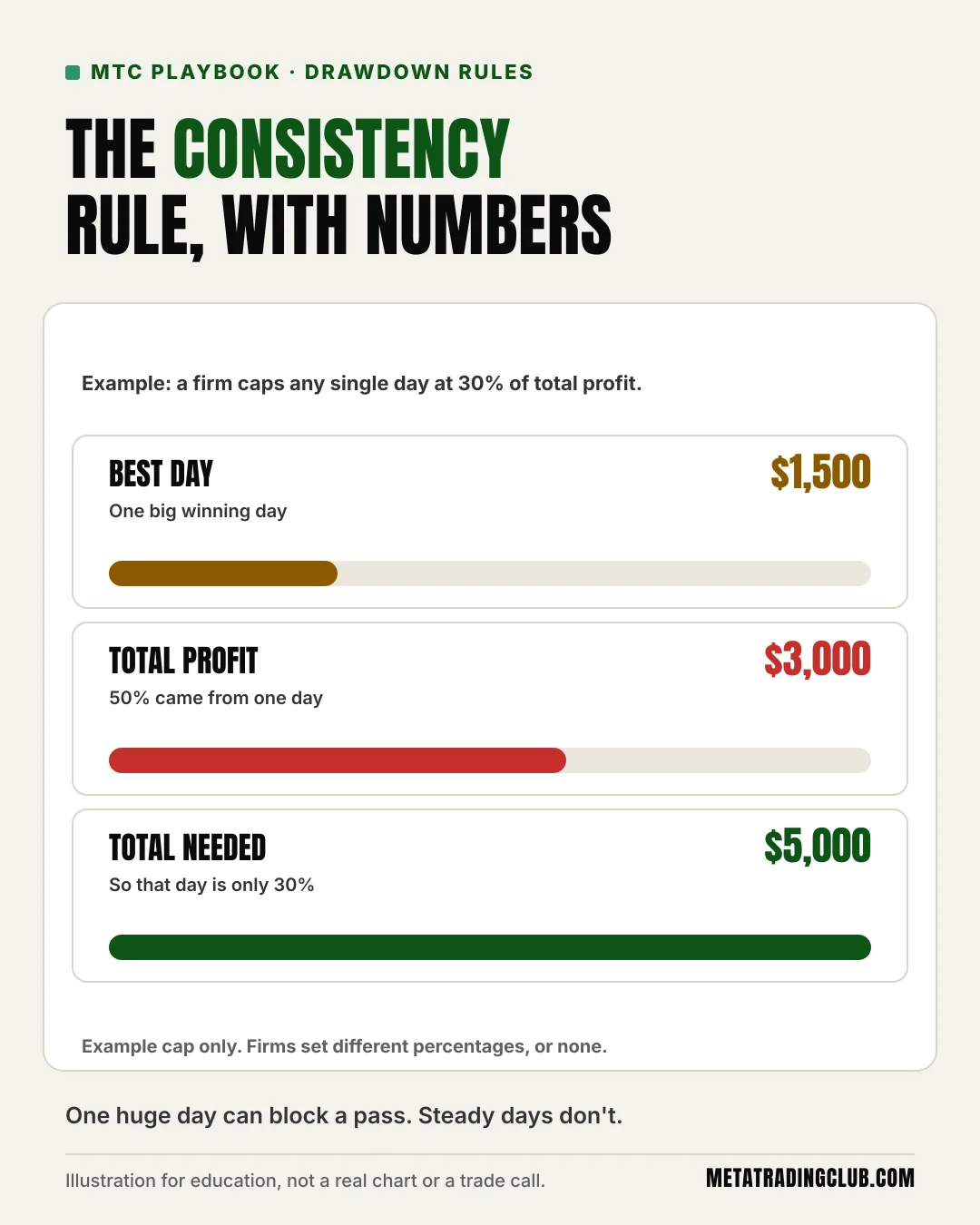
On top of the overall drawdown, most firms run a daily loss limit — a cap on how much you can lose in a single trading day, measured from that day’s starting balance and reset each morning. It exists independently of the max drawdown, so you can be nowhere near your overall line and still fail the account by having one bad day. Many programs also enforce a consistency rule: no single day’s profit can make up more than a set percentage of your total gains. That rule quietly kills the ‘one lucky home run’ approach — the firm wants to see repeatable skill, not a single outlier that passed the target by accident. Both rules reward the same thing: steady, sized-down trading instead of swinging for the fences.
The practical takeaway is that your position size has to be set against the tightest rule in play, not the loosest. If your daily limit is $1,000, your per-trade risk and trade count both have to fit inside that number with room to spare — a single oversized trade that hits a stop can end the day, and a trailing rule can mean the overall line is tighter than the daily one once you’re in profit. The traders who pass size so small that no single rule is ever in real danger. It feels slow. That’s the point.
MTC Analysis
Where Drawdown Discipline Lives in the Process
Drawdown survival is decided at Execution — the phase where position size is set against the tightest rule in play. Get sizing right there and the drawdown line never gets close.
Get the free challenge risk checklist
DM us the keyword RISK on Instagram @metatradingclub and we’ll send over the sizing worksheet free.
How to Trade Inside the Drawdown Rules
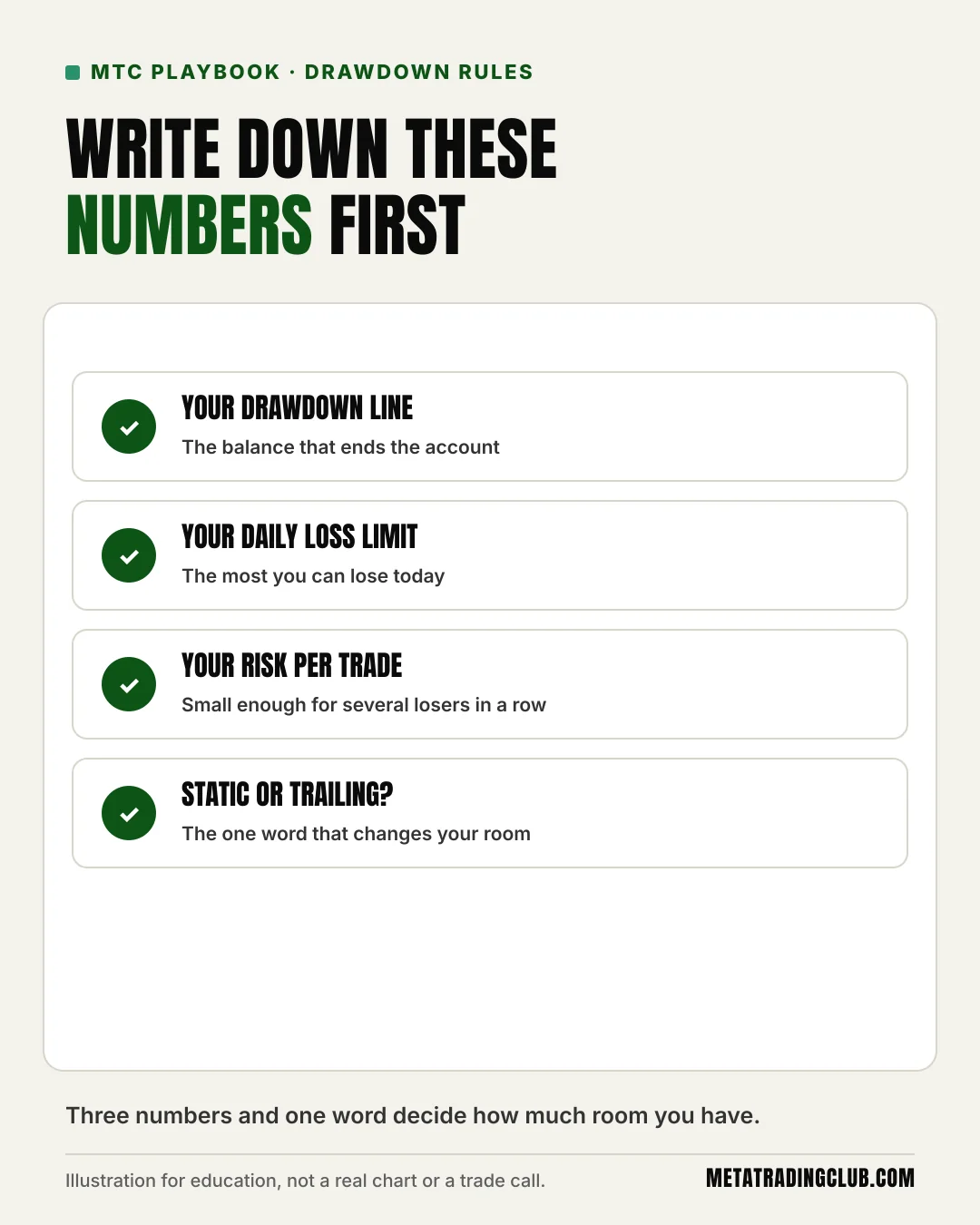
Once the mechanics are clear, the discipline is simple to state and hard to do. Read the rule sheet and write down three numbers before you place a trade: your overall drawdown line, your daily loss limit, and your per-trade risk. Confirm whether the overall rule is static or trailing, because that one word changes how much room you really have as you climb. Then size so that a normal losing streak — say three or four stops in a row — still leaves you comfortably inside both limits. This is the same discipline that separates traders who get funded from those who don’t, and it’s the exact failure pattern we covered in common reasons traders fail prop firm challenges. The rules aren’t the enemy. Not knowing them is.
Educational content only. Nothing here is financial advice or a promise of results. Prop firm rules vary by program — always confirm the exact terms with your firm. Trading involves substantial risk of loss.