In Canada, your day trading profits are taxed one of two ways: as capital gains or as business income. Which one you fall under can roughly double your tax bill. There’s no checkbox to pick — the CRA decides based on how you trade.
Here’s how it works, and what to do about it.
This is for Canadian residents. For US rules, see our US day trading tax guide.
Capital gains vs business income
| Capital gains | Business income | |
|---|---|---|
| How much is taxed | 50% of the gain | 100% of the profit |
| Losses | Only offset capital gains | Offset any income |
| Where you report it | Schedule 3 | Form T2125 |
| Who it usually fits | Occasional traders, longer holds | Frequent, short-term, systematic traders |
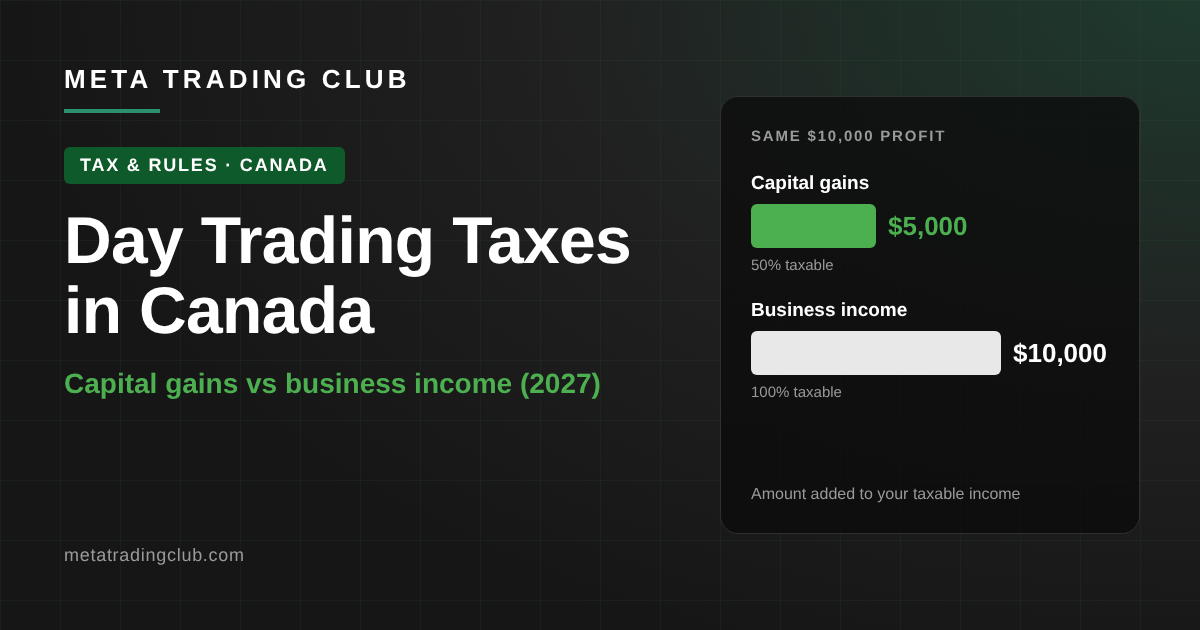
Same $10,000 profit, two tax treatments
How much gets added to your taxable income
Your actual tax depends on your marginal rate and province.
Quick example: you make $10,000 trading this year. As capital gains, $5,000 gets added to your income. As business income, the full $10,000 does. Same trades, double the taxable amount.
The inclusion rate is still 50%. The proposed increase to two-thirds was cancelled in 2025 (Stephenson Harwood), so ignore older articles that say otherwise.
What happened to the capital gains hike
- Jun 2024Hike to two-thirds proposed
- Jan 2025Delayed to Jan 1, 2026
- 2025Cancelled
- 2027Still 50%
Articles quoting a 66.67% rate are out of date.
How the CRA decides
The CRA looks at the full picture. No single factor decides it:
- How often you trade
- How long you hold positions
- Your knowledge and experience
- Time spent researching and watching the market
- Whether you use margin or borrowed money
- Whether trading looks like your job
If you day trade most mornings with a system, expect it to be treated as business income. Plan for that instead of hoping for capital gains.
Losses: the part that can help you
- Business income: trading losses can reduce your other income, like your salary.
- Capital gains: losses only offset capital gains. Unused losses can be carried back 3 years or forward indefinitely (CRA).
Watch the superficial loss rule. If you sell at a loss and buy the same stock back within 30 days before or after the sale, the capital loss is denied for now (TaxTips.ca). It gets added to your cost base instead. Day traders trip this constantly.
The 61-day superficial loss window
Buy the same stock back anywhere in the band and the capital loss is denied for now.
Applies to capital losses. The denied loss is added to your new cost base.
Day trading in a TFSA is not a tax shelter
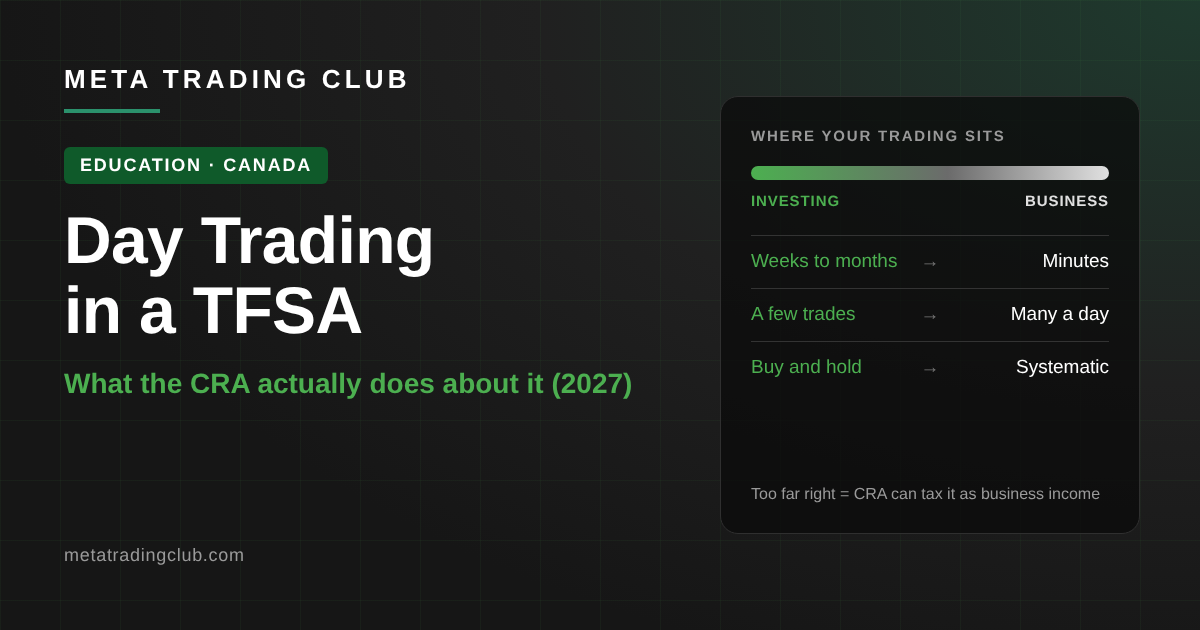
If the CRA decides your TFSA trading is a business, the profits get taxed — and you’re personally liable for that tax. Full breakdown: Day Trading in a TFSA.
What to keep for tax time
- Your broker’s annual tax slips and full trade history
- A trade journal with dates, entries, exits and size
- Expenses, if you’re treated as a business (data, platforms, education may be deductible — confirm with your accountant)
- CAD conversions for US trades, using the exchange rate on each trade date
Once trading becomes a real part of your income, get an accountant who works with traders. It pays for itself.
Trade like a business either way
The traders who handle taxes well usually handle trading well too. They keep records, they size positions on purpose, and they follow a process.
That’s the idea behind the MTC Alignment Engine™, the 5-step system we’ve used to train 600+ traders. Our guide walks you through it.
Frequently asked questions
Is day trading legal in Canada?
Yes. Canada has no pattern day trader rule. If you trade US stocks through a US-clearing broker, US rules can apply — but FINRA replaced the PDT rule and its $25,000 minimum effective June 4, 2026, with firms allowed to phase it in until October 20, 2027 (FINRA Notice 26-10). Check your broker’s current policy.
Is day trading taxed as capital gains or income in Canada?
It depends on how you trade. Frequent, short-term, systematic trading is usually business income. Occasional trading can be capital gains.
What’s the capital gains inclusion rate in 2027?
50% under current rules. The proposed increase to two-thirds was cancelled.
Can I deduct day trading losses in Canada?
Yes. Business losses reduce other income. Capital losses only offset capital gains, and can be carried back 3 years or forward indefinitely.
Do I pay tax on day trading in a TFSA?
You can, if the CRA treats it as a business. See Day Trading in a TFSA.
Education only. Not financial advice. General information, not tax advice. Tax rules change; confirm with a qualified professional.