Friday, November 13, 2026 · 5:00 PM ET · Shahryar Rahmani, MTC Desk
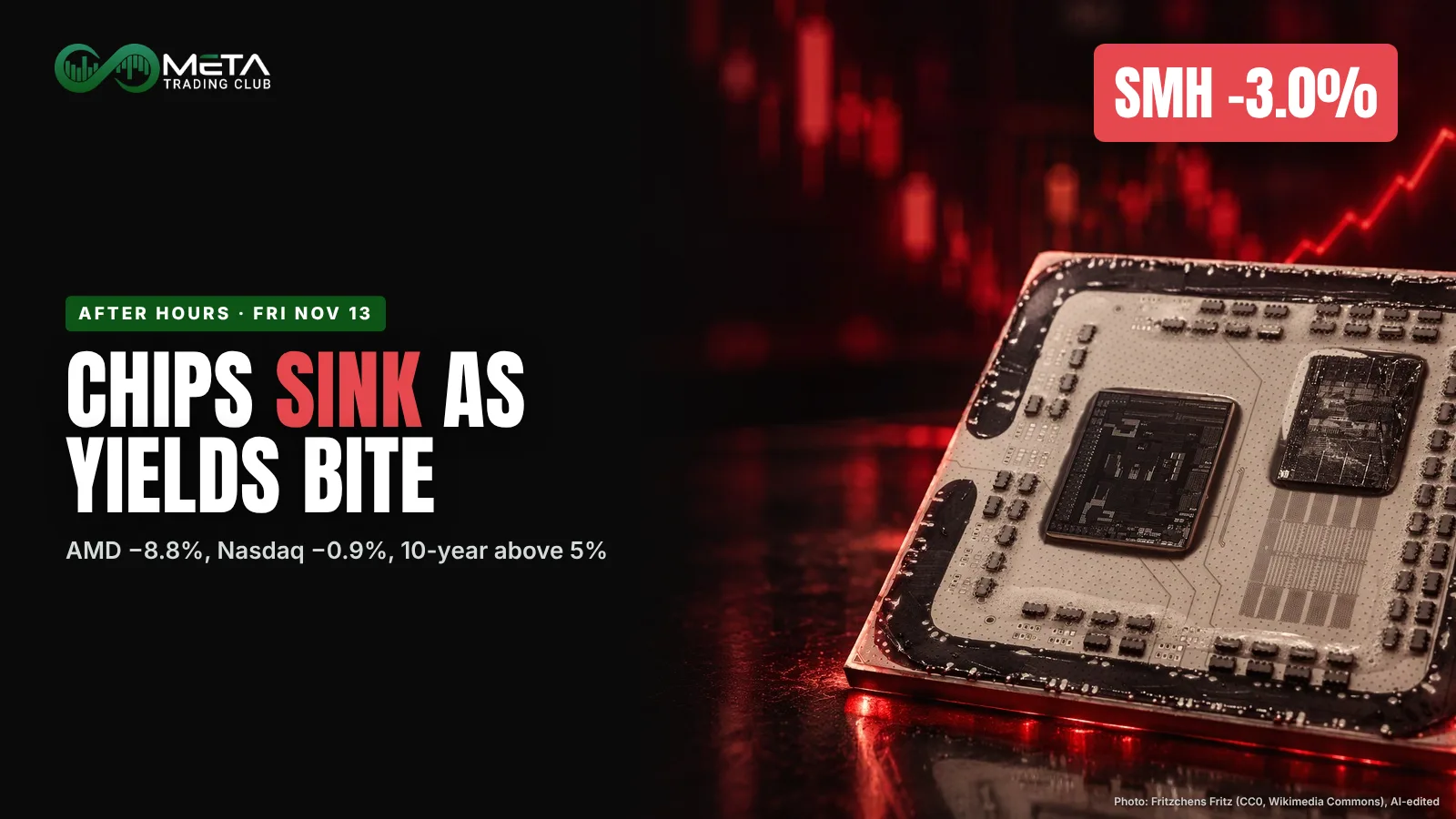
Chip stocks fall hard to end the week, and the Nasdaq loses 0.91%. AMD dropped 8.75%, Broadcom −4.76% and the chip ETF (SMH) −2.99%, as worries over Nvidia’s leadership spread through the group and the 10-year Treasury yield stayed above 5% (Motley Fool; StockStory). Even Cisco, a day after a record quarter, fell 6.24%.
Read the episode
Hey, I’m Shah, your host, and this is MTC Radio.
Okay, so chips got hit hard to end the week. AMD was down almost nine percent, Broadcom down almost five, and the whole chip group lost about three percent. And remember, yesterday AMD was up almost six percent. Today it gave all of that back and more.
Now, there were really two things weighing on it. The worry around Nvidia’s leadership after Jensen Huang stepped down is spreading through the whole group. Nvidia itself was down about two percent today, and it reports earnings next Tuesday after the close. And then the ten-year stayed above five percent all day, closing around five point one five. And when yields are that high, the stocks priced on profits far in the future, basically tech and chips, feel it first.
Cisco was a good example of how tough the tape was. Yesterday they reported a record quarter, revenue up twenty four percent, and they raised the outlook for the year. The stock was up close to six percent after hours. Today it closed down more than six percent. The one soft spot in the report was margins, a bit lower than a year ago. So a beat and a raise, and it still got sold with the rest of tech.
On the data side, producer prices for October came in at three tenths of a percent for the month, a little cooler than expected. But from a year ago they’re up six and a half percent, the fastest pace since late twenty twenty two. And that yearly number is what the bond market is watching.
So for the indexes, the Nasdaq was down about nine tenths of a percent, the S&P 500 down about four tenths, and the Dow was actually up a little, because money moved into the safer corners. Consumer staples were up more than one percent, and six of the eleven sectors finished green. Tech was the worst, down about two percent, and tech is the biggest weight in the index, so it pulled the S&P lower. And even with today, the S&P 500 was up about two and a half percent for the week, the first green week since early October.
Now, this morning on Spy we had seven fifty three and a half to seven fifty five as the lower zone. Spy opened around seven fifty nine, topped in the first minute, then slid right into that zone and broke through it around ten o’clock. No reaction at all. It bottomed just under seven forty eight, then slowly ground back up all afternoon and closed right back inside the zone, around seven fifty four. Q Q Q, same story. It broke the six seventy nine and a half to six eighty one zone around ten, bottomed around six seventy one and a half, and got back into the zone by about two fifteen. So no reaction on the first test means nothing to confirm. When a zone breaks like that, the break itself is the information.
In the live room we traded that breakdown with Nvidia puts and a Q Q Q short, and both closed green. And the lesson I gave everyone for the weekend, winning streaks are more dangerous than losing streaks. Reset, and start next week fresh.
For Monday on Spy, I’m watching seven fifty eight and a half to seven sixty up top, that’s today’s opening high, and seven forty seven and a half to seven forty nine below, that’s today’s low. On Q Q Q, six eighty six and a half to about six eighty nine above, and six seventy one and a half to six seventy three below. We’ll see if we reject these or break them. And the big one next week is Nvidia earnings on Tuesday after the close.
So yeah, that’s what I’m watching. If you want to trade it with us, we’re live Monday, Tuesday, Thursday and Friday in the community. Have a good weekend, and see you there.
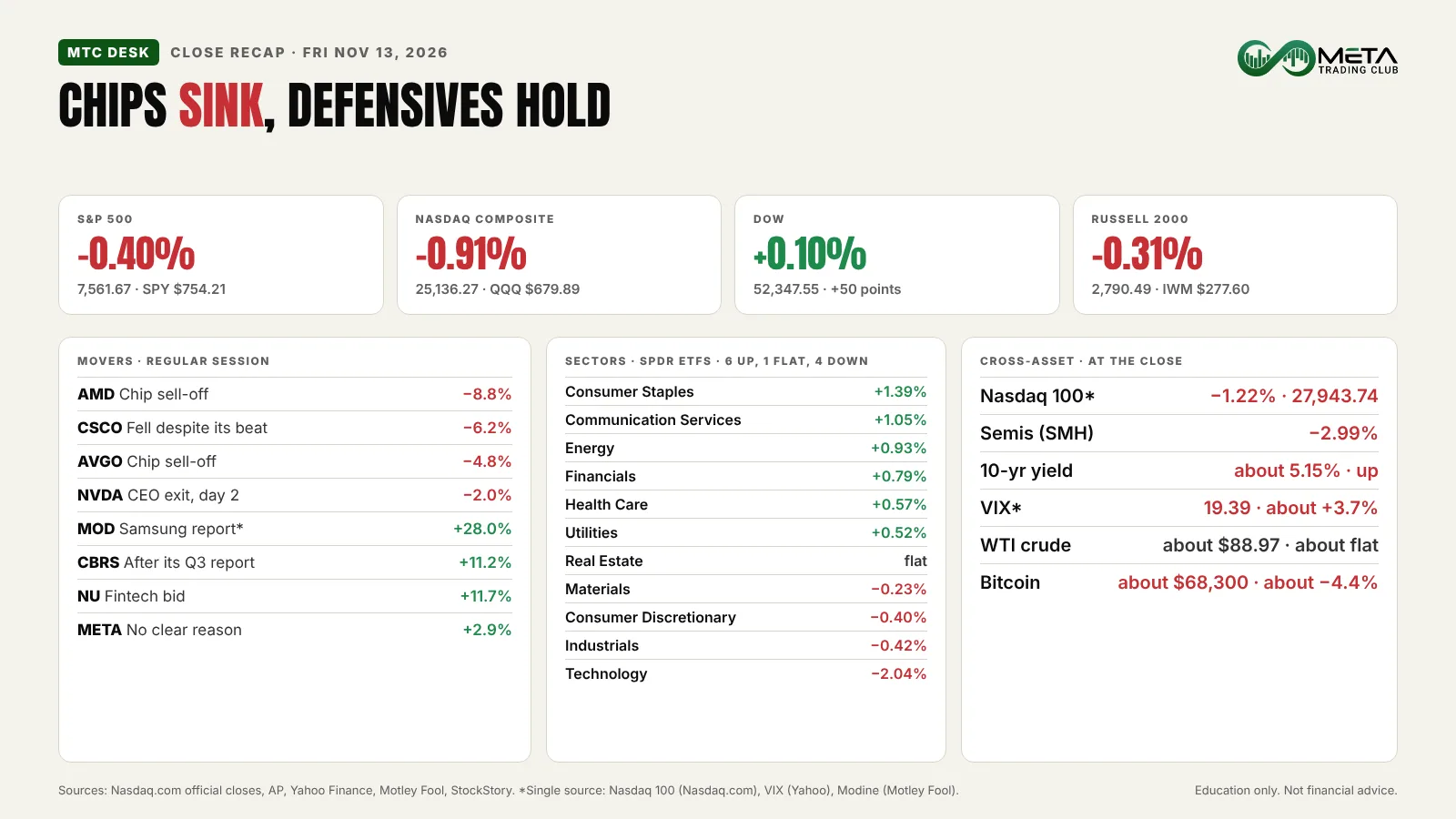
The Nasdaq Composite lost 0.91% and the S&P 500 −0.40% to 7,561.67, while the Dow edged up 0.10% (AP). Money moved into the safe corners: six of 11 sectors rose, led by Consumer Staples (+1.39%).
The backdrop: October producer prices rose 0.3% on the month, a little cooler than forecast, but 6.5% from a year ago, the fastest since November 2022 (BLS via RTTNews). Even so, the S&P 500 finished the week up 2.5%, its first winning week since early October (AP).
The Closing Bell
Index levels are from the Associated Press, checked against Yahoo Finance and Nasdaq.com; ETF closes are official 4:00 PM ET prints from Nasdaq.com.
| Index | Close | Change | ETF |
|---|---|---|---|
| S&P 500 | 7,561.67 | −0.40% (−31 points) | SPY $754.21 (−0.38%) |
| Nasdaq Composite | 25,136.27 | −0.91% (−230 points) | QQQ $679.89 (−1.20%) |
| Nasdaq 100 | 27,943.74 (Nasdaq.com) | −1.22% | |
| Dow Jones | 52,347.55 | +0.10% (+50 points) | DIA $523.22 (+0.14%) |
| Russell 2000 | 2,790.49 | −0.31% (−9 points) | IWM $277.60 (−0.30%) |
For the week: S&P 500 +2.5%, Nasdaq +2.3%, Dow +2.1%, Russell 2000 +1.3% (AP).
Chip Stocks Fall: What Drove the Day
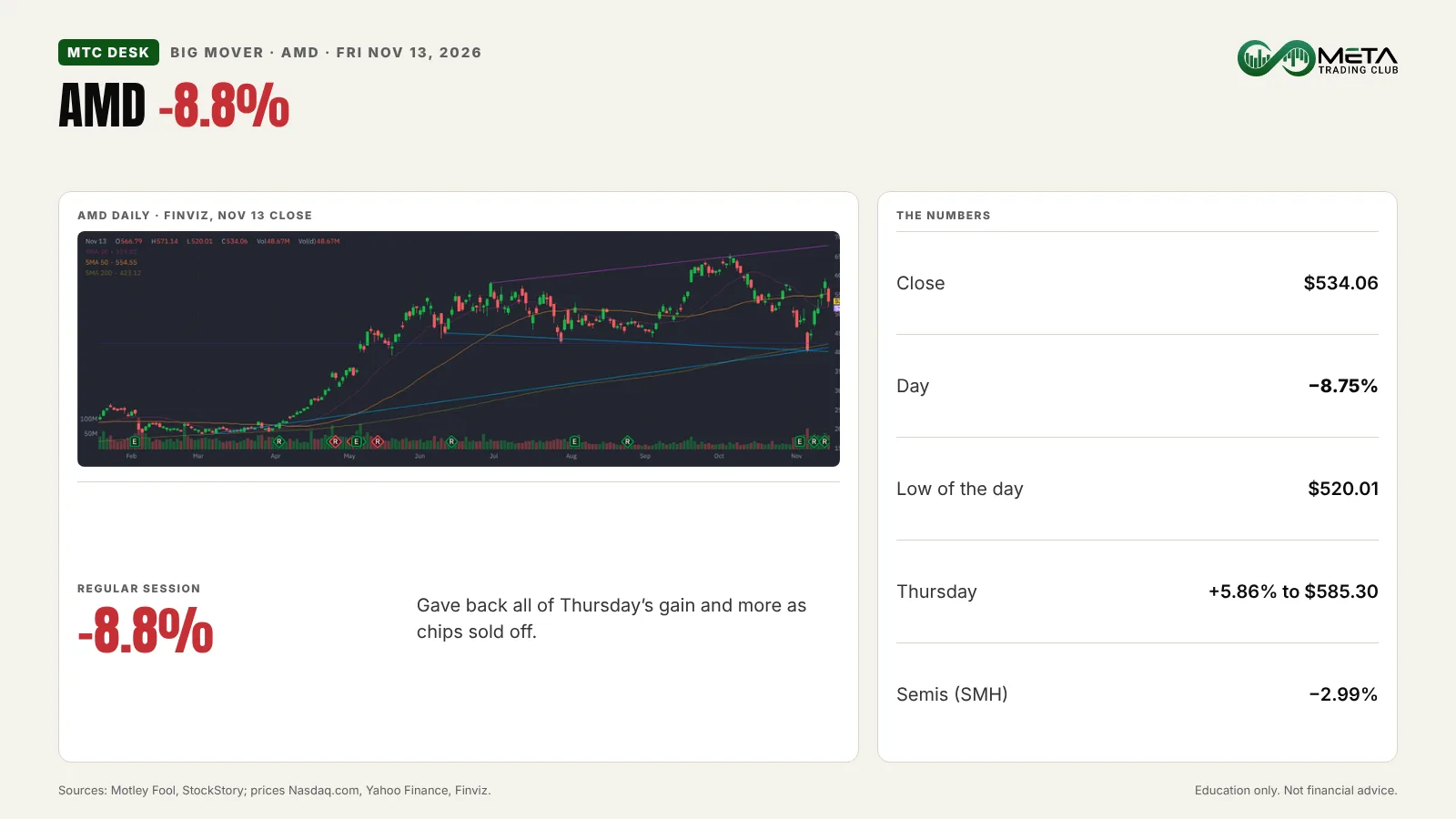
AMD closed at $534.06, down 8.75%, with a low of $520.01 (Nasdaq.com; Yahoo Finance). That erased Thursday’s 5.86% gain. Today the whole group sold: Broadcom −4.76%, MACOM −5.57%, Western Digital −5.00%, Micron −2.52% and Applied Materials −2.74%. Nvidia slipped 2.01% to $162.85 on day two after Jensen Huang’s exit, with earnings due after the close Tuesday, November 17. Our Thursday close recap covers the resignation itself.
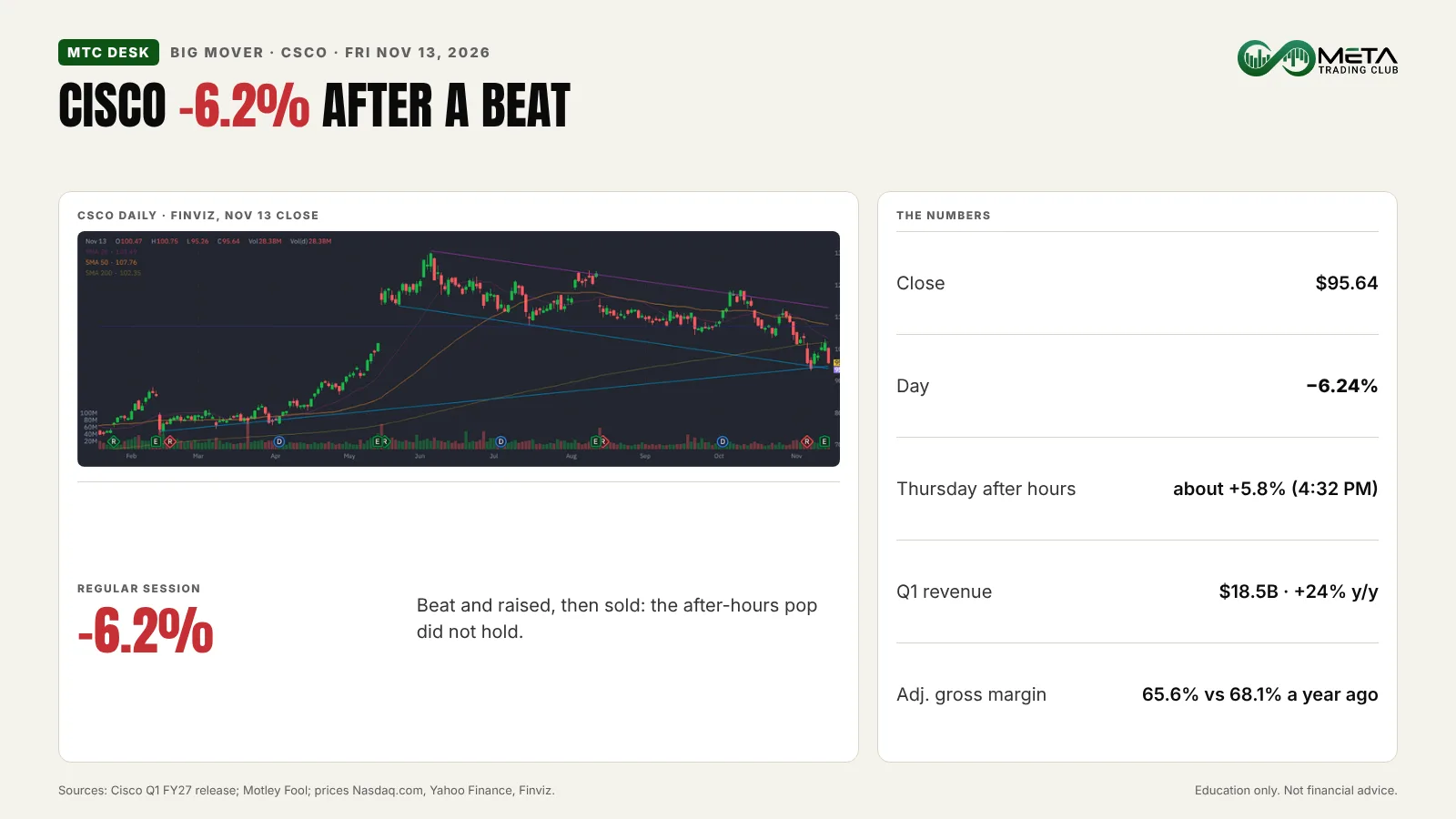
Cisco fell 6.24% to $95.64. On Thursday it reported record revenue of $18.5 billion (+24%), adjusted EPS of $1.40, both above estimates, and raised its fiscal 2027 outlook (company release), and it traded about 5.8% higher after hours at about 4:32 PM ET. The pop did not hold. The one soft spot in the report: adjusted gross margin of 65.6%, down from 68.1% a year ago. The Motley Fool also points to broader weakness in enterprise tech.
Other movers. Modine jumped 27.95% on reports that Samsung Electronics was exploring a possible acquisition (Motley Fool). Nu Holdings rose 11.67% and Cerebras 11.22% after its third-quarter report. Meta gained 2.90%; Tesla fell 1.82%. Our guide to bull vs bear markets explains why a day with more sectors up than down can still close red.
Sectors: Tech Out, Staples In
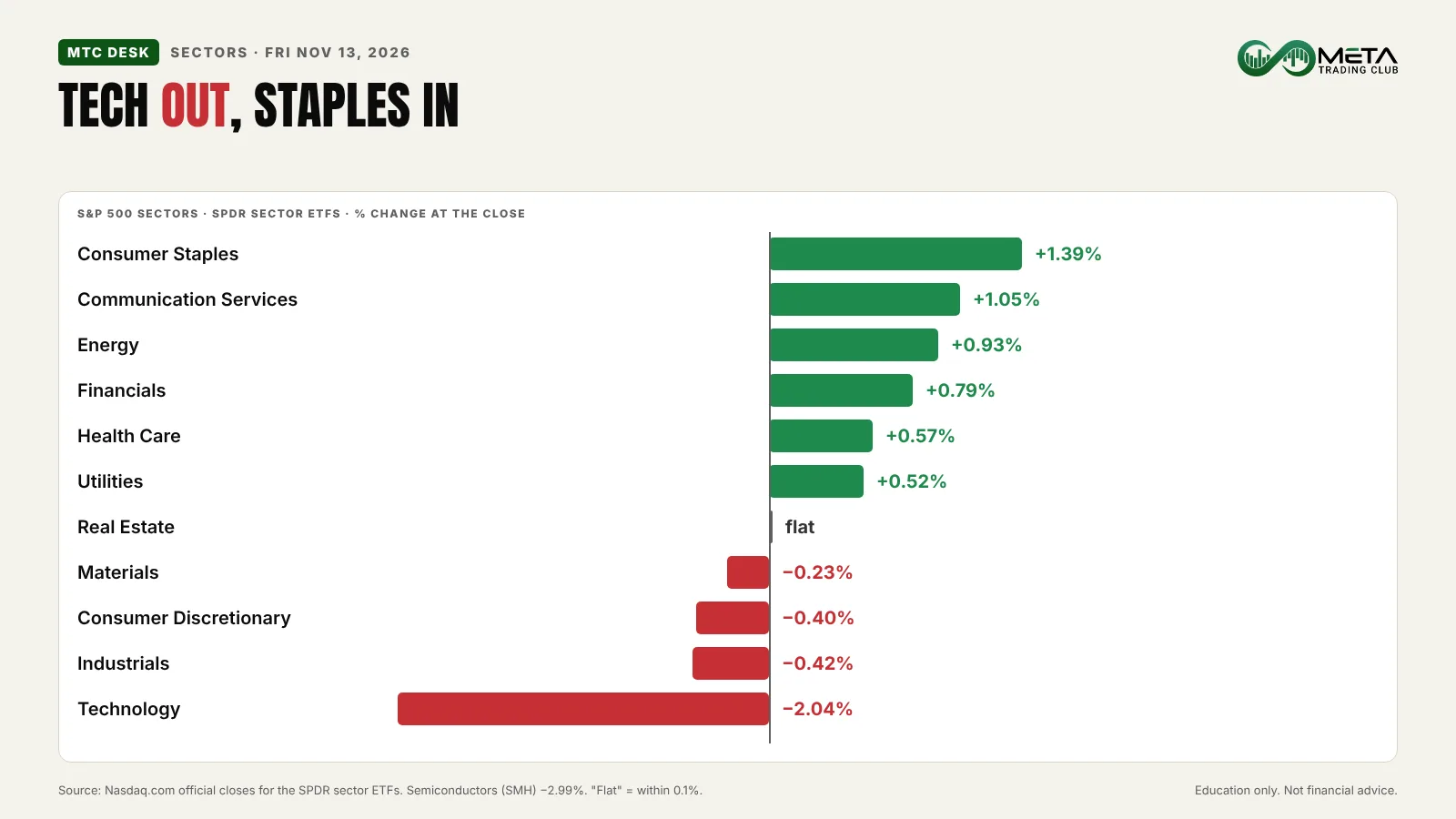
Six sectors rose. Consumer Staples led at +1.39%, then Communication Services +1.05%, Energy +0.93%, Financials +0.79%, Health Care +0.57% and Utilities +0.52%. Real Estate was flat. Materials fell 0.23%, Consumer Discretionary 0.40% and Industrials 0.42%. Technology was the worst at −2.04%, and because tech is the biggest weight in the index, it pulled the S&P 500 lower. The Motley Fool called it a rotation out of tech into defensive sectors.
Rates, Commodities and Crypto
| Asset | Level | One line |
|---|---|---|
| 10-year Treasury yield | about 5.15% | Yahoo Finance at the close; 5.14% in the morning (StockStory, citing CNBC) |
| WTI crude | about $88.97 (about flat) | Yahoo Finance; USO −0.29% (Nasdaq.com) |
| Gold | about $3,876 (about −0.2%) | Yahoo Finance; Motley Fool at midday |
| Bitcoin | about $68,300 (about −4.4%) | Yahoo Finance, about 4:25 PM ET |
| VIX | 19.39 (about +3.7%) | Yahoo Finance |
| US dollar (UUP) | +0.27% | A little firmer (Nasdaq.com) |
Northlight Asset Management’s Chris Zaccarelli told CNBC that persistent price pressures keep the Fed on course to raise rates in December (via StockStory). With the 10-year above 5%, stocks priced on far-off profits feel it first.
Economic Data Today
| Time (ET) | Release | Consensus | Prior | Actual |
|---|---|---|---|---|
| 8:30 AM | PPI Final Demand (Oct) m/m | +0.4% | +1.4% (revised) | +0.3% |
| 8:30 AM | PPI Final Demand (Oct) y/y | about 6.6% | 6.3% | +6.5% |
| 8:30 AM | PPI Goods / Services (Oct) m/m | — | — | +0.5% / +0.2% |
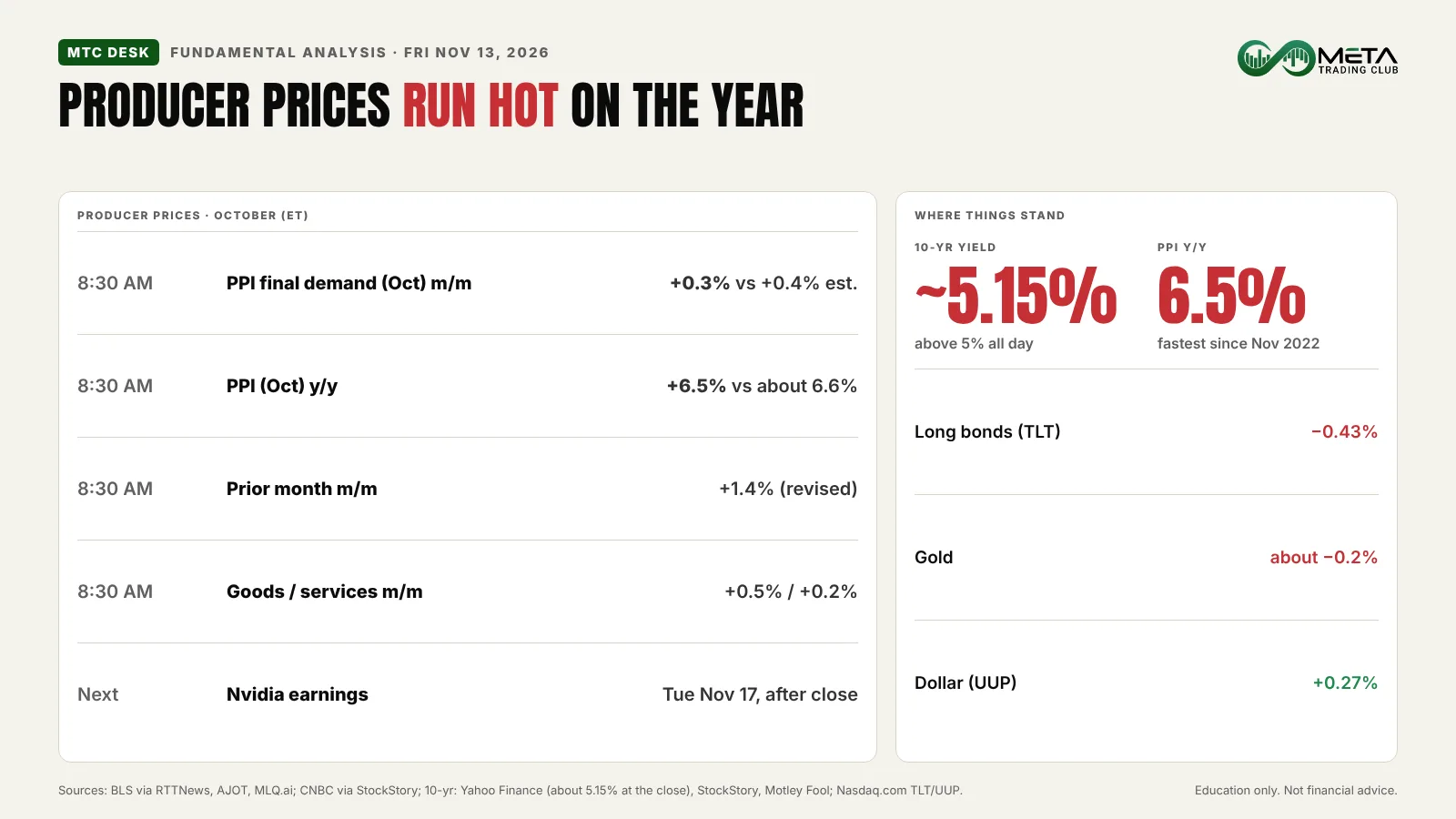
Producer prices rose 0.3% in October against a 0.4% forecast, but the yearly pace climbed to 6.5% from 6.3% (BLS via RTTNews, AJOT, MLQ.ai). A slightly cooler month did not calm the bond market. Our explainer on CPI vs PPI vs PCE shows how this report feeds the Fed’s preferred inflation gauge.
After the Bell
A quiet Friday evening: no major companies reported after the close. QQQ was about 0.6% lower and SPY about 0.4% lower at about 4:22 PM ET (Nasdaq.com).
Setup Review and What to Watch Next
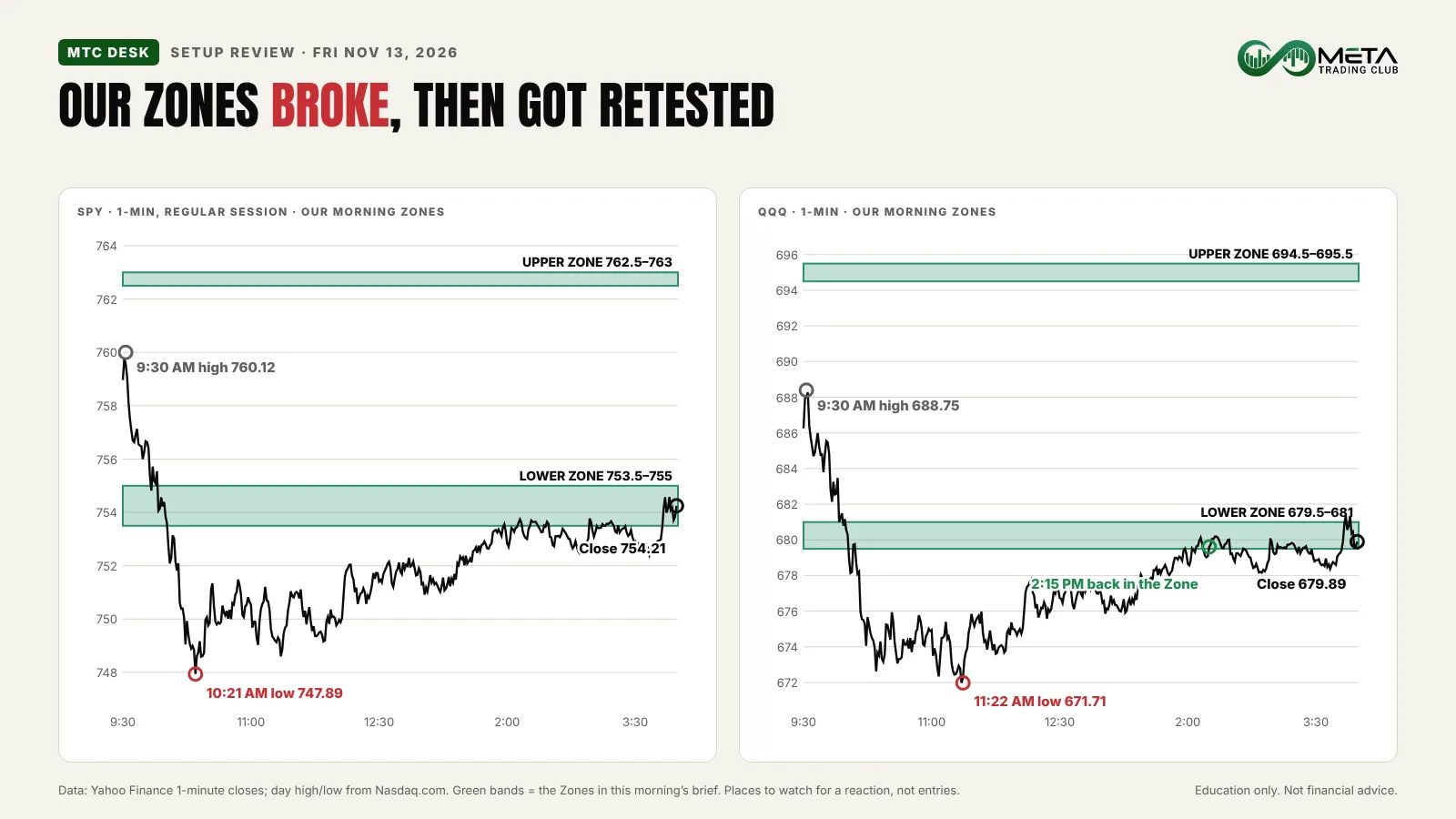
How our morning Zones did. In our premarket brief, SPY’s Lower Zone was 753.5–755. SPY opened about 758.96, made its high of 760.12 in the first minute, then slid into the Zone and broke below it at about 10:02 AM with no reaction. It bottomed at 747.89 at about 10:21 AM and climbed back all afternoon to close at 754.21, inside the Zone. QQQ did the same: it broke its 679.5–681 Zone at about 10:02 AM, hit 671.71 at 11:22 AM and was back in the Zone by about 2:15 PM, closing at 679.89. The Upper Zones were never tested. Honest grade: no reaction on the first test, so there was nothing to confirm. When a Zone breaks with no reaction, the break is the information.
Monday’s Zones to watch for a reaction: SPY 758.5–760 (Friday’s opening high) and 747.5–749 (Friday’s low), and QQQ 686.5–688.75 and 671.5–673. Our guide to using premarket data to prepare for the day shows how we build these Zones.
Next week: Nvidia reports after the close Tuesday, November 17. Risks: the 10-year staying above 5%, more news on Nvidia’s leadership before its report, and whether the chip sell-off spreads.
FAQ
Chip stocks fell as uncertainty over Nvidia’s leadership after Jensen Huang’s resignation spread across the group and the 10-year Treasury yield stayed above 5% (Motley Fool; StockStory). AMD fell 8.75%, Broadcom 4.76% and the VanEck Semiconductor ETF (SMH) 2.99% (Nasdaq.com).
Cisco closed down 6.24% at $95.64 on November 13, 2026, a day after reporting record revenue of $18.5 billion and raising its fiscal 2027 outlook. Its adjusted gross margin fell to 65.6% from 68.1% a year earlier (company release), and the Motley Fool pointed to broader weakness in enterprise technology stocks. The stock had traded about 5.8% higher after hours on Thursday.
Producer prices for final demand rose 0.3% in October, a little below the 0.4% forecast, and 6.5% from a year earlier, the fastest annual pace since November 2022 (BLS via RTTNews, AJOT and MLQ.ai). September was revised up to 1.4%.
Despite Friday’s dip, the S&P 500 rose 2.5% for the week, the Nasdaq 2.3% and the Dow 2.1%, the market’s first winning week since early October (Associated Press). On Friday the S&P 500 fell 0.40% to 7,561.67 and the Dow rose 0.10%.
Sources: Associated Press; Motley Fool; StockStory (citing BLS and CNBC); TradingKey; Yahoo Finance; Nasdaq.com official closes and day ranges; Finviz charts; Cisco Q1 FY2027 release; BLS PPI via RTTNews, AJOT and MLQ.ai. After-hours and commodity levels are approximate and carry their time. Featured image: AI-edited from a photo of an AMD Ryzen processor by Fritzchens Fritz (CC0, Wikimedia Commons).
Education only. Not financial advice.