Most traders fail prop firm challenges for the same handful of reasons — and none of them is a lack of talent. They’re behavioral, they’re predictable, and they’re fixable.
Walk through why traders fail prop firm challenges and you’ll notice the stories rhyme. The strategy wasn’t the problem. The trader got a few trades in, felt the pressure of the profit target and the drawdown line, and started making decisions a calm version of themselves never would. Overtrading, no plan, revenge after a loss, and blowing the max-drawdown rule — four failures that account for the vast majority of busted evaluations. The good news: every one of them maps to a missing step in a repeatable process, which means every one of them is preventable.
Why Do Traders Fail Prop Firm Challenges?
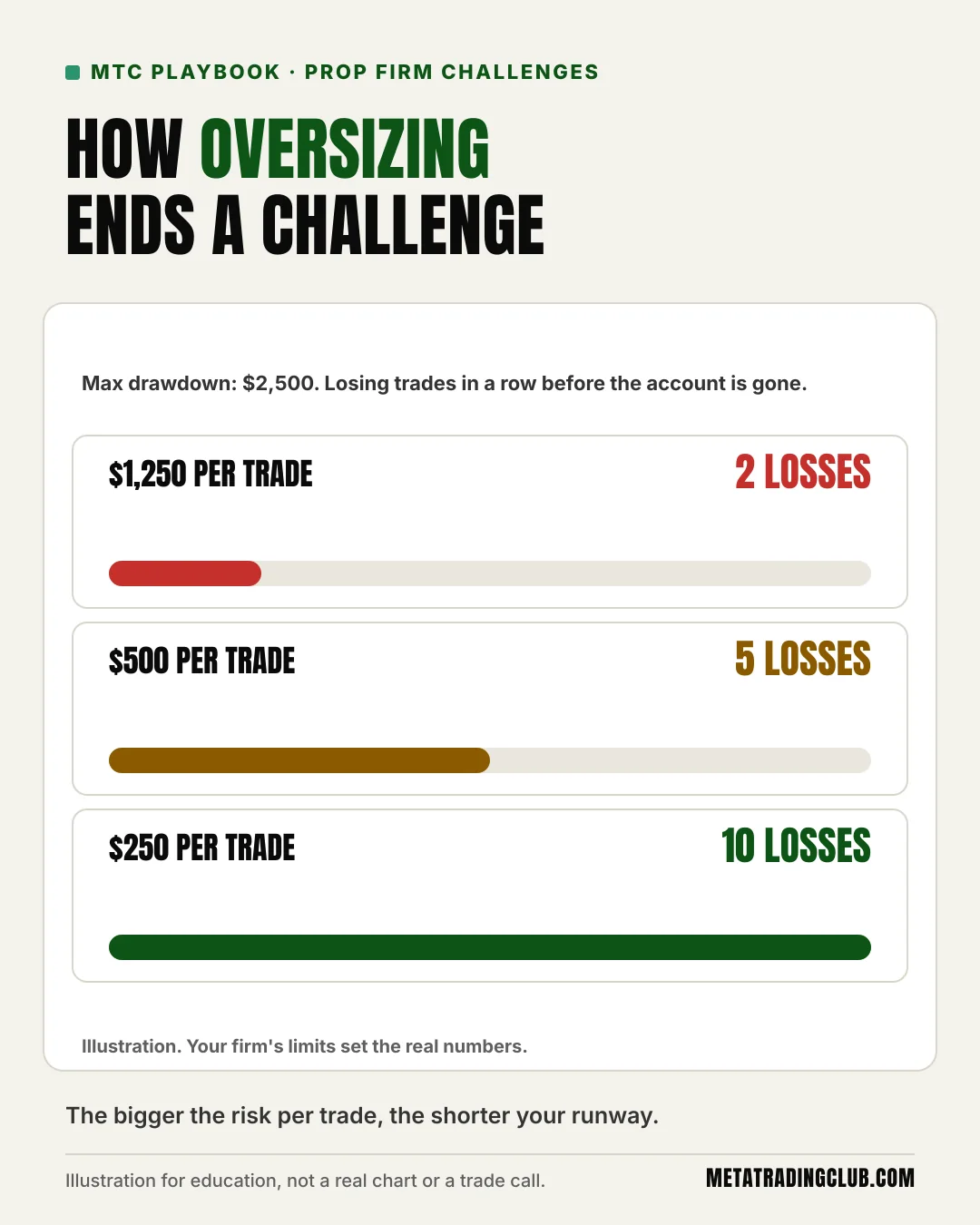
Because the challenge format changes behavior. Suddenly there’s a profit target with a deadline and a hard drawdown limit that ends the account instantly. That combination makes people trade bigger when they should trade smaller, and more often when they should wait. The firm isn’t hoping you fail — but the structure exposes anyone without a process, and most applicants don’t have one. If you want the full playbook for getting through, start with how to pass a prop firm challenge; this article is the mirror image — the specific ways people break.
Got a quick question? Our Prop Firm FAQ answers 19 common questions on funded accounts, drawdown rules, payouts and taxes.
The Four Reasons Traders Fail Prop Firm Challenges
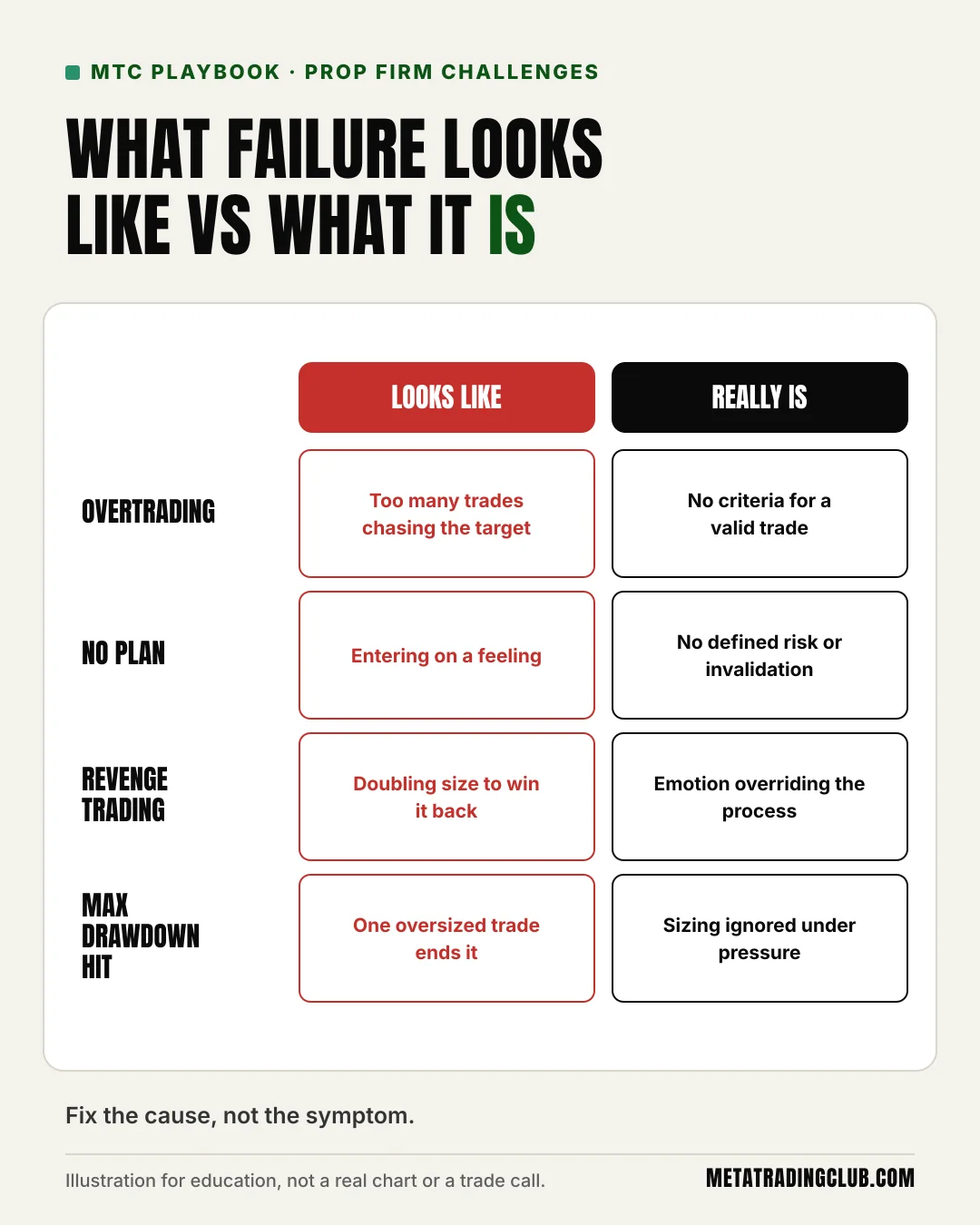
| Failure | What it looks like | What it really is |
|---|---|---|
| Overtrading | 20 trades a day chasing the target | No criteria for what a valid trade even is |
| No plan | Entering on a feeling, no invalidation | No defined risk, so no way to be ‘wrong small’ |
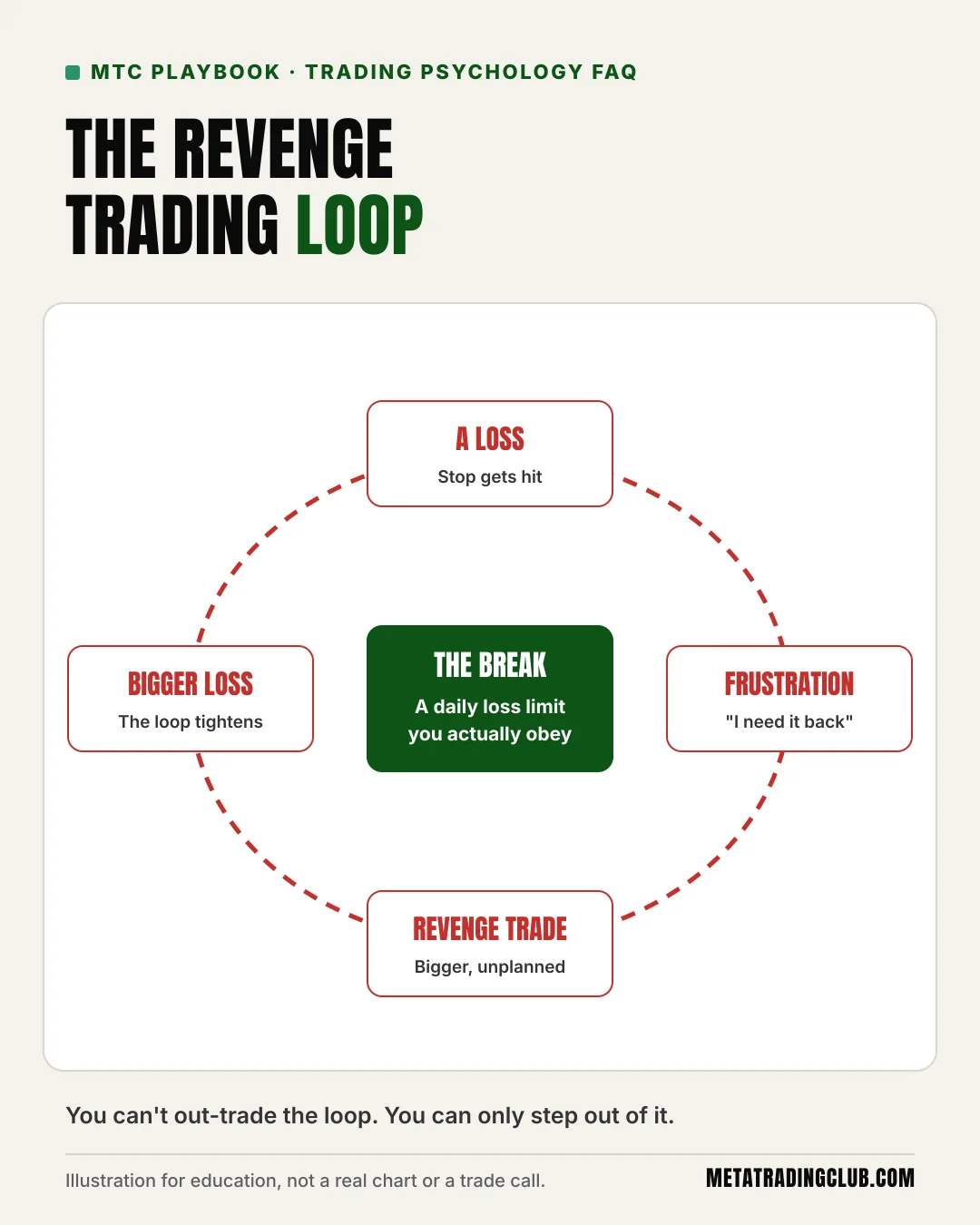
| Revenge trading | Doubling size to win a loss back | An emotional reaction overriding the process |
| Breaking max drawdown | One oversized trade ends the account | Position sizing ignored under pressure |
Overtrading is first because it feels productive. The target is sitting there, so the trader forces activity to reach it, taking marginal setups that a plan would have filtered out. Trading without a plan is the root cause underneath most of the others — with no defined entry, level, and invalidation, there’s nothing to follow and nothing to stop you. Revenge trading is what happens right after a loss, when the goal silently switches from ‘trade well’ to ‘get it back,’ and size balloons. And breaking the max-drawdown rule is usually the final act — one position sized far too large relative to the account, taken to make up ground, that trips the hard limit and ends the evaluation in a single click.
If you want the mechanics of those drawdown and loss-limit rules themselves — static vs trailing, daily caps, consistency — we break them down in funded account rules explained. Here the point is simpler: the rule didn’t fail you. The behavior did.
MTC Analysis
Every Failure Is a Missing Step
Traders who blame variance keep repeating the same failure. Traders who trace it to a missing step stop making it. That’s the whole difference.
The Challenge Is a Risk Test, Not a Trading Test
Here’s the reframe that passes challenges: the firm isn’t measuring whether you can call direction. It’s measuring whether you can protect capital while doing it. That’s why the drawdown rule, not the profit target, is what ends most accounts. The traders who pass treat the profit target as a by-product of not losing, and they get there with a fraction of the activity. The ones who fail attack the target directly and trip the risk rules on the way.
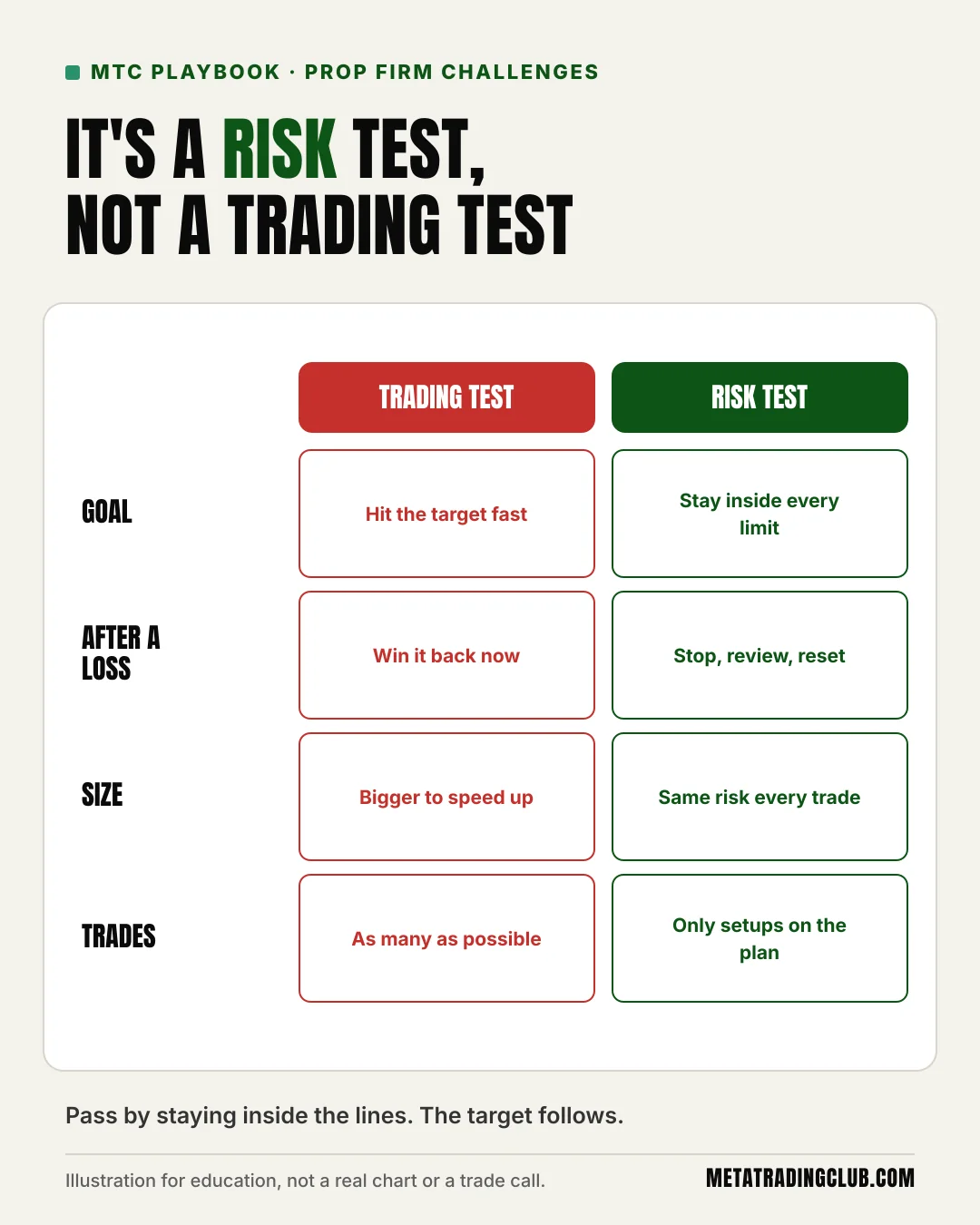
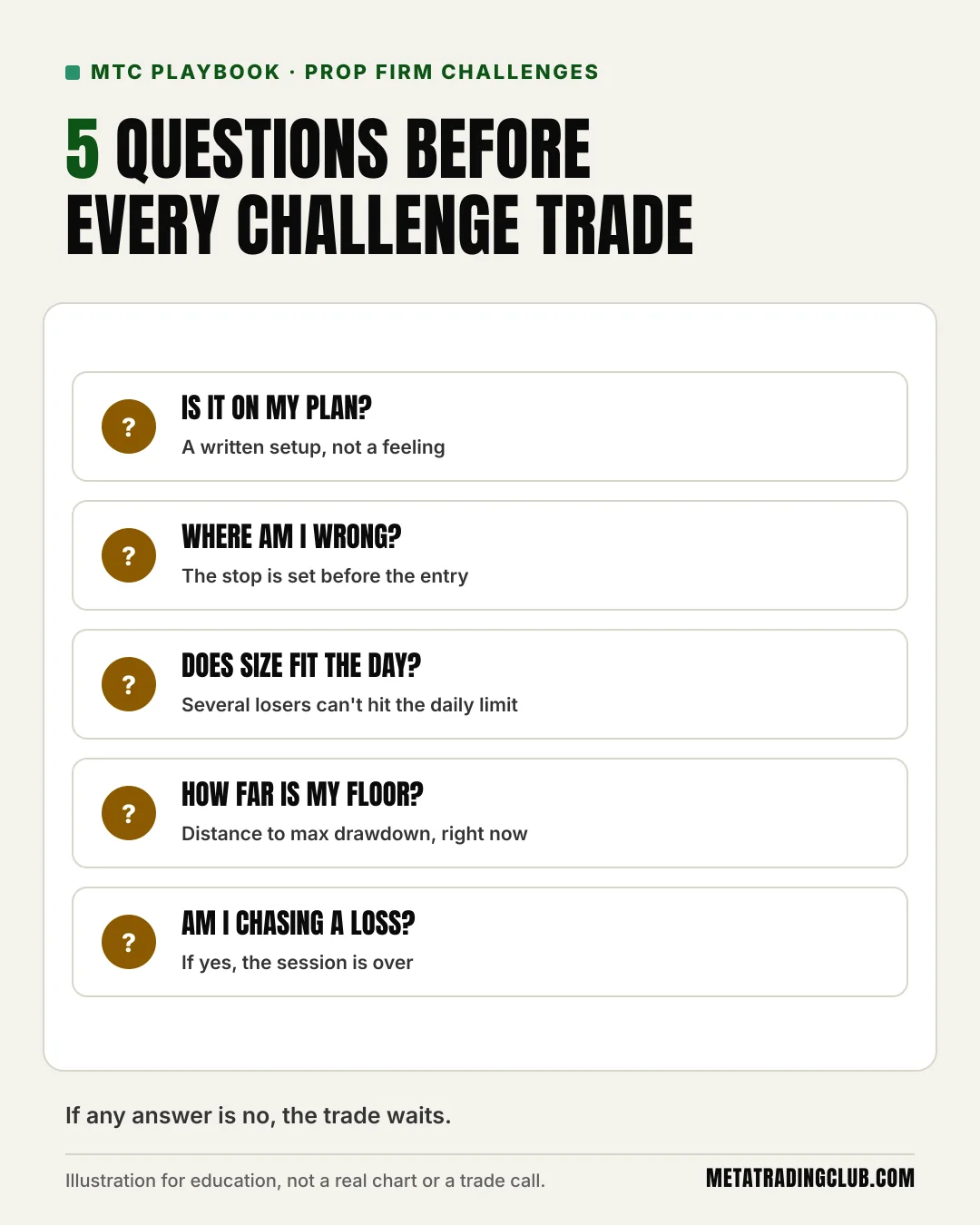
Two habits fix three of the four failures by themselves. First, a fixed position size on every trade, so no single loss can break your drawdown and revenge trading can’t escalate. Second, a written plan with an invalidation on each trade, so ‘I think it goes up’ becomes a trade you can actually manage and exit. The emotional side — the part that drives revenge trading — is real, and worth training deliberately; our guide to trading psychology covers how to keep process intact when a loss stings.
MTC Analysis
What Passing Actually Requires
Overtrading skips Bias and Level. Revenge trading skips Confirmation. A blown account skips sizing at Execution. Run every phase and the four failures have nowhere to live.
Get the free challenge risk checklist
DM us the keyword RISK on Instagram @metatradingclub and we’ll send it over free.
The Bottom Line on Why Traders Fail Prop Firm Challenges
The four reasons traders fail prop firm challenges — overtrading, no plan, revenge trading, and breaking max drawdown — all trace back to the same root: trading without a repeatable process under pressure. That’s genuinely good news, because a process is learnable and a mindset is trainable. Fix the behavior and the pass rate takes care of itself. The traders who get funded aren’t the ones with the flashiest strategy; they’re the ones who were boring, disciplined, and small when it counted. Once you’re through, it’s worth knowing what separates a good funded program from a trap — because the firm matters too.
Educational content only. Nothing here is financial advice or a promise of results. Trading involves substantial risk of loss.