Ask a struggling trader what they’re working on and they’ll say entries, indicators, setups. Ask a consistent trader what kept them in the game long enough to get good and they’ll say one thing: position sizing. It is the most important skill in trading and the one almost nobody studies, because it isn’t exciting. There’s no chart pattern to it. But it’s the entire difference between surviving a losing streak and being ended by one.
The skill nobody studies
Traders rarely blow up from being wrong too often. They blow up from being too big when they’re wrong. Sizing is what decouples survival from accuracy.
The Real Reason Traders Blow Up
Here’s a truth that sounds wrong until you sit with it: traders rarely blow up because they’re wrong too often. They blow up because they’re too big when they’re wrong. You can have a winning strategy and still go to zero if you size carelessly, because a few oversized losses in a row can erase months of careful gains and your entire account.
Position sizing is what decouples your survival from being right. It accepts up front that you’ll be wrong constantly, and ensures that being wrong is always small and survivable.
MTC Analysis
Risk 1% vs Risk 10% — Same Losing Streak
The stop comes from the chart; the size comes from the stop. A fixed small risk per trade is what lets a decent edge compound instead of getting wiped out.
The Core Rule: Risk a Fixed, Small Percentage
The foundation is simple: risk a fixed, small percentage of your account on every trade — most consistent traders use 1% to 2%. On a $10,000 account, 1% is $100. That $100 is the most you lose if the trade hits your stop. Not your position size — your risk.
This single rule changes everything. With 1% risk, you can be wrong ten times in a row and only be down about 10%. You’re still standing, still thinking clearly, still able to trade the next setup. The trader risking 10% per trade is gone after the same streak — and every trader, no matter how good, gets losing streaks.
How to Actually Calculate It
Position size isn’t guessed — it’s derived. Work backward from your risk:
First, define your dollar risk: account size times your risk percent. $10,000 times 1% equals $100.
Second, define your per-unit risk: the distance from your entry to your stop. If you enter a stock at $50 and your stop is at $48, you’re risking $2 per share.
Third, divide: dollar risk divided by per-unit risk gives your size. $100 divided by $2 equals 50 shares. For options, the same logic applies using the per-contract risk to your stop.
Notice what this does: a wider stop automatically gives you a smaller position, and a tighter stop a larger one — so your dollar risk stays constant no matter the setup. The stop comes from the chart; the size comes from the stop. Most traders do it backwards, picking a size first and discovering their risk after.
Why This Is ‘Underrated’
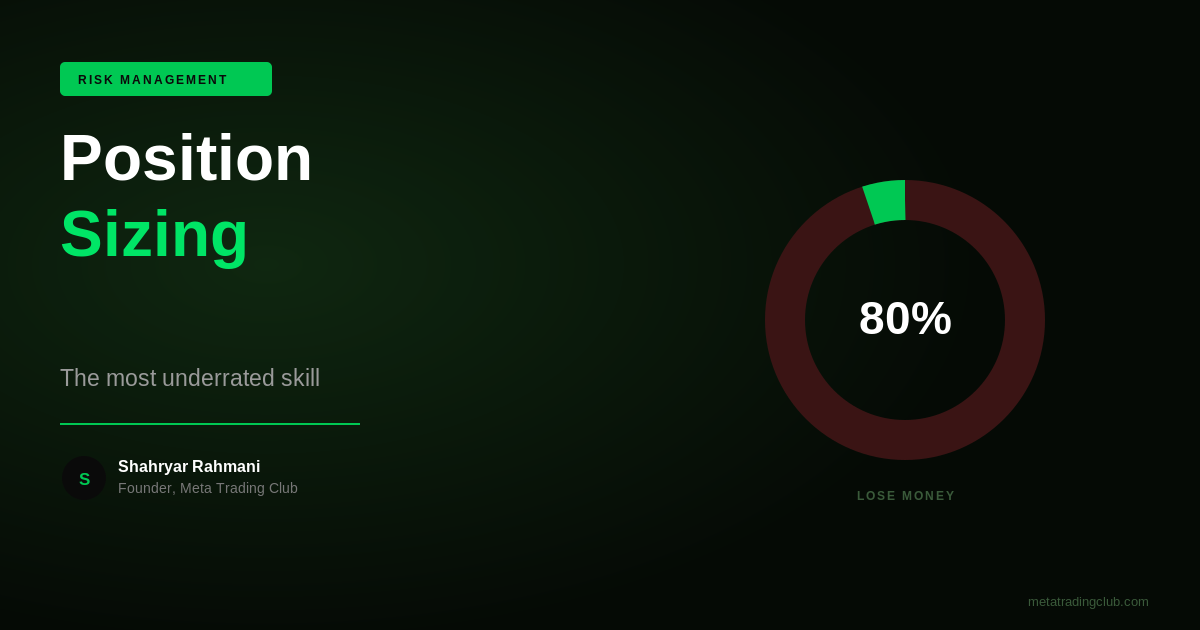
Position sizing is unglamorous, which is exactly why it’s neglected. New traders want the secret entry, the magic indicator, the perfect setup. They spend hundreds of hours on the 20% of the equation that’s fun and zero hours on the 80% that actually determines whether they survive. The professionals invert this. They’ll trade a mediocre edge profitably because their sizing is bulletproof, while the beginner with a better edge blows up because their sizing isn’t.
If you fixed nothing else about your trading this year except sizing every trade to a fixed 1–2% risk, you’d likely outperform most of the effort you’d put into chasing better entries.
Sizing Is a System, Not a Feeling
The reason this is hard isn’t the math — it’s the discipline. Sizing correctly means staying small when you’re confident, resisting the urge to ‘load up’ on a setup that feels certain. Certainty is exactly when traders oversize and exactly when the market humbles them. A real sizing system removes the feeling from the decision: the percentage is fixed, the math is mechanical, and the temptation to bet big never gets a vote.
Building that system — one that fits your account, your strategy, and your psychology — is the core of what the MTC Incubator does with traders: not a hotter entry, but the sizing and risk framework that lets a decent edge actually compound instead of getting wiped out.
Proprietary Framework
The MTC Alignment Engine™ — Applied Every Live Session
Every trade runs the same five checkpoints — consistency over gut reaction. Inside the MTC Incubator, members build their own system on top of this framework.
Frequently Asked Questions
What is position sizing in trading?
Position sizing is deciding how large each trade should be, based on how much of your account you’re willing to risk if the trade hits its stop. Rather than choosing a size and discovering your risk afterward, you fix your risk first — usually 1–2% of your account — and calculate the position size from your stop distance.
How much should I risk per trade?
Most consistent traders risk 1% to 2% of their account per trade. At 1% risk, even a string of ten consecutive losses only draws your account down about 10%, leaving you able to keep trading. Larger per-trade risk dramatically increases the odds that a normal losing streak ends your account.
How do I calculate position size?
Multiply your account size by your risk percent to get your dollar risk, then divide that by your per-unit risk (the distance from entry to stop). For example, $10,000 × 1% = $100 risk; if your stop is $2 away, $100 ÷ $2 = 50 shares. The same logic applies to options using per-contract risk.
Why is position sizing more important than entries?
Because a good entry can’t save you from a position that’s too large when it loses, but proper sizing keeps any single loss small and survivable regardless of the entry. Traders rarely blow up from being wrong too often — they blow up from being too big when wrong. Sizing decouples survival from accuracy.
Does position sizing apply to options trading?
Yes. The same principle holds: fix your risk per trade and size the number of contracts so that hitting your stop (or your defined max loss on a spread) costs only your set percentage of the account. Because options can move fast, disciplined sizing matters even more, not less.
Should I increase my size when I’m confident?
Be careful — confidence is exactly when traders tend to oversize, and exactly when the market punishes them. A disciplined approach keeps risk per trade fixed regardless of how certain a setup feels. The goal is a mechanical sizing system that removes emotion, so a ‘sure thing’ can’t tempt you into an account-threatening bet.
Related reading
Meta Trading Club Community
Start Your 7-Day Free Trial
Daily live sessions. Real-time market prep — not signals. The MTC Alignment Engine™ applied in front of you. Trade alongside Shahryar from day one.
Cancel anytime. No contracts. Built for Canadian traders.
Already trading and want to build your own system?
The MTC Incubator is an application-based mentorship — 1-on-1 work building a personalized system on the Alignment Engine™.