
The superficial loss rule stops you from claiming a capital loss if you, or someone affiliated with you, buy the same or identical property in the 30 days before or after the sale and still own it 30 days after. The loss isn’t gone. It is usually added to the cost of the shares you bought back.
That is 61 days in total: 30 before, the sale day, and 30 after. Traders who sell a loser and jump back in a week later trip it all the time. Here is how it works, with the numbers.
This is for Canadian residents holding shares as capital property. For the bigger picture of how trading is taxed here, start with our guide to day trading taxes in Canada.
Key takeaways
- The window is 61 days: 30 days before the sale, the day of the sale and 30 days after.
- Both tests must be met: identical property bought in the window and still held on day 30 after the sale.
- A purchase by your spouse or common-law partner, or a corporation you control, counts as yours.
- The denied loss is usually added to the adjusted cost base (ACB) of the new shares, so it is deferred, not erased.
- Buying back inside your TFSA or RRSP can make the loss disappear for good. Confirm your case with an accountant.
What is the superficial loss rule in Canada?
The CRA defines a superficial loss as a loss on the sale of capital property where two things are true. First, you or a person affiliated with you buy, or get the right to buy, the same or identical property during the period that starts 30 calendar days before the sale and ends 30 calendar days after it. Second, you or that affiliated person still own it, or still have the right to buy it, 30 calendar days after the sale (CRA, capital losses; checked November 2026).
If both are true, you can’t deduct the loss that year. TaxTips.ca describes the same test and calls it “really a 61-day rule” (TaxTips.ca). The point is to stop “fake” sales: selling to book a loss, then buying straight back.
How does the 61-day window work?
Put the sale date in the middle of a calendar and count 30 days each way. Buying identical shares in that band is a problem if you still hold them at the far end.
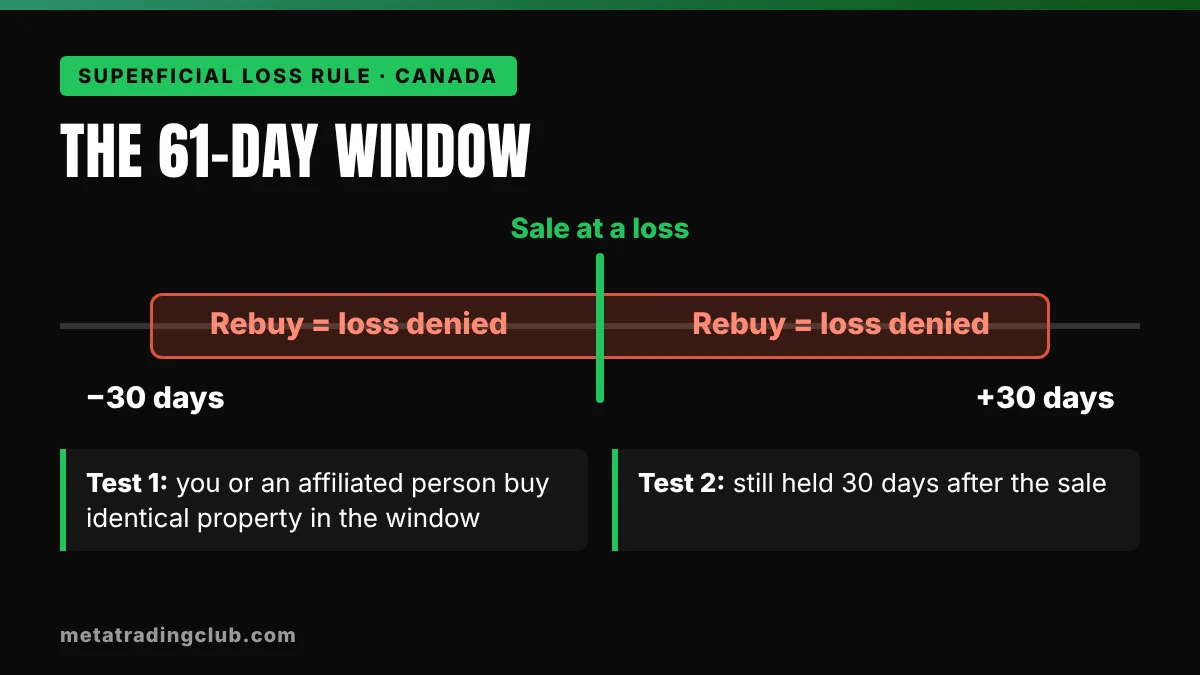
Two details catch people:
- The days before count too. Buying extra shares to “average down” and then selling the original lot at a loss a few days later can trigger the rule, because the new shares were bought inside the window.
- Selling the new shares fixes the second test. If you bought back but no longer own the identical shares (and have no right to buy them) 30 days after the sale, the second condition isn’t met and the loss is not superficial.
RBC Dominion Securities notes the count runs from the settlement date of the sale (RBC).
What counts as “identical property”?
The CRA says properties are identical when each one is the same as all the others. In practice that usually means shares of the same class of the same company, or units of the same fund (CRA guide T4037).
Options are trickier. TaxTips.ca cites a CRA technical interpretation saying options on the same company with the same strike and expiry are identical, while different strikes or dates may not be. Both TaxTips.ca and the CRA also say a loss from an option that simply expires is not treated as superficial. More on how options are taxed in our options trading tax guide for Canada.
Who is an “affiliated person”?
This is where the rule reaches past your own account. The CRA lists, among others (CRA):
- You and your spouse or common-law partner.
- You and a corporation controlled by you or your spouse or common-law partner.
- A partnership and its majority-interest partner.
- A trust and its majority-interest beneficiary.
So if you sell at a loss and your spouse buys the same stock a week later in their account, it can be a superficial loss for you. CI Global Asset Management notes that a child, parent or sibling is not an affiliated person (CI GAM).
What if you buy it back in your TFSA or RRSP?
This is the costly one. TaxTips.ca lists a trust such as an RRSP, TFSA or RRIF that you are a beneficiary of as an affiliated person (TaxTips.ca). CI GAM says a denied loss “also occurs if substituted property is acquired within the RRSP or TFSA”, and that in those cases the loss is permanently denied (CI GAM).
Why permanent? The usual fix is adding the loss to the cost of the new shares. But gains and losses inside a TFSA or RRSP aren’t reported on your return, so a higher cost base there does you no good. The CRA’s own capital loss pages don’t spell out the registered-account case, so treat this as the common reading and confirm it with an accountant before you rely on it. If your TFSA is very active, also read our piece on day trading in a TFSA.
Sell the loser in cash, rebuy it in your TFSA the same week, and the tax loss can vanish for good.
How is the denied loss added to your adjusted cost base?
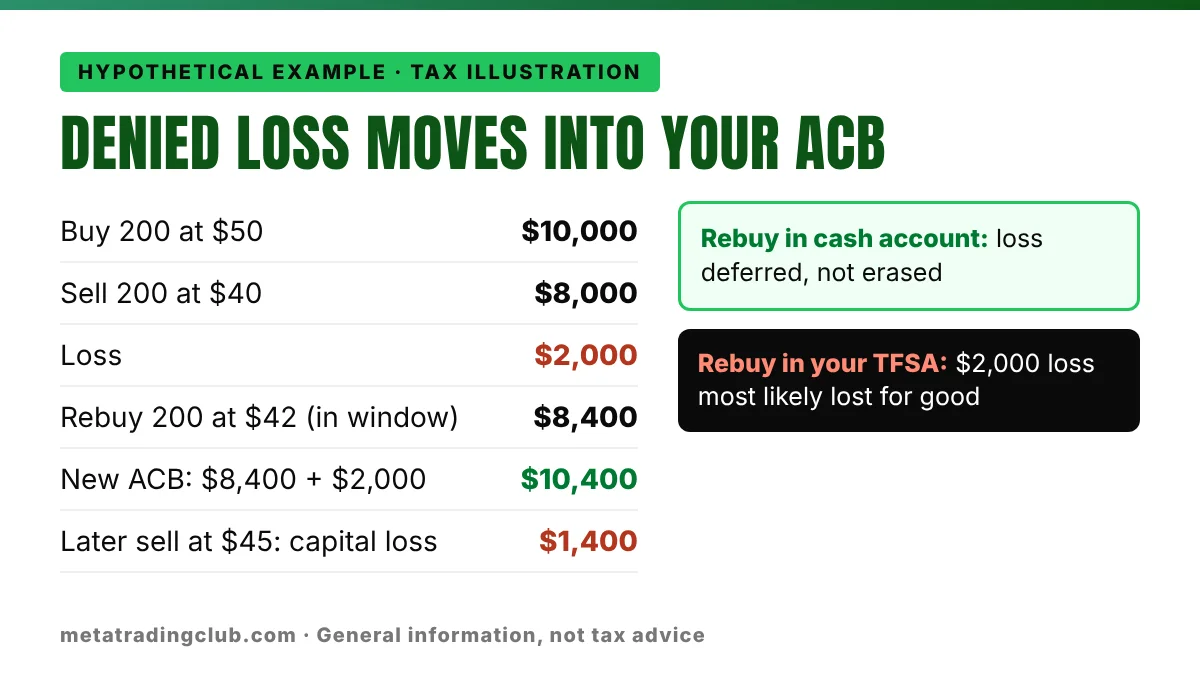
When the loss is superficial, the CRA says you can usually add it to the adjusted cost base of the substituted property (CRA). TaxTips.ca says the same: the loss can be claimed when those repurchased shares are sold. A higher ACB means a smaller gain, or a bigger loss, later. The tax hit is pushed into the future, not removed.
MTC Analysis · Hypothetical example
Tax illustration only, not a trade result. Made-up prices, shares held as capital property in a non-registered account.
- Oct 1: buy 200 shares at $50 = $10,000 cost.
- Nov 2: sell all 200 at $40 = $8,000. Loss = $2,000.
- Window: Oct 3 to Dec 2 (61 days; treat these as settlement dates, as RBC notes).
- Nov 20: buy 200 back at $42 = $8,400, still held on Dec 2. Both tests met.
- Result: the $2,000 loss is denied this year. New ACB = $8,400 + $2,000 = $10,400 ($52 a share).
- Next February: sell the 200 at $45 = $9,000. Capital loss = $9,000 − $10,400 = $1,400.
Compare: wait until Dec 3 to buy back at the same $42. The $2,000 loss counts this year, your ACB is $8,400, and the February sale is a $600 gain. Net over both years: −$2,000 + $600 = −$1,400. Same total, different timing.
Now the bad version: buy the 200 back on Nov 20 inside your TFSA. The $2,000 loss is still denied, and the ACB add-back sits in an account where gains and losses don’t count. That $2,000 is most likely lost for good.
Superficial loss vs the US wash sale rule: what’s different?
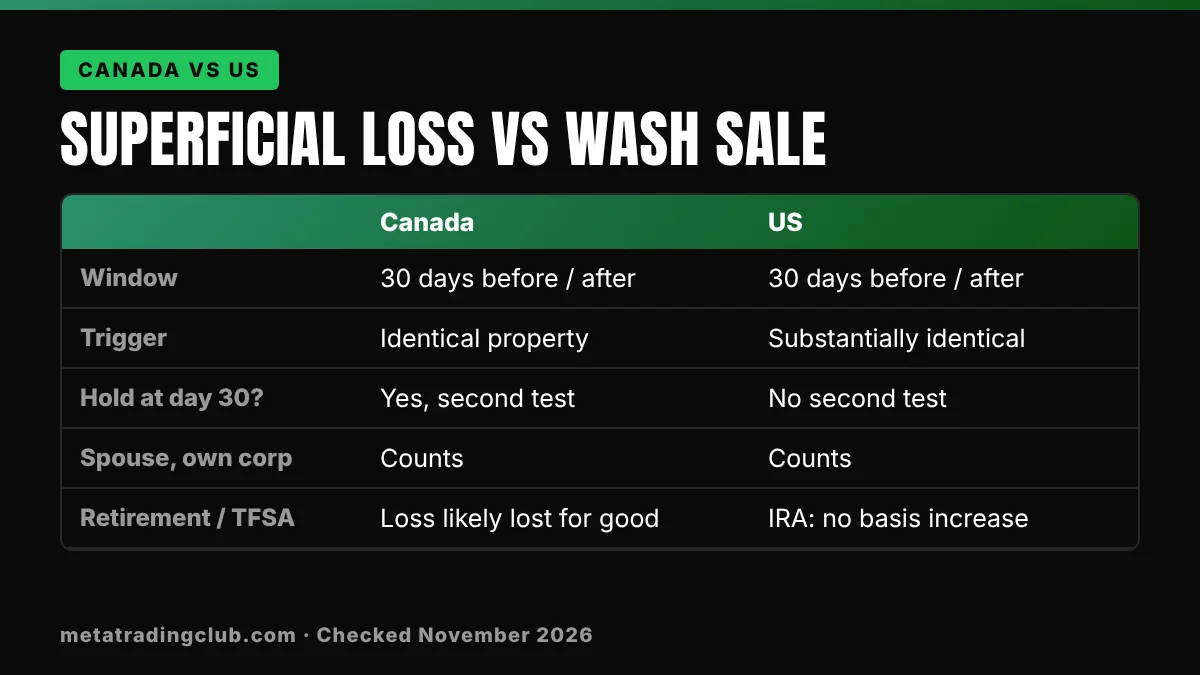
If you have read about the US wash sale rule, this will feel familiar. Both use 30 days before or after the sale, both catch a spouse or a corporation you control, and both add the denied loss to the cost of the new shares (IRS Publication 550). The details differ:
| Canada: superficial loss | US: wash sale | |
|---|---|---|
| Window | 30 days before to 30 days after the sale | 30 days before or after the sale |
| What triggers it | Same or identical property | Substantially identical stock or securities |
| Must still hold at the end? | Yes, on day 30 after the sale | No such second test in the IRS wording |
| Spouse / controlled corporation | Yes (affiliated persons) | Yes |
| Registered / retirement account | TFSA, RRSP: loss generally lost for good (confirm with an accountant) | IRA or Roth IRA: loss disallowed, no basis increase |
| Denied loss goes to | ACB of the substituted property | Basis of the new shares |
| Who it applies to | Capital property | Generally all taxpayers; not a dealer’s losses in the ordinary course of business (IRS Pub. 550) |
The IRA line comes from IRS Revenue Ruling 2008-5, which says the loss is disallowed and the IRA’s basis is not increased (IRS Rev. Rul. 2008-5). Canadian residents filing in Canada follow the Canadian rule; the US rule is here only for comparison. Checked November 2026.
Does the superficial loss rule apply to day traders taxed on business income?
Maybe not in the same way, and this is where you need a professional. The superficial loss rule is written for capital property. The CRA states that capital property does not include the trading assets of a business, such as inventory (CRA guide T4037).
If the CRA treats your trading as a business, your gains and losses go on income account, and different rules can apply. Whether any loss-denial rule reaches your trades depends on your facts. We are not going to guess: ask an accountant who works with active traders.
How do traders avoid tripping it by accident?
- Log every re-entry. Your journal should show the date of each sale at a loss and any buy of the same ticker 30 days either side.
- Check the household. Your spouse’s account and any corporation you control count.
- Keep registered accounts separate. Don’t rebuy a loser in your TFSA or RRSP inside the window.
For more quick answers on losses, ACB and slips, see our taxes for traders FAQ.
Should tax decide your re-entry?
No. A re-entry should pass the same 5 steps as the first trade: Bias → Zone → Reaction → Confirmation → Execution. If the bias still holds, price is back at a Zone, you see the reaction and get confirmation, then execution is a trading decision.
The tax side is record-keeping: if a re-entry lands inside the 61 days, note it so the ACB is right at tax time.
No alignment, no trade.
How we handle this at Meta Trading Club
We at Meta Trading Club teach trading, not tax filing. Since November 2021 we have trained 600+ traders out of Toronto. Our own track record is logged in R (1R = 2% account risk), and a dated log like that is exactly what you or your accountant need when a re-entry lands inside the window.
In premarket prep every market day and live sessions four days a week (Mon, Tue, Thu, Fri), the question is whether a setup passes the 5 steps and how it grades under Qualification (A+, A, B). Tax rules like this one we flag, then send to the professionals.
Frequently asked questions
Sources: CRA: Capital losses; CRA: Guide T4037; TaxTips.ca; CI Global Asset Management; RBC Dominion Securities; IRS Publication 550: Wash sales; IRS Revenue Ruling 2008-5. All checked November 2026.
Featured image: Connaught Building (CRA HQ), Ottawa by Jcart1534 (CC BY-SA 3.0), Wikimedia Commons, AI-edited
Education only. Not financial advice. General information, not tax advice. Tax rules change; confirm with a qualified professional.