Section 1256 contracts are a group of US-taxed instruments, mainly regulated futures and broad-based index options like SPX, whose gains and losses are split 60% long-term and 40% short-term no matter how long you held them. Open positions are also marked to market at year end and reported on IRS Form 6781.
That one rule is why two traders with the same yearly profit can owe very different federal tax. One traded SPY options. The other traded ES futures or SPX options. Here is how it works.
This is about US federal tax. If you’re a Canadian resident, none of this applies to you: the CRA has its own rules. See our Canadian day trading tax guide instead.
Key takeaways
- Section 1256 covers regulated futures, foreign currency contracts, nonequity options (such as SPX), dealer equity options and dealer securities futures contracts.
- Gains and losses are taxed 60% long-term and 40% short-term, even on a trade held for minutes.
- Anything still open on the last business day of the year is treated as sold at fair market value.
- SPY options, single-stock options and stock or ETF shares are not Section 1256 contracts.
- Individuals can elect to carry a net Section 1256 loss back 3 years, but only against earlier Section 1256 gains.
What are section 1256 contracts?
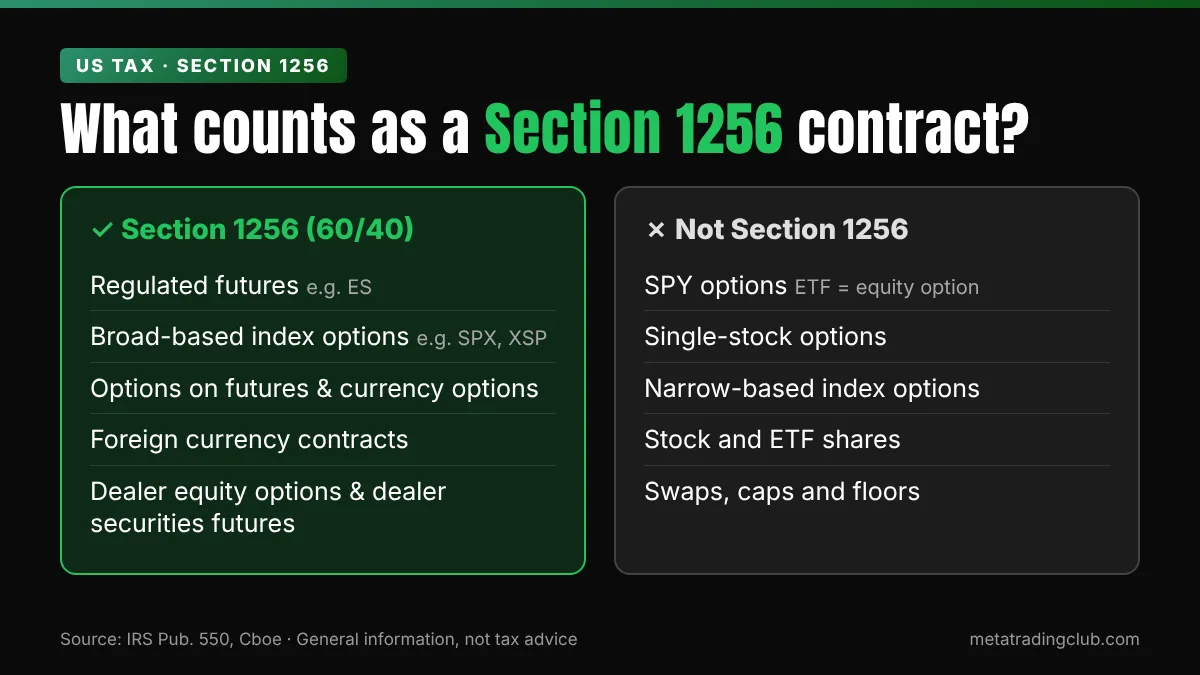
The name comes from section 1256 of the US Internal Revenue Code. IRS Publication 550 lists five types of section 1256 contracts (IRS Pub. 550, checked November 2026):
- Regulated futures contracts. Futures that are marked to market daily through your margin account and trade on a qualified exchange, like the E-mini S&P 500 (ES) on CME.
- Foreign currency contracts. Certain interbank currency contracts in currencies that also trade as regulated futures.
- Nonequity options. Listed options that are not equity options: debt options, commodity futures options, currency options and broad-based stock index options. The IRS uses the S&P 500 index as its example of a broad-based index.
- Dealer equity options. Equity options bought or written by a registered options dealer in the normal course of dealing.
- Dealer securities futures contracts. Securities futures handled by a dealer in the normal course of dealing.
For most retail traders, only two of those matter: index futures (and options on futures) and cash-settled index options such as SPX. Cboe says its S&P 500 index options suite, including SPX and the smaller XSP, can qualify for this treatment (Cboe).
What is NOT a Section 1256 contract?
SPX and SPY both track the S&P 500, but they are taxed differently.
- SPY options. SPY is an ETF, so its options are equity options. Cboe states plainly that SPY option gains are taxed as short-term capital gains if held less than one year.
- Single-stock options. The IRS defines an equity option as an option to buy or sell stock, or one valued by reference to a stock or a narrow-based index. Equity options are excluded from the nonequity group.
- Narrow-based index options. Options on a small group of stocks count as equity options too.
- Stock and ETF shares. Shares aren’t on the list at all. They follow the normal holding-period rules. Check a fund’s own tax documents if it holds futures inside.
- Swaps and similar agreements. Pub. 550 excludes interest rate, currency, equity, equity index, commodity and credit default swaps, plus caps and floors.
Under the normal rules, property held more than 1 year gives a long-term gain; 1 year or less is short-term (IRS Pub. 550). For a day trader, that means almost every gain on SPY or stock options is short-term. We cover that split in detail in day trading taxes explained.
| Instrument | Section 1256? | Day-trade gain taxed as | Year-end open positions |
|---|---|---|---|
| ES and other regulated futures | Yes | 60% long-term / 40% short-term | Marked to market |
| SPX and XSP index options | Yes (nonequity option) | 60% long-term / 40% short-term | Marked to market |
| SPY options | No (equity option) | Short-term | Taxed when closed |
| Single-stock options | No | Short-term | Taxed when closed |
| Stock and ETF shares | No | Short-term | Taxed when sold |
How does the 60/40 rule work?
Pub. 550 says it in one line: 60% of your gain or loss is treated as long-term and 40% as short-term, “regardless of how long you actually held the property.” The Form 6781 instructions say the same (IRS Form 6781, checked November 2026).
So a five-minute ES scalp and a futures position held for ten months get the same split. The 60% slice is taxed at long-term capital gain rates. The 40% slice is taxed as short-term, which means at your ordinary income rate.
It works on losses too. A net loss is also split 60/40, which matters if you have long-term gains elsewhere.
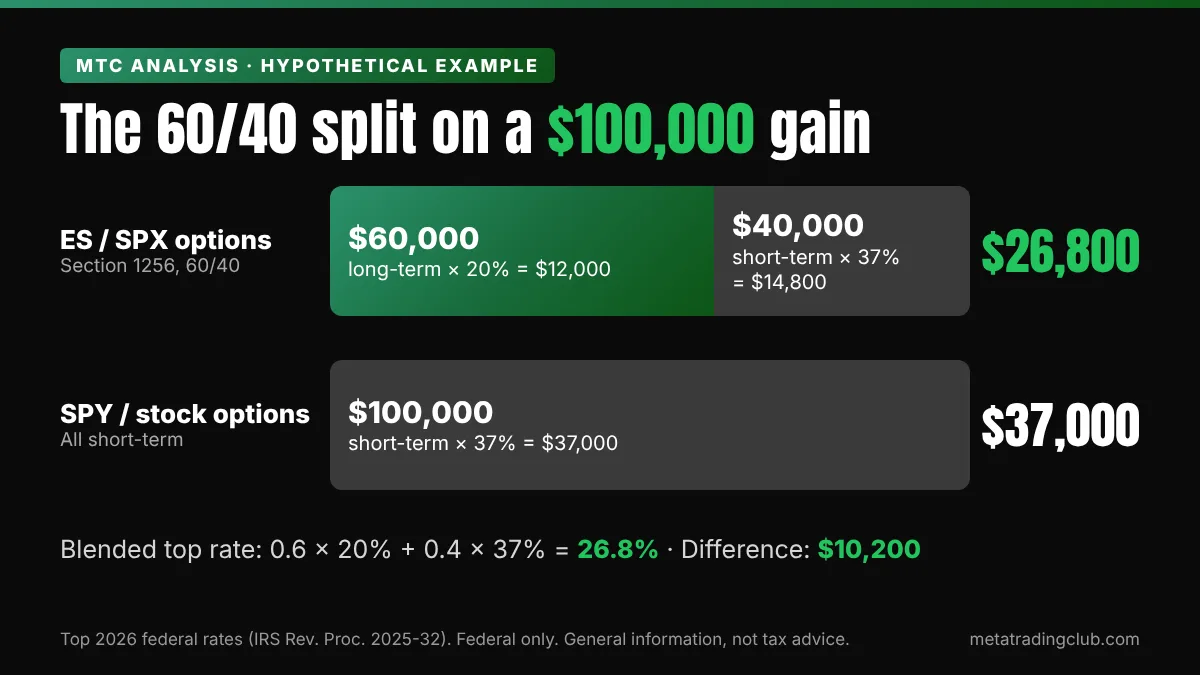
MTC Analysis · Hypothetical example
Same $100,000 net trading gain, two tax treatments
Assumptions: a single filer whose income already sits in the top bracket, so the whole gain is taxed at the top rates. For 2026 the IRS sets the top ordinary rate at 37% (over $640,600 for a single filer) and the 20% long-term rate applies above $545,500 (Rev. Proc. 2025-32; the same 37% and 20% rates appear in Pub. 550, checked November 2026). Federal income tax only: no state tax, no other surtaxes.
- SPY or stock options (all short-term): $100,000 × 37% = $37,000
- ES futures or SPX options (60/40): $60,000 × 20% = $12,000, plus $40,000 × 37% = $14,800, total $26,800
- Difference: $37,000 − $26,800 = $10,200
- Blended top rate: 0.6 × 20% + 0.4 × 37% = 12% + 14.8% = 26.8%
A lower bracket shrinks the gap. With an assumed 24% ordinary rate and 15% long-term rate: all short-term is $24,000; 60/40 is $9,000 + $9,600 = $18,600. The gap is $5,400.
Hypothetical. Real brackets apply in layers and depend on your full return.
Contract size, liquidity, spreads and exercise style all differ between ES, SPX and SPY. Cboe points out that XSP options are European style and cash settled, while SPY options are American style and can be assigned early. Those differences hit your results before tax ever does.
The 60/40 rule changes the rate on your gains; it never makes a bad trade a good one.
What does year-end mark-to-market mean?
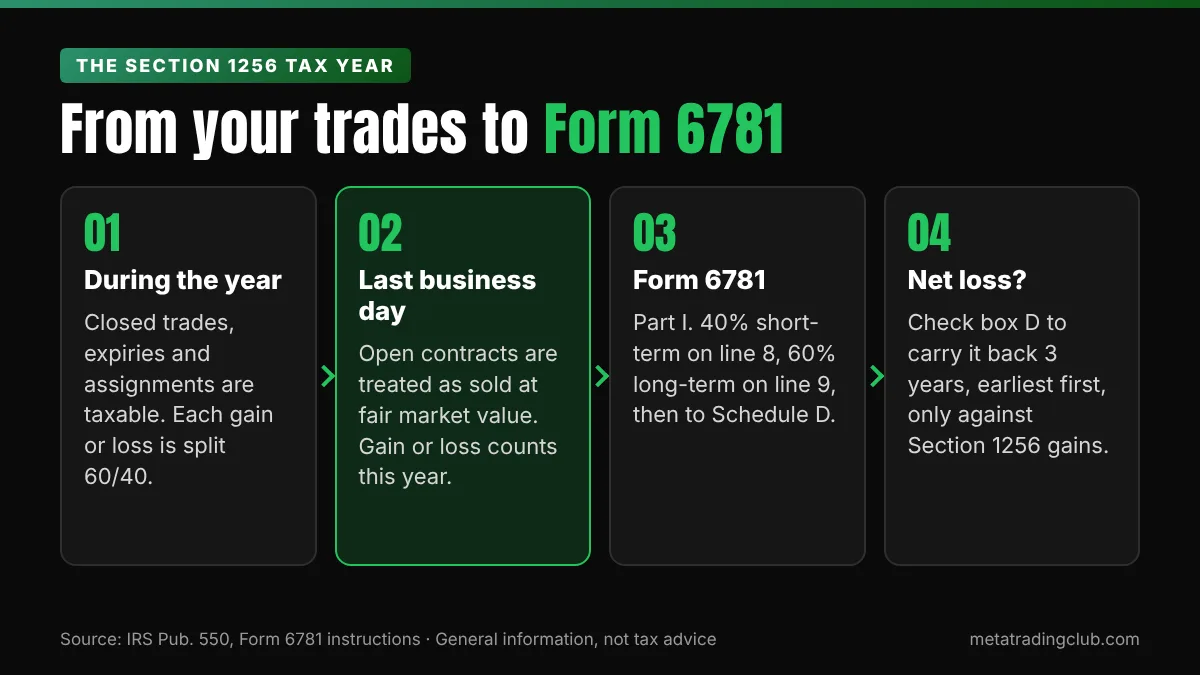
If you hold a Section 1256 contract at the end of the tax year, the IRS treats it as sold at its fair market value on the last business day of the year. You report that gain or loss now, even though you haven’t closed the trade. Closing, offsetting, exercise, assignment, delivery or expiry during the year also counts as a taxable event.
The IRS’s own example
A trader buys a regulated futures contract for $50,000 on June 3, 2024. On December 31, 2024, the last business day of the year, it is worth $57,000. The trader reports a $7,000 gain for 2024, split 60/40, without selling.
On February 3, 2025, the contract is sold for $56,000. Because $57,000 was already taxed, the 2025 return shows a $1,000 loss, also split 60/40. (Source: IRS Pub. 550.)
This automatic rule is different from the Section 475 mark-to-market election for traders with trader tax status. We explain that one in trader tax status and mark-to-market.
How do you report Section 1256 contracts on Form 6781?
Pub. 550 says to use Part I of Form 6781 for all Section 1256 contracts closed during the year or still open at year end, including the amount in box 11 of Form 1099-B from your broker. On the form, the short-term 40% goes on line 8 and the long-term 60% on line 9. The net amounts then flow to Schedule D, and a copy of Form 6781 goes with your return.
Keep your own trade journal next to the broker’s 1099-B. It lets you check the broker’s figure and review your trading in R, which is the number that tells you whether your process works.
Can you carry back a Section 1256 loss?
Yes, with limits. An individual with a net Section 1256 contracts loss can elect to carry it back 3 years instead of only carrying it forward. You make the election by checking box D on Form 6781 for the loss year. Corporations, estates and trusts can’t use it.
- The loss goes to the earliest of the 3 years first, then the next two.
- It can only offset net Section 1256 gains in those years, not stock gains or wages.
- It can’t create or increase a net operating loss in the carryback year.
- In each carryback year, it is treated 60% long-term and 40% short-term.
- You claim it on Form 1040-X or Form 1045 for the earlier year, with an amended Form 6781 and Schedule D.
Any part that can’t be absorbed carries forward under the normal capital loss rules. For how losses work more broadly, see are trading losses tax deductible.
Does the wash sale rule apply to Section 1256 contracts?
The Form 6781 instructions say it directly in the mark-to-market section: “The wash sale rules don’t apply.” Pub. 550 adds that wash sale rules don’t apply to losses on commodity futures contracts, but they do apply to contracts and options to buy or sell stock or securities.
In practice, that means a trader who flips between SPY options and SPY shares is still inside wash sale territory. A trader in ES futures is not. Our wash sale rule guide covers the 30-day window for stocks and options.
Should tax decide which instrument you trade?
Tax is a cost, like commissions. It is worth knowing. It is not a setup.
In our Alignment Engine, the trade comes from five steps in order: Bias → Zone → Reaction → Confirmation → Execution. The first four tell you whether there is a trade at all: the direction of the day, the Zone where you expect price to respond, the reaction you see there and the confirmation that follows. Only at Execution do you choose the vehicle. ES, SPX options or SPY options are an Execution decision, weighed on liquidity, contract size, how risk is defined and, yes, tax.
Picking SPX over SPY to save tax on a setup that never aligned is still a bad trade.
How we handle this at Meta Trading Club
We at Meta Trading Club were founded in Toronto in November 2021 and have trained 600+ traders, many of them trading US index products. We teach process, not tax filing. In our live trading sessions (Monday, Tuesday, Thursday and Friday) we talk about why we pick a vehicle, but the trade itself still has to pass all five steps and earn a Qualification grade (A+, A or B) before risk goes on.
Our track record is logged in R, where 1R is 2% account risk. R tells you whether your edge works. Tax is applied afterwards to the dollar result. Keep both records clean and talk to a tax professional about your own situation. If you want to size each trade in R before you place it, our free position size calculator does the math.
Frequently asked questions
Sources: IRS Publication 550 (2025), Investment Income and Expenses; IRS Form 6781 and instructions (2024); IRS Rev. Proc. 2025-32 (2026 inflation adjustments); Cboe, Why Trade XSP vs. SPY. All checked November 2026.
Featured image: AI-edited from a photo of the Internal Revenue Service building sign by G. Edward Johnson (Wikimedia Commons, CC BY 4.0).
Education only. Not financial advice. General information, not tax advice.