
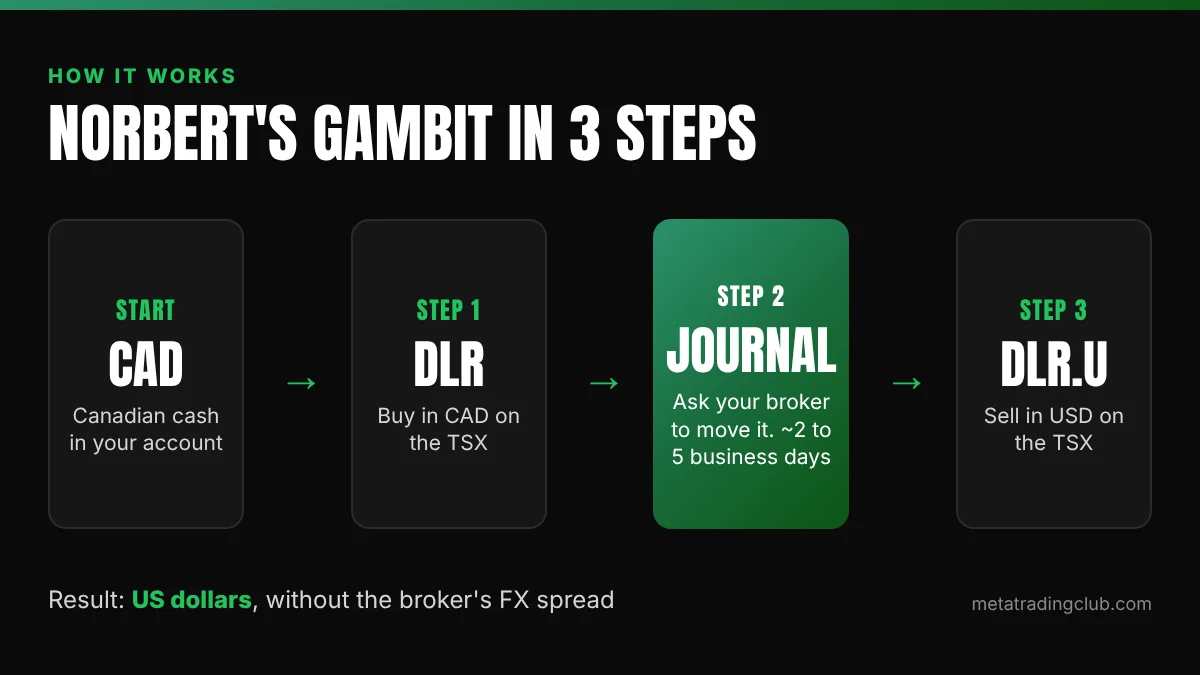
Norbert’s gambit is a way for Canadians to get US dollars without paying the broker’s currency spread. You buy DLR in Canadian dollars on the TSX, ask your broker to journal it to DLR.U, then sell DLR.U for US dollars. Your costs become commissions, the bid/ask spread, a possible journal fee and a few days of waiting.
If you trade US stocks or US options from Canada, you need US dollars at some point. How you get them can cost you hundreds of dollars a year without you noticing. Here’s how the gambit works, what it really costs, and when it isn’t worth the trouble.
Key takeaways
- Norbert’s gambit swaps a percentage-based FX spread for mostly fixed costs: commissions, the ETF’s bid/ask and any journal fee.
- The tool is the Global X US Dollar Currency ETF: DLR trades in Canadian dollars, DLR.U in US dollars, both on the TSX.
- The journal step is usually not automatic. You request it, and it can take from about two to five business days depending on the broker.
- Some brokers (like Interactive Brokers) already convert currency cheaply, so the gambit matters most at brokers that charge a percentage.
- In a non-registered account, each buy and sell is a disposition for tax purposes. Keep your confirmations.
What is Norbert’s gambit?
It’s a currency conversion trick that uses one ETF listed in two currencies. The ETF is the Global X US Dollar Currency ETF. Its Canadian-dollar units trade as DLR and its US-dollar units trade as DLR.U, both on the Toronto Stock Exchange.
The fund holds mostly US-dollar cash and cash equivalents. Global X says it “seeks to reflect the reference value in Canadian dollars” of the US dollar, net of expenses. So DLR’s price in CAD moves with the exchange rate, while DLR.U’s price in USD barely moves at all.
Because DLR and DLR.U are the same units, your broker can move (“journal”) them from the CAD side of your account to the USD side. You buy in one currency and sell in the other. No currency desk, no conversion spread.
Why do Canadian traders need US dollars at all?
US stocks, US ETFs and US-listed options are priced in US dollars. If you buy them from a CAD account, your broker converts the money for you on every trade, and again when you sell. Each conversion carries a spread.
Questrade’s own learning article puts typical retail CAD/USD conversions at about 1.5% to 2.5% per transaction (Questrade). Wealthsimple’s fee schedule lists 1.5% for trading US-listed securities from a CAD account (Wealthsimple fees). If you trade US names actively, that adds up fast.
A USD account solves the round-trip problem: you convert once, then trade in US dollars as long as you like. Norbert’s gambit is one way to fill that USD account cheaply. If you’re still choosing a broker, start with our guide to the best trading platforms in Canada.
How do you do Norbert’s gambit, step by step?
The steps are the same at every broker that supports it. Only the journal request screen changes.
- Make sure you have a USD account or USD side. Wealthsimple, for example, requires an active USD account and enough CAD cash to cover its journal fee (Wealthsimple Help Centre).
- Buy DLR in Canadian dollars with a limit order. Don’t use a market order on a currency ETF; the limit protects you from a wide spread.
- Request the journal from DLR to DLR.U. At Wealthsimple you do it on the web from DLR’s security page. At Questrade you go to the Management page and choose “Journal shares” (Questrade journaling). Other brokers may want a phone or chat request.
- Wait. Don’t trade the units while the request is pending. Both brokers say so plainly.
- Sell DLR.U for US dollars once it shows up on the USD side, again with a limit order.
- Save the trade confirmations for your adjusted cost base records.
Going the other way (USD back to CAD) is the mirror image: buy DLR.U, journal to DLR, sell DLR.
How long does the journal take?
It depends on the broker. Wealthsimple estimates about two business days and warns that holidays can stretch it. Questrade says requests “may take up to 5 business days to process,” and adds a business day if you’re journaling a recent purchase, because the buy has to settle first.
That settlement day comes from Canada’s T+1 cycle: trades settle one business day after the trade date. Canadian securities regulators moved to T+1 on May 27, 2024 (CSA via Alberta Securities Commission).
Plan for it. If you want US dollars ready for Monday’s session, starting on Friday afternoon is too late.
Broker FX vs Norbert’s gambit vs low-cost FX: which is cheaper?
Here’s how the three routes compare, using only what the brokers publish on their own pages. Fees change, so check before you convert.
| Broker FX conversion (Wealthsimple, CAD account) |
Norbert’s gambit (Wealthsimple / Questrade) |
Low-cost FX (Interactive Brokers) |
|
|---|---|---|---|
| Published cost | 1.5% on top of the corporate exchange rate | $9.95 per journal request (plus tax at Wealthsimple); free at Questrade with Questrade Plus | 0.20 basis points (0.002%) of trade value, minimum USD 2.00 per order |
| Other costs | None separate, but the corporate exchange rate itself includes a spread that varies | Commissions on two trades, ETF bid/ask, a few days of MER | The market bid/ask on the currency pair |
| Speed | Happens with the trade | About 2 business days (Wealthsimple); up to 5 (Questrade) | As soon as the currency order fills |
| Effort | None | Two trades plus a journal request | One currency order |
| Best for | Small, occasional amounts | Larger amounts at percentage-fee brokers | Frequent conversions of any size |
Checked November 2026. Sources: Wealthsimple’s fee schedule and Norbert’s gambit help article; Questrade’s journaling page; IBKR’s spot currency commissions and US trading costs for Canadians pages. Wealthsimple’s USD-account conversion fee is tiered by amount (1.5% under $10,000, down to 0% at $100,000 and over).
The takeaway: if your broker already converts at a tiny commission, the gambit adds work for almost no saving. It earns its keep at brokers that charge a percentage. We compare the main options in Questrade vs IBKR vs tastytrade in Canada.
What does it save on CAD $20,000?
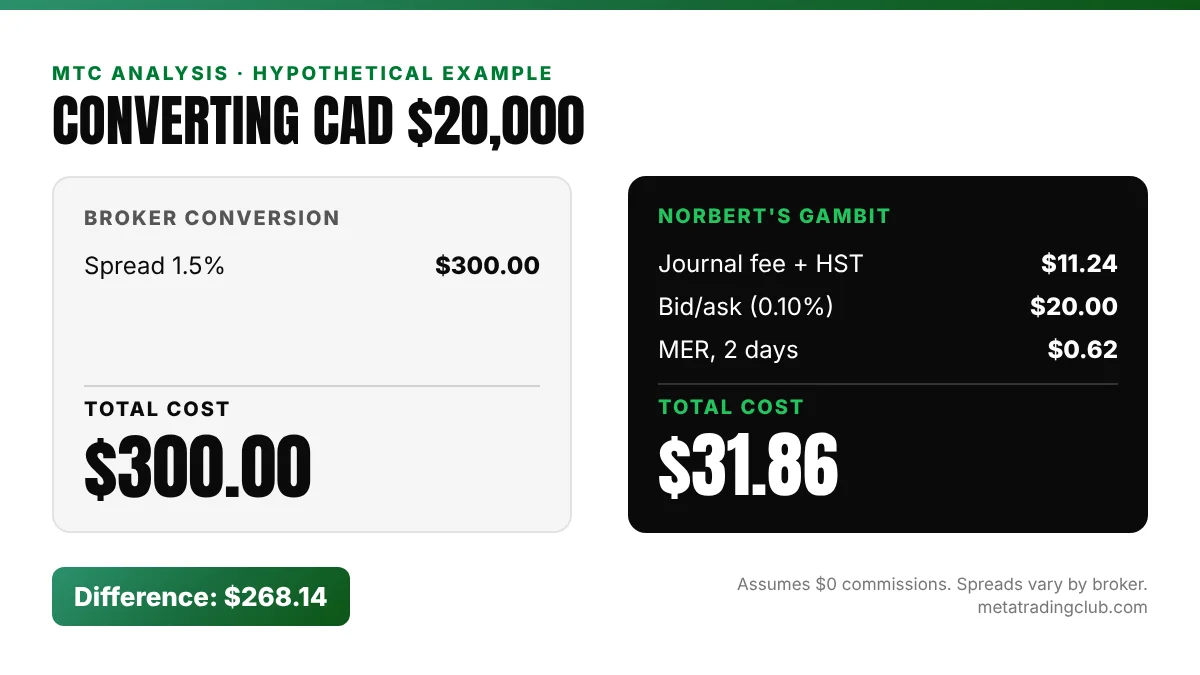
MTC Analysis · Hypothetical example
Converting CAD $20,000 two ways
Assumptions (made up for illustration): a broker FX spread of 1.5%; a broker charging $0 commission on the two ETF trades; a combined bid/ask cost of 0.10% across the buy and the sell; a $9.95 journal fee plus 13% HST; units held for 2 days at a 0.57% MER.
Route A: broker conversion
- $20,000 × 1.5% = $300.00
Route B: Norbert’s gambit
- Journal fee: $9.95 × 1.13 = $11.24
- Bid/ask: $20,000 × 0.10% = $20.00
- MER for 2 days: $20,000 × 0.57% × 2 ÷ 365 = $0.62
- Commissions: $0.00
- Total: $11.24 + $20.00 + $0.62 = $31.86
Difference: $300.00 − $31.86 = $268.14 kept, about 1.34% of the amount.
Spreads, commissions and journal fees vary by broker and change over time. Run the numbers with your own broker’s published fees.
Now flip it. On CAD $1,000 with the same assumptions, the broker spread costs $15.00. The gambit costs $11.24 + $1.00 + about $0.03 = $12.27, for a saving of $2.73 and several days of waiting. Below a few thousand dollars, the gambit is rarely worth it.
What are the risks of Norbert’s gambit?
It’s low-risk, not no-risk. Here’s what can go wrong:
- Rate moves while you wait. Wealthsimple warns the exchange rate can shift during the journal. Because DLR holds US-dollar cash, the number of US dollars you end up with is mostly set when you buy DLR; what moves is the CAD value of what you hold. Selling DLR.U promptly once it lands keeps this small.
- Journal delays. Holidays and processing backlogs stretch the wait. Questrade’s “up to 5 business days” is a real number to plan around.
- Settlement. Trades settle T+1. Questrade adds that after a journal is processed, you may need to wait for the new shares to settle before you sell and withdraw.
- Selling too early. Selling before the journal completes can leave a temporary negative balance, and the units are locked while pending.
- The ETF’s cost. The fund charges a 0.45% annual management fee plus tax, and the MER was 0.57% on Global X’s August 2026 fact sheet. Over a few days, that’s cents, not dollars.
- Execution errors. Wrong ticker, wrong currency side, or a market order into a wide spread. Read the order ticket twice.
Is Norbert’s gambit taxable in Canada?
In a non-registered account, yes, it creates dispositions. Questrade’s guide notes that each step involves buying or selling a security, “which constitutes a disposition under Canadian tax rules.” Because DLR’s price moves a little between your buy and the DLR.U sale, you can end up with a small capital gain or loss, reported in Canadian dollars.
The same guide flags that the superficial loss rule can apply if the same security is sold and bought back within 30 days. If you run the gambit often, ask your accountant how it applies to you. Registered accounts like a TFSA or RRSP follow their own rules, so confirm there too. For the bigger picture on how trading is taxed, read day trading taxes in Canada.
General information, not tax advice.
Don’t let the currency step rush your trade
Convert before you need the money, not on the morning of a setup. A pending journal on a Monday is how traders end up forcing a trade on Thursday to “make up” for the wait.
Currency is plumbing. Get it done in quiet time, then let your process decide when you trade.
How do we handle this at Meta Trading Club?
We’re based in Toronto, and we run live trading sessions four days a week (Monday, Tuesday, Thursday and Friday) on US markets. If you trade US markets from Canada, the “how do I get US dollars” question comes up sooner or later.
This isn’t a broker recommendation, and neither route is right for everyone. We teach traders to treat it as setup work done before the session, so that when the Alignment Engine lines up (Bias, Zone, Reaction, Confirmation, Execution), the Execution step isn’t held up by a cash balance in the wrong currency. If you’re trading US options from a registered account, our guide on options in a TFSA covers the account rules.
Frequently asked questions
Sources: Global X, DLR/DLR.U fact sheet (Aug 2026) and interim report (June 30, 2026); Wealthsimple, Convert currency with Norbert’s Gambit and fee schedule; Questrade, Journaling shares and Norbert’s Gambit currency conversion; Interactive Brokers Canada, Commissions: spot currencies and US stock trading costs for Canadian residents; Canadian Securities Administrators via the Alberta Securities Commission. Fees checked November 2026.
Featured image: AI-edited from “Exchange Tower, Toronto Stock Exchange” by Ken Lund (CC BY-SA 2.0, Wikimedia Commons); the edit is shared under CC BY-SA 2.0.
Education only. Not financial advice. General information, not tax advice. Fees and rules change; confirm with your broker and a qualified professional.