
Cash account vs margin account comes down to one trade-off. A cash account only lets you trade money that has settled, so you can never lose more than you deposit. A margin account lends you money, roughly doubling buying power and allowing short selling, but adds interest, margin calls and losses bigger than your deposit.
If you trade US stocks or options, the account type shapes how often you can trade, what you can trade and how much a bad week hurts. Here is the full comparison, with the 2026 rule changes.
Key takeaways
- A cash account trades settled cash only. No loan, no interest, no margin call, no short selling.
- A margin account can buy up to 2x on most stocks (Reg T 50%), needs $2,000 minimum equity and at least 25% maintenance.
- Stocks settle T+1 since May 28, 2024. Selling a stock bought with unsettled money before that money settles is a good-faith violation.
- FINRA replaced the PDT rule and its $25,000 minimum with intraday margin standards effective June 4, 2026; brokers can phase in until October 20, 2027.
- Leverage changes the size of your position, not the size of your risk. That part is still on you.
What is the difference between a cash account vs margin account?
In a cash account, you pay for every purchase in full with your own money. In a margin account, the broker lends you part of the price and holds your securities as collateral. Under Regulation T, the Federal Reserve’s rule, the initial margin on most stocks is 50% of the current market value (12 CFR 220.12), so you can borrow up to half the purchase price (Investor.gov).
| Cash account | Margin account | |
|---|---|---|
| Buying power | Your settled cash. $10,000 in = $10,000 to trade. | Up to 2x on most stocks under Reg T’s 50% initial margin. $10,000 can buy $20,000 of stock. |
| Borrowing and interest | No loan, no interest. | You borrow from the broker and pay interest on the loan. Rates vary a lot by firm. |
| Settlement and violations | Must use settled cash. Good-faith and freeriding violations can lock you into settled-cash-only trading for 90 days. | The broker covers unsettled trades with credit, so these violations don’t come up the same way. |
| Short selling | Not allowed. | Allowed (needs a margin account and shares to borrow). |
| Options permissions | Usually buying calls and puts, plus covered calls if approved. Some brokers add cash-secured puts. | Needed for spreads and most option writing, subject to the broker’s approval levels. |
| Day-trading rules | No PDT rule. You’re limited by settled cash instead. | Old PDT rule replaced by FINRA’s intraday margin standards (phase-in until Oct 20, 2027). |
| Minimum equity | None set by FINRA. | $2,000 minimum equity to trade on margin (FINRA Rule 4210). |
| Margin call risk | None. The most you can lose is what you put in. | Yes. Maintenance is at least 25% (many firms set 30-40%). The broker can sell without asking, and you can lose more than you deposited. |
Rules checked November 2026. Sources: margin figures from Investor.gov and FINRA Rule 4210; cash-account limits from Fidelity and Schwab. Your broker can set stricter house rules than any of these minimums.
Can you day trade in a cash account?
Yes. The pattern day trader rule never applied to cash accounts. The limit in a cash account is settlement, not a trade count.
Since May 28, 2024, US stock trades settle one business day after the trade date, known as T+1 (Investor.gov, SEC). Schwab notes that T+1 is also the standard for options (Schwab). When you sell, the cash shows in your account right away, but it isn’t settled until the next business day.
That creates two violations to know cold:
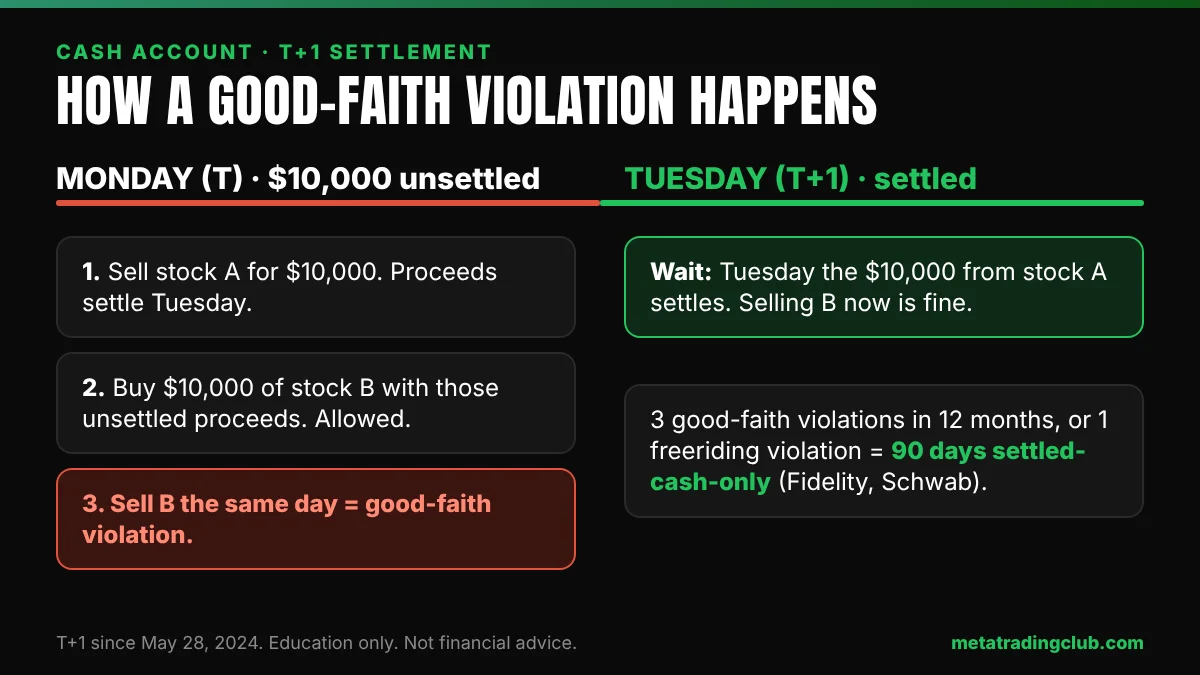
- Good-faith violation: you buy a stock with unsettled sale proceeds, then sell it before those proceeds settle. Three in 12 months restricts you to settled cash for 90 days at Fidelity and Schwab (Fidelity, Schwab).
- Freeriding: you buy and sell a security before paying for it at all. It isn’t permitted under Regulation T, and it may require your broker to freeze the account for 90 days, meaning you must fully pay for any purchase on the trade date (Investor.gov). One freeriding violation can trigger that 90-day restriction.
In practice, a cash account lets each dollar of settled cash make one round trip per settlement cycle. With $10,000 settled, you can buy and sell $10,000 of stock on Monday. Monday’s sale proceeds settle Tuesday, so the next full round trip happens Tuesday. For a selective day trader, that is a built-in brake on overtrading.
What replaced the pattern day trader rule in margin accounts?
For years, a margin account flagged as a pattern day trader (four or more day trades in five business days) needed $25,000 in equity. That’s gone. The SEC approved FINRA’s amendments to Rule 4210 on April 14, 2026 (SEC order, Release No. 34-105226), and FINRA set the effective date as June 4, 2026, with firms allowed to phase in until October 20, 2027 (FINRA Regulatory Notice 26-10). Our full breakdown is in what is a pattern day trader.
What the new intraday margin rule actually does
- Removed: the pattern day trader designation, the day-trading buying power calculation and the $25,000 minimum.
- Added: an intraday margin level: roughly, the cash you could withdraw (or would need to deposit) and still meet maintenance margin, measured after trades that reduce it. It applies to standard margin accounts, whether you day trade or not.
- Deficits: if you fall short intraday, you must cover the deficit as promptly as possible. An unmet deficit lapses after the 15th business day.
- The penalty: if you make a practice of not covering deficits and one is still open at the close of the 5th business day, the firm must block new short positions or debit balances for 90 calendar days (or until it’s covered). Deficits up to the lesser of 5% of equity or $1,000 don’t count toward that practice.
- Unchanged: regular maintenance margin, and the $2,000 minimum equity to trade on margin.
Checked November 2026 against FINRA Regulatory Notice 26-10 and the SEC approval order. Some brokers may run the old PDT checks until their phase-in ends; ask yours.
One honest caution: removing the $25,000 floor makes it easier to day trade a small margin account. It doesn’t make it safer. If you’re sizing up what a small account can realistically do, read how much money you need to day trade first.
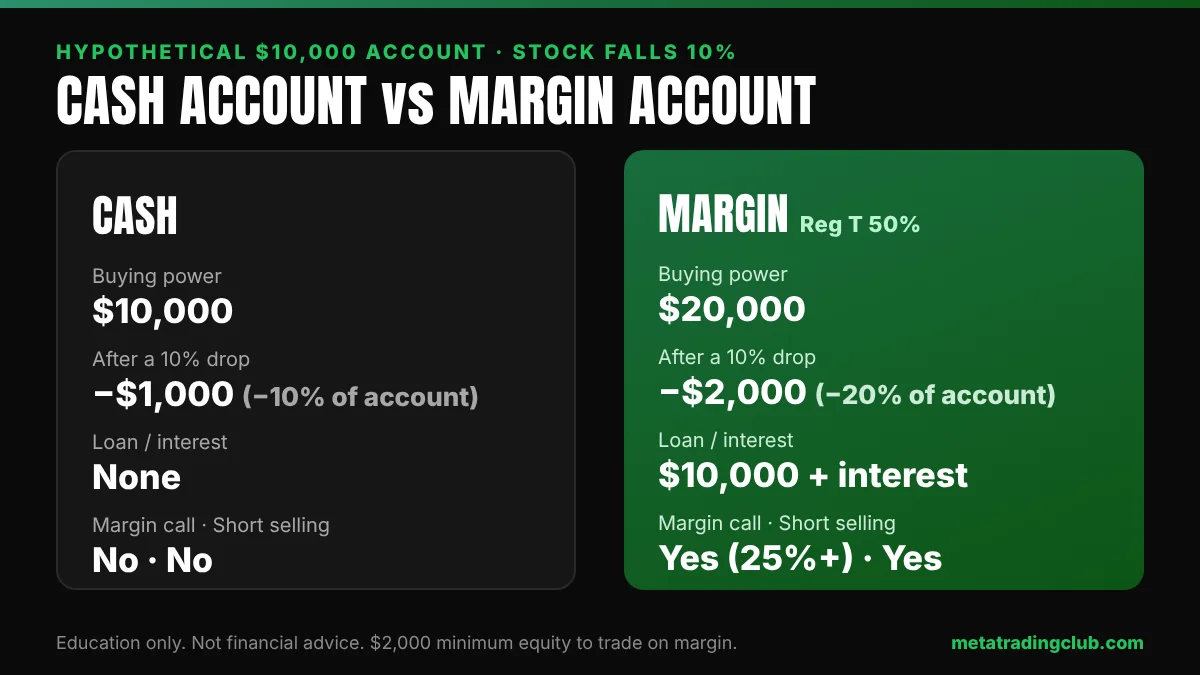
How much can you lose on margin? A $10,000 example
Same trader, same stock, same 10% drop, two account types.
MTC Analysis · Hypothetical example
$10,000 account, fully invested, stock falls 10%
Cash account
- Buying power: $10,000. Position: $10,000.
- After a 10% drop: position worth $9,000.
- Loss: $1,000, or 10% of the account. No loan, no interest, no margin call.
Margin account (Reg T 50%)
- Buying power: $20,000. Position: $20,000 ($10,000 yours + $10,000 loan).
- After a 10% drop: position worth $18,000. You still owe $10,000.
- Equity: $8,000. Loss: $2,000, or 20% of the account, before interest.
- Equity is $8,000 ÷ $18,000 = 44.4% of the position, above the 25% FINRA maintenance minimum, so no margin call yet.
Where the margin call starts
- At 25% maintenance: equity hits 25% when the position falls to $13,333 (a 33.3% drop). Equity left: $3,333.
- At a 40% house requirement: the call comes at $16,667 (a 16.7% drop).
The same 10% move cost twice as much of the account. And the broker doesn’t have to warn you: Investor.gov notes your firm can sell your securities without consulting you, and that you can lose more than you invested (Investor.gov). How that plays out step by step is in what is a margin call.
Here’s the part most traders miss. If your plan risks 1R per trade, and in our track record 1R = 2% of the account, that’s $200 on $10,000 in both accounts. Margin doesn’t change your R. It only changes how big a position you are able to hold, which is exactly why position sizing for day trading matters more on margin, not less.
Margin raises the ceiling on what you can buy, never the limit on what you should risk.
Which account should you trade in?
A cash account tends to fit if:
- You’re still building a process and want a hard cap on losses.
- You mainly buy calls and puts, or sell covered calls.
- You trade a few quality setups a day, not dozens.
- You don’t want a loan, interest or a broker selling your positions for you.
A margin account tends to fit if:
- You need to short stocks, or trade spreads and other strategies that require option writing.
- You want to reuse capital the same day without waiting for settlement.
- You already size every trade by risk, not by buying power, and you’d never max out the loan.
- You understand that a gap through your stop can mean losses past your deposit.
A middle path: open a margin account but trade it like a cash account, sizing by risk and leaving the borrowing power unused. Note that some brokers won’t allow option spreads in a cash account at all: at Fidelity, for example, option writing other than covered calls isn’t permitted there (Fidelity).
For Canadian readers: If you trade from Canada, check your broker’s own day-trading and margin rules for US stocks. Registered accounts have their own limits, covered in trading options in Canada.
How do we handle account choice at Meta Trading Club?
I’ve traded for 8+ years, and the account question comes up constantly with the 600+ traders we’ve trained since 2021. Our answer is always the same: the account type sits at the very end of the process, not the start.
Every trade we take in live sessions (Monday, Tuesday, Thursday and Friday) goes through the Alignment Engine: Bias → Zone → Reaction → Confirmation → Execution. The first four steps decide whether a trade exists. Only at Execution do cash and margin matter, because that’s where size is set. A setup that passes all five steps gets a Qualification grade (A+, A or B), and the grade, not the buying power on screen, sets how much we risk.
If you want to see the sizing side in numbers, our position size calculator turns your stop distance and risk into a share count in a few seconds.
No alignment, no trade.
Frequently asked questions
Sources: FINRA Regulatory Notice 26-10; SEC approval order, Release No. 34-105226 (Federal Register, April 17, 2026); FINRA Rule 4210; Investor.gov, Understanding Margin Accounts; Regulation T, 12 CFR 220.12; Investor.gov, New T+1 Settlement Cycle; SEC press release 2024-62; Investor.gov, Trading in Cash Accounts; Schwab, Trading in Cash Accounts; Fidelity, Cash account trading and freeride restrictions. Rules checked November 2026.
Featured image: AI-edited from a public-domain photo of the Federal Reserve’s Eccles Building (Federal Reserve, via Wikimedia Commons).
Education only. Not financial advice. Margin and settlement rules can change and brokers can set stricter terms; confirm with your broker.