Is trading mentorship worth it? Only when feedback is your bottleneck. If you already know the rules but keep breaking them, a mentor who reviews your real trades can show you what you can’t see. If you still need the basics, or want someone to tell you what to buy, it isn’t worth paying for.
Let me say the uncomfortable part first: you can learn almost every trading concept for free. Market structure, risk management, position sizing, stop placement. It’s on YouTube, in books, and on this blog. Information is cheap. If information were what held traders back, far more people would trade well than actually do.
The gap between knowing and doing is the only thing a mentor can really sell you. Whether that’s worth paying for depends on what’s broken in your trading right now.
Key takeaways
- Mentorship pays off for one problem: you know the rules, but you can’t see why you keep breaking them.
- If you’re missing information, a book, a course or free content is the cheaper fix.
- If you want someone to think for you, no mentor helps. Signal services just rent you their answers.
- A real mentor reviews your trades, teaches a process you can run alone, and leads with risk.
- Walk away from anyone selling easy profits, lifestyle photos or “only a few spots left”.
What is actually holding your trading back?
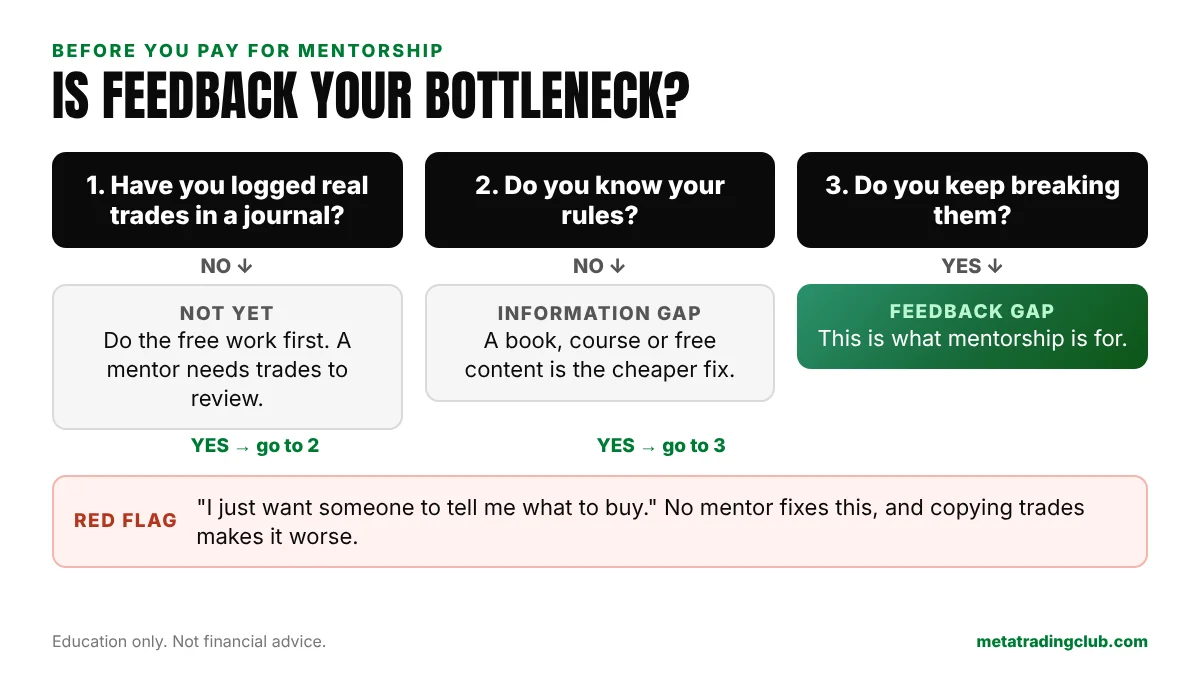
Every struggling trader is stuck on one of two things: information or feedback. From the inside they feel the same. They need opposite fixes.
An information bottleneck means you don’t know something yet. You’ve never learned how to size a position or read market structure. The fix is cheap: go learn it.
A feedback bottleneck is different. You know the concepts. You could explain risk management to a friend. But you still move stops, revenge trade and take setups that don’t meet your own rules. That isn’t missing information. It’s missing feedback, and feedback is the one thing you can’t search for.
The bottleneck test
“I don’t understand what makes a setup valid.”
Information. A course or free content fixes this.
“I know the rules, but I keep breaking them.”
Feedback. This is what mentorship is for.
“I just want someone to tell me what to buy.”
Neither. No mentor can fix this, and copying trades makes it worse.
Be honest about which line sounds like you. If it’s the first, save your money and go read. If it’s the second, mentorship can earn its price. If it’s the third, keep reading, because that’s the harder conversation.
When is a trading mentor a waste of money?
Two situations.
You haven’t put in any reps yet. A mentor can’t give feedback on trades you haven’t taken. You’d pay mentorship prices to learn material you could get for free. Do the free work first and build a record, even a small losing one, in a trade journal. Then feedback has something to work with.
What you really want is to stop thinking. If the hope is to pay someone so you can copy their entries and exits, mentorship won’t help. Neither will anything else. The CFTC warns that trading signal products “often come with hidden costs”, and that “there is no such thing as a risk-free investment” (CFTC). We cover the deeper problem in why signal groups fail.
A signal answers one trade; the skill to read the market answers every trade after it.
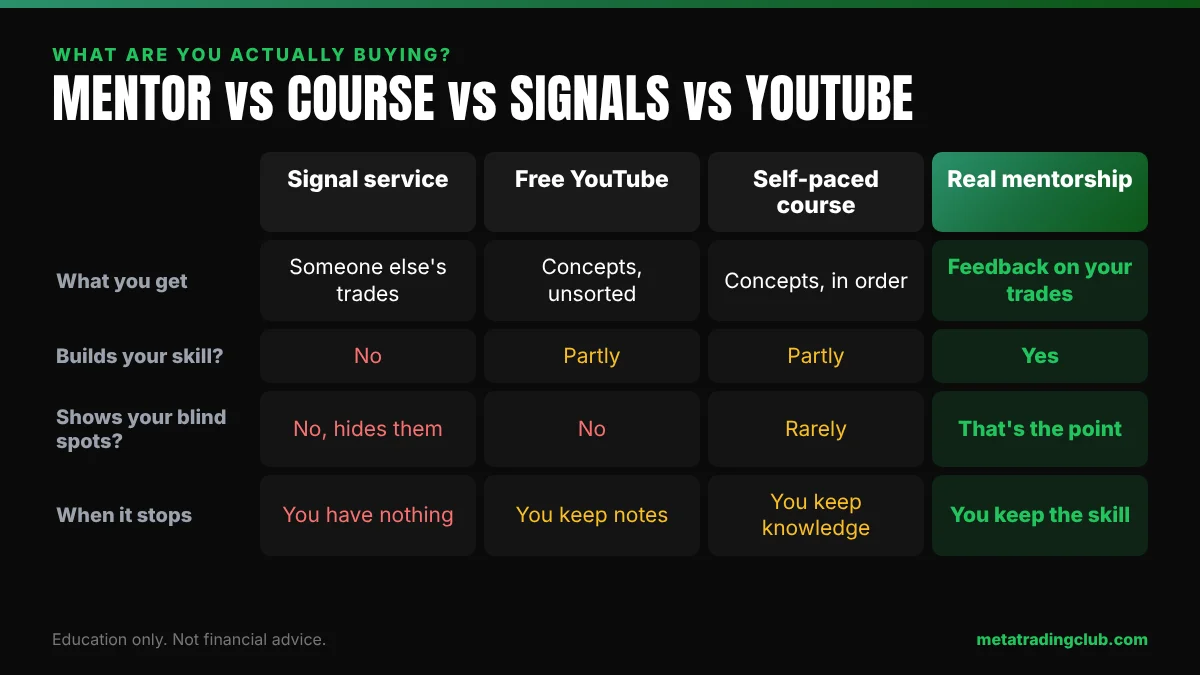
Mentor vs course vs signals vs YouTube: what are you buying?
These get lumped together, but they solve different problems.
| Signal service | Free YouTube | Self-paced course | Real mentorship | |
|---|---|---|---|---|
| What you get | Someone else’s trades | Concepts, unsorted | Concepts, in order | Feedback on your trades |
| Builds your skill? | No | Partly | Partly | Yes |
| Shows your blind spots? | No, it hides them | No | Rarely | That’s the point |
| When it stops | You have nothing | You keep the notes | You keep the knowledge | You keep the skill |
| Best for | Nobody trying to learn | Information gaps | Information gaps, faster | Feedback gaps |
Notice the pattern. A signal service works best for the seller when you never learn to trade on your own. Good mentorship is the opposite: it should make itself unnecessary. If a program isn’t trying to work itself out of a job with you, it’s a subscription to someone else’s opinions.
What does good trading feedback look like?
Trading is one of the few skills where you can do everything wrong and still win one trade, or do everything right and still lose one. The outcome of a single trade tells you very little about whether your process was good.
That’s why solo traders plateau. They can’t tell a bad decision that worked from a good decision that lost. So they keep the habits that got lucky and drop the ones that were sound. A mentor’s real job is to look at your decisions, separate process from outcome, and point at the leak you keep repeating.
Here’s what that looks like on paper.
MTC Analysis · Hypothetical example
One journal, two stories
A trader logs 20 trades in R and finishes at +1R. Their conclusion: “my strategy barely works, I need a new one.” A reviewer splits the same 20 trades by whether the plan was followed:
- 14 trades by the plan: 7 winners × +2R = +14R. 7 losers × −1R = −7R. Net +7R.
- 6 trades off the plan (stop moved, step skipped): 2 winners × +1R = +2R. 4 losers × −2R = −8R. Net −6R.
- Total: +7R − 6R = +1R.
The strategy wasn’t the problem. Six off-plan trades gave back almost everything the other 14 made. A new strategy wouldn’t fix that. Seeing the split would. That outside read is the product.
The −2R losers matter most. A loss bigger than 1R usually means a stop was moved or never set. That’s a discipline problem, not a strategy problem. Our pillar guide on how pre-set exit rules beat emotional decisions goes deeper on exactly this leak.
How does a mentor review a trade with a process?
Feedback only helps if it’s measured against something. “That felt early” isn’t feedback. “You skipped step 4” is. At Meta Trading Club, we review trades against the Alignment Engine, our 5-step process:
- Bias: did you know which direction you favoured before the open, and why?
- Zone: did price reach a Zone you marked in advance, or did you chase it mid-move?
- Reaction: did price actually react at the Zone, or did you assume it would?
- Confirmation: did you wait for confirmation, or enter on hope?
- Execution: was the stop set before entry, and was the size right for the setup?
Setups that pass all five get a Qualification grade (A+, A, B and so on), and the grade sets how much risk the trade is allowed. Go back to the hypothetical journal: each of the six off-plan trades breaks at a specific step. Once you can name the step, you can fix it. That’s what makes a process teachable, and why a mentor without one can’t hand you much.
How do you judge a mentorship before you pay?
Run any program through these five questions. If it fails more than one, keep your money.
- Does it look at YOUR trades? If there’s no way for someone to review your actual decisions, it’s a course. Price it like one.
- Is the goal independence? Ask what “done” looks like. If the honest answer is “you stay subscribed forever,” that’s a dependency model.
- Is there a repeatable process? “I just feel the market” can’t be taught. You want a framework you can run without them.
- Does it teach risk before entries? The SEC’s investor alert on trading seminars puts it plainly: “Trading strategies are not ‘simple’ or ‘easy'” (Investor.gov). Anyone leading with profits instead of risk is selling a story.
- Are the claims honest? The same alert flags “only a few spots left” pressure and warns that past trading success doesn’t predict future success. NASAA adds that if a finfluencer only promotes their “amazing” results, they’re likely too good to be true, and that finfluencers should disclose compensation they receive (NASAA). The CFTC lists photos of exotic vacations, sports cars and mansions as a common lure.
If you’re comparing specific providers in Canada, our guide to trading mentorship in Canada walks through what to look for and what to avoid.
How do we handle mentorship at Meta Trading Club?
We started Meta Trading Club in Toronto in November 2021. I’ve been trading for 8+ years, and we’ve trained 600+ traders since then. Here’s what that looks like day to day:
- Premarket prep every market day, so Bias and Zones are set before the open, not during it.
- Live trading sessions 4 days a week (Mon, Tue, Thu, Fri), where the Alignment Engine is run out loud on real charts.
- Every trade on our track record is logged in R (1R = 2% account risk), losses included, so the process is judged on many trades, not one.
Our mentorship program, the Incubator, is application-based. If you’ve done the reps and feedback is your bottleneck, you can apply for the Incubator here. If you’re not there yet, start with the free lesson and build your journal first.
So, is trading mentorship worth it?
Worth it if: you’ve put in reps, you know the concepts, and you keep repeating mistakes you can’t see. Feedback is your bottleneck, and it’s the one thing you can’t get cheaply anywhere else.
Not worth it if: you haven’t done the free work yet, or what you really want is for someone to think for you. A mentor can teach a person who’s trying to learn. They can’t help a person trying to outsource.
Whichever path you pick, pick the one that makes you more independent, not less. No alignment, no trade.
Frequently asked questions
More on the discipline side: our trading psychology FAQ.
Sources: Investor.gov (SEC), Investor Alert: Investment Seminars, Trading Seminar Scams; CFTC, Customer Advisory: There’s Nothing to Like About Scammers on Social Media; NASAA, Informed Investor Advisory: Financial Advice via Social Media, the Rise of the “Finfluencer”. All checked November 2026.
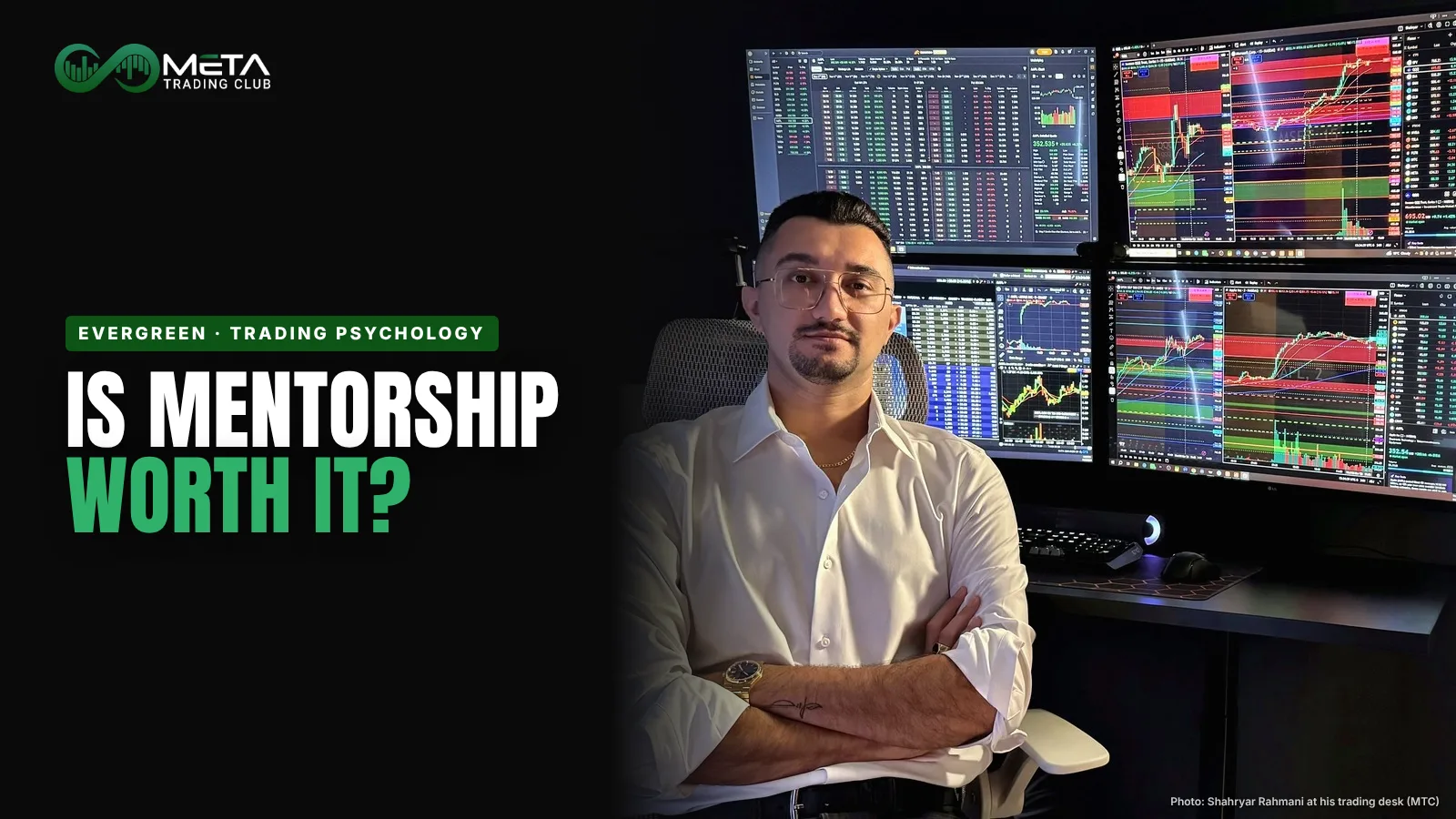
Featured image: photo of Shahryar Rahmani at his trading desk (Meta Trading Club).
Education only. Not financial advice. Trading involves risk, including loss of capital.