Yes, you can day trade in a TFSA. It’s not illegal, and most Canadian brokers will let you place the trades. The problem is tax. If the CRA decides your TFSA trading is a business, the profits stop being tax-free. And you can be on the hook for that bill personally.
Here’s how it actually works, and how to set up your accounts so this never becomes your problem.
Why day trading in a TFSA is a tax risk
A TFSA normally pays no tax on its gains. But the Income Tax Act has an exception: if the TFSA is “carrying on a business,” the income from that business is taxable (s. 146.2(6)).
Frequent, short-term trading is exactly what the CRA looks at when it decides something is a business.
One more thing most people miss. Since the 2019 federal budget, the TFSA holder is jointly and severally liable with the account for that tax (s. 146.2(6.1)). In plain English: if the TFSA can’t cover the bill, the CRA can come after you.
What the CRA looks at
There’s no magic number of trades. The CRA doesn’t publish a trade-count threshold. It looks at the overall pattern, including:
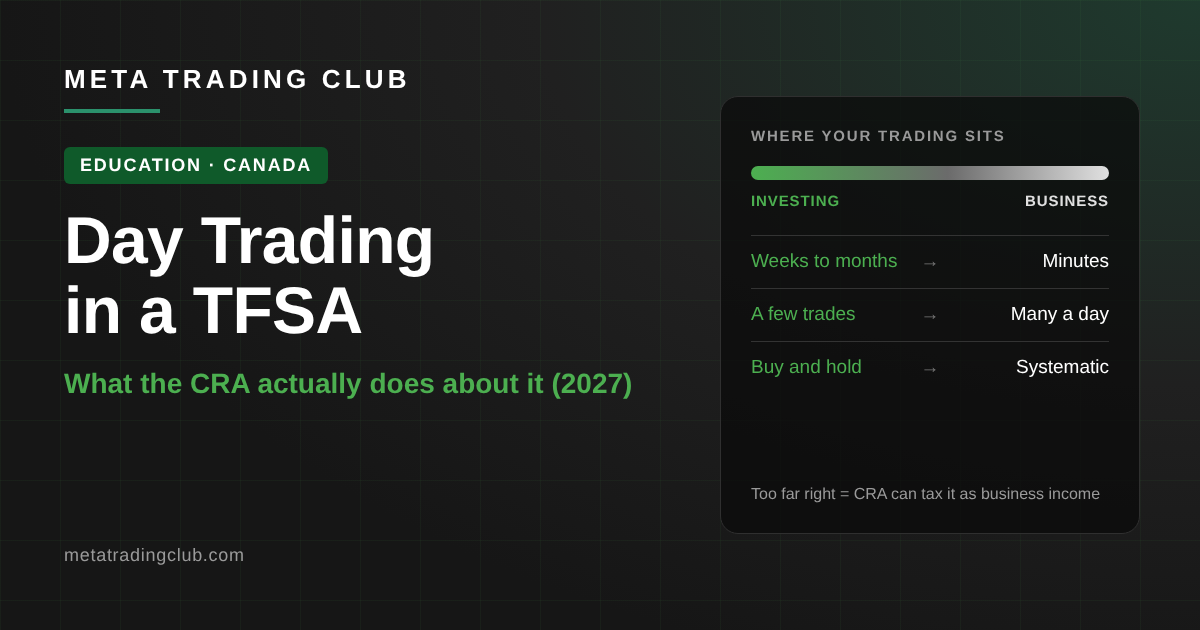
Where your TFSA trading sits
The further right you are on most rows, the more it looks like a business to the CRA.
There is no trade-count cutoff. CRA weighs the whole pattern.
No single factor decides it. It’s the combination. And the more skilled and serious you get, the more your trading starts to look like a business — which is the irony for anyone actually getting good at this.
The case that settled it: Ahamed
Fareed Ahamed traded actively in his TFSA from 2009 to 2013. The CRA said it was a business and taxed it. He fought it.
The Tax Court sided with the CRA in 2023. The Federal Court of Appeal dismissed his appeal on June 11, 2024 (2024 FCA 108). The court confirmed that business income earned by a TFSA is taxable, and that the RRSP-style exemption doesn’t apply to TFSAs.
The Ahamed case, start to finish
- 2009–2013Active trading inside his TFSA
- 2023Tax Court sides with the CRA
- Jun 11, 2024Appeal dismissed (2024 FCA 108)
Result: business income earned in a TFSA is taxable. That’s the law today.
“Everyone does it” is not a defence.
What happens if the CRA reassesses you
- Your TFSA trading profits get taxed as business income — fully taxable, not at the 50% capital gains rate
- Interest and possibly penalties get added if past years are reassessed
- Losses inside a TFSA can never be claimed against other income
And brokers report TFSA activity to the CRA, so large TFSA gains are easy to spot.
TFSA room in 2027
The 2027 TFSA limit is expected to be $7,500, up from $7,000 in 2026. As of early October 2026, the CRA had not confirmed it yet (Waypoint). If you’ve been eligible since 2009 and never contributed, that would put your total room at $116,500 on January 1, 2027.
TFSA limit by year, 2009–2027
Green = 2026. Striped = 2027, expected but not yet confirmed by CRA.
Total room since 2009: $109,000 in 2026 → $116,500 in 2027*.
*2027 figure is the expected amount. Sources: TFSA limits 2009–2026; 2027 expected per Waypoint (Oct 2026).
We’ll update this page as soon as the CRA confirms the 2027 limit.
What to do instead
This is how we set it up with traders at Meta Trading Club:
The two-account setup
Non-registered account
- Cash or margin
- Profits taxable, losses deductible
- No TFSA reassessment risk
TFSA
- Swing trades and longer holds
- Low turnover
- Gains stay tax-free
- Day trade in a non-registered account. Cash or margin. Your profits are taxable, but your losses are deductible too, and there’s no surprise reassessment of your TFSA.
- Use your TFSA for slower trades. Swing trades and longer holds, where you’re not turning positions over every day.
- Keep a trade journal. Entry, exit, size, reason. If the CRA ever asks, you have records — and you’ll trade better anyway.
- Talk to an accountant once you’re trading often. Especially before you move serious money into active trading.
The real goal isn’t to dodge rules. It’s to build a process that’s repeatable — so your results come from structure, not luck.
Find your trading style first
Most traders don’t fail because of taxes. They fail because they have no process for when to enter, when to exit and how much to risk. Start by finding the trading style that fits your schedule and psychology.
At Meta Trading Club we’ve trained 600+ traders using the MTC Alignment Engine™, a 5-step process from market bias to execution.
Frequently asked questions
Is day trading in a TFSA illegal?
No. It’s allowed. The risk is that the CRA treats it as a business and taxes the profits.
How many trades count as day trading in a TFSA?
There’s no set number. The CRA looks at frequency, holding periods, your experience and time spent, taken together.
Can the CRA tax my TFSA?
Yes. If your TFSA is carrying on a business, that income is taxable, and you’re jointly liable for the tax.
Can I claim day trading losses in a TFSA?
No. Losses inside a TFSA can’t be deducted against other income.
Can I trade options in a TFSA?
Some strategies, yes. See Can you trade options in a TFSA?
Education only. Not financial advice. General information, not tax advice. Tax rules change; confirm with a qualified professional.