
By Shahryar Rahmani · Meta Trading Club
The prop firm vs trading your own account debate usually gets framed as free money versus real money. That misses the point. Both paths reward the exact same thing — a repeatable process with disciplined risk. The real question isn’t which is better. It’s whether you have an edge worth scaling in the first place.
Prop firm vs trading your own account: which is better?
Neither is universally better. A prop firm caps your downside to an evaluation fee and hands you larger capital, but the firm sets the rules and takes a cut. Trading your own account gives you total freedom and 100% of the upside, but every loss is your own cash and your size is limited by your balance.
The right choice depends less on the accounts and more on you: your capital, your discipline, and whether your process is already consistent. Get that honest, and the decision usually makes itself.
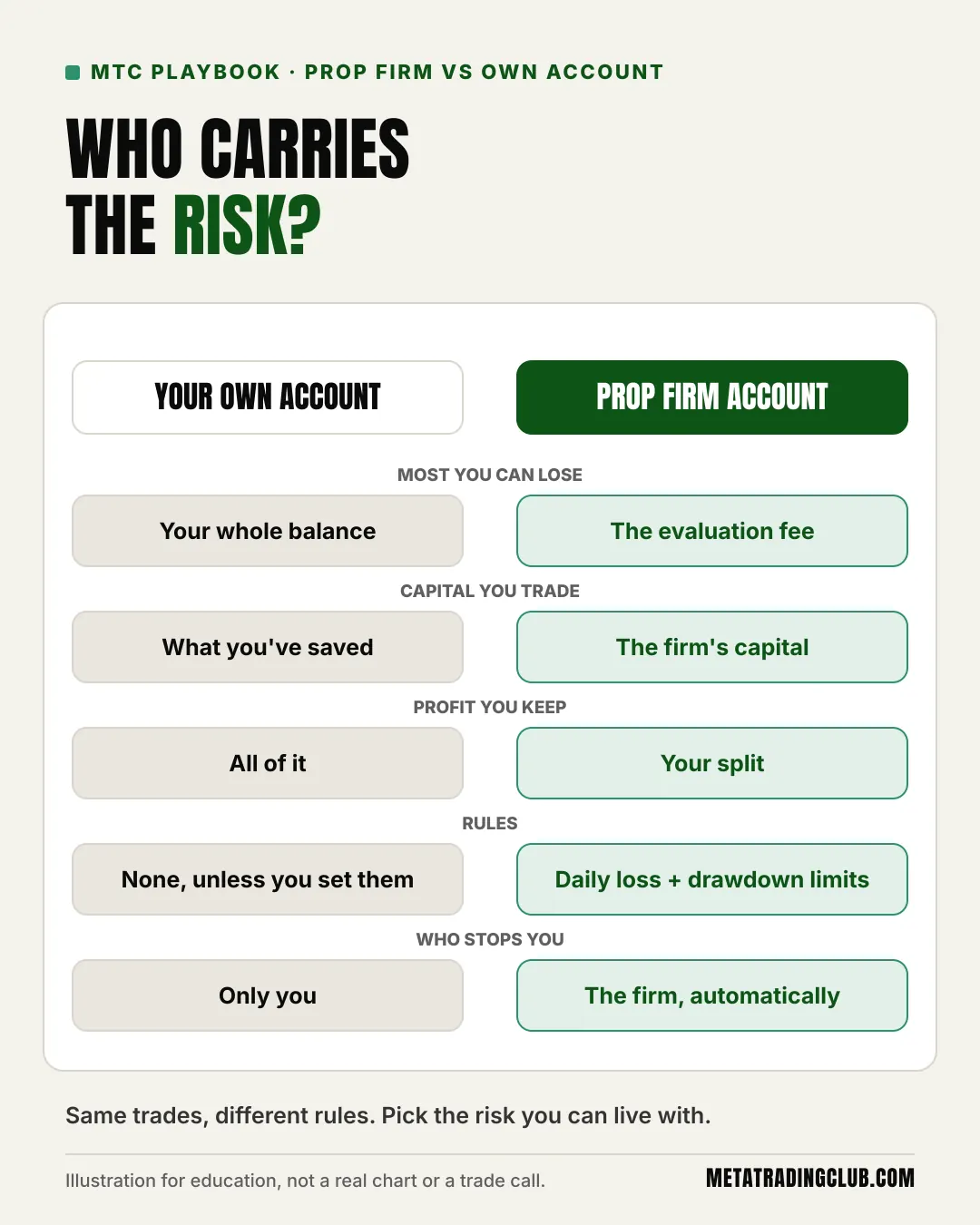
The honest side-by-side comparison
Here’s how the two stack up on the dimensions that actually affect your trading day.
The freedom trade-off most people underestimate
On your own account you answer to no one. That freedom is a double-edged sword: no rules also means no guardrails. A funded account replaces your judgment with a hard rulebook. For an undisciplined trader, that structure can actually help. For a disciplined one, it can feel like a straitjacket.
So the trade-off is really structure vs autonomy. Ask yourself which one your current habits need more of.
The psychology nobody warns you about
Trading a funded account changes how your brain treats risk. Some traders get reckless because “it’s not my money.” Others freeze because a rule breach ends a real income stream. Both reactions come from the same place: the account changed, but the process didn’t come with it.
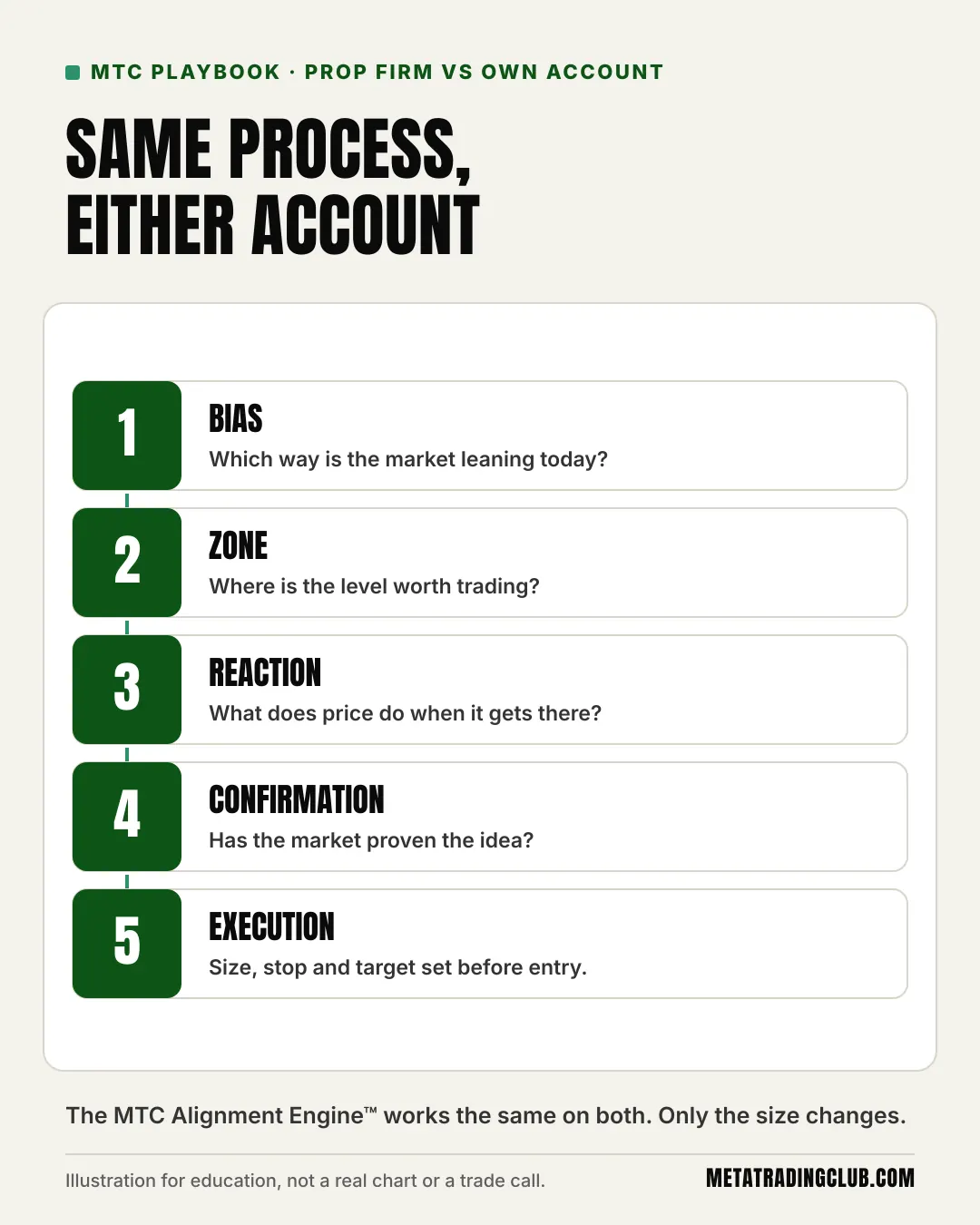
This is the counter-position at the heart of it. A funded account is a tool, not a trading system. Without your own process, a funded account just lets you lose someone else’s money faster — and then you’re out the fee with nothing learned.
The question that actually decides it
Forget “prop firm or my own account” for a second. The question that matters is: do you have a defined edge you can execute the same way, every time, regardless of account size? If yes, a prop firm is a sensible way to scale it with limited downside. If no, neither account will save you — you’ll just lose money faster or slower.
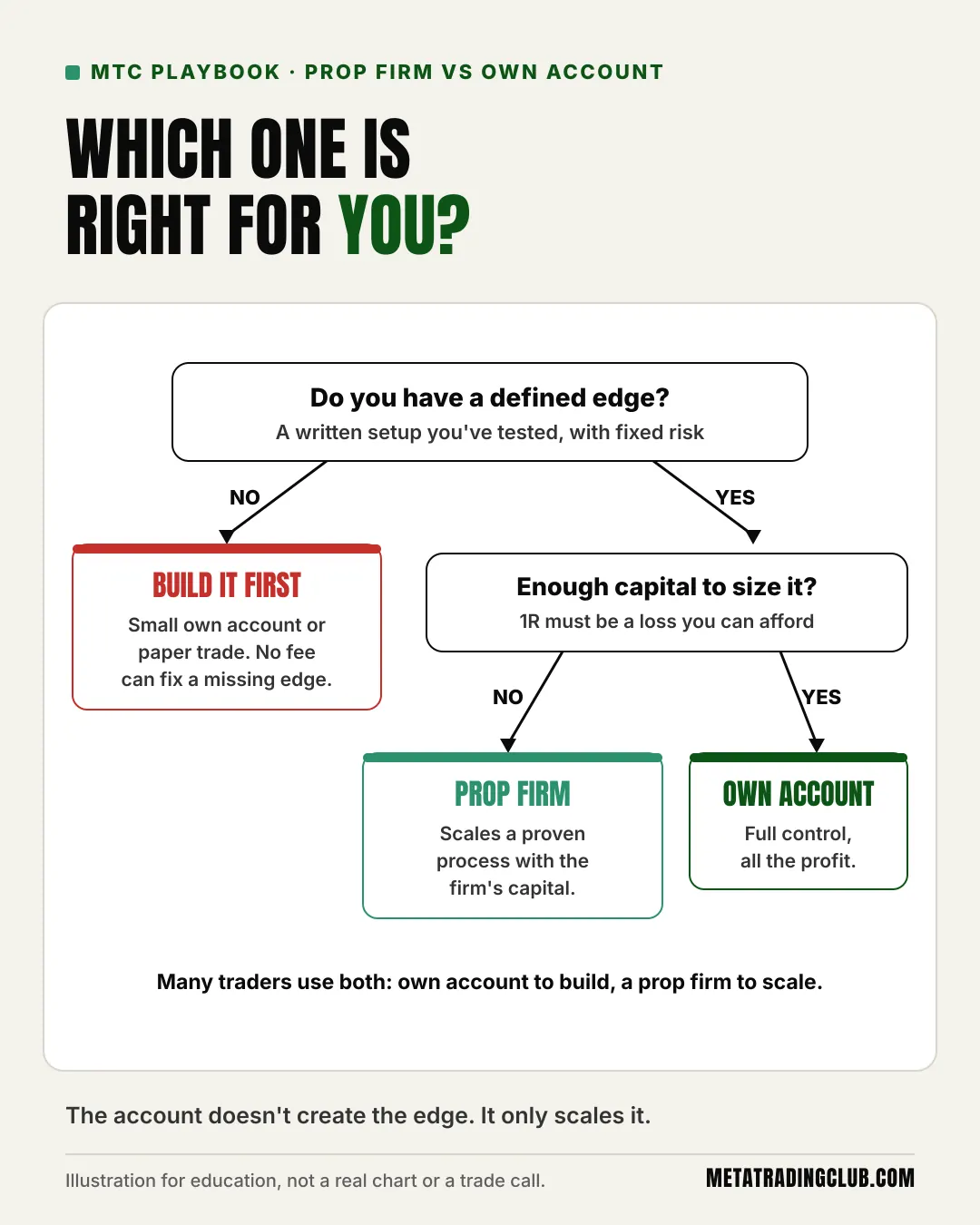
Build the process first. Run every trade through the same filter. Then the account is just a decision about leverage and cost, not a hope for a different outcome.
When a prop firm is the smarter choice
A prop firm makes sense when you already trade a defined setup with real risk management but lack the capital to size it properly. It also fits traders who want a hard external rulebook to keep them honest, and smaller US accounts that would otherwise be boxed in by the pattern day trader minimum. In all three cases the funded account is scaling something that already works.
What a prop firm cannot do is manufacture consistency. If you are still switching strategies or trading on impulse, the evaluation fee is just a faster way to pay for that lesson.
When your own account is the better path
Trading your own account wins when you value total freedom, want to keep every dollar of upside, and have enough capital to size your edge without stress. It is also the right place to learn. There is no substitute for building a process on an account where the rules are yours and the feedback is direct. Once that process is consistent, you can always add funded capital on top of it.
Many serious traders end up running both: a personal account for freedom and long-term holds, and a funded account to scale their intraday edge with capped downside. That is only a good outcome because the process came first.