

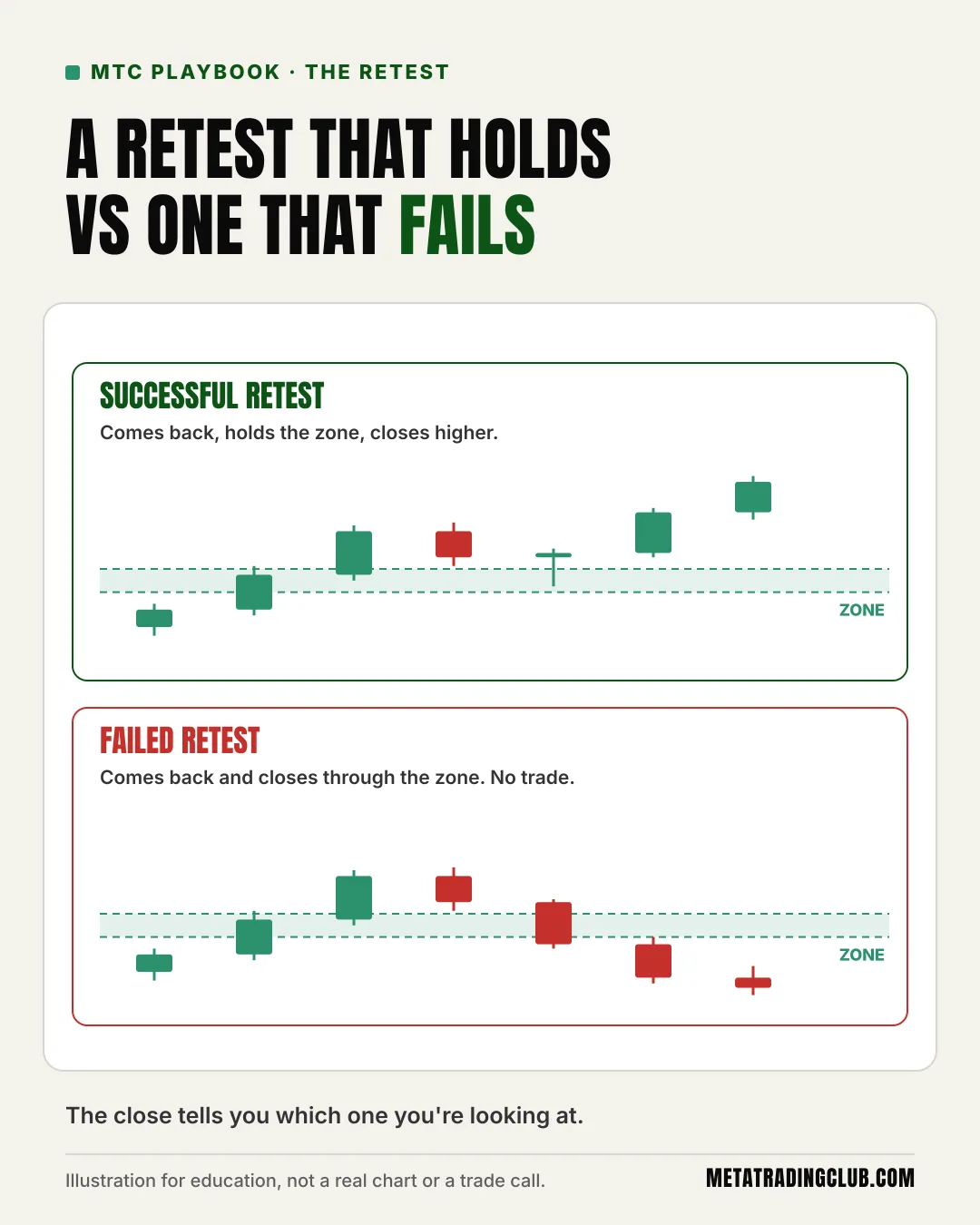
A retest is when price breaks through a key level, then comes back to touch that same level again before continuing. Traders watch retests because they turn a risky breakout into a higher-probability entry: the old resistance that price just broke should now act as support. If it holds, the move is confirmed. If it fails, you know early and get out cheap.
Think of it as the market asking, “Do we really want to be above this level?” A clean retest that holds is the market answering yes — and giving you a defined spot to enter with a tight, logical stop.
What a Retest Actually Tells You
When price breaks a level and never looks back, chasing it means buying the top of a move with no clear stop. A retest gives structure. The broken level becomes your reference point: you enter as price holds it, and you’re wrong the moment price closes back through it. That’s a tight, defined risk instead of a guess.
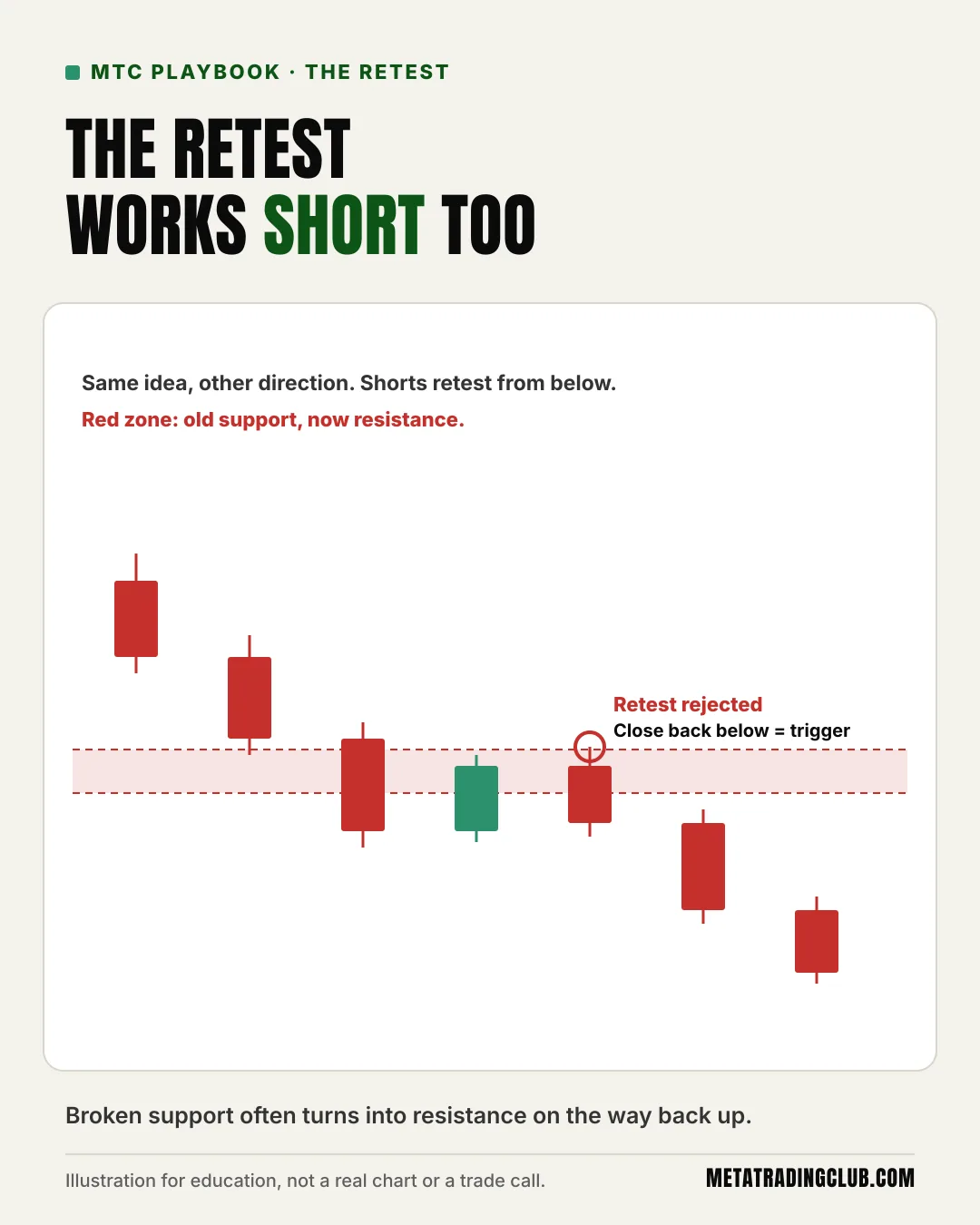
The concept works in both directions. Break support and it often becomes resistance on the way back up — a short retest. Same logic, opposite side.
Retest vs Breakout: Why Waiting Pays
| Chasing the Breakout | Trading the Retest | |
|---|---|---|
| Entry | As price breaks, often extended | On the pullback to the level |
| Stop distance | Wide — no clear invalidation | Tight — just below the level |
| Risk/reward | Worse entry, worse R:R | Better entry, cleaner R:R |
| Trade-off | You never miss the move | Some breakouts never retest |
Not every breakout retests — sometimes the best moves run without you. That’s fine. Trading is about taking the setups where your risk is clearly defined, not catching every move.
How to Trade a Retest: 4 Steps
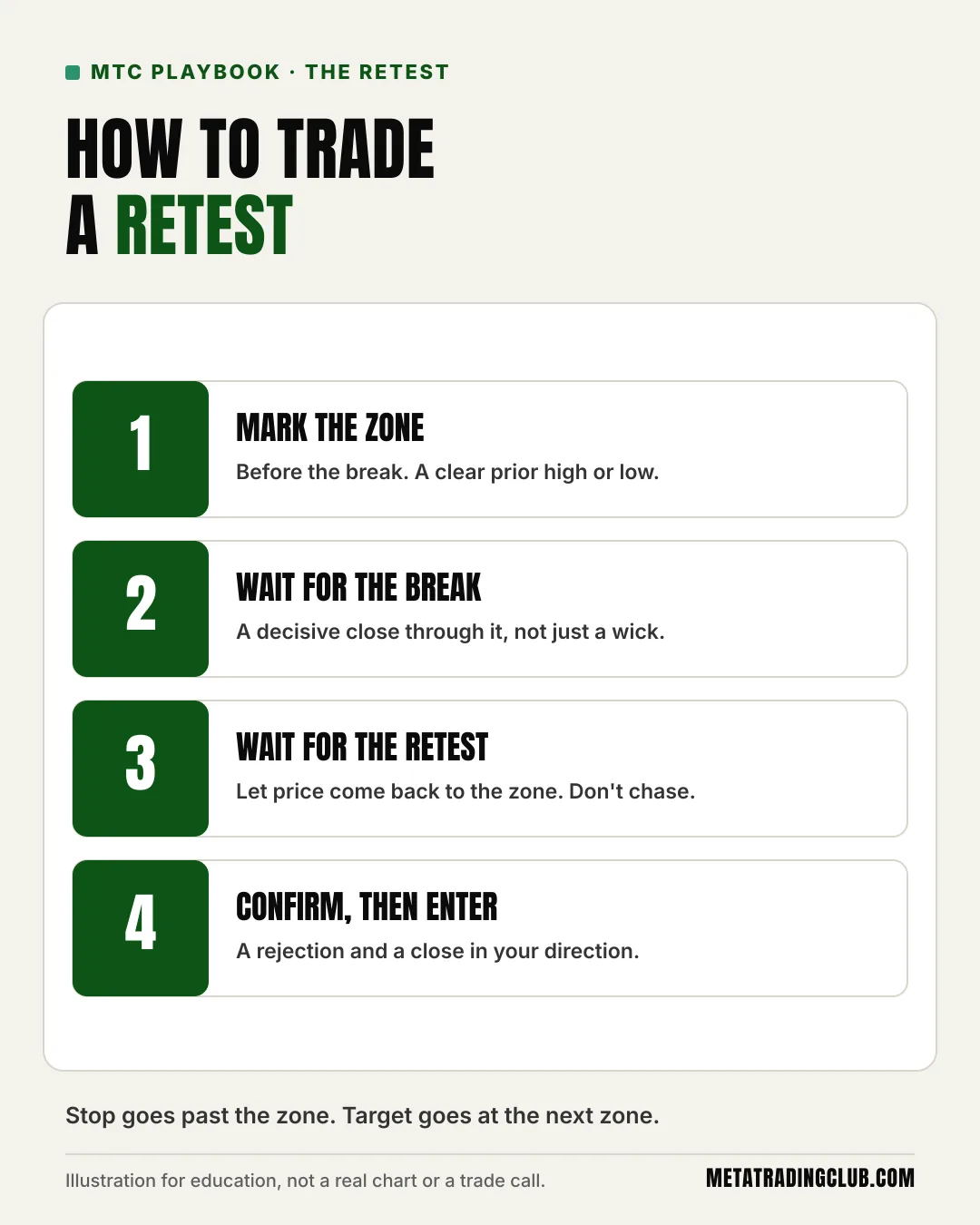
- Mark the level before the break — a clear prior high, low, or range edge.
- Wait for a decisive break, ideally on a closing basis, not a quick wick.
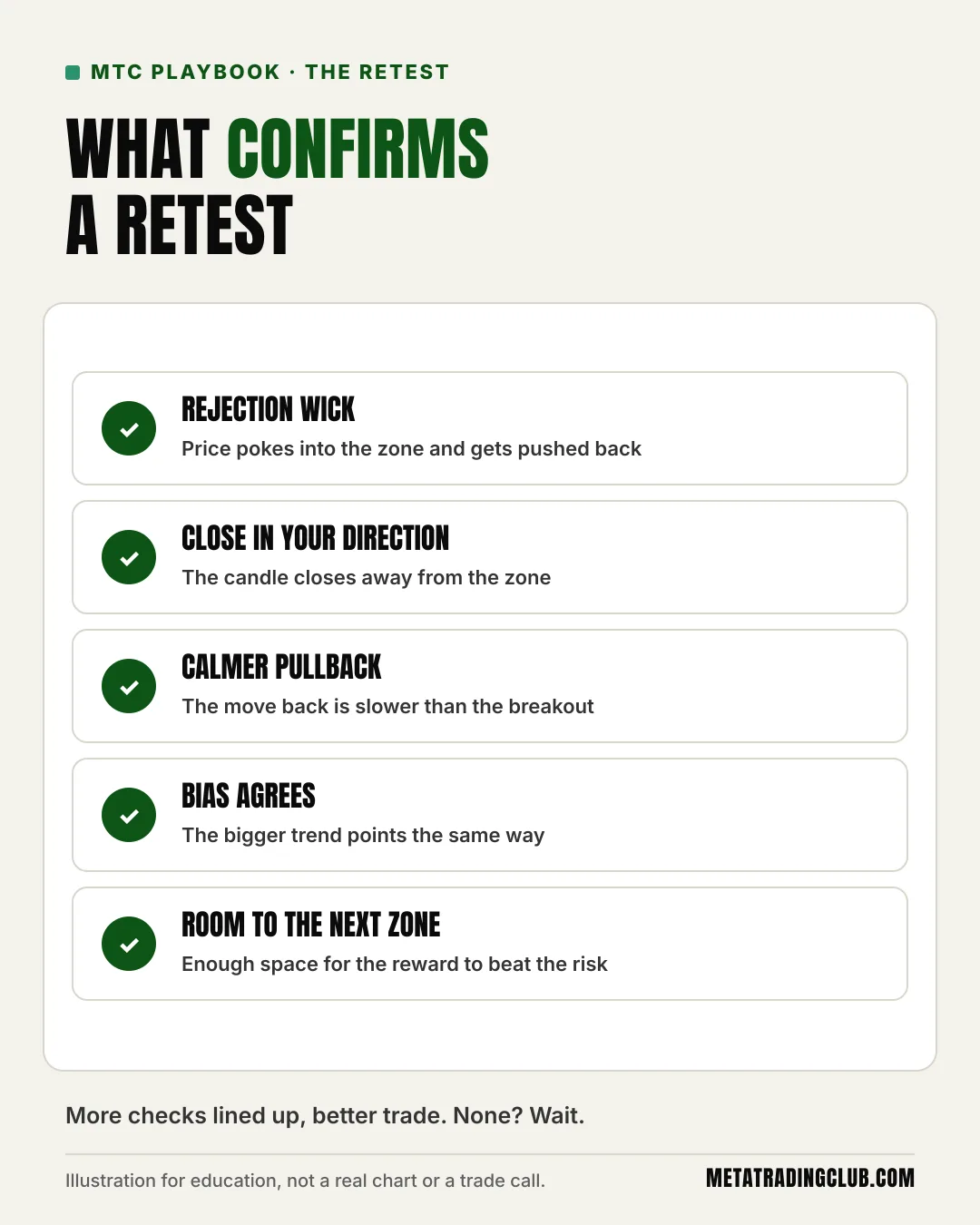
- Let price come back to the level and watch for a reaction — a rejection candle, a slowdown, buyers stepping in.
- Enter on confirmation, stop just beyond the level, target the next structure.
The Retest Is a Confirmation, Not a Guarantee
A retest improves your odds — it doesn’t remove risk. Levels fail. The edge isn’t that the retest always works; it’s that when it fails, you’re out fast for a small loss, and when it works, your entry is clean enough to make the winners pay for the losers.
For the full playbook with more examples, see our breakout and retest strategy. To place the stop, read how to set a stop loss the right way.
Levels Are Only Half the Trade
A retest tells you where. It doesn’t tell you whether the broader bias supports the trade, how big to size, or where to take profit. That’s the difference between spotting a pattern and running a system. At MTC we teach the full sequence — bias, level, reaction, entry, exit — so a retest becomes a complete trade, not just a chart shape.