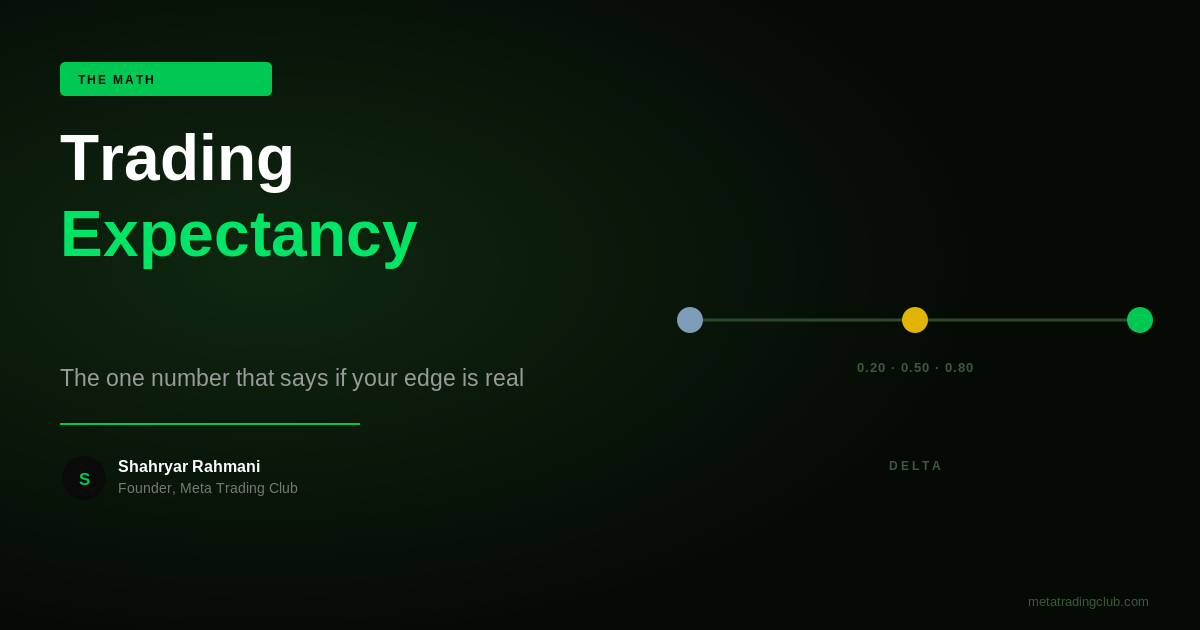
Ask most traders if their strategy works and they’ll point to a recent winner. That’s not evidence — it’s a memory. The real answer lives in one number that combines how often you win with how much you win and lose: expectancy.
Expectancy tells you what you can expect to make, on average, per trade over many trades. It’s the single most honest measure of whether you have an edge or are just riding variance.
The honest number
Expectancy turns ‘I think this works’ into ‘this returns X per dollar risked over many trades.’ Positive means an edge. Negative means you’re paying the market to play.
What Expectancy Actually Measures
Expectancy is your average result per trade, expressed in the units you risk. A simple way to write it: (win rate × average win) minus (loss rate × average loss). If the result is positive, the strategy makes money across a large sample. If it’s negative, no amount of position-sizing tricks will save it.
MTC Analysis
Expectancy in ‘R’ (Multiples of Risk)
Measuring expectancy in ‘R’ — multiples of what you risk per trade — makes strategies comparable. A +0.3R system makes, on average, 30 cents per dollar risked.
Two Systems, Same Win Rate, Different Outcomes
Win rate alone hides the answer. Here are two strategies that both win half their trades — one is a money-maker and one slowly bleeds, purely because of the size of wins versus losses.
MTC Analysis
Expectancy per Trade: Two 50% Systems
Both win 50% of the time. System A wins bigger than it loses (positive expectancy); System B loses bigger than it wins (negative). Identical win rate, opposite fates.
How to Calculate Yours
You need a sample — ideally 50-100 trades from your journal. Compute your win rate, your average winning trade, and your average losing trade, then run the formula. One quarter of honest data tells you more than a year of selective memory.
| Input | Example | Where it comes from |
|---|---|---|
| Win rate | 45% | Wins ÷ total trades |
| Average win | +1.8R | Mean of winning trades |
| Average loss | -1.0R | Mean of losing trades |
| Expectancy | (.45×1.8) − (.55×1.0) = +0.26R | Positive → edge |
That +0.26R means that, on average, this trader earns about a quarter of their risk per trade. Across hundreds of trades with disciplined sizing, that compounds. A single trade tells you nothing; the average over many is everything.
Why This Changes How You Think
Once you trade for expectancy, individual losses stop stinging. A loss isn’t failure — it’s a budgeted cost of a system that wins over time. Your job shifts from ‘win this trade’ to ‘protect the inputs that keep expectancy positive’: defined risk, consistent sizing, and not sabotaging the sample with revenge trades.
- Track enough trades to compute it honestly (50-100+)
- Express results in R so strategies are comparable
- Protect the average; don’t fixate on single trades
- A negative-expectancy system can’t be fixed by sizing
Proprietary Framework
The MTC Alignment Engine™ — Applied Every Live Session
Every trade runs the same five checkpoints — consistency over gut reaction. Inside the MTC Incubator, members build their own system on top of this framework.
Frequently Asked Questions
What is expectancy in trading?
Expectancy is the average amount you can expect to win or lose per trade over many trades. It combines win rate with the average size of wins and losses. Positive expectancy means the strategy makes money across a large sample; negative means it loses.
How do I calculate trading expectancy?
A common form is (win rate × average win) − (loss rate × average loss), usually measured in R (multiples of the amount risked per trade). You need a sample of past trades — ideally 50-100 — to compute it honestly from your own results.
What is a good expectancy?
Any positive expectancy is an edge; the bigger and more stable, the better. Measured in R, even +0.2R to +0.3R can compound meaningfully over many trades with disciplined sizing. The priority is keeping it reliably positive, not maximizing a single number.
Can a strategy with a low win rate have positive expectancy?
Yes. If your winners are large relative to your losers, you can win well under half the time and still have strongly positive expectancy. Win rate and average win/loss size must always be judged together.
Why is expectancy better than win rate?
Win rate ignores the size of wins and losses, so it can be misleading — a high win rate with large losers loses money. Expectancy folds both together into one number that actually reflects whether the strategy is profitable over time.
Related reading
Meta Trading Club Community
Start Your 7-Day Free Trial
Daily live sessions. Real-time market prep — not signals. The MTC Alignment Engine™ applied in front of you. Trade alongside Shahryar from day one.
Cancel anytime. No contracts. Built for Canadian traders.
Already trading and want to build your own system?
The MTC Incubator is an application-based mentorship — 1-on-1 work building a personalized system on the Alignment Engine™.