
Choosing the wrong platform is one of the most expensive beginner mistakes in trading — and most people don’t realize it until they’re already deep into a position and struggling with a clunky interface, high commissions, or limited options tools.
Your platform is not just where you place trades. It’s your workspace. It’s how fast you can act on a setup, how clearly you can read a chart, how efficiently you manage risk. For options traders specifically, the platform choice becomes even more important because options require more than a basic buy/sell interface — you need a chain viewer, Greeks display, multi-leg order routing, and ideally paper trading to practice.
In Canada, the brokerage landscape is more limited than in the US, but there are solid choices depending on your experience and how actively you trade. This guide breaks down the main platforms Canadian options traders use: Interactive Brokers Canada (IBKR), Questrade and TD Direct Investing. It also covers why tastytrade is no longer an option for Canadians. We’ll cover commissions, tools, account types and who each platform suits.
New to options? Here is how to start options trading in Canada, step by step.
The goal isn’t to tell you which platform is ‘the best’ in some absolute sense — it’s to help you make an informed decision based on where you are right now and what your trading style demands.
Why Platform Choice Matters More for Options Traders
For someone buying and selling stocks, most platforms are functionally similar. You enter a ticker, hit buy, set a limit, done. The differences are marginal.
Options trading is different. Here’s why the platform gap matters more:
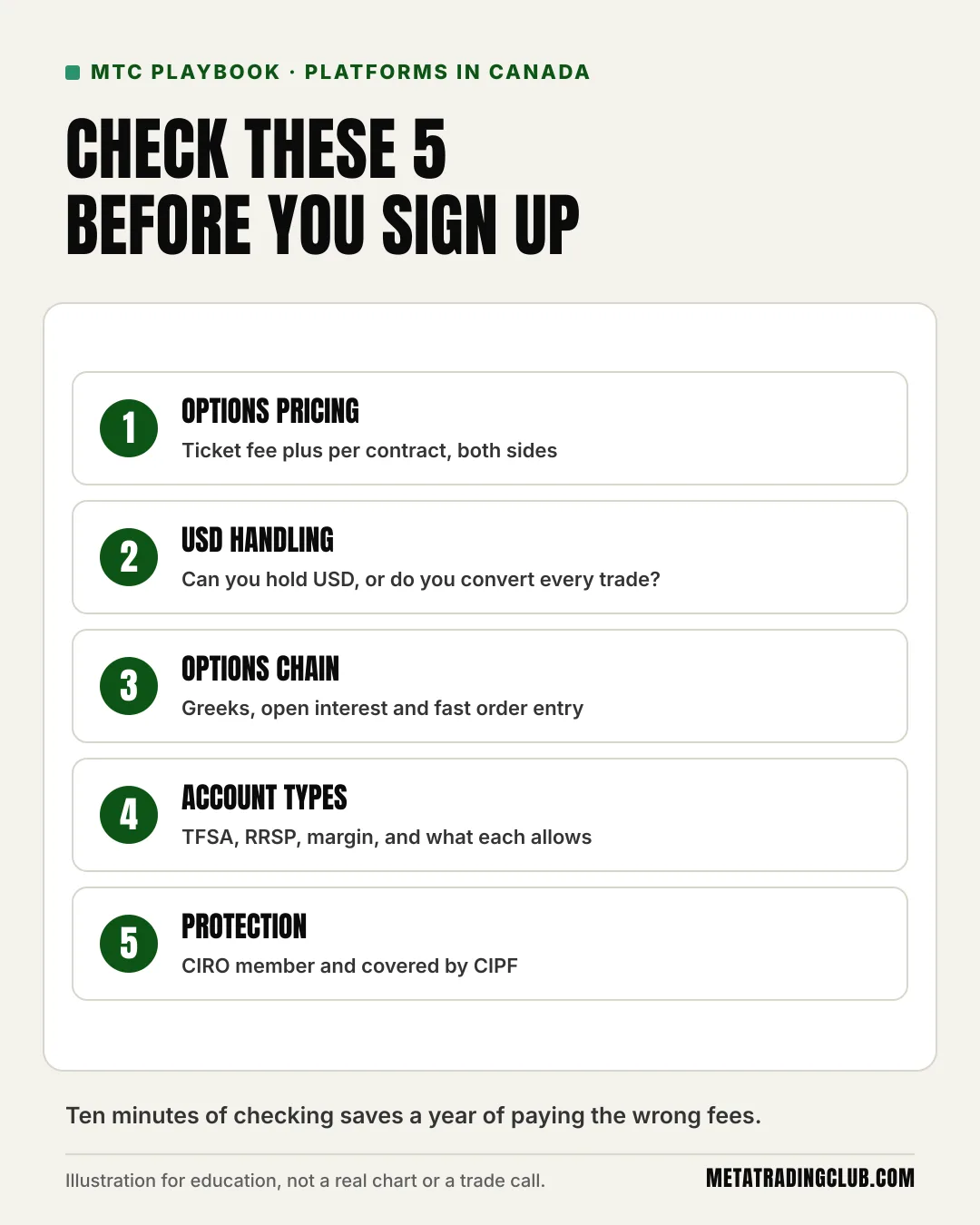
Commissions compound quickly. If you’re actively trading options and paying $9.95 per leg on some legacy bank platform, that cost destroys your edge on smaller trades. A $1 wide vertical spread traded 3 times a week costs you close to $6,000/year in commissions alone at that rate. On a per-contract pricing model, the same activity might cost a fraction of that.
Tools affect decision quality. A platform with a clean options chain, visual P&L diagrams, and real-time Greeks gives you information you can act on. A platform that hides Greeks behind extra clicks or doesn’t show implied volatility rank is actively working against you.
Order types matter. Multi-leg strategies — spreads, strangles, iron condors — require platforms that support them natively. If you’re manually legging into spreads on a platform that doesn’t support combo orders, you’re adding execution risk every single time.
Account structure is uniquely Canadian. In Canada, we have TFSAs and RRSPs, and the rules around trading options inside these accounts are restrictive. Understanding which strategies are allowed — and which platforms support them cleanly — is essential.
The Main Options Trading Platforms in Canada
Interactive Brokers Canada (IBKR)
Some links in this section are referral links. If you open an account through them, MTC may earn a referral bonus at no extra cost to you.
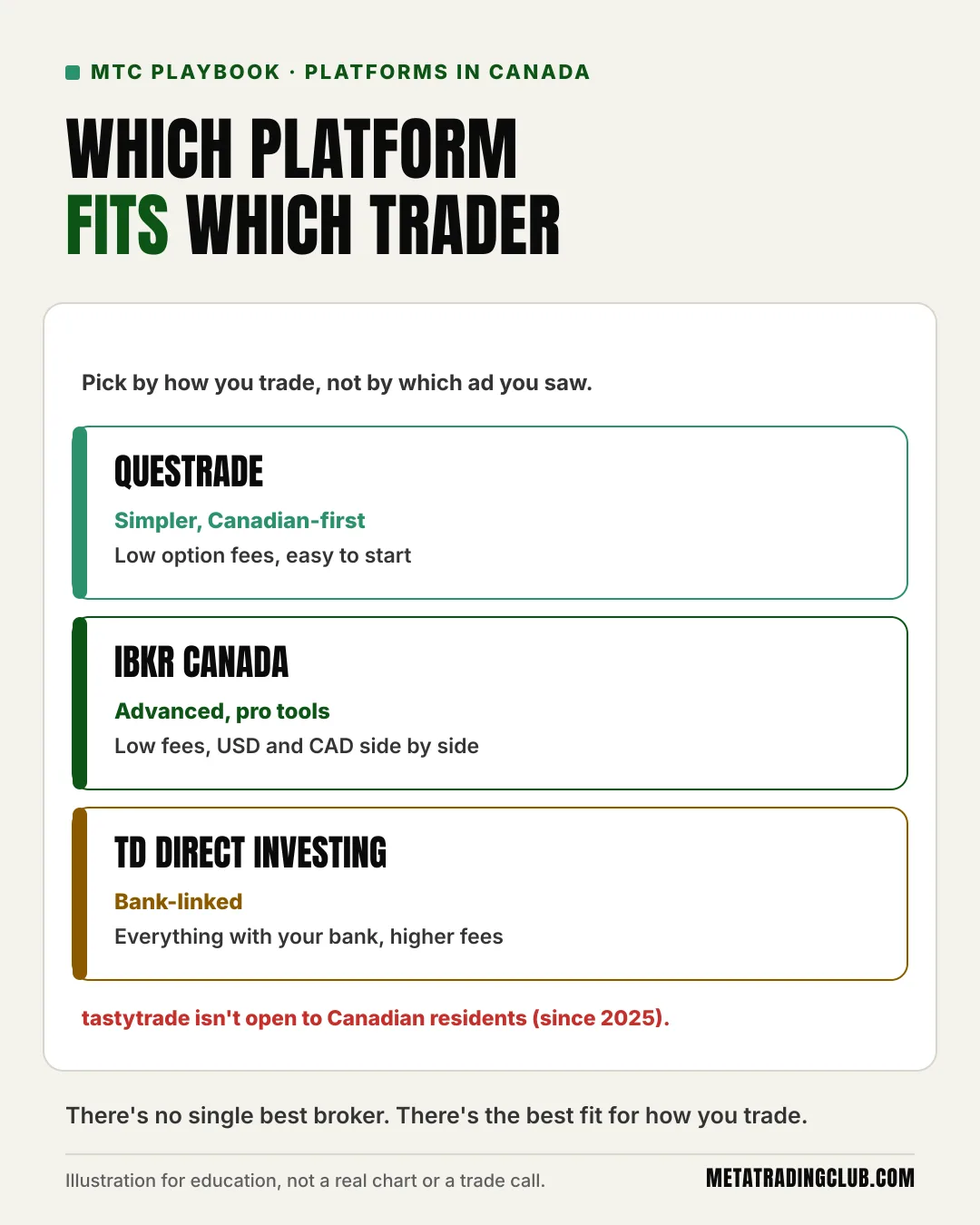
IBKR is consistently the top choice for serious and active options traders in Canada. It’s not the most beginner-friendly platform, but it’s the most capable.
The Trader Workstation (TWS) is a professional-grade tool. The options chain is clean, Greeks are visible, and order routing is sophisticated. If you’re trading spreads, rolling positions, or managing a multi-leg book, IBKR handles it cleanly.
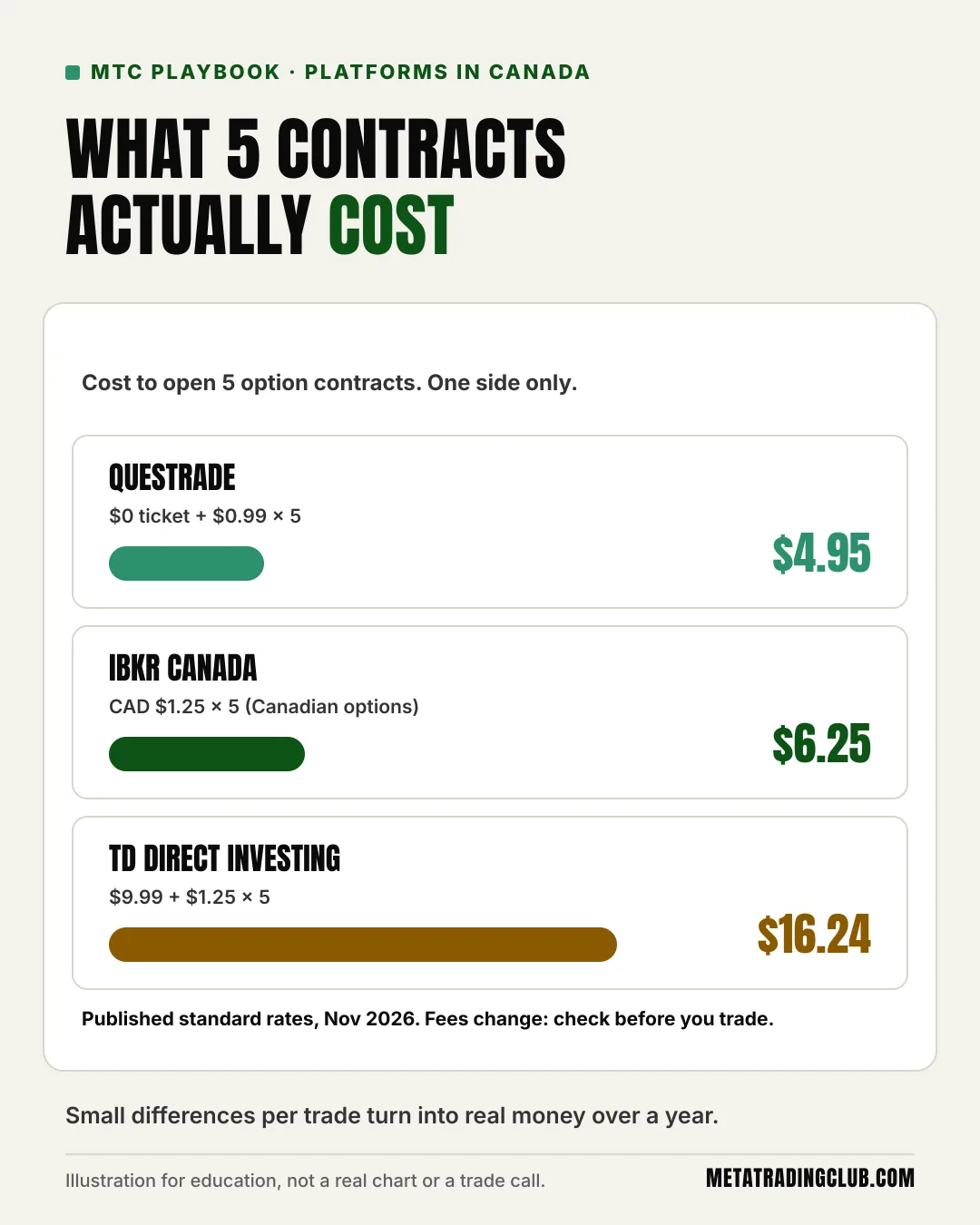
Commissions are low: about USD $0.65 per contract on US options and CAD $1.25 per contract on Canadian options (tiered pricing), with a minimum per order. Check IBKR’s current pricing page before you trade, since rates change.
IBKR Canada also handles CAD/USD currency conversion better than most brokers, which matters when trading US options from a Canadian account. They offer both a Canadian entity (regulated by IIROC) and USD-denominated accounts.
The learning curve is real. TWS is powerful but dense. There’s also a newer mobile-friendly interface (IBKR GlobalTrader and IBKR Mobile) if you want something cleaner for occasional use.
Best for: Intermediate to advanced options traders, high-volume traders, anyone who needs professional tools.
Questrade
Questrade is the most popular Canadian discount broker and a common starting point for newer options traders. It’s more approachable than IBKR and significantly cheaper than the bank-owned brokerages.
Options at Questrade cost $0 per ticket plus $0.99 per contract, after a pricing change in February 2025. That’s one of the lower per-contract prices in Canada, and it makes Questrade a cheap place to learn with small, single-leg trades.
The platform is cleaner and easier to navigate than IBKR’s TWS. Questrade supports TFSA, RRSP, and margin accounts for options trading, though options strategies allowed within registered accounts are restricted (covered calls and cash-secured puts are typically permitted; spreads generally are not in registered accounts).
One weakness: the options chain tools aren’t as sophisticated as IBKR or Thinkorswim. Greeks are available but the interface is less fluid for active options management.
Questrade does offer practice accounts (paper trading), which is useful for newer traders.
Best for: Beginner to intermediate traders, investors transitioning into options, anyone wanting a low-cost entry point.
What Happened to tastytrade in Canada?
tastytrade used to be a popular options-first choice, but it is no longer available to Canadian residents. In June 2025 it resigned its CIRO membership after struggling to find a Canadian clearing firm. If you liked its options-focused workflow, IBKR is the closest fit for Canadians today. Full details: is tastytrade available in Canada?
TD Direct Investing (Thinkorswim Canada)
TD’s offering of Thinkorswim — the same platform widely used by active options traders in North America — was a significant development for Canadian active traders. Thinkorswim is considered one of the best options platforms available.
Pricing at standard rates is $9.99 plus $1.25 per options contract ($7.00 plus $1.25 for Active Traders). thinkorswim access for Canadian clients has changed over time, so confirm with TD that it’s available on your account before you choose TD for it.
The charting is exceptional. The options chain is fully customizable. thinkScript allows custom indicators. Paper trading is built in and robust. If you want professional tools inside a major Canadian bank’s ecosystem, this is the closest you’ll get.
The catch: commissions at TD Direct Investing are higher than IBKR or Questrade. You’re paying for the platform access through the brokerage cost structure. For lower-frequency traders, this tradeoff may be acceptable. For high-frequency traders, commissions will eat into returns.
Best for: Traders who want best-in-class tools and are comfortable paying higher commissions, or those who prefer banking with a major Canadian institution.
Platform Comparison Table
| Platform | Best For | Options Commission | Approval Difficulty | Tools | CAD/USD Handling |
|---|---|---|---|---|---|
| IBKR Canada | Active/advanced traders | US: ~USD $0.65/contract · CA: CAD $1.25/contract | Moderate–High | Professional (TWS) | Excellent — dual currency accounts |
| Questrade | Beginners–intermediate | $0 ticket + $0.99/contract | Low–Moderate | Functional, limited Greeks depth | Good — CAD primary |
| TD Direct Investing | Tool-focused traders | $9.99 + $1.25/contract | Moderate | Thinkorswim — best-in-class charts | Good |
What Features Matter Most for Options Traders
Here’s what to prioritize when evaluating any platform:
Options chain quality. Can you see all strikes, expirations, Bid/Ask spreads, and Greeks in one view without extra clicks?
Multi-leg order support. Can you enter a vertical spread, iron condor, or strangle as a single combo order? This reduces execution slippage.
P&L visualization. Does the platform show you your max gain, max loss, and breakeven points graphically? This is important for defined-risk trades.
Paper trading. Especially if you’re newer — the ability to practice in real market conditions without risking capital is valuable.
Mobile functionality. If you need to manage or close a position while away from your desk, how usable is the mobile app?
Speed and reliability. During high-volatility events (earnings, Fed days), platform stability matters.
Account Types in Canada — What You Need to Know
Canadian traders have access to account types that US traders don’t — and those account types affect what you can do with options.
Tax on options gains depends on the account and how often you trade. Read our guide to options trading tax in Canada.
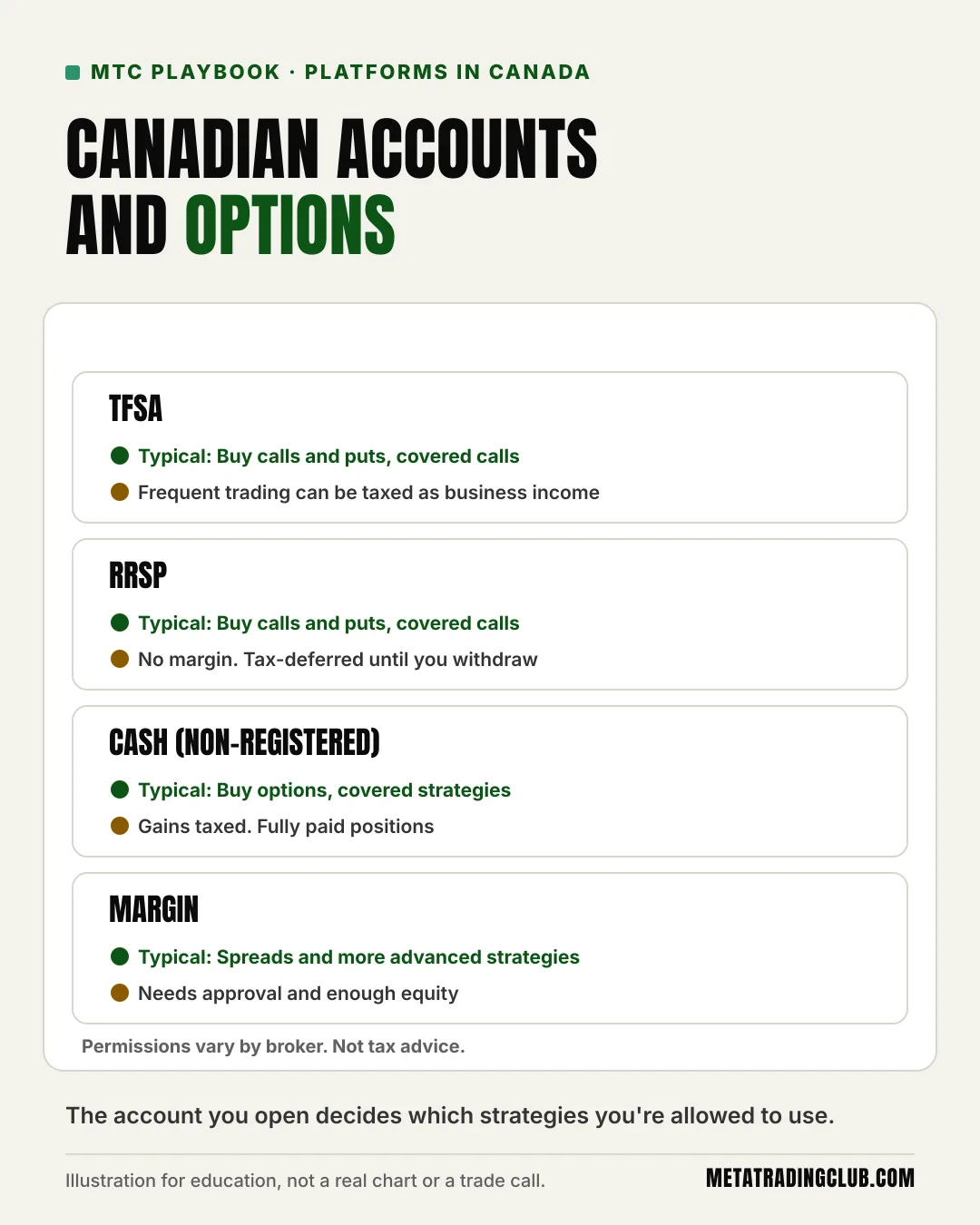
TFSA (Tax-Free Savings Account): Options strategies are limited to lower-risk approaches — typically covered calls and cash-secured puts. You cannot run spreads or naked positions in a TFSA. The CRA also watches for active trading activity inside TFSAs, which can result in the account being treated as business income. Keep it conservative inside registered accounts.
RRSP: Similar limitations to TFSA. Options strategies are restricted. Best used for longer-term positions and basic options strategies.
Margin Account: This is where you get full access to options strategies — spreads, multi-leg positions, higher-level approvals. Your options approval level is determined by your broker based on experience and financial profile. Most active options traders need a margin account to access the full range of strategies.
If you’re serious about learning options properly, the path is typically: start with a margin account at a broker that supports your strategy type, and keep your TFSA/RRSP for simpler, longer-term positions.
How to Choose Based on Your Experience Level
If you’re brand new to options: start with Questrade. The low cost and simpler interface reduce the friction of learning. Use paper trading to practice before going live.
If you’re actively learning and want to level up your tools: IBKR. It has the most powerful tools if you’re willing to invest time in learning the platform, plus low commissions and easy USD handling.
If you’re a serious, active options trader: IBKR Canada is the standard for a reason. The tools, execution quality, and commission structure all favor active trading. Thinkorswim via TD is a close second if you want the charting depth and can absorb higher commissions.
Learning options isn’t just about the platform — it’s about having a structured approach to reading the market, managing risk, and executing with a clear process. That’s what we focus on at MTC.
How Meta Trading Club Fits Into This
At Meta Trading Club, we don’t tell you which platform to use — but we do teach you how to trade with structure and discipline regardless of your brokerage.
The MTC Alignment Engine — our 5-step framework covering Market Bias, Zones, Reaction, Confirmation, and Execution — applies to any platform. What we focus on is giving you the tools to read the market clearly before you ever open an order ticket.
Our daily premarket live sessions walk through market context every morning. Our live trade execution shows the process in real time. We’re not a signals group — we’re a trading education community that teaches you to think and trade independently.
If you’re newer to options and still figuring out the Canada-specific landscape, check out our guide on how to start options trading in Canada and our breakdown of the best options trading courses in Canada for more context on building a real foundation.
Platform choice matters. But process matters more.
Start Trading with More Structure
The platform is the tool. The process is what makes the difference.
At Meta Trading Club, we run live premarket sessions 4 days a week, walk through real setups in real time, and teach you to build the kind of structured, disciplined approach that compounds over time.
No signals. No hype. Just education, live execution, and a community of traders doing the work.
Proprietary Framework
The MTC Alignment Engine™ — Applied Every Live Session
Every trade runs the same five checkpoints — consistency over gut reaction. Inside the MTC Incubator, members build their own system on top of this framework.