Yes, day trading in a Roth IRA is allowed. But an IRA can’t borrow, so most work like cash accounts: you trade with settled money, and selling too soon causes good-faith violations. Losses can’t be deducted, and money you lose doesn’t come back as new contribution room.
Key takeaways
- Day trading is legal in a Roth IRA, but there’s no borrowing. Most IRAs trade like cash accounts.
- Stock trades settle one business day after the trade (T+1). Buy with unsettled money and sell before it settles, and you get a good-faith violation.
- Some brokers offer “limited margin” IRAs: you can use unsettled proceeds, but you still can’t borrow, short stock or sell naked options.
- The 2026 IRA limit is $7,500 ($8,600 if you’re 50 or older), combined across all your IRAs. Losses don’t refill it and aren’t deductible.
- FINRA’s old $25,000 pattern day trader minimum is being replaced. It always applied to margin accounts, not cash accounts.
Is day trading in a Roth IRA allowed?
Yes. No IRS rule caps how often you buy and sell inside a Roth IRA. Gains stay inside the account and you don’t report each trade on your tax return while the IRA is open. The IRS says it plainly: don’t take IRA losses or gains into account on your return while the IRA is still open (IRS IRA FAQs).
The catch is the plumbing. An IRA can’t borrow, so your broker sets it up as a cash-type account, and cash accounts live by settlement rules.
New to the difference? Start with cash accounts vs margin accounts.
Why does settled cash matter so much in an IRA?
In a cash account you must pay the full amount for what you buy, and you can’t borrow from your broker to do it. Under the Federal Reserve’s Regulation T, you must pay for a security before you sell it. Buying and selling a security before paying for it is called freeriding, and it can get your account frozen for 90 days (SEC Investor Bulletin: Trading in Cash Accounts).
When does money count as “paid”? When the sale that produced it settles. Since May 28, 2024, most US stock trades settle one business day after the trade date, called T+1. A Monday sale settles Tuesday. Before that, the cycle was T+2 (SEC/Investor.gov T+1 bulletin).
Brokers name three common cash account violations:
- Good-faith violation: you buy with unsettled money, then sell that position before the money settles.
- Freeriding: you buy and then pay for the purchase by selling that same security.
- Cash liquidation violation: you cover a purchase after the trade date by selling other securities.
The penalty is similar at the brokers we checked. At Fidelity, three good-faith violations or one freeriding violation in 12 months restricts the account to settled-cash buying for 90 calendar days (Fidelity trading restrictions FAQ). E*TRADE describes the same pattern: a third good-faith violation within 12 months means 90 days of settled-cash-only trading (E*TRADE limited margin IRA). Checked November 2026; your broker’s exact policy may differ.
MTC Analysis · Hypothetical example
One Roth IRA, $10,000 settled cash, two days of trading
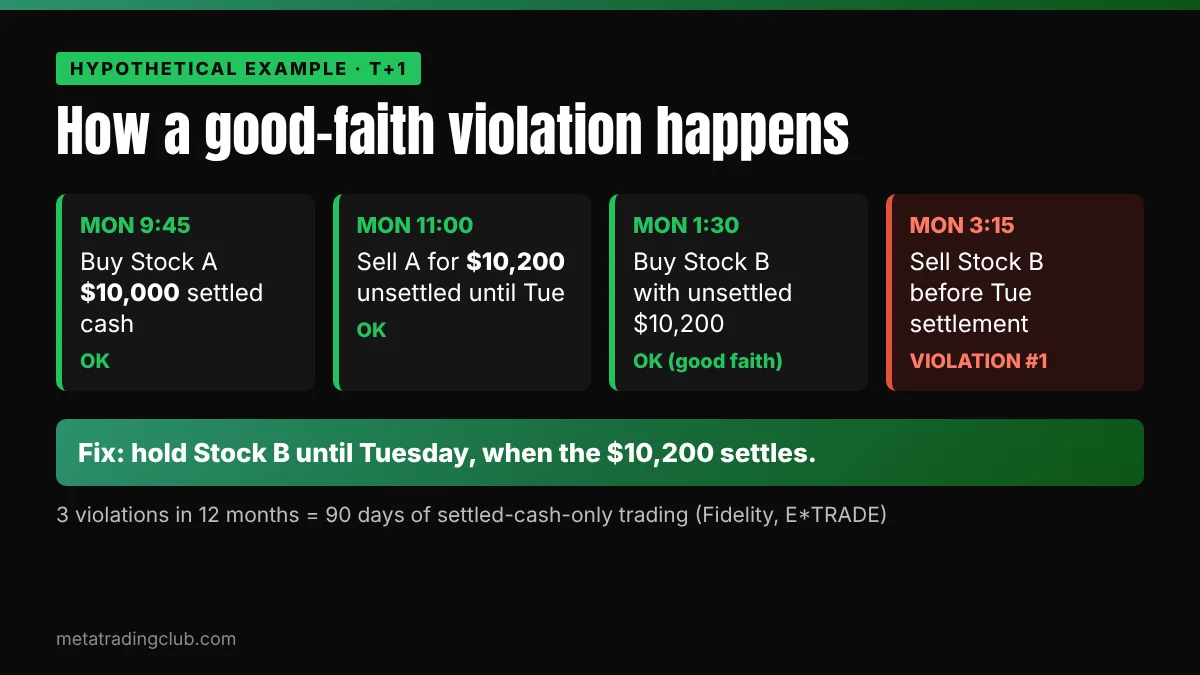
A trader’s Roth IRA is a plain cash-type IRA. On Monday morning it holds $10,000 of settled cash. Stocks settle T+1.
- Monday 9:45 AM: buys $10,000 of Stock A with settled cash. Fully paid. No issue.
- Monday 11:00 AM: sells Stock A for $10,200. Day trade done, also fine: the shares were paid for. But the $10,200 is unsettled until Tuesday.
- Monday 1:30 PM: buys $10,200 of Stock B with that unsettled money. Allowed, in good faith.
- Monday 3:15 PM: sells Stock B. Good-faith violation #1. Stock B was sold before the money that bought it settled on Tuesday.
- The fix: hold Stock B until Tuesday, when the $10,200 from Stock A settles. Selling it then is clean.
The math of a cash-type IRA: each dollar of settled cash can open and close one round trip per day. With $10,000 settled, this account has $10,000 of clean day-trading buying power each day. The second trade on Monday used Tuesday’s money.
Repeat the 3:15 PM mistake three times in 12 months and, at the brokers above, the account is limited to settled cash for 90 days.
Does the pattern day trader rule apply to a Roth IRA?
For a plain cash-type IRA, no. FINRA’s pattern day trader rule was a margin account rule: four or more day trades within five business days, a $25,000 minimum, and the trading had to happen in a margin account (Investor.gov). In a cash IRA, the limit on day trading was never a trade count. It’s settled cash.
The rule itself is also changing. FINRA adopted new intraday margin standards that replace the old day trading margin requirements, including the $25,000 pattern day trader minimum. They took effect June 4, 2026, and firms that need more time can phase them in until October 20, 2027 (FINRA Regulatory Notice 26-10; confirmed by Investor.gov). Checked November 2026.
If your IRA has limited margin, ask your broker which day-trading standard it uses today. Full background: what is a pattern day trader.
What is a limited margin IRA?
“Limited margin” sounds like borrowing. It isn’t. It lets an IRA trade with unsettled proceeds instead of waiting. Two brokers, checked November 2026:
- Fidelity: limited margin lets you use unsettled cash proceeds in your IRA to trade stocks and options actively. You can’t borrow against holdings, sell short or hold naked options. Fidelity requires minimum equity of $10,000 or more (Fidelity).
- E*TRADE: limited margin is optional, needs $2,000 to open, and lets you use unsettled funds. No borrowing, no leverage, no short selling, no naked options (E*TRADE).
In our worked example, limited margin would make the 3:15 PM sale of Stock B clean. It doesn’t add a dollar of buying power. It only removes the waiting.
Can you trade options in a Roth IRA?
Yes, once your broker approves the account for options. The menu is shorter than in a margin account because an IRA can’t borrow:
- Usually allowed: buying calls, covered calls on shares you own, and certain defined-risk spreads once the IRA has limited margin (Schwab).
- Sometimes allowed: cash-secured puts, depending on your approval level.
- Not allowed: naked calls and other uncovered options. Schwab, Fidelity and Interactive Brokers all bar them in IRAs.
Buying a contract still uses cash, so the same settled-cash logic from the example applies when you buy and sell options on the same day in a cash-type IRA. Ask your broker how it handles option settlement.
How much can you put in a Roth IRA in 2026?
For 2026, the total you can contribute to all your traditional and Roth IRAs combined is $7,500, or $8,600 if you’re 50 or older. You also can’t contribute more than your taxable compensation for the year (IRS: IRA contribution limits). The IRS announcement confirms the $7,500 limit and the $1,100 catch-up (IRS news release). For 2027, the IRS says the IRA limit stays at $7,500. Checked November 2026.
Roth eligibility also phases out at higher incomes, and the IRS updates those ranges every year, so check the current ones before you contribute.
Why can’t you deduct losses or refill your room?
This is the trap most articles skip. Inside an open IRA, losses don’t go on your return at all (IRS IRA FAQs). For how losses work in a regular account, see are trading losses tax deductible.
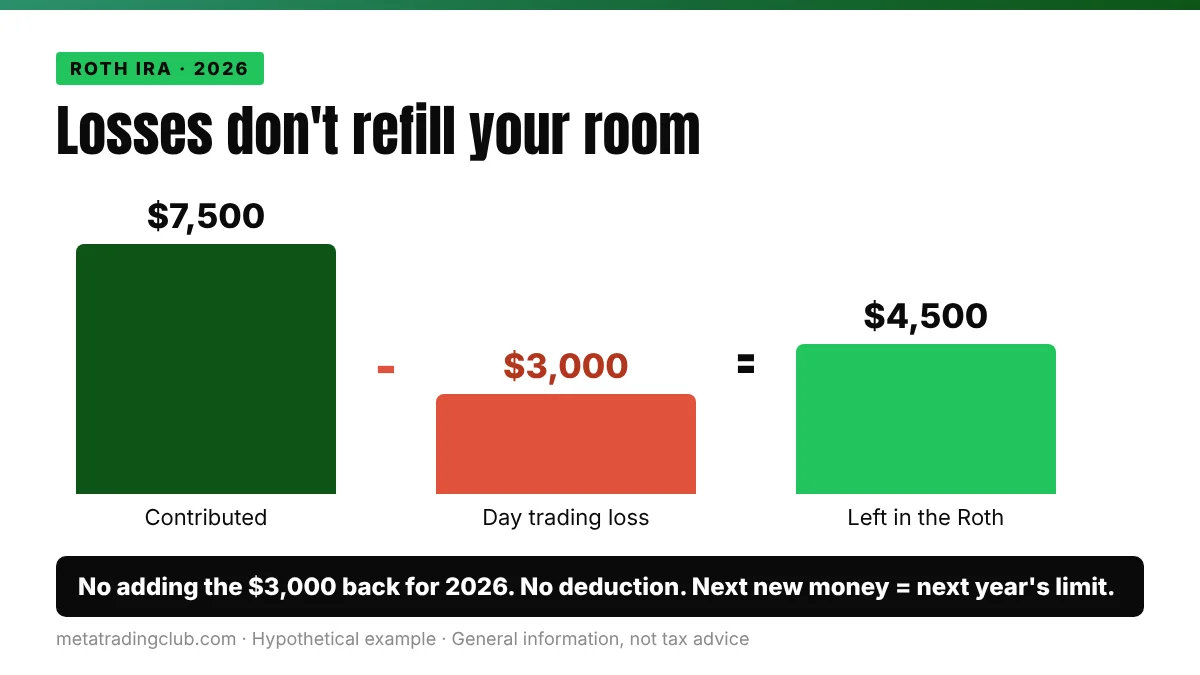
And the contribution limit is a yearly cap on what goes in, not a balance you can top back up. Say you contribute the full $7,500 for 2026 and lose $3,000 day trading. The account now holds $4,500. You can’t add another $3,000 for 2026 to make up for it. Your next new money is next year’s limit.
The real cost isn’t just the $3,000. It’s the tax-free growth that money would have had.
The Roth’s best feature is also its sharpest edge
Tax-free growth is valuable because the room is scarce. A taxable account gives you unlimited deposits and deductible losses. A Roth gives you neither.
So decide what the Roth is for before you day trade in it. Practising the process on paper first costs nothing.
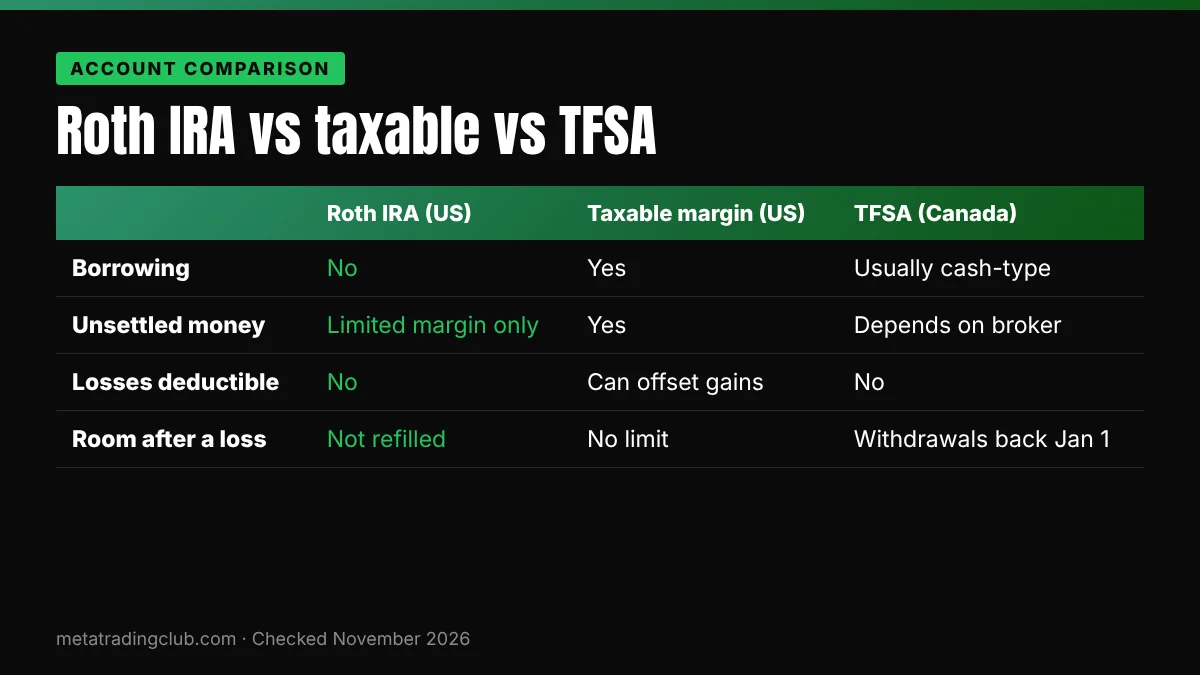
Roth IRA vs taxable account vs TFSA: which fits day trading?
Canadian readers: the TFSA has similar appeal and different traps. See day trading in a TFSA.
| Roth IRA (US) | Taxable margin account (US) | TFSA (Canada) | |
|---|---|---|---|
| Borrowing | No | Yes | Check your broker; usually cash-type |
| Trade unsettled money | Only with limited margin | Yes | Depends on broker |
| Day-trade rule | Settled cash (cash IRA); ask broker for limited margin | PDT being replaced by intraday margin (by Oct 20, 2027) | No PDT rule in Canada |
| Tax on gains | Not reported while the IRA is open | Taxed each year | Tax-free, unless the CRA says you’re running a business |
| Losses | Not deductible | Can offset gains | Not deductible |
| Room after a loss | Not refilled; only next year’s limit | No contribution limit | Not refilled; only withdrawals come back, on January 1 of the next year |
| Naked options | Not allowed | With high approval level | Limited; check your broker |
TFSA withdrawal rule: CRA, calculate your TFSA room. Checked November 2026.
In a taxable account, short-term gains are taxed and the wash-sale rule applies; our guide to day trading taxes covers it.
How should you day trade a small Roth IRA?
A cash-type IRA gives you fewer shots, so each one has to be worth taking. That’s where a process matters more than speed. At Meta Trading Club we use the Alignment Engine, five steps in this order:
- Bias: which way is the market leaning?
- Zone: where might price react?
- Reaction: did price respond there?
- Confirmation: does the lower timeframe agree?
- Execution: stop and size planned in advance.
In a settled-cash account, skipping a half-aligned setup isn’t a missed opportunity. It’s settled cash you keep for the setup that passes all five steps. Plan your size before you click, too. Our position size calculator does the arithmetic.
How we handle account rules at Meta Trading Club
We’ve trained 600+ traders since November 2021, out of Toronto. We don’t pick your account. We teach its rules first, then the method.
We do premarket prep every market day and trade live four days a week (Mon, Tue, Thu, Fri). Setups that pass the five steps get a Qualification grade (A+, A or B), and the grade sets the risk. Our track record is logged in R, which matters even more in an account you can’t refill.
Frequently asked questions
Sources: IRS, IRA contribution limits; IRS news release, 2026 limits; IRS news release, 2027 limits; IRS IRA FAQs; SEC/Investor.gov, Trading in Cash Accounts; SEC/Investor.gov, T+1 settlement; FINRA Regulatory Notice 26-10; Investor.gov, pattern day trader; Fidelity, limited margin; Fidelity, trading restrictions; E*TRADE, limited margin IRA; Schwab, options in an IRA; Interactive Brokers, IRA unsettled funds; CRA, TFSA room. All checked November 2026.
Featured image: U.S. Treasury Building by APK (CC BY-SA 4.0), Wikimedia Commons, AI-edited
Education only. Not financial advice. General information, not tax advice. Account rules and limits change; confirm with your broker and a qualified tax professional.