The Sunday Setup · Trading week ending August 21, 2026 · ~6 min read
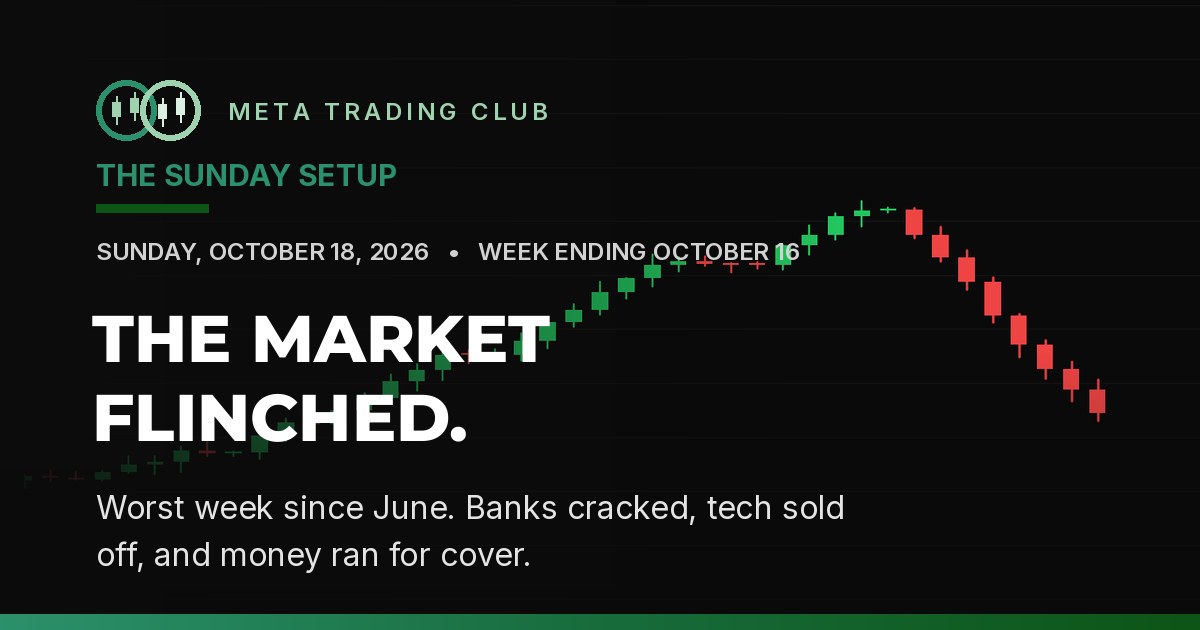
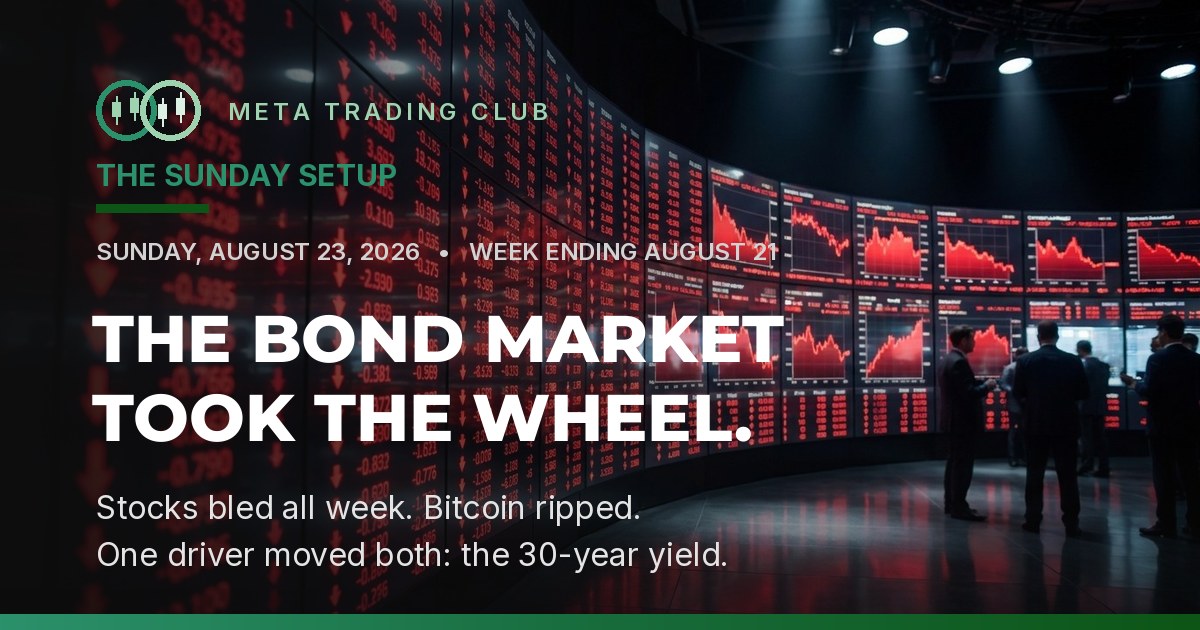
Two facts from this week look impossible sitting next to each other. Every major stock index finished lower. And Bitcoin had its best week in almost two years — up roughly 22% to around $77,000.
Stocks down all week. Crypto straight up. Most people will tell you those are two separate stories. They’re not. They’re the same story, told from two sides — and the author wasn’t the stock market at all.
Here’s the shift, and it’s the whole issue in one line: this week the bond market took the wheel. On Monday the 30-year Treasury yield spiked to 5.31% — its highest since 2007. That one number is the hidden hand behind everything that followed: it’s why high-priced tech got hit hardest, why the Dow held up best, and — once Washington moved to calm it midweek — why Bitcoin exploded. When stocks and bonds disagree, the bond market usually wins the argument. For the next six minutes, we’ll break the week down the way we’d break down a single setup — and by the end you’ll read a “stocks down, crypto up” week the way a professional does.
The Scoreboard
The whole board finished red — but how red is the tell. The tech-heavy Nasdaq lost the most because high-priced growth is the most sensitive to rising yields. The Dow held up best, cushioned by materials and healthcare. Growth punished, value protected — the fingerprint of a rate move, not a growth scare.
| Index | Close | Week |
|---|---|---|
| Dow Jones ★ | 53,277.01 | ▼ −0.8% |
| S&P 500 | 7,674.37 | ▼ −1.4% |
| Russell 2000 | 3,017.87 | ▼ −1.6% |
| Nasdaq Composite | 26,180.45 | ▼ −2.1% |
★ The whole board finished red — but the order is the tell. The Nasdaq lost the most (−2.1%) because high-priced growth is most sensitive to rising yields. The Dow held up best (−0.8%). Growth punished, value protected.

One number tells the whole story — and it isn’t any index close. It’s the 30-year Treasury yield at 5.31%, its highest since 2007. When the longest, safest bond in the world pays that much, every risk asset has to justify itself against it. The most expensive, longest-duration growth names — big tech — get repriced hardest. Watch the yield, and you saw the week coming.
Read the catalyst. Trade the names it’s actually hitting, not the average. A red board isn’t automatically a growth scare — the order of the losses told you this was a rate move, and a rate move sorts the market instead of sinking all of it.
Decoded: The Two That Actually Matter
1. The 30-year yield hit 5.31% — and stocks paid the bill
Monday’s bond selloff ran the whole week. The 30-year Treasury yield spiked to 5.31% — its highest since 2007 — on deficits, sticky inflation, and heavy new supply. A higher risk-free rate makes every stock’s math worse overnight, and the most expensive, longest-duration growth names get repriced hardest. That’s why the Nasdaq led the losses and the Dow lagged them.

Imbalance: higher rates lower what future earnings are worth today; long-duration growth feels it first and worst.
Positioning: the tell was the order of the red — Nasdaq worst, Dow best. A rate move, not a recession fear. Trade the names it’s actually hitting, not the average.
The stock market wasn’t the story this week — it was the audience. It reacted to a decision made in the bond market. If you only watched the S&P bleed, you missed the driver. If you watched the yield, you saw the whole thing coming.
2. Washington moved to calm the bond market — and Bitcoin ripped
Midweek, the Treasury roughly doubled its buybacks of long-term bonds to soak up supply and ease yields. The signal underneath: when the government has to step in and support its own bond market, it’s a message about how much debt is out there and how far the authorities may go to keep money cheap. That’s exactly the environment Bitcoin was built for — and it delivered its best week in nearly two years, roughly +22% to around $77,000.

Imbalance: the worry crushing long-dated stocks is the core bull case for a fixed-supply asset. One tape’s poison is the other’s fuel.
Positioning: stocks-down / Bitcoin-up isn’t two moods — it’s one macro trade in two assets. Read the driver both are pricing.
Chart of the Week: TSLA Through the Engine
While the indexes bled, Tesla did the opposite — the honest way. TSLA pressed a ceiling near $352 it kept rejecting. Tuesday it tagged the line and sold off. Wednesday it retested and held $338.96. Friday, on a real catalyst, it broke $352 and closed $362.86 — up 5.1% on the day, 6.0% on the week, green while the market was red.

Here’s the sequence, run through the Alignment Engine:
1. Bias — a leader recovering, but capped. Going in, TSLA was a leader recovering off its July-gap base — constructive, but capped under $352. “Recovering” isn’t “broken out.”
2. Key Level — the $352 ceiling. One line framed the whole trade: the resistance near $352 it kept rejecting. A daily close above it changes everything.
3. Reaction — rejected twice, base held. Tuesday it tagged $352 and sold off. Wednesday it retested lower and held $338.96. A level that gets pressed and still holds is getting stronger, not weaker.
4. Confirmation — the close that meant it. Friday TSLA broke $352 and closed at $362.86 on a real catalyst — a record semi-truck order and a robotaxi permit. Not an intraday poke, a close. The rejected ceiling became the floor.
5. Execution — buy the proven break, not the failed tag. The qualified trade was never to front-run the earlier rejections. It was to wait for the proven close-and-hold above $352, with risk defined under the base. You skipped the two head-fakes. You bought the confirmation.
What the Street Is Buzzing About
Under the red tape, single names popped on real catalysts. Moderna (MRNA) jumped ~17% Friday on Phase 3 cancer-vaccine data with Merck. The crypto complex ripped with Bitcoin: Robinhood (HOOD) +11%, Coinbase (COIN) +8.5%, MicroStrategy (MSTR) +7.6%. But the loudest arguments were about next week — the biggest of the quarter: Nvidia earnings and Jackson Hole.

“Nvidia prints a blowout and the whole market rips back to highs.” The bull thread is banking on the biggest earnings number of the quarter to erase the week’s damage. But a good number and a good reaction are two different things. With the 30-year at 5.3%, a beat has to fight the yield, not just the estimate. We don’t pre-position on the story — we mark the level and trade the reaction the print actually creates.
“5.3% yields break the AI trade. This is the start of the unwind.” The bears seized on the yield spike, calling it the beginning of a growth-stock unwind. The pressure is real — rising yields are the growth trade’s kryptonite. But “the start of the unwind” is a prediction, not a trade. Shorting into a levered, emotional tape on a thesis alone is how you donate. The trade is to mark the level where the growth tape actually breaks, and wait for price to lose it.
Inside the Community
Every morning before the bell we run a live pre-market session — walk the indices, mark the levels, build the watchlist, then trade it live. In an ugly, red week, the room’s edge was refusing to trade the index and hunting the individual names with a clean level and a real catalyst behind them.
The setup that kept working was the one the tape rewarded all week — a clean break of a marked level on a name with a catalyst behind it. The clearest example was TSLA into Friday — the exact $352 break we walked through in Chart of the Week. The room had that line marked days before it broke. A down market doesn’t take your setups away; it takes away the lazy ones.
| Date | Member | Ticker & Setup | Result |
|---|---|---|---|
| Aug 21 | Leila | TSLA calls, break of $352 | Win |
| Aug 21 | Prashanthi | MRNA, breakout & retest of PMH | Win (+1.5R) |
| Aug 20 | Prashanthi | SPY, 2-min reversal (4DTE) | Win |
| Aug 21 | Hamidreza | MRNA scalps (8 trades) | 4W / 4L, +1.5% net |
The mixed one is the most instructive: Hamidreza went 4 wins and 4 losses scalping MRNA and still finished net green by keeping every loss small. The job isn’t to win every trade — it’s to make the winners bigger than the losers.
Member spotlight — the level, not the luck. Leila caught the trade this whole issue is built around: TSLA long on the break of $352 — the same level we graded in Chart of the Week. No signal, no tip. She had the line marked and waited for it. She didn’t chase the earlier rejections; she waited for price to reclaim $352 with confirmation stacking — the level, the candle, volume, the moving averages, a Stochastic RSI turn, a hold above the prior-day high — then entered on a 15-minute chart with calls near $7.85 and scaled out into strength around $8.40–$8.55. Every reason to be in agreed before she clicked. That’s alignment. Leila didn’t get lucky on Tesla — she got ready for it.
The Week Ahead
Earnings — the whole growth trade in one print. Nvidia (NVDA) reports Wednesday after the close — the most important number of the quarter, into a tape already nervous about valuations and yields. The reaction matters as much as the result. Marvell (MRVL) follows Thursday; CRM, CRWD and OKTA pepper the week.
Data — the Fed’s favorite number. Core PCE lands Wednesday (~+3.3% year-over-year) — the same day as Nvidia. Add durable goods, the second read on Q2 GDP, and jobless claims.
The set-piece — a new Fed Chair’s debut. Jackson Hole runs into Friday, and new Fed Chair Kevin Warsh gives his first symposium speech (~10am ET). His tone on inflation, the rate path, and the bond market could move yields hard — which, this week proved, moves everything else.

The watchlist — levels we’re marking
| Ticker | Resistance | Support |
|---|---|---|
| SPY | 775 | 758 |
| QQQ | 755 | 740 |
| TSLA | 380 | 352 |
Note the TSLA line: the $352 it broke Friday is now support. The reclaimed ceiling becomes the floor — if it holds on a retest, the breakout stays alive. These are lines, not predictions. Define your invalidation before the open and let the reactions come to you.
Trade the driver, not the reaction.
Want to learn how to read the one driver moving both stocks and crypto — and trade the level that confirms it, the way the room did with TSLA this week? That’s what we do, live, every session inside the MTC Community. You watch the Alignment Engine run in real time, build the skill, and stop following — start deciding.
Frequently Asked Questions
Why did stocks fall while Bitcoin surged in August 2026?
In the trading week ending August 21, 2026, both moves shared one driver: the bond market. On Monday the 30-year Treasury yield spiked to 5.31%, its highest since 2007, which repriced every stock in order of risk and hit high-priced growth hardest — sending all four major indexes lower. Midweek, the Treasury roughly doubled its long-bond buybacks to calm that same market, signaling a lean toward easier money. That is the core bull case for a fixed-supply asset, and Bitcoin responded with its best week in nearly two years, up about 22% to around $77,000.
Why did the Nasdaq fall more than the Dow this week?
Because this was a rate move, not a growth scare. When the 30-year Treasury yield jumps, the most expensive, longest-duration growth stocks — concentrated in the tech-heavy Nasdaq — get repriced hardest, since a higher risk-free rate lowers the present value of their future earnings. The Nasdaq fell 2.1% while the blue-chip Dow, cushioned by materials and healthcare, held up best at −0.8%. The order of the losses was the fingerprint of a rate move.
What is the Alignment Engine?
It’s Meta Trading Club’s framework for qualifying a trade before taking it: bias, key level, reaction, confirmation, execution. The rule is simple — no alignment, no trade. TSLA’s week is a textbook example: it rejected a $352 ceiling twice, held its base at $338.96, then closed above $352 at $362.86 on a real catalyst — the confirmation the Engine waits for — before the trade qualified.
What should traders watch the week of August 24, 2026?
Three events land in the same 72 hours: Nvidia (NVDA) reports Wednesday after the close, core PCE inflation lands Wednesday (~+3.3% year-over-year), and the Jackson Hole symposium runs into Friday, where new Fed Chair Kevin Warsh gives his first symposium speech. With the 30-year Treasury yield still near 5.3%, each of these can move yields hard — and this week proved that when yields move, everything else follows.
Meta Trading Club provides educational content only. Nothing here is financial, investment, or trading advice, or a recommendation to buy or sell any security. Trading involves substantial risk of loss. Past performance does not guarantee future results.