MTC Investing Analyst · Weekly Report · Aug 22, 2026
Gold ripped to a record. Bonds whipsawed. Bitcoin ran 20% in a week. But the quiet story is a defense-electronics backlog boom — and the suppliers three layers down from the primes.
Every hot name has a supply chain, and the boring company three layers down often has better margins and more room to run. This week the crowd is chasing gold and crypto. The edge is in the verified suppliers arming the missile buildout that nobody’s putting on a watchlist.
0. Scorecard — How Our Calls Are Doing
Accountability first. Every pick is logged with an entry level and graded out loud — losers as plainly as winners. Since the system started we’ve logged 44 picks: 61.4% win rate, +2.44% average return (prices as of Aug 22, 2026).
| Basket | Picks | Avg Return | Read |
|---|---|---|---|
| Conservative | 7 | +8.2% | Defensive + quality carried the book |
| Moderate | 7 | +15.5% | MSFT + ADBE did the heavy lifting |
| Aggressive | 11 | +0.2% | Winners offset the AI-infra drawdowns |
| Silent Supplier | 19 | -3.2% | Three broken names we own out loud |
What’s working
The Moderate quality-growth sleeve is the standout: ADBE +41%, MSFT +27%. Real assets and defensives held: XOP +24%, IBIT +23%, XLE +18%, JNJ +18%, XLV +17%. On the supplier side, STVN +26% (GLP-1 packaging), CCJ +14% and LEU +10% (nuclear fuel), and ATEYY +13% (memory test) are proof the layer-3 thesis works when the demand link is real.
What isn’t — and we’re owning it
Four names are stopped: MOD -29%, ALAB -29%, FN -22%, and ORCL -20%. The AI-infra optics and connectivity trade got ahead of itself and we sized into it too early — that’s the honest lesson. SMH -15%, AVGO -10% and VRT -13% are on the watch line as AI-capex expectations reset. The Silent Supplier book being down 3% is the price of fishing in under-covered water; the winners more than pay for it across the full book, but we don’t hide the drawdowns.
1. Market Environment This Week
A rough week for the indices, saved by a Friday bounce. The S&P 500 closed 7,674.37 (-1.4% on the week), the Nasdaq 26,180 (-2.1%), the Dow 53,277 (-0.9%), and the Russell 2000 3,018 (-1.7%). The driver wasn’t earnings — it was the bond market. A mid-week Treasury sell-off pushed the 10-year yield to a 3-month high near 4.7% before the Treasury announced plans to at least double its long-term debt buybacks, which cooled yields and knocked the dollar lower into Friday.
On rates and the Fed: funds sit at 3.50–3.75%. Markets price roughly 68% odds the Fed holds at the Sept 16 meeting, with about a 65% chance of one more cut by year-end; hike bets faded after soft retail sales and a cooler labor read. Commodities told the real story — gold surged ~5.6% to a record (~$4,570–4,680 futures) and WTI broke $85 to ~$87 (+5.7%) on Middle East supply risk. The dollar (DXY) eased to ~98.8, and Bitcoin ripped ~20% to ~$77,000. Volatility stayed calm (VIX ~15) despite the bond drama.
Environment label: Bond-volatility + record-gold, hard-asset rotation into a cautious tape — capital pre-positioning ahead of Jackson Hole and Nvidia.
2. Best Long-Term Themes This Week
1) Defense & the missile buildout (Hot Topic). What: record defense-electronics and munitions backlogs. Why it matters: multi-year, budget-backed demand that doesn’t care about the Fed. What to watch: book-to-bill ratios above 1.5. Who it fits: moderate-to-aggressive. This feeds Section 3.
2) Hard assets / gold. What: gold at records, real rates in focus. Why: debt-supply worries and buyback intervention are structurally bullish for the metal. What to watch: real yields. Who it fits: everyone as a sleeve.
3) Energy. What: WTI above $85 on Hormuz risk. Why: geopolitical premium plus an inflation hedge. What to watch: the spread between crude and producer equities. Who it fits: moderate.
4) AI-capex digestion. What: the AI-infra trade is resetting, not breaking. Why: the spend is real but sentiment ran ahead of it. What to watch: Nvidia’s guide next week. Who it fits: aggressive, on pullbacks.
5) Crypto beta. What: Bitcoin’s 20% weekly run. Why: liquidity and a weaker dollar. What to watch: whether it holds the breakout. Who it fits: aggressive, small sleeve only.
3. Silent Supplier Spotlight — The Missile Supply Chain
Everyone can name the primes — Lockheed, RTX, L3Harris. The edge isn’t there. It’s in the propulsion, the electronics, and the actuation that every one of those missiles needs, sold by companies that don’t make the front page.
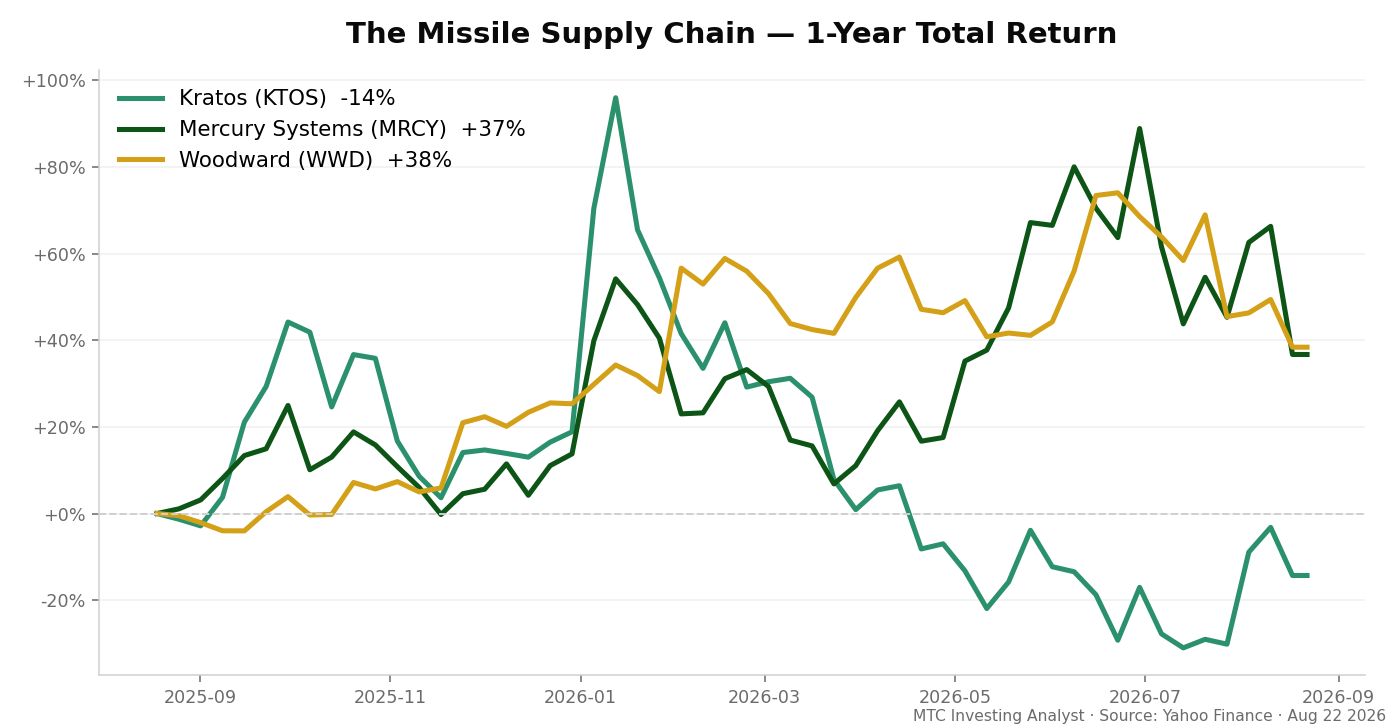
Kratos makes solid rocket motors (the Zeus and Oriole lines) and tactical drones — the scarce propulsion input the whole hypersonic push depends on. It’s down ~14% over the past year even as the order book exploded, which is exactly the setup we look for: rising demand, falling price.
Mercury builds the RF and processing subsystems that go inside missile-defense, space, and airborne platforms. It sells into the primes rather than competing with them — customer concentration here is the feature, not the bug.
Woodward makes the actuation, fuel, and motion-control systems that steer guided weapons and run aero engines. It’s the “muscle” of a missile — every smart munition needs to move a control surface, and Woodward’s content is climbing.
What this means
The demand engine — the “hot name” the suppliers feed — is the prime layer: Lockheed Martin (LMT, ~$564), RTX, L3Harris. You can own the prime for the anchor. But the suppliers carry the higher-torque exposure: same multi-year backlog, cheaper entry, less crowding. We anchor on the prime and lean on the supplier layer for the upside.
4. Conservative Investing Basket
Capital preservation and income. VOO (core S&P, expense 0.03%) — dollar-cost, add under $700 rather than chase (ref. $703.71). SCHD (dividend/quality, 0.06%) — income anchor, attractive under $34 (ref. $35.11). SGOV / BIL — get paid ~4% to wait; entry any level while the Fed holds. IAU (gold) — the week’s momentum name; it’s extended, so add on a dip toward $84 (ref. $86.79) rather than at the record. XLV — defensive earnings, attractive under $172 (ref. $174.62). JNJ — AAA balance sheet, ~3% yield; fine to hold, add under $262 (ref. $270.24).
5. Moderate / Balanced Basket
Quality growth plus diversification. MSFT — durable cloud + AI earnings; extended after a +27% run, add under $470 (ref. $483). ADBE — our best pick at +41%; take the win seriously and only add under $250 (ref. $275). QQQ — growth core, but into AI-capex digestion; add under $700 (ref. $713). XLE — energy hedge with the oil breakout, under $60 (ref. $63.64). BRK.B — cash-rich ballast, under $485 (ref. $496). IBIT — small crypto sleeve; it just ran 20%, so size it and don’t chase (ref. $43.68). VXUS — international diversification off a stretched US tape (ref. $87.71).
6. Aggressive Basket
Higher beta and thematic single names. LMT (new — the missile-supply anchor) — the prime the suppliers feed; entry under ~$560 (ref. $563.57), risk is program timing and budget headlines. NVDA — core AI infra into next week’s earnings; add under $215 (ref. $214.72), major risk is a soft guide. MU — memory supercycle, +15%; only add on a pullback under $840 (ref. $967), memory is cyclical. TSM — advanced-packaging foundry, under $400 (ref. $419). LLY — GLP-1 demand engine, +14%, add under $1,150 (ref. $1,255). CEG — nuclear-for-AI utility, under $265 (ref. $273). XOP — high-beta energy, +24%; extended, add under $180 (ref. $190). IWM — small-caps on a dovish pivot (ref. $300). AVGO — AI networking, on the watch line at -10%; under $360 to add (ref. $368). SMH — semis basket, stopped-out territory at -15%; watching, not adding.
7. What Looks Attractive This Week
Long-term watchlist (own on the level): KTOS under $58, MRCY under $88, WWD under $330 — the missile-supply trio. LMT under $560 as the anchor.
Buy-on-dip candidates (good theme, extended price): IAU toward $84, XOP under $180, MSFT under $470, NVDA under $215 into earnings weakness. These are quality names you want — just not at this week’s price.
8. What Does NOT Look Attractive Right Now
Chasing gold at the record. The thesis is right but a +5.6% week into an all-time high is the wrong entry — wait for the pullback. Chasing Bitcoin after a 20% run. Momentum is real; the risk/reward one week in is not. Long-duration Treasuries here. With supply worries forcing buyback intervention, duration is a policy football, not a clean bet. The crowded AI-infra optics/connectivity names (the FN/ALAB cohort) — the demand is real but positioning and valuation are still unwinding; we own the lesson and won’t add until they base.
9. Portfolio Allocation Examples
Illustrative sleeves, not advice.
Conservative: 40% broad equity (VOO), 25% short Treasuries (SGOV/BIL), 15% dividend/quality (SCHD), 10% gold (IAU), 10% defensive sectors (XLV/JNJ).
Moderate: 45% core equity (VOO/QQQ), 15% quality growth (MSFT/ADBE), 10% energy (XLE), 10% international (VXUS), 10% gold, 5% crypto (IBIT), 5% cash.
Aggressive: 35% growth/AI (QQQ/NVDA/MU), 20% defense & suppliers (LMT/KTOS/MRCY/WWD), 15% energy (XOP), 10% single-name growth (LLY), 10% crypto/small-cap (IBIT/IWM), 10% cash for pullbacks.
10. Key Risks for Next Week
1) Jackson Hole (headline risk). Fed Chair Kevin Warsh speaks; any hawkish tone on rates or central-bank independence moves bonds first, stocks second. 2) Nvidia Q2 earnings. The single biggest swing factor for the AI-infra complex and the tape’s risk appetite. 3) Bond-market volatility. Treasury supply and the buyback response keep the 10-year twitchy. 4) Oil / Middle East. A Hormuz escalation adds an inflation shock on top of the yield story. 5) The path to Sept 16 FOMC. The August CPI print before the meeting sets the odds.
11. Final MTC Investing View
Stay patient and lean on real assets. This is a week to protect capital, not chase momentum. Gold and crypto already made their move; the durable opportunity is the defense-supply backlog boom, where the demand is contracted years out and the suppliers are still cheap relative to the primes. Anchor on quality, buy the missile-supply trio on the levels, and keep cash ready for the volatility Jackson Hole and Nvidia will almost certainly deliver.
Frequently Asked Questions
What is a “silent supplier” stock?
A silent supplier is an under-covered company that sells a critical input into a well-known “hot name.” The crowd buys the front-page stock; the silent supplier often has better margins, less hype, and more room to run — as long as the demand link is verifiable.
What are the missile supply chain stocks this week?
Our spotlight names are Kratos Defense (KTOS, solid rocket motors), Mercury Systems (MRCY, defense electronics), and Woodward (WWD, guided-weapon actuation), with Lockheed Martin (LMT) as the prime-layer anchor.
Why did the stock market fall this week?
It wasn’t earnings — it was a mid-week Treasury sell-off that pushed the 10-year yield to a 3-month high, pressuring tech and AI stocks. A Treasury buyback announcement cooled yields into Friday’s bounce.
Is this financial advice?
No. This report is educational only. Every idea includes an entry level so you can think for yourself — the goal is to build independent investors, not signal-followers.
Want to learn to find these setups yourself?
The MTC Incubator is our mentorship program for investors who want to build a repeatable process — not follow signals. If you’re serious about learning the framework behind reports like this, see if it’s a fit.