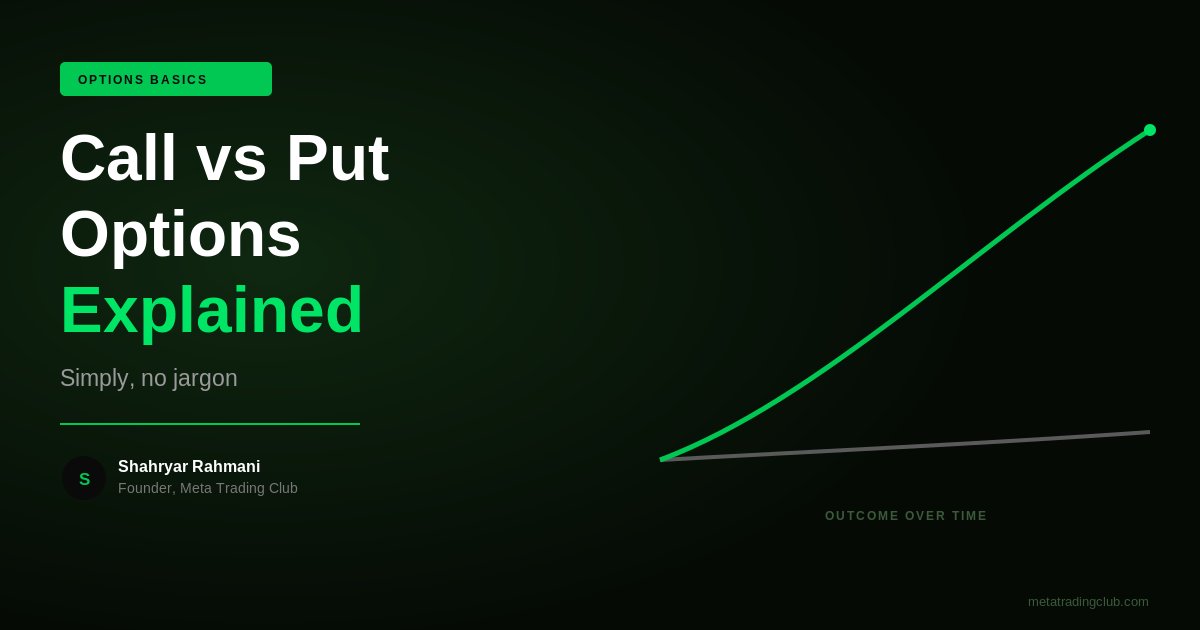
Calls and puts are the two building blocks of all options trading, and almost every guide manages to make them more confusing than they need to be. So here it is in plain English, no jargon, no Greek letters: what a call is, what a put is, when you’d use each, and how they actually make or lose money. If you can understand a coupon and an insurance policy, you can understand calls and puts.
A coupon and an insurance policy
If you can understand a coupon and an insurance policy, you can understand calls and puts. A call is a bet up; a put is a bet down.
The Simplest Possible Definitions
A call option gives you the right to buy a stock at a set price by a set date. You buy calls when you think the price is going up.
A put option gives you the right to sell a stock at a set price by a set date. You buy puts when you think the price is going down.
That’s genuinely the core of it. A call is a bet up; a put is a bet down. Everything else is detail.
MTC Analysis
Call vs Put — The Whole Idea
Equal and opposite. For both, max loss as a buyer is the premium — and time decay works against you, so direction alone isn’t always enough.
The Two Analogies That Make It Click
For a call, think of a coupon. Imagine a coupon that lets you buy a $100 item for $100 anytime in the next month. If the item’s price jumps to $130, your coupon is valuable — you can still buy at $100 and you’re $30 ahead. If the price drops to $80, your coupon is worthless; you’d just buy at the lower market price. A call works the same way: it lets you ‘buy at the set price,’ so it gains value when the stock rises above that price.
For a put, think of insurance. Imagine insurance that lets you sell something for $100 even if its value crashes. If the item drops to $70, your insurance is valuable — you can still sell at $100. If it stays at $100 or rises, you didn’t need the insurance. A put works the same way: it lets you ‘sell at the set price,’ so it gains value when the stock falls below that price.
The Key Terms (Just Three)
You only need three terms to use these.
The strike price is the set price in the contract — the price you can buy at (call) or sell at (put). The expiration is the deadline; the option only exists until then. The premium is what you pay to own the option — and as a buyer, it’s the most you can lose. That’s it. Strike, expiration, premium.
How They Make and Lose Money
As a buyer, your risk is capped and your math is clean.
When you buy a call, you profit if the stock rises enough above the strike to more than cover the premium you paid. Your maximum loss is the premium — if the stock doesn’t rise, the option can expire worthless and you lose what you paid, nothing more.
When you buy a put, you profit if the stock falls enough below the strike to more than cover the premium. Again, your maximum loss is just the premium.
The catch for both: time works against you. Options lose value as expiration approaches (time decay), so the stock doesn’t just need to move in your direction — it needs to move enough, in time. This is why simply being right on direction isn’t always enough to profit, and it’s the single most common surprise for new options traders.
When to Use Each
Use a call when you’re bullish and want leveraged upside with defined risk — a way to profit from a rise while risking only the premium instead of the full cost of the shares. Use a put when you’re bearish and want to profit from a decline, or when you want to protect stock you already own (a put acts as insurance on your shares). Beyond these basics, calls and puts combine into spreads and more advanced strategies — but every one of those is just built from these two pieces.
You Now Understand the Foundation
That’s calls and puts, honestly and without the jargon. A call is the right to buy, a bet up, like a coupon. A put is the right to sell, a bet down, like insurance. Strike, expiration, premium. Max loss is the premium. Time works against the buyer. Master this, and you have the foundation every options strategy is built on.
The next step — knowing when the setup is actually there, sizing it, and managing it — is where the real skill lives. At Meta Trading Club, members watch calls and puts chosen and managed live every market day with the MTC Alignment Engine, turning this foundation into trades you can actually execute with confidence.
Proprietary Framework
The MTC Alignment Engine™ — Applied Every Live Session
Every trade runs the same five checkpoints — consistency over gut reaction. Inside the MTC Incubator, members build their own system on top of this framework.
Frequently Asked Questions
What is the difference between a call and a put option?
A call option gives you the right to buy a stock at a set price by a set date — you buy calls when you expect the price to rise. A put option gives you the right to sell a stock at a set price by a set date — you buy puts when you expect the price to fall. Simply put, a call is a bet up and a put is a bet down.
When should I buy a call vs a put?
Buy a call when you’re bullish and expect the stock to rise, since calls gain value as the stock climbs above the strike. Buy a put when you’re bearish and expect the stock to fall, or when you want to protect shares you own, since puts gain value as the stock drops below the strike (and act as insurance on a position).
How do call and put options make money?
As a buyer, a call profits if the stock rises enough above the strike to exceed the premium you paid; a put profits if the stock falls enough below the strike to exceed the premium. Your maximum loss is the premium. Time decay works against buyers, so the stock must move enough in your direction before expiration to be profitable.
What is the maximum loss on a call or put option?
For a buyer, the maximum loss on a long call or long put is the premium paid — you can’t lose more than what you spent to buy the option. If the stock doesn’t move in your favor, the option can expire worthless and you lose the premium, but nothing beyond it. This defined risk is a key appeal of buying options.
What are strike price, expiration, and premium?
The strike price is the set price in the option contract — the price you can buy at (call) or sell at (put). The expiration is the deadline after which the option no longer exists. The premium is what you pay to buy the option, which as a buyer is also your maximum possible loss. These three terms are all you need to start.
Why can I be right about direction and still lose on an option?
Because of time decay. Options lose value as expiration approaches, so being right on direction isn’t always enough — the stock must move far enough, fast enough, to overcome the premium and the decay. A correct but slow or too-small move can still leave a long option worth less than you paid, which surprises many new options traders.
Related reading
Meta Trading Club Community
Start Your 7-Day Free Trial
Daily live sessions. Real-time market prep — not signals. The MTC Alignment Engine™ applied in front of you. Trade alongside Shahryar from day one.
Cancel anytime. No contracts. Built for Canadian traders.
Already trading and want to build your own system?
The MTC Incubator is an application-based mentorship — 1-on-1 work building a personalized system on the Alignment Engine™.