Wednesday, October 7, 2026 · 4:30 PM ET · MTC Market Close
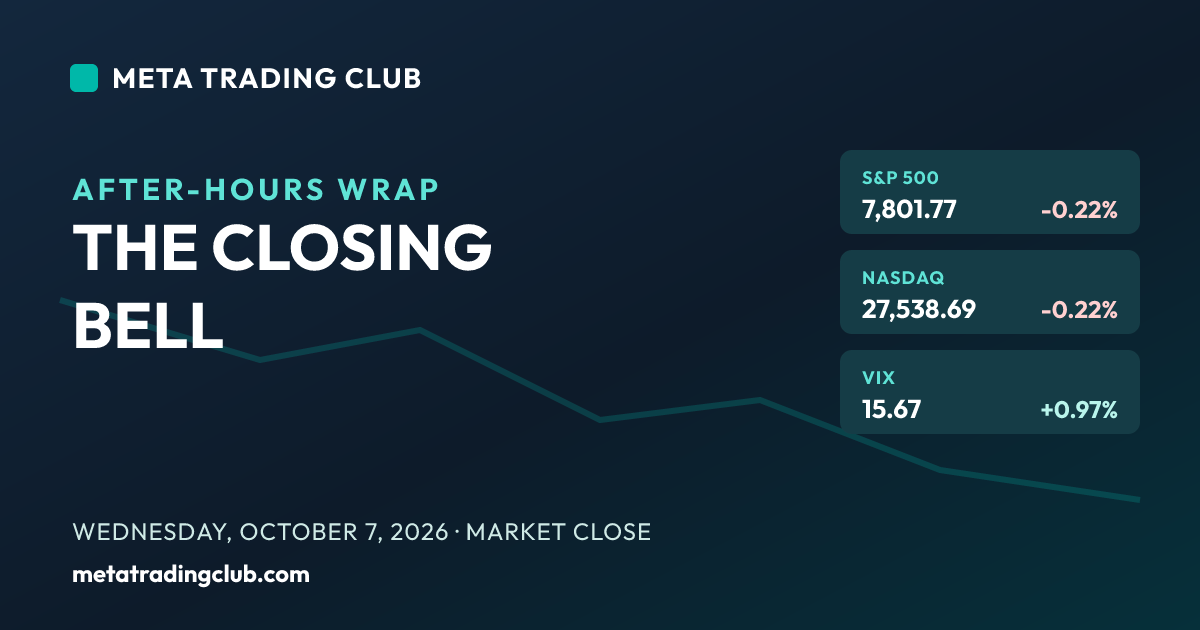
The big story in the stock market today: the record run finally hit a wall, but the one line that mattered held. After Tuesday’s first-ever close above 7,800, the S&P 500 slipped 0.22% to 7,801.77, finishing a grand total of 1.77 points above the level we flagged as the whole game. The Nasdaq also eased 0.22% to 27,538.69, the Dow fell 0.66% to 51,179.87, and the Russell 2000 was the worst of the majors, down 1.31% to 2,793.36. Breadth was ugly under the surface, with roughly 68% of US issues lower on the day, yet the VIX barely moved, closing at 15.67. That combination, a soft tape with no spike in fear, is the signature of orderly rotation rather than panic. What drove it was rates. The 10-year Treasury yield pushed to 5.304%, its highest since 2002, after Fed minutes at 2 PM showed officials still leaning toward one more hike before year-end, and the 30-year cleared 5.67%, a 24-year high. Rising yields pulled money out of the growth and small-cap names and into defensives: utilities led, healthcare caught a bid after Tuesday’s rout, and energy firmed with WTI near $90 on fresh Houthi strikes against Saudi airports and a Gulf hurricane threat. So the record paused, the internals cracked, but 7,800 did its job on the retest. That hands Thursday a clean setup: jobless claims at 8:30 AM ET and PepsiCo before the open to kick off Q3 earnings season. Hold 7,800 and the breakout is still intact. Lose it and the retest failed.
The Closing Bell
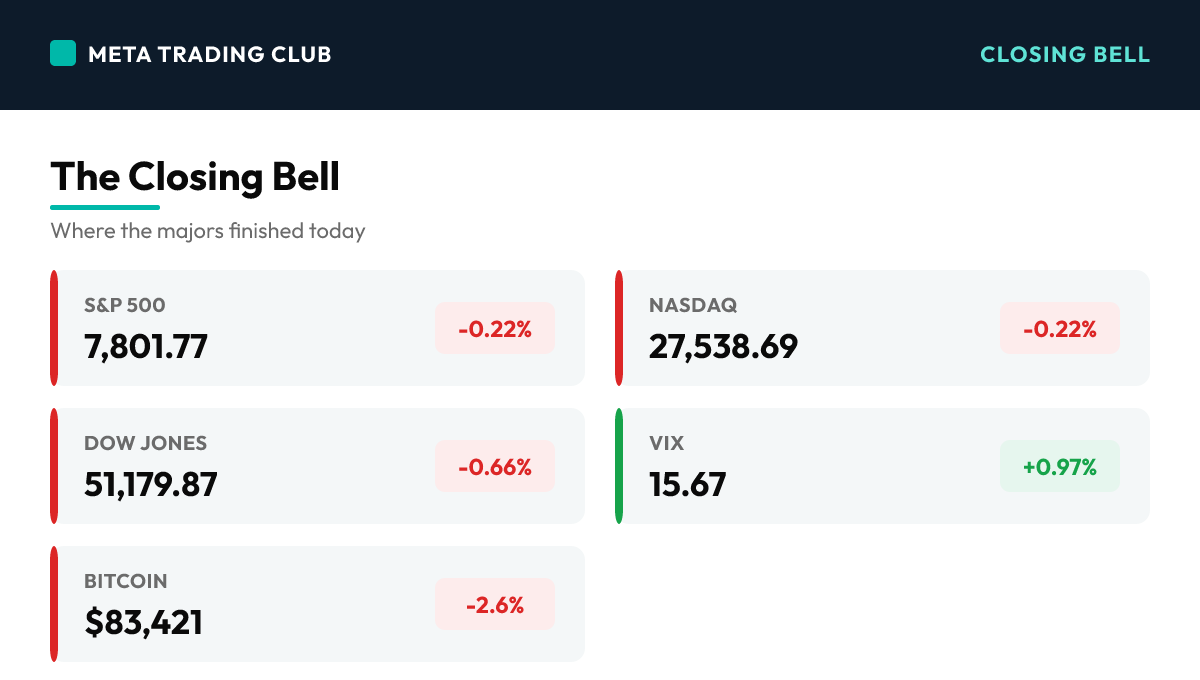
| Instrument | Close | Change | Note |
|---|---|---|---|
| S&P 500 | 7,801.77 | -0.22% | Slipped about 17 points to 7,801.77, its first down day after clearing 7,800, and here is the detail that matters: it closed exactly 1.77 points above that level. Yesterday we said 7,800 was the single line that decided whether the breakout was real, and today the market came back down to test it and buyers stepped in right at the line. That is a textbook retest of a broken ceiling turning into a floor, and it held on the close. Breadth was poor, with roughly 68% of issues lower, so this was not a day of strength. It was a day the key level did its job while the rest of the tape rotated. Hold 7,800 on Thursday and the breakout stands. Lose it and the retest failed. |
| Nasdaq | 27,538.69 | -0.22% | Eased about 61 points to 27,538.69, pulling back from its record as rising yields pressured the long-duration growth and AI names that carry the index. The decline was orderly rather than a rout, matching the S&P point for point in percentage terms. With the 10-year pushing to a 2002 high, the valuation math on the most rate-sensitive leadership got harder, and the Nasdaq gave back a modest slice of its record run. A measured pullback on a rate scare is healthier than a panic flush, but the index is now tied to how far yields want to run. |
| Dow Jones | 51,179.87 | -0.66% | Fell about 341 points to 51,179.87, the weakest of the large-cap majors with only 12 of its 30 components higher. Caterpillar was a notable drag, down more than 3% as industrials led the risk-off tone. The Dow’s underperformance versus the S&P and Nasdaq fit the day’s rotation: economically sensitive blue chips lagged while defensives held up. When the Dow trails the broad tape on a down day led by industrials, it usually signals the market is pricing a slightly more defensive posture, not a growth scare. |
| Russell 2000 | 2,793.36 | -1.31% | The clear loser again, down about 37 points to 2,793.36 and off six times as much as the large-cap indexes. Small caps carry the most floating-rate debt on their balance sheets, so a 10-year at a 2002 high and a 30-year at a 24-year high hit them hardest. For the second straight session the Russell was the weakest major index, and today the reason was explicit: rising rates. Small caps are the market’s live read on the cost of money, and that read turned negative the moment yields broke higher. |
| VIX | 15.67 | +0.97% | Barely moved, ticking up about 1% to 15.67 even as the broad tape fell and breadth collapsed. That is the most important internal of the day: a down session with poor breadth that produces almost no rise in the fear gauge is the signature of orderly rotation, not panic selling. Money moved out of growth and small caps and into defensives rather than rushing for the exits. A calm VIX on a red day says the market is repositioning, not de-risking, and that is a meaningful distinction into Thursday. |
| 10-Year Yield | 5.304% | +2.9 bps | Pushed to 5.304%, up about 3 basis points and its highest close since 2002, after touching 5.35% intraday. The move accelerated after the 2 PM Fed minutes showed officials still leaning toward one more rate hike before year-end. This was the engine of the entire session: rising yields pulled capital out of growth and small caps and into defensives, and the whole rotation flows from this one line. A 10-year at a 24-year high is a restrictive, headwind-level rate, and until it stabilizes it will keep setting the tone for equities. |
| WTI Crude | $90.09 | +0.1% | Firmed slightly to near $90.09, holding its war premium as fresh Houthi strikes targeted Saudi airports at Jazan and Najran and a hurricane threatened Gulf production, with Brent back above $101. Energy was one of the few groups to firm as a result, giving the sector a bid on a broadly red day. Oil near $90 keeps an inflation and margin worry alive in the background, which is part of why the bond market stayed under pressure. The geopolitical bid in crude is a slow-burn risk the rate market is watching closely. |
| Gold | $4,147.70 | -0.9% | Eased about 0.9% to near $4,147.70, giving back a slice as the surge in real yields raised the opportunity cost of holding a non-yielding asset. With the 10-year at a 2002 high, the pullback in gold fit the rate story cleanly: when money markets pay this much, the bar for parking capital in metal rises. The move was a modest consolidation rather than a trend change, and gold remains elevated against a backdrop of geopolitical risk and multi-decade-high yields. Level approximate into the settle. |
| Bitcoin | $83,421 | -2.6% | Fell about 2.6% to near $83,421, slipping back below $84,000 as rising yields pressured the entire risk complex and roughly $547 million in leveraged long positions were liquidated. Crypto was again on the weaker side of the risk ledger, consistent with a day that saw money rotate toward defensives and away from the highest-beta corners of the market. The liquidation flush is a reminder that leverage cuts both ways when rates jump. Level approximate into the settle. |
Today’s Charts
Daily candlestick charts with 20/50/200-day moving averages — the index majors, the day’s biggest mover on each side, and the leading sector ETF.

Charts: Finviz (daily). Levels and overlays update through the next session.
Sector Scoreboard
What Drove The Day
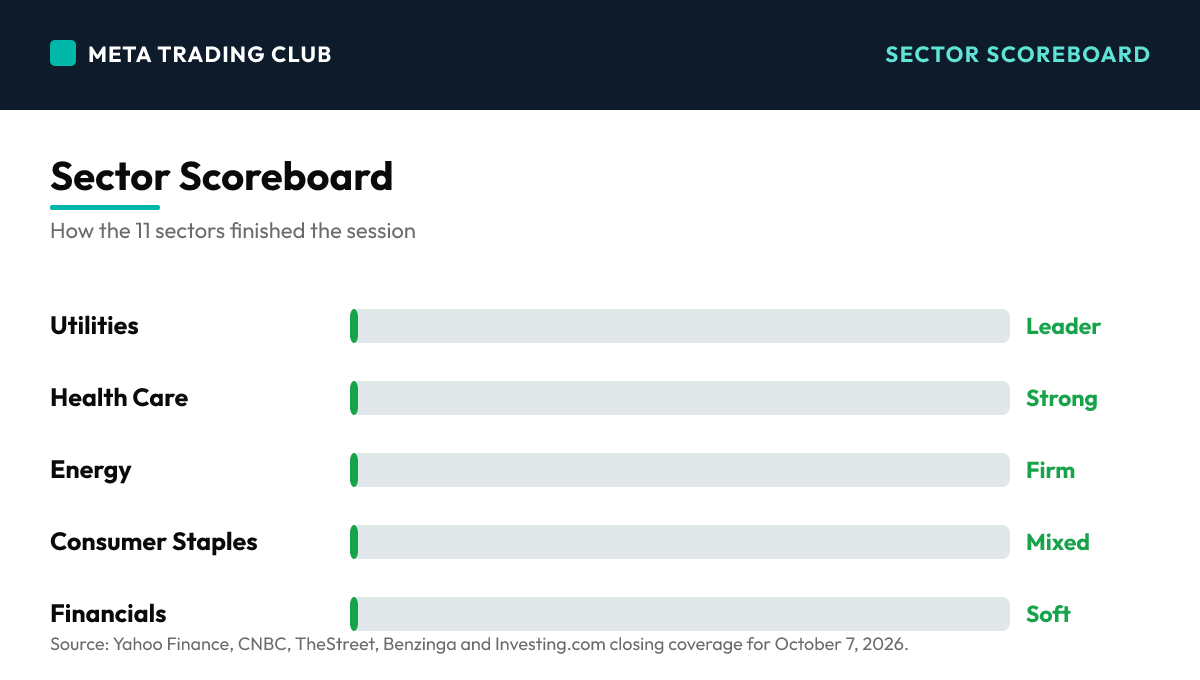
Today was the retest, and it held, barely. After Tuesday’s first-ever close above 7,800, the S&P 500 came back down and closed at 7,801.77, a grand total of 1.77 points above the exact level we flagged yesterday as the whole game. That is how a retest is supposed to work: an old ceiling that gets broken comes back to be tested as a floor, and buyers decide. On the close, they did. But make no mistake about the quality of the day underneath that level. The index fell 0.22%, the Nasdaq matched it, the Dow dropped 0.66% on industrial weakness, and the Russell 2000 was crushed for 1.31%. Roughly 68% of US issues finished lower. The driver was rates: the 10-year yield pushed to 5.304%, its highest since 2002, and the 30-year cleared 5.67%, a 24-year high, after 2 PM Fed minutes showed officials still leaning toward one more hike before year-end. Rising yields pulled money out of growth and small caps and into defensives, with utilities leading, healthcare rebounding from Tuesday’s rout, and energy firm on a crude price near $90. Yet the VIX barely moved, closing at 15.67, which tells you this was orderly rotation, not panic. So the setup into Thursday is clean and binary at the same line as yesterday. The S&P held 7,800 on the retest, which keeps the breakout technically intact, but it did so on poor breadth with yields running. Hold 7,800 again Thursday and the floor is confirmed. Lose it, especially if yields keep climbing, and the retest failed and the range comes back.
MAJOR HEADLINES AND CATALYSTS
Top Market-Moving Stories
- S&P 500 RETESTS 7,800 AND HOLDS BY 1.77 POINTS (Day) – After Tuesday’s first-ever close above 7,800, the S&P fell 0.22% but closed at 7,801.77, exactly 1.77 points above the level we flagged as the whole game. The market came back down to test the broken August record as new support and buyers defended it on the close. The retest held, which keeps the breakout technically intact, but it did so on poor breadth. 7,800 is still the only line that matters into Thursday.
- 10-YEAR YIELD HITS HIGHEST SINCE 2002 (Day) – The 10-year Treasury yield pushed to 5.304%, its highest close in 24 years, after touching 5.35% intraday, and the 30-year cleared 5.67%, also a 2002-era high. This was the engine of the entire session, pulling money out of growth and small caps and into defensives. A 10-year at a 24-year high is a restrictive, headwind-level rate, and until it stabilizes it will keep setting the tone for the whole equity tape.
- FED MINUTES SIGNAL ONE MORE HIKE AHEAD (Day) – The 2 PM release of the latest Fed minutes showed officials still leaning toward one more rate hike before year-end, at either the October 28 or December 9 meeting, with the market pricing roughly 20% odds of a move this month. The hawkish tone was the catalyst that drove yields to their highs into the close and reinforced the rotation out of rate-sensitive growth. The path of rates, not earnings, is running this tape right now.
- OIL HOLDS NEAR $90 ON FRESH MIDEAST STRIKES (Day) – WTI crude held near $90.09 and Brent stayed above $101 after fresh Houthi strikes targeted Saudi airports at Jazan and Najran and a hurricane threatened Gulf production. The war and weather premium in oil gave energy a bid on an otherwise red day and kept an inflation worry alive in the background, part of why the bond market stayed under pressure. Geopolitical oil risk is a slow-burn input the rate market is watching closely.
AFTER-HOURS EARNINGS SPOTLIGHT
A Light Post-Close Slate Ahead of Earnings Season
- LEVI STRAUSS HEADLINES A LIGHT SLATE (AH) – The post-close earnings slate was light, with Levi Strauss the most-watched report after the bell and Applied Digital also on the tape. Neither is an index-moving S&P name, so the after-hours session leaves the day’s rate story and the 7,800 retest as the full picture. The quiet slate keeps attention squarely on the technical setup and Thursday’s data rather than a fresh earnings catalyst into the open.
- PEPSICO KICKS OFF Q3 SEASON THURSDAY MORNING (AH) – The real earnings catalyst is tomorrow: PepsiCo reports before the open around 6 AM ET to unofficially kick off Q3 earnings season, with the focus on North American snack volumes and the full-year outlook. As a consumer-staples bellwether, PEP’s report and guidance will set an early tone for how the market reads demand into the quarter. Delta follows on Friday. The season starts just as the rate backdrop turns restrictive.
WHAT IT SETS UP FOR THURSDAY
Same Line, Two Data Points
- 7,800 IS STILL THE LINE THAT MATTERS (AH) – The S&P held 7,800 on the retest, closing at 7,801.77. That keeps the breakout intact but unconfirmed, because the hold came on poor breadth with yields running. Thursday is the second test of the same line. Hold 7,800 again and the old ceiling is confirmed as a floor. Lose it, especially if yields keep climbing, and the retest failed and the prior range comes back into play. The first clean move relative to 7,800 at the open tells you which it is.
- JOBLESS CLAIMS AT 8:30 AM AND PEPSI AT 6 AM (AH) – Thursday opens with two catalysts: weekly jobless claims at 8:30 AM ET, with consensus near 200,000 versus 197,000 prior, and PepsiCo earnings before the open. A hot or cold claims print will move yields, which are the whole story right now, and PEP sets the first tone for earnings season. Watch the bond market’s reaction to claims closely, since the 10-year at a 2002 high is what is driving the equity rotation.
Winners & Losers
Winners
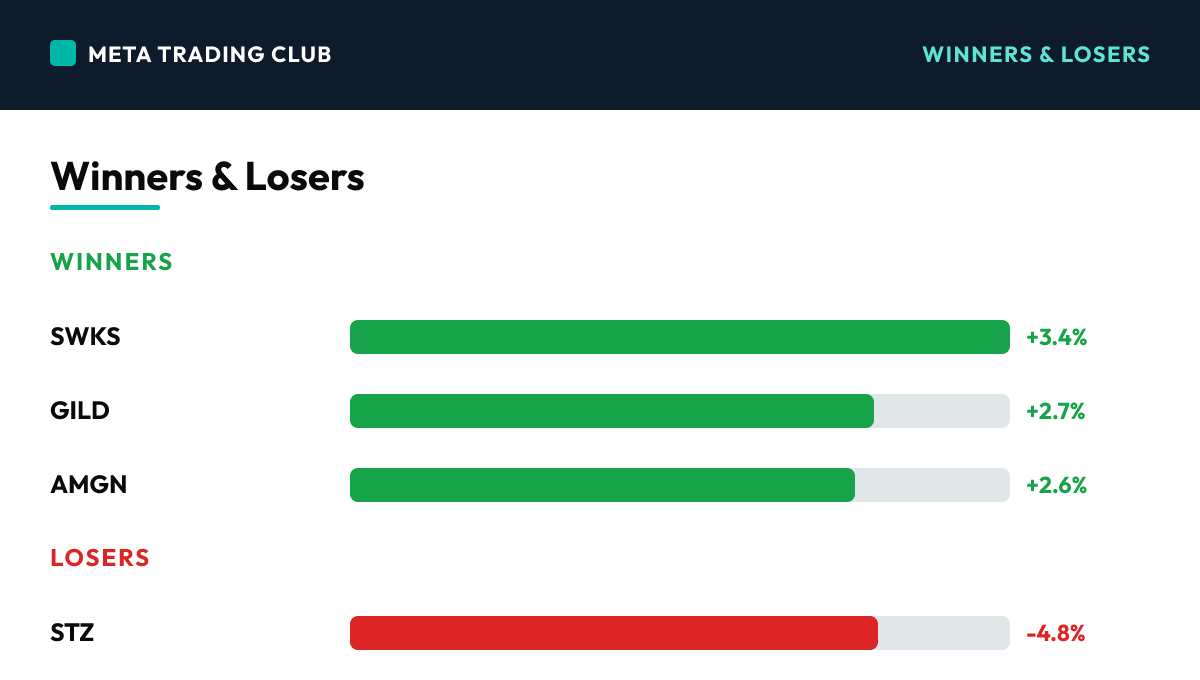
| SWKS | +3.4% | Skyworks Solutions rose about 3.4% after confirming a roughly $22 billion merger agreement with Qorvo that would combine two of the largest radio-frequency chip makers. The deal was an M&A story that cut against the day’s risk-off tone, giving the semiconductor space a rare green name on a red tape. Consolidation in the RF chip sector was read as a positive for pricing power and scale, and the stock was one of the clearest large-cap winners on a day most of the market rotated defensive. | |
| GILD | +2.7% | Gilead Sciences gained about 2.7% on reports of an AI-focused collaboration with Cognizant, and the move fit the day’s broader rotation as healthcare caught a defensive bid after Tuesday’s rout. A stable, dividend-paying biopharma with a fresh AI angle was exactly the kind of name money rotated toward on a session that fled growth and small caps. Gilead’s strength was both a company-specific catalyst and a symptom of the day’s flight to the defensive corners of the market. | |
| AMGN | +2.6% | Amgen rose about 2.6%, participating in the sharp rebound across healthcare as the sector flipped from Tuesday’s worst-performing group to among the best. On a day the market rotated hard into defensives on a rate scare, the large-cap pharma names with steady earnings and dividends were natural beneficiaries. Amgen’s gain was part of the clearest rotation signal of the session: money leaving rate-sensitive growth and parking in the defensive strength of big healthcare. |
Losers
| STZ | -4.8% | Constellation Brands fell about 4.8% after an earnings miss, the worst of the large-cap consumer-staples names on a day the sector otherwise leaned defensive and held up. The drop was a company-specific earnings story that cut across the day’s rotation theme, dragging on an otherwise supportive staples group. It was a reminder that even in a clean defensive rotation, an individual earnings miss can send a name the opposite way from its sector, and that Q3 season is starting with caution around consumer demand. | |
| ALLE | -6.0% | Allegion dropped about 6.0%, one of the worst industrial decliners as the economically sensitive sector led the market lower on the rate scare. Industrials are the most cyclical corner of the market, so a day driven by a 2002-high 10-year yield and fears that higher-for-longer rates bite growth hit them hardest. Allegion’s slide was part of the industrial weakness that dragged the Dow to a 0.66% loss, and a clear example of where the risk-off rotation did its damage. | |
| CAT | -3.3% | Caterpillar fell about 3.3%, a major drag on the Dow and a bellwether for the industrial weakness that defined the risk-off tone. As one of the most economically sensitive blue chips, Caterpillar is a direct read on how the market is pricing the growth risk of restrictive rates, and today that read turned negative. The stock’s decline was a key reason the Dow underperformed the broader indexes and a clear signal that the rate move was weighing on the cyclical heart of the market. |
What It Sets Up For Tomorrow
Levels Into Tomorrow
- S&P 500 7,800 – THE LINE THAT HELD, NOW TESTED AGAIN. Price closed at 7,801.77, a mere 1.77 points above this level after retesting it today. This is still the single most important line on the page. Today was the first retest of the broken August ceiling as new support, and buyers defended it on the close. But the hold came on poor breadth with yields running, so it is intact, not confirmed. Hold 7,800 again Thursday and the old ceiling is a genuine floor. Lose it and the breakout failed its retest. The first clean move relative to 7,800 at the open settles it.
- S&P 500 7,820 – THE RECLAIM THAT CONFIRMS STRENGTH. A clean push back above the 7,816 to 7,820 zone, where Tuesday’s record close sits, would tell you the retest did its job and buyers are back in control above the breakout level. That is the level that turns a successful defense of 7,800 into renewed upside momentum. Reclaiming it on steadier yields would confirm the rotation was a pause that refreshes rather than the start of a rollover, and would reopen the path toward 7,850.
- S&P 500 7,750 – THE SHELF IF THE RETEST FAILS. The first real support if 7,800 gives way on Thursday. A loss of 7,750 would confirm the retest failed and that the poor breadth, the red Russell and the industrial weakness were the honest signals under the record. This is where a failed breakout turns into a genuine pullback into the prior range, and where the rate-sensitive and lower-quality names would likely lead the move lower. Below it, the pre-breakout range comes back into play.
Bull case: The breakout is still intact because the one line that matters held its first retest. The S&P came all the way back to 7,800 today and closed 1.77 points above it, exactly the defense you want to see after a breakout. The down day was orderly, not a panic: the VIX barely moved at 15.67, and the weakness was a clean rotation into defensives like utilities and healthcare rather than a rush for the exits. If jobless claims Thursday cool the rate story even slightly, yields stabilize off their 2002 highs, and the S&P holds 7,800 again and reclaims 7,820, the retest is confirmed and the path reopens toward 7,850. In this read, today was the healthy pullback that tests and confirms the breakout before the next leg, and the defensive rotation is money repositioning inside the market, not leaving it.
Bear case: A hold by 1.77 points on 68% negative breadth is not a hold you can trust yet. The internals were poor across the board: the Russell fell 1.31%, the Dow dropped on industrial weakness, and roughly two-thirds of issues declined. The reason was a 10-year at a 2002 high and a 30-year at a 24-year high, driven by Fed minutes pointing to another hike, and rising yields are the most direct threat to the long-duration leadership carrying this tape. If Thursday’s jobless claims come in hot and yields push further above 5.3%, the pressure on growth and small caps intensifies and 7,800 is unlikely to hold a second test. A failed retest sends price back toward 7,750 and the prior range, led by the same rate-sensitive and small-cap names that cracked today. The level held once on thin margin; the rate backdrop says do not assume it holds twice.
Risks Into Tomorrow
- The retest is where a breakout earns its stripes, not the breakout day — Yesterday the S&P closed above 7,800 for the first time ever, and we said the same thing we always say: the breakout is not confirmed on the day it happens, it is confirmed on the retest. Today was the retest. Price came all the way back down to 7,800 and closed at 7,801.77, a margin of less than two points, and buyers defended the line on the close. This is exactly the sequence that separates a real breakout from a false one, and it is why we tell traders not to chase the initial pop. The mistake is piling in at the record high and then panicking when price pulls back. The discipline is understanding that the pullback to the broken level is the most informative part of the whole move. When the market comes back to 7,800 and holds, you get confirmation and a defined risk point right below the line. When it slices through and cannot reclaim, you get your answer just as clearly. Either way, the level does the work and you do not have to guess. Today the level held, which keeps the breakout alive, but a hold by 1.77 points on poor breadth is a thin hold. The retest is not fully over. Thursday is the second test of the same line, and the discipline is the same: mark 7,800, let price come to it, and let the reaction tell you. That is trading the level instead of the headline.
- Know what your move depends on, because that is what takes it away — Today’s entire session came down to one input: rates. The 10-year Treasury yield pushed to 5.304%, its highest since 2002, and the 30-year cleared 5.67%, a 24-year high, after Fed minutes showed officials still leaning toward another hike before year-end. Everything else flowed from that one line. Money rotated out of growth and small caps because higher yields raise the valuation bar on long-duration earnings. The Russell fell 1.31% because small caps carry the most floating-rate debt. Utilities and healthcare led because defensives are where capital hides when rates spike. If you understand that the whole move depended on yields, you know exactly what to watch, because the same input that drove today will drive tomorrow. This is the core discipline: identify the single factor your market is keyed to, and then watch that factor like a hawk. Right now that factor is the bond market, not earnings and not headlines. That is why Thursday’s jobless claims at 8:30 AM ET matter more for how yields react than for the number itself, and why the 10-year around 5.30% is the real tell for whether the S&P can keep holding 7,800. A rotation built on rising yields is only as stable as the next yield print. You do not trade your opinion on rates. You watch what rates actually do and let the level confirm or deny. No alignment until the bond market and the price agree.
- A calm VIX on an ugly tape is the market telling you the difference between rotation and panic — Here is the detail most traders missed today. The tape was broadly red, roughly 68% of issues fell, the Russell got hit for 1.31%, and yet the VIX barely moved, closing at 15.67. That combination is one of the most useful tells in the market, and it changes how you should read the whole day. When stocks fall and the fear gauge spikes, money is leaving the market, de-risking, heading for the exits. That is panic, and it tends to feed on itself. When stocks fall and the fear gauge stays calm, money is not leaving, it is moving, out of one part of the market and into another. That is rotation, and it is a completely different animal. Today was rotation. Capital moved out of rate-sensitive growth and small caps and into defensives like utilities and healthcare, in an orderly way, without a spike in fear. That matters because rotation inside a market is a sign of health, not breakdown. It means investors are repositioning for a higher-rate backdrop, not abandoning equities. The discipline here is to read the internals, not just the index. A down day is not automatically a risk-off flush, and a calm VIX on a red tape is the market telling you to stay measured. If the VIX had spiked today, the hold at 7,800 would mean far less. Because it did not, the defense of the level reads as credible rotation, and that is the context you carry into Thursday.
Frequently Asked Questions
How did the S&P 500 close today?
On Wednesday, October 7, 2026, the S&P 500 closed at 7,801.77 (-0.22%), with the VIX at 15.67. The big story in the stock market today: the record run finally hit a wall, but the one line that mattered held.
What drove the market today?
S&P 500 RETESTS 7,800 AND HOLDS BY 1.77 POINTS (Day) – After Tuesday’s first-ever close above 7,800, the S&P fell 0.22% but closed at 7,801.77, exactly 1.77 points above the level we flagged as the whole game. The market came back down to test the broken August record as new support and buyers defended it on the close. The retest held, which keeps the breakout technically intact, but it did so on poor breadth. 7,800 is still the only line that matters into Thursday.
What levels matter for tomorrow?
S&P 500 7,800 – THE LINE THAT HELD, NOW TESTED AGAIN. Price closed at 7,801.77, a mere 1.77 points above this level after retesting it today. This is still the single most important line on the page. Today was the first retest of the broken August ceiling as new support, and buyers defended it on the close. But the hold came on poor breadth with yields running, so it is intact, not confirmed. Hold 7,800 again Thursday and the old ceiling is a genuine floor. Lose it and the breakout failed its retest. The first clean move relative to 7,800 at the open settles it. S&P 500 7,820 – THE RECLAIM THAT CONFIRMS STRENGTH. A clean push back above the 7,816 to 7,820 zone, where Tuesday’s record close sits, would tell you the retest did its job and buyers are back in control above the breakout level. That is the level that turns a successful defense of 7,800 into renewed upside momentum. Reclaiming it on steadier yields would confirm the rotation was a pause that refreshes rather than the start of a rollover, and would reopen the path toward 7,850. S&P 500 7,750 – THE SHELF IF THE RETEST FAILS. The first real support if 7,800 gives way on Thursday. A loss of 7,750 would confirm the retest failed and that the poor breadth, the red Russell and the industrial weakness were the honest signals under the record. This is where a failed breakout turns into a genuine pullback into the prior range, and where the rate-sensitive and lower-quality names would likely lead the move lower. Below it, the pre-breakout range comes back into play.
How does Meta Trading Club prepare for the next session?
We wrap every session and carry the read forward through the MTC Alignment Engine — bias, level, reaction, confirmation, execution, targets. No alignment, no trade. Learn the full process inside the MTC Incubator.
New to this? Start with the free training.
Learn how we read the market before you risk a dollar — our free education library and ebook break down the fundamentals step by step.
Free education → Get the free ebookThe session’s over. The prep isn’t.
This is how MTC members close each day — wrap what happened, mark the levels, and carry one clean read into tomorrow. If you want to build that habit and qualify your own A+ setups instead of chasing alerts, the MTC Incubator is mentorship and a repeatable process. It’s application-based — see if it’s a fit.
Explore the MTC Incubator → Apply nowSources: Yahoo Finance, CNBC, TheStreet, Benzinga and Investing.com closing coverage for October 7, 2026.. For educational purposes only. Not financial advice.