

Table of Contents
How It Works:
The protective collar strategy consists of two key actions: buying an out-of-the-money (OTM) put option and writing an OTM call option, both of which have the same expiration date. This method is used when an investor already owns the underlying asset. The purchase of an OTM put option provides downside protection by locking in a potential sale price for the asset, whereas selling (writing) an OTM call option creates revenue that can pay the cost of the put option but limits the potential upside.
Objective:
Investors generally utilize this method after making big profits on a long position in a stock to protect those gains from a market downturn. The protective collar acts as a hedge, allowing the investor to sell the asset at a defined minimum price through the put option while also requiring the investor to sell the asset at a predetermined maximum price through the call option.
Risk and Rewards:
The key advantage of the protective collar is that it protects the investor’s stock holdings from downside risk. This protection is especially useful after large profits, as it protects a portion of the reward from potential losses. The premium gained from writing the call option often more than covers the cost of purchasing the put option, making this technique cost-effective in terms of out-of-pocket expenses.
The trade-off is that the investor limits their investment’s upside potential. Selling a call option commits the investor to selling shares at the strike price of the call if the asset’s price climbs to that level before the option expires. This means that any price appreciation above the call’s strike price will not benefit the investor because they are forced to sell the shares at that price, thus missing out on additional gains.
An illustrative example of this strategy is an investor holding 100 shares of IBM, bought at $100 each. To implement a protective collar, the investor might sell a March 105 call option, capping potential gains at $105 per share, and buy a March 95 put option, ensuring they can sell their shares at no less than $95 each, regardless of how much the market price may fall. This setup provides a safeguard against loss while limiting the potential for further profit.
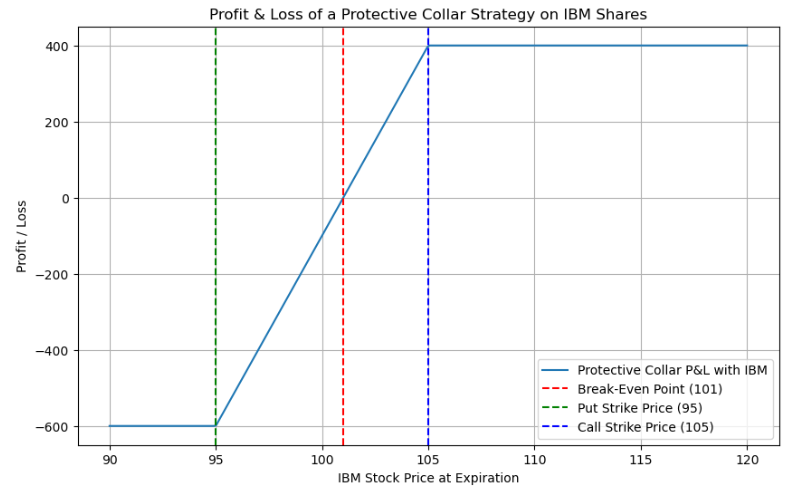
You can see that the protective collar is a combination of a long put and a covered call in the P&L graph above. Since this trade setup is neutral, the investor is safeguarded in the event that the stock declines. Potentially having to sell the long stock at the short call strike is the trade-off. But since they have already made money on the underlying shares, the investor will probably be pleased to do this.