Delta is the first Greek most options traders encounter — and also the one they misunderstand the longest.
Most beginner explanations treat delta as a single number attached to a contract. ‘This option has a 0.45 delta.’ Okay. What does that actually mean? How does it move? How do you use it when selecting a trade, sizing a position, or managing risk?
This guide answers all of that. No jargon, no unnecessary complexity — just a clear explanation of what delta measures, how it behaves, and how to apply it in your actual trading decisions.
The one Greek to start with
If you only learn one Greek first, make it delta. It tells you your directional exposure and roughly how the option moves per $1.
What Delta Measures
Delta is one of the ‘Greeks’ — a set of metrics that describe how an option’s price behaves in relation to various factors. Delta specifically measures how much an option’s price is expected to change for every $1 move in the underlying asset.
If SPY moves up by $1 and you hold a call option with a delta of 0.50, that option’s price is expected to increase by approximately $0.50.
If SPY moves down by $1 and you hold a put option with a delta of -0.40, that option’s price is expected to increase by approximately $0.40 (because puts gain value when the underlying falls).
Simple version: delta tells you how ‘sensitive’ your option is to movement in the underlying. Higher delta = more direct exposure to the underlying’s price action.
MTC Analysis
Delta: What the Number Tells You
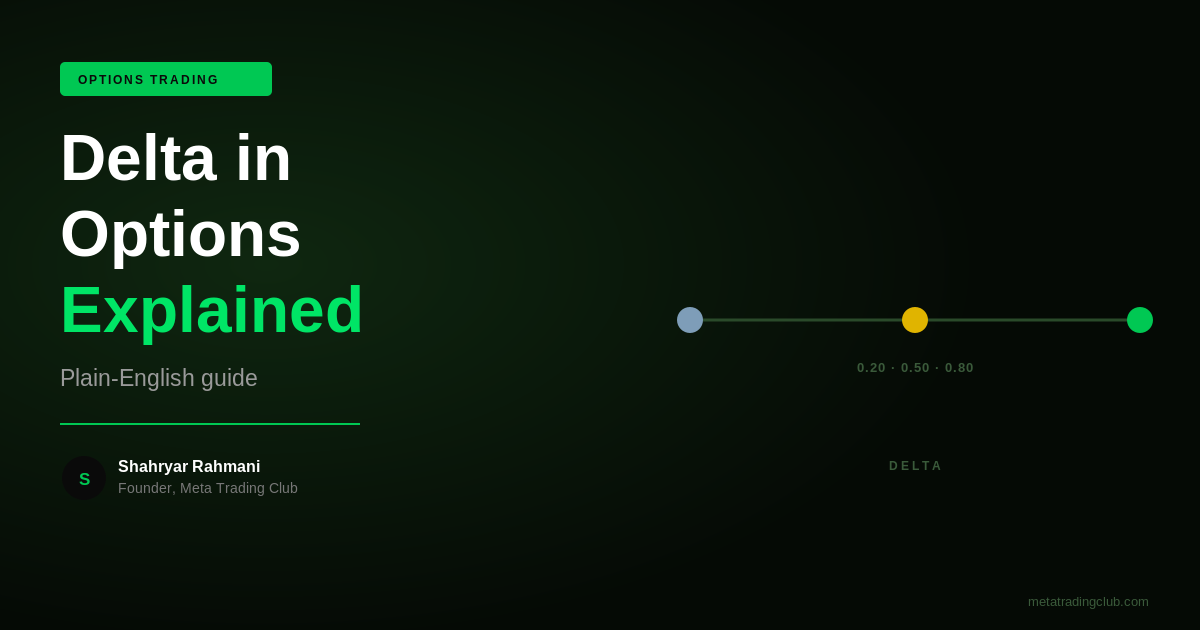
Delta is both a probability gauge and a speed dial: ~0.50 at the money, lower out of the money, higher in the money.
Delta Ranges for Calls vs Puts
Delta always falls within a specific range depending on whether you’re looking at a call or a put.
Calls: Delta ranges from 0 to +1.00
- Deep OTM call: delta near 0 (barely moves with the underlying)
- ATM call: delta around 0.50
- Deep ITM call: delta near 1.00 (moves almost dollar-for-dollar with the underlying)
Puts: Delta ranges from -1.00 to 0
- Deep OTM put: delta near 0
- ATM put: delta around -0.50
- Deep ITM put: delta near -1.00
The sign just tells you the direction of the relationship. Calls have positive delta (they gain when the underlying rises). Puts have negative delta (they gain when the underlying falls).
ITM, ATM, and OTM Delta: Understanding Where Each Sits
The location of your strike relative to the current price directly determines your delta. Here’s how to think about it:
Out-of-the-Money (OTM) Options
OTM options have low delta — typically between 0.05 and 0.35. Because the underlying still needs to move significantly for these options to have intrinsic value, they respond less directly to each $1 move.
A SPY call with a $540 strike when SPY is at $525 has a low delta. SPY would need to move $15 just to reach the strike. Until then, the option’s price changes are driven more by time and volatility than by small directional moves.
Low delta options are cheaper in premium but require bigger, faster moves to generate profit. They also lose value more quickly if the underlying doesn’t move in your direction.
At-the-Money (ATM) Options
ATM options have a delta around 0.50 for calls (-0.50 for puts). This means they respond roughly 50 cents for every $1 the underlying moves. These are the most commonly traded options for directional plays because they balance cost with sensitivity.
ATM options are also the most liquid in most cases — market makers and other traders are most active at the ATM strike, which keeps spreads tight.
In-the-Money (ITM) Options
ITM options have higher delta — typically 0.60 to 1.00. A deep ITM call behaves almost like owning the stock outright. These options move dollar-for-dollar (or near it) with the underlying.
The tradeoff: ITM options cost significantly more in premium. You’re paying for intrinsic value upfront. The upside is less ‘lottery ticket’ risk and more predictable, stock-like behavior.
Delta as a Probability Proxy
One of the most useful ways to think about delta — especially for strike selection — is as a rough probability estimate.
A delta of 0.30 on a call suggests approximately a 30% probability that the option expires in the money. A delta of 0.70 suggests approximately 70%.
This isn’t a perfect probability model (options pricing doesn’t work exactly like that), but it’s a useful mental shortcut. When you’re deciding between a 0.25 delta call and a 0.50 delta call, you’re also roughly deciding between a ‘lower probability, higher leverage’ bet and a ‘higher probability, lower leverage’ position.
For traders early in their development, favoring higher delta (0.40-0.60) reduces the odds of buying OTM options that expire worthless — which is one of the most common and expensive beginner mistakes.
How Delta Changes Over Time
Delta is not static. It changes as conditions change — which is what makes it a dynamic and important concept to track.
Delta Changes as the Underlying Moves
When the underlying moves toward your strike, delta increases. When it moves away, delta decreases. This sensitivity of delta to price movement is measured by another Greek called gamma — but you don’t need to master gamma to understand the practical implication.
Practical implication: When the underlying is moving in your favor and approaching your strike, your option accelerates. Each additional $1 move generates more dollar gain than the previous one. This is why options can produce outsized returns relative to the underlying’s percentage move.
Delta Changes as Expiration Approaches
As an option nears expiration, delta becomes more binary. ITM options approach a delta of 1.00 (they’re almost certainly expiring with value). OTM options approach a delta of 0 (they’re almost certainly expiring worthless).
This means that 0DTE (zero days to expiration) options behave very differently from weekly or monthly options. Their delta moves faster and more dramatically in response to underlying price changes. That’s why 0DTE trading has a higher skill requirement — small moves can create large delta swings in either direction.
Delta Table: OTM vs ATM vs ITM
| Option Type | Typical Delta (Call) | Typical Delta (Put) | Premium | Probability of Profit | Behavior |
|---|---|---|---|---|---|
| Deep OTM | 0.05 – 0.20 | -0.05 to -0.20 | Very low | Low | Needs big, fast move |
| Slightly OTM | 0.20 – 0.40 | -0.20 to -0.40 | Low-moderate | Moderate-low | Needs moderate directional move |
| ATM | ~0.50 | ~-0.50 | Moderate | ~50% | Most balanced — common for directional plays |
| Slightly ITM | 0.60 – 0.75 | -0.60 to -0.75 | Moderate-high | Moderate-high | More stock-like behavior |
| Deep ITM | 0.80 – 1.00 | -0.80 to -1.00 | High | High | Near stock-like movement, less leverage |
How to Use Delta for Position Sizing and Strike Selection
Understanding delta isn’t just academic — it has direct application in how you structure a trade.
Strike Selection
When you’re planning a directional trade, delta helps you choose a strike that matches your conviction level.
High conviction, expecting a significant move: ATM or slightly OTM strike gives more leverage. The move needs to happen, but if it does, returns are amplified.
Moderate conviction, expecting a smaller directional move: Slightly ITM strike gives more consistent delta exposure with less dependence on a large move.
Uncertainty about timing but confident in direction: ITM call with higher delta reduces the impact of time decay eating into position value while you wait.
Position Sizing with Delta
Some traders use delta to normalize their position size across different trades. If you typically want $0.50 of exposure per $1 move in the underlying, you’d buy 1 contract of an ATM option (delta ~0.50). If you bought a 0.25 delta option instead, you’d need 2 contracts to get the same dollar sensitivity.
This kind of delta-normalized sizing helps traders maintain consistent risk across different setups rather than randomly buying the same number of contracts regardless of how the options actually behave.
Common Beginner Misunderstandings About Delta
‘Delta is a fixed number’ — It isn’t. Delta changes constantly as the underlying moves and as expiration approaches. A 0.40 delta call today might be a 0.65 delta call tomorrow if the underlying moves higher.
‘High delta always means better’ — Not necessarily. Higher delta means more exposure — which means bigger losses when wrong, not just bigger gains when right. The right delta depends on your thesis, your risk tolerance, and your expected move.
‘Delta as probability is precise’ — Delta is a rough proxy for probability, not an exact calculation. Real options pricing involves many factors. Use it as a guideline, not a hard number.
‘OTM options are always better because they’re cheap’ — Cheap premium doesn’t mean good value. A 0.10 delta option needs a large, fast move in your direction just to recover its premium. Most OTM options expire worthless. Starting beginners with near-ATM options is almost always the more practical approach.
How MTC Teaches Delta in Context
At Meta Trading Club, delta is always taught in context — not as an abstract number, but as a practical input in trade planning.
During live premarket sessions, when setups are being analyzed using the MTC Alignment Engine, the discussion naturally includes which strike makes sense given the expected move and where the key levels are. Members learn to ask: ‘Given the market bias and the distance to my target, what delta makes sense for this position?’
That kind of applied learning — using delta alongside market structure, confirmation signals, and defined risk — is how the concept actually becomes useful. Reading about it is the first step. Seeing it applied to real setups is where it sticks.
For a deeper dive into the full options chain, including how delta fits alongside other columns like IV and theta, read How to Read an Options Chain. For foundational context on trading options in Canada, see the full Options Trading Canada Beginners Guide.
Learn Options Trading with Structure and Clarity
Delta is one piece of a larger process. Knowing what it means is the start — knowing how to use it within a structured trading methodology is what makes the difference.
MTC Community teaches options trading through live daily sessions, a clear 5-step framework, and real-time application to actual market setups. No guesswork. No copying signals. Just a process you can own.
Start your 7-day free trial at MTC Community →
Learn delta in context. Learn options the right way.
Proprietary Framework
The MTC Alignment Engine™ — Applied Every Live Session
Every trade runs the same five checkpoints — consistency over gut reaction. Inside the MTC Incubator, members build their own system on top of this framework.
Frequently Asked Questions
What is delta in options trading?
Delta measures how much an option’s price changes for every $1 move in the underlying asset. A call with a delta of 0.50 gains approximately $0.50 in value for every $1 increase in the underlying. Delta ranges from 0 to 1.00 for calls and 0 to -1.00 for puts, with at-the-money options typically having a delta near 0.50.
What does a 0.50 delta mean for an option?
A 0.50 delta means the option will gain or lose approximately $0.50 for every $1 move in the underlying. It also serves as a rough indicator that the option has approximately a 50% probability of expiring in the money. A 0.50 delta call is at-the-money and represents the most commonly traded strike for directional options plays.
Is higher delta better for options trading?
Higher delta means your option moves more directly with the underlying — which amplifies both gains and losses. Higher delta isn’t inherently better or worse; it depends on your trade thesis. If you expect a large move, lower delta (with higher leverage) can be appropriate. If you want more consistent directional exposure with less time pressure, higher delta is often more practical, especially for beginners.
How does delta change as expiration approaches?
As options approach expiration, delta becomes more binary. ITM options see their delta move toward 1.00; OTM options see their delta move toward 0. This acceleration is why same-day expiration (0DTE) options are more volatile — small underlying moves create large, fast delta changes. Beginners are generally better served by avoiding very short-dated options until they understand this dynamic.
What is the relationship between delta and probability?
Delta is commonly used as a rough probability estimate for whether an option will expire in the money. A 0.30 delta call is approximately 30% likely to expire ITM; a 0.70 delta call is approximately 70% likely. This isn’t a precise probability model — actual options pricing is more complex — but it’s a useful mental framework for understanding the risk-reward profile of different strikes.
How do I use delta to choose an options strike?
Use delta to match your strike to your conviction level and expected move. For high-conviction directional plays expecting a significant move, ATM or slightly OTM options (0.40-0.50 delta) provide leverage while staying reasonably accessible. For more conservative positions or when you’re less certain about timing, slightly ITM options (0.60+ delta) give more direct exposure and are less vulnerable to time decay eating your premium before the move happens.
Meta Trading Club Community
Start Your 7-Day Free Trial
Daily live sessions. Real-time market prep — not signals. The MTC Alignment Engine™ applied in front of you. Trade alongside Shahryar from day one.
Cancel anytime. No contracts. Built for Canadian traders.
Already trading and want to build your own system?
The MTC Incubator is an application-based mentorship — 1-on-1 work building a personalized system on the Alignment Engine™.