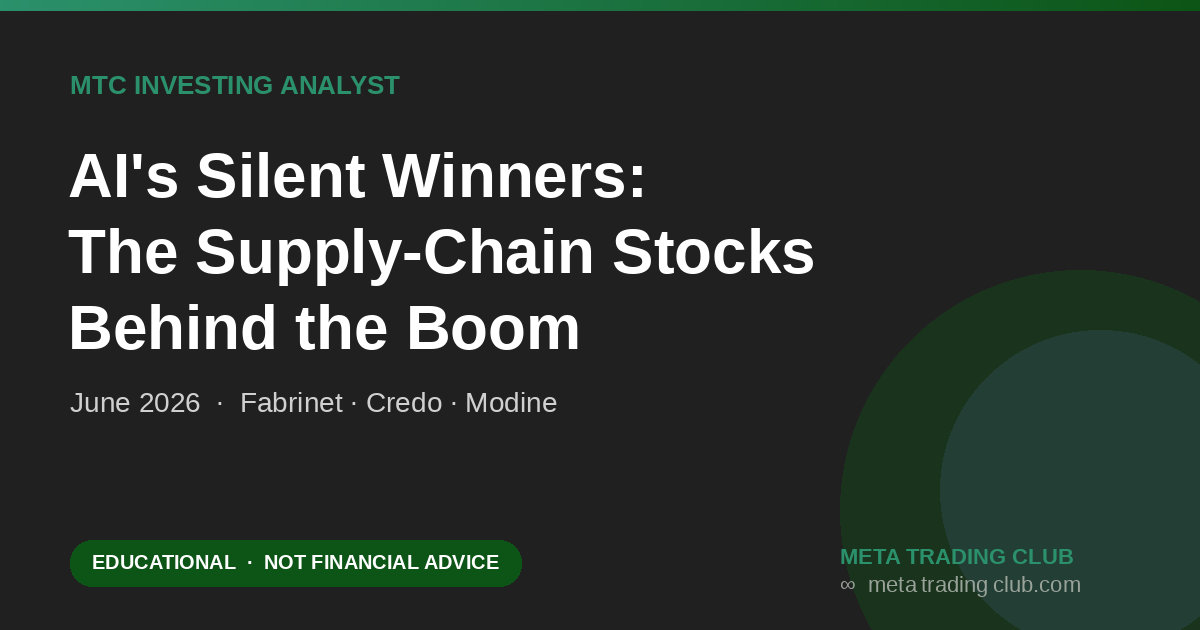
Everyone already owns Nvidia. That’s exactly why it’s not where the edge is anymore. The real opportunity in AI is one layer down — the under-the-radar companies quietly selling the parts every data center has to buy. Here’s how to find them, and three names doing it right now.
Educational only — not financial advice.
The market backdrop: patience over chasing
It’s been a whippy stretch. The S&P 500 set a record above 7,600 in early June, then took a sharp chip-led hit — the Nasdaq fell more than 4% on June 4, its worst day since April 2025 — before rebounding on hopes of a US–Iran deal (the Dow jumped roughly 900 points on June 10 as oil eased). The index now sits in the mid-7,000s, with the 10-year Treasury yield near 4.5% and WTI crude in the mid-$80s.
The macro setup is hawkish. May CPI came in hot at +4.2% year-over-year (energy-driven; core +2.9%), the fed funds rate is holding at 3.50–3.75% after four straight meetings without a cut, and the easing bias is gone. The big catalyst ahead: the June 16–17 FOMC meeting, Kevin Warsh’s first as Fed Chair after Jerome Powell’s term ended in May.
Translation for long-term investors: this is an “own quality, let pullbacks set your entries” market, not a chase-the-highs market. And with the recent volatility centered on chips, the smarter way to keep AI exposure is one layer down — through the supply chain.
The “picks and shovels” framework
In a gold rush, the people who reliably got rich weren’t the miners — they were the ones selling picks and shovels. Same logic in AI. The front-page names get all the attention and all the valuation. But every one of them depends on a supply chain: chips, power, cooling, optics, and the cables that wire it together.
A supplier only earns a spot if it passes all four tests:
- It sells into a hot name. Customer concentration here is a feature, not a bug.
- It’s under-covered. Off the front page, low retail awareness.
- It has pricing power. Real margins, not a commodity it can’t defend.
- There’s a verifiable demand link. A named customer, a contract, a capex line that flows to them.
Run that filter on today’s AI buildout and three names stand out — and all three have quietly crushed the market over the past year:

1. Fabrinet (FN) — the optics layer
Recent price ~$611 · 52-wk range $248–$749 · about +149% over 1 year
What they sell: Contract optical manufacturing — the high-speed optical transceivers (800G today, 1.6T next) that move data between GPUs across an AI cluster.
Who buys it: Fabrinet is Nvidia’s primary optics supplier (also Cisco, Lumentum). Optical-communications revenue hit roughly $689M in Q4 FY25, up about 15% year-over-year.
Why it’s overlooked: A “boring” Thailand-based contract manufacturer — not a logo retail chases, despite sitting directly inside Nvidia’s networking stack.
The risk: Coherent was just named a second source on Nvidia systems Fabrinet had sole-sourced — watch for share shift. Plus customer concentration and rate sensitivity.
2. Credo Technology (CRDO) — the connectivity layer
Recent price ~$251 · 52-wk range $76–$270 · about +241% over 1 year
What they sell: Active Electrical Cables (AECs) — the “$300–$500 purple cables” that wire AI server racks more reliably than fiber over short runs.
Who buys it: Hyperscalers — AWS (shown in Trainium racks by AWS’s own CEO) and Microsoft. Sales up ~120% to roughly $425M; Credo pioneered the AEC category (est. ~88% share), a market seen reaching ~$4B by 2028.
Why it’s overlooked: A niche connectivity component, not a chip — it flies under the mega-cap radar despite being mission-critical to uptime (“link flaps” waste expensive GPU time).
The risk: SemiAnalysis has flagged that hyperscaler demand may be overstated and margins thinner than bulls assume. Heavy customer concentration — keep the position small.
3. Modine Manufacturing (MOD) — the cooling layer
Recent price ~$275 · 52-wk range $86–$323 · about +193% over 1 year
What they sell: Thermal management and data-center cooling — the gear that keeps dense AI racks from melting as the industry shifts to liquid cooling.
Who buys it: Hyperscaler data-center buildouts. Data-center sales rose ~31% sequentially in Q3 FY26, the order book now stretches roughly five years out, and management guides 50–70% annual data-center growth. A spin-off of its legacy unit (~Q4 2026) leaves a pure-play climate-solutions company.
Why it’s overlooked: An old-line industrial radiator maker re-rating into an AI infrastructure play — the market is still catching up to the pure-play story.
The risk: Cyclical industrial business; spin-off execution risk; the valuation has already moved — let dips set the entry.
On the bench (same theme, also real demand links): Comfort Systems USA (FIX), the contractor physically building the data centers; nVent Electric (NVT), electrical connection and liquid-cooling enclosures; and Vicor (VICR), power-delivery modules that sit right next to the GPU.
How to actually use this
This isn’t a “go all-in on small caps” pitch. The smart structure is to own the obvious AI names for stability and add one or two verifiable silent suppliers for upside — sized to their risk. Optics and connectivity names (FN, CRDO) are high-beta; treat them as aggressive-sleeve positions bought on volatility-driven dips. Cooling (MOD) is a longer-horizon industrial re-rate. And always anchor the portfolio with quality, income, and a real cash/gold hedge while a hawkish Fed pays you to wait.
The discipline that separates investors from gamblers: name your entry before you buy, write down why you own it, and track whether the thesis actually plays out. That last part — keeping score — is what most people skip, and it’s exactly why they never improve.
The bottom line
A hawkish Fed and energy-driven inflation cap the upside for now, while an Iran deal is the wildcard that could flip sentiment risk-on quickly. Chasing extended mega-cap tech at the highs is poor risk/reward here. The differentiated opportunity is in the AI supply chain — own a couple of verifiable silent suppliers alongside the obvious names, build the position on dips, and keep score on every call.
FAQ
What are AI supply chain stocks? Companies that sell critical components — optics, cables, power and cooling — into the AI data-center buildout, rather than the headline chipmakers themselves. Examples include Fabrinet (optics), Credo (connectivity) and Modine (cooling).
What is a “picks and shovels” AI investment? Buying the suppliers that every AI builder must pay, instead of the most crowded front-page names — the modern version of selling tools during a gold rush.
Is Fabrinet a supplier to Nvidia? Yes. Fabrinet is Nvidia’s primary optical-components manufacturer, building the high-speed transceivers used to connect GPUs in AI clusters.
Trade the next session with us live. Start your 7-day free trial →
Want the full weekly report?
The MTC Investing Analyst publishes a complete long-term report every Friday — market environment, three risk-tiered baskets, the silent-supplier spotlight, and a live scorecard tracking every call. Built to make you an independent investor, not a signal-follower.
Disclaimer: This article is for educational purposes only and is not financial advice. It is not a recommendation to buy or sell any security. Company figures and prices are drawn from public reporting and market data and will change; always confirm current data and do your own research before making investment decisions, considering your own risk tolerance. Meta Trading Club.