Thursday, October 29, 2026 · 4:30 PM ET · MTC Market Close
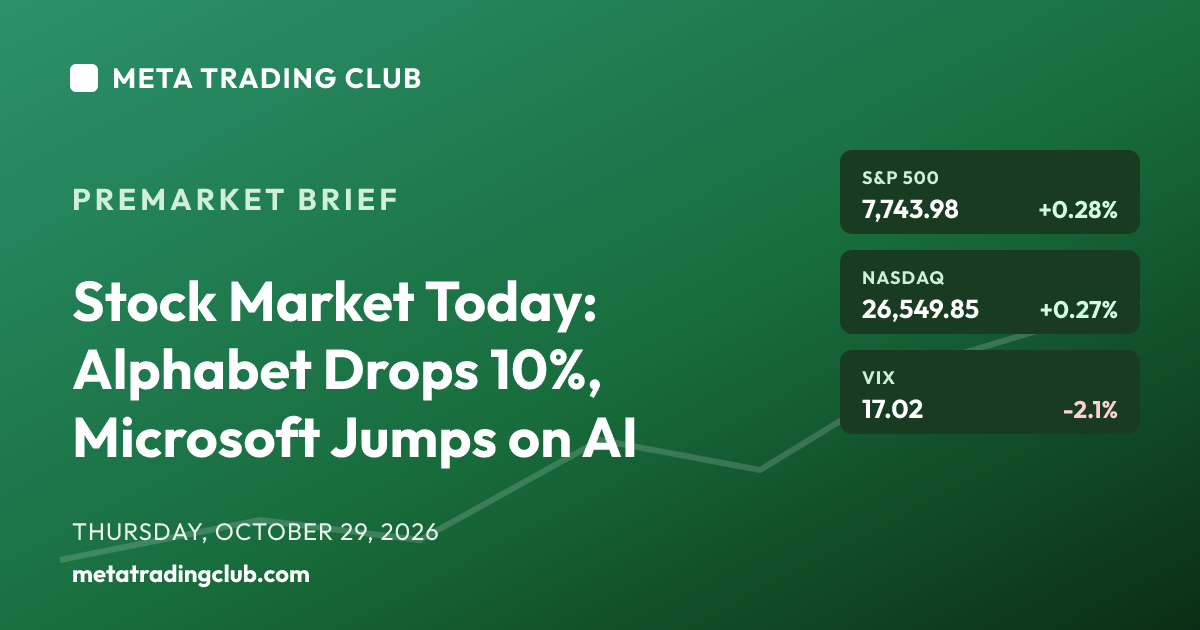
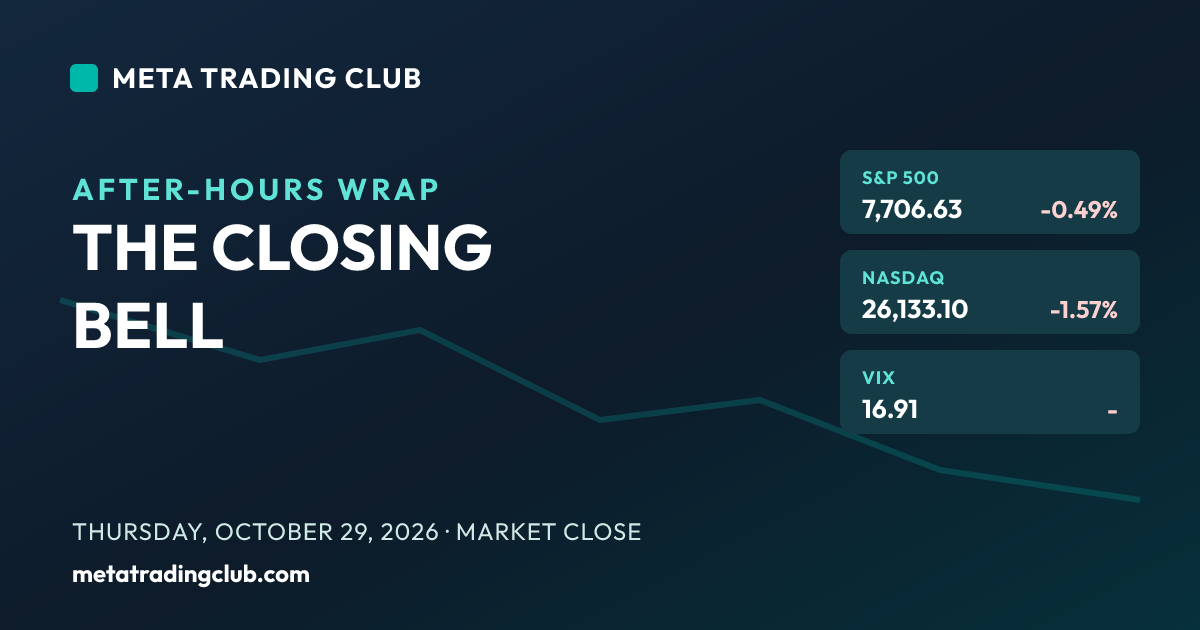
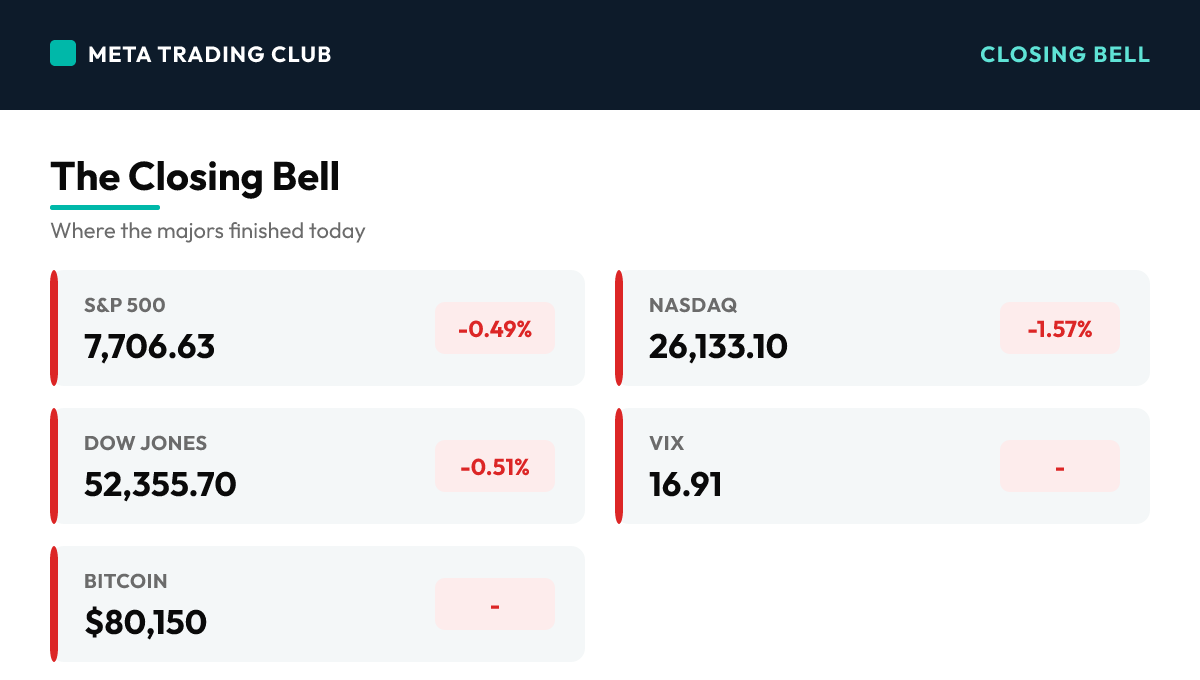
Here is the stock market today in one line: the index closed red and the tape underneath it was green. The S&P 500 slipped 0.49% to 7,706.63, the Nasdaq fell 1.57% to 26,133.10, and the Dow eased 0.51% to 52,355.70, yet eight of the eleven sectors actually finished higher. That is the whole read of the day, and it is the mirror image of Wednesday: a modest red headline sitting on top of broad green breadth, dragged lower by one name. Alphabet did the damage, falling about 12.7% after its overnight capex scare carried into the regular session, and because it is one of the heaviest weights in the cap-weighted index, its single slide was enough to paint the headline red while most of the market rose underneath it. Take Alphabet and the mega-cap tech complex out of it and the session was broadly constructive, with Real Estate, Healthcare, and Energy leading and the equal-weight tape clearly positive. The macro backdrop helped: Q3 GDP came in hot at 3.4%, the September PCE read cooled to about 2.1% headline, and the 10-year yield fell to 4.988%, finally dipping back below 5%. That combination, strong growth with cooling inflation and easing yields, is the goldilocks mix that let the rate-sensitive and small-cap corners breathe, with the Russell 2000 up 0.79% on the day. But the session was never fully about the close. Amazon reported after the bell and extended the AI-capex story that started with Alphabet: EPS of $1.89 missed the $1.96 estimate, AWS grew a strong 39.3%, capital spending is tracking near $220 billion, and the stock fell roughly 8 to 11% after hours. Intel beat on its third quarter but guided the fourth quarter light. The S&P closed holding 7,700 by about six points, which makes that line the single shelf into Friday. Hold it through the Amazon reaction and the month-end flows and this stays a healthy, broadening tape despite the mega-cap drag. Lose it, and the capex question that is now hitting both Alphabet and Amazon starts to outweigh the strong breadth underneath.
The Closing Bell
| Instrument | Close | Change | Note |
|---|---|---|---|
| S&P 500 | 7,706.63 | -0.49% | Slipped about 37 points to close at 7,706.63, but the red headline is misleading: eight of the eleven sectors finished green. The entire decline was a cap-weight story, with Alphabet off roughly 12.7% and dragging the index down almost single-handedly while the broad tape rose underneath. The index closed holding the 7,700 shelf by about six points, which makes that line the single level that matters into Friday. Hold it through the Amazon after-hours reaction and month-end flows and this stays a healthy, broadening tape; lose it and the AI-capex worry now hitting two mega-caps starts to outweigh the strong breadth. |
| Nasdaq | 26,133.10 | -1.57% | Fell about 417 points, the clear laggard of the majors, because it carries the heaviest concentration of the exact names under pressure. Alphabet’s 12.7% drop, ServiceNow’s collapse, and softness across mega-cap tech hit the Nasdaq hardest while the rest of the market held up far better. The gap between the Nasdaq down 1.57% and the Russell up 0.79% is the entire story of the day in two numbers: this was a rotation out of the most crowded AI-levered names, not broad risk-off. Amazon’s after-hours miss keeps the pressure on the index into Friday. |
| Dow Jones | 52,355.70 | -0.51% | Eased about 270 points, pulled down by its mega-cap tech components even as the broader blue-chip names held firm. On a day the equal-weight tape was green, the Dow’s modest red close tells you the weakness was concentrated at the top of the cap structure rather than spread across the index. Healthcare and energy strength inside the Dow cushioned the drag, which is why the blue-chip index fell far less than the tech-heavy Nasdaq. A controlled pullback, not a breakdown. |
| Russell 2000 | 2,862.34 | +0.79% | Small caps were the quiet winner of the day, rising 0.79% to 2,862.34 as the 10-year yield finally slipped back below 5% to 4.988%. This is the clearest signal in the tape: the most rate-sensitive corner of the market led on the day the mega-caps fell, which tells you the session was a rotation, not a liquidation. Hot GDP with cooling PCE and easing yields is exactly the backdrop small caps need, and they took it. If yields keep falling, this leadership can broaden; the Russell is the group to watch for whether the rotation has legs into Friday. |
| VIX | 16.91 | – | The volatility gauge eased to about 16.91, a calm reading that confirms the day was a rotation rather than a panic. A VIX in the mid-16s on a day the Nasdaq dropped more than 1.5% is the market telling you this is orderly repositioning out of crowded mega-cap tech, not a broad flight to safety. The number to watch is whether it stays subdued through Amazon’s after-hours reaction and Friday’s month-end flows, or whether a second mega-cap miss finally wakes it up. For now it is pricing calm, not fear. Level approximate into the settle. |
| 10-Year Yield | 4.988% | – | Finally slipped back below 5% to about 4.988% as the September PCE read cooled to roughly 2.1% headline, giving the bond market its first real relief in weeks. A 10-year under 5% is the quiet engine of today’s broad breadth: it let real estate, small caps, and the rate-sensitive groups catch a bid even as mega-cap tech fell. This is the level that has been capping the market all month, so a decisive move lower here is exactly what the bull case needs. Friday’s month-end and the Amazon reaction are the next tests of whether the yield relief holds. Level approximate into the settle. |
| WTI Crude | $102.78 | + | Held firm above $102 a barrel, extending its climb on continued supply tension. Firm crude over $100 was a direct tailwind for the energy sector, one of the day’s leaders, but it remains the one cloud over the otherwise friendly macro picture: sustained high oil keeps a floor under inflation even as PCE cools, and it is the variable that could stall the yield relief that drove today’s broad breadth. A bid for energy and a warning for the inflation path, both at once. Level approximate into the settle. |
| Gold | $4,031.40 | – | Eased to about $4,031 an ounce, consolidating just above the $4,000 handle as yields fell but risk appetite held. On a day stocks mostly rose and the 10-year dropped under 5%, gold treading water rather than ripping tells you the move lower in yields was read as goldilocks growth, not a flight to safety. Holding $4,000 after its enormous run is still constructive; a decisive break back above $4,100 would signal renewed safe-haven and inflation-hedge demand. For now it is in a holding pattern. Level approximate into the settle. |
| Bitcoin | $80,150 | – | Held near $80,150, hovering just above the $80,000 line even as yields eased and the broad equity tape rose. Bitcoin’s failure to catch a stronger bid on a day with falling yields and green breadth is its own quiet tell that the crypto complex is still digesting a tight-liquidity regime. Holding $80,000 is the near-term line in the sand; a break below it would say the risk rotation has not yet reached crypto in a meaningful way. For now it is treading water with the majors. Level approximate into the settle. |
Today’s Charts
Daily candlestick charts with 20/50/200-day moving averages — the index majors, the day’s biggest mover on each side, and the leading sector ETF.

Charts: Finviz (daily). Levels and overlays update through the next session.
Sector Scoreboard
What Drove The Day
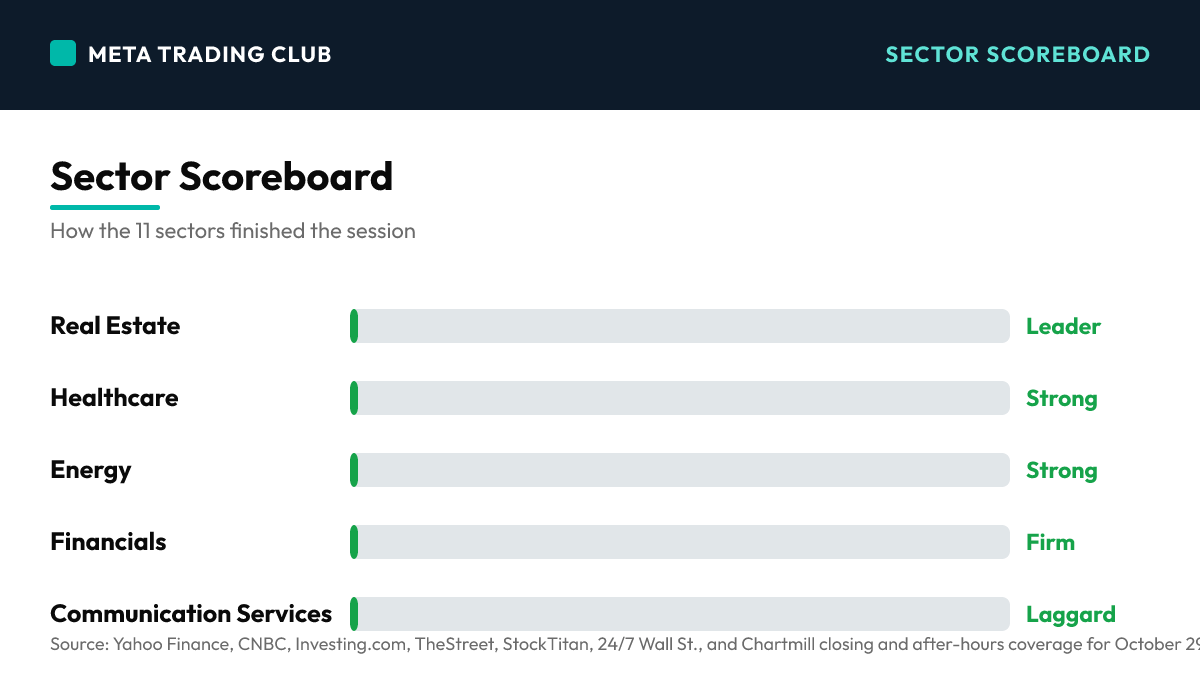
This was a red index wrapped around a green tape, the exact inverse of Wednesday. The S&P 500 slipped 0.49% to 7,706.63, the Nasdaq fell 1.57% to 26,133.10, and the Dow eased 0.51% to 52,355.70, yet eight of eleven sectors finished higher and the Russell 2000 rose 0.79%. The entire red headline was a cap-weight illusion: Alphabet dropped about 12.7% as its overnight capex scare carried into the regular session, and because it is one of the heaviest names in the index, its single slide dragged the headline negative while most of the market rose underneath. The macro backdrop did the opposite of weighing on the tape. Q3 GDP came in hot at 3.4% against expectations near 3.0%, the September PCE read cooled to about 2.1% headline, and the 10-year yield fell back below 5% to 4.988%, its first real relief in weeks. That goldilocks mix of strong growth, cooling inflation, and easing yields let the rate-sensitive groups lead, with Real Estate, Healthcare, and Energy at the top of the sector board. Eli Lilly jumped about 6.7% on a strong report, while the carnage stayed concentrated in high-multiple tech and software: ServiceNow collapsed roughly 26.5% and Marvell fell about 13%. Then the bell rang and Amazon extended the story that Alphabet started. Amazon reported EPS of $1.89 against a $1.96 estimate, with AWS growing a strong 39.3% but capital spending tracking near $220 billion, and the stock fell roughly 8 to 11% after hours. Intel beat on the third quarter but guided the fourth quarter light. The S&P closed holding 7,700 by about six points, which turns Friday, after the Amazon reaction and month-end flows, into a clean test of whether the broad green breadth can absorb a second mega-cap capex miss.
MAJOR HEADLINES AND CATALYSTS
Top Market-Moving Stories
- ALPHABET FALLS 12.7% AND DRAGS THE INDEX RED (Day) – The headline event. Alphabet’s overnight capex scare carried straight into the regular session, and the stock dropped about 12.7%. Because it is one of the heaviest weights in the cap-weighted S&P, that single slide was enough to pull the index headline negative even though eight of eleven sectors closed green. This is the whole illusion of the day: the market looked red on the screen, but under the surface the tape was broadly higher. One name did the damage.
- HOT GDP, COOL PCE, AND YIELDS BACK UNDER 5% (Day) – The macro backdrop that drove the rotation. Q3 GDP came in hot at 3.4% against expectations near 3.0%, the September PCE inflation read cooled to about 2.1% headline, and the 10-year yield fell back below 5% to 4.988%. That goldilocks combination, strong growth with cooling inflation and easing yields, is exactly what the rate-sensitive groups needed. It is why real estate led, small caps rose, and the broad tape was green even as mega-cap tech fell.
- AMAZON MISSES AFTER THE BELL ON THE CAPEX BILL (After Hours) – The night’s biggest story, and it rhymes with Alphabet. Amazon reported EPS of $1.89 against a $1.96 estimate. AWS grew a strong 39.3%, but capital spending is tracking near $220 billion, and the stock fell roughly 8 to 11% after hours. This is the AI-payoff question hitting a second mega-cap in two sessions: the cloud growth is real, the spending is enormous, and the market is now pricing the gap between the two across the whole hyperscaler group.
- INTEL BEATS BUT GUIDES LIGHT (After Hours) – The other after-hours report that mattered. Intel topped third-quarter estimates but guided the fourth quarter below expectations, a split result that kept the semiconductor group cautious into Friday. On a day the chip complex already softened during regular hours, a beat-and-weak-guide from Intel is the kind of mixed signal that does not rescue the sector. It adds to the picture of a market separating the names converting spend into profit from the ones still writing bigger checks.
AFTER-HOURS EARNINGS SPOTLIGHT
Post-Close Reports
- AMAZON (AMZN): AWS SOARS, STOCK SINKS (After Hours) – Amazon Web Services grew about 39.3% year over year, a genuinely strong cloud number, yet the stock fell roughly 8 to 11% after hours. Headline EPS came in at $1.89 against a $1.96 estimate, and the real pressure point was capital spending tracking near $220 billion. The read is identical to Alphabet the night before: the cloud growth is real, but the capital bill is now big enough that investors want to see the return, not just the revenue. The capex, not AWS, moved the stock.
- INTEL (INTC): A BEAT WITH A SOFT OUTLOOK (After Hours) – Intel delivered a third-quarter beat but guided the fourth quarter light, a mixed result that left the chip group without a clean win to lean on into Friday. On a day semiconductors already softened during regular hours, Intel’s cautious outlook reinforced the theme rather than breaking it. The beat shows the base business is stabilizing; the weak guide shows the market is right to stay selective inside the sector.
- THE CAPEX QUESTION IS NOW A GROUP STORY (After Hours) – Two nights, two mega-caps, the same verdict. Alphabet fell on capex Wednesday, Amazon fell on capex Thursday, and the market has now made clear it is grading the entire hyperscaler complex on payoff rather than growth. The overnight futures reaction to Amazon will set Friday’s open on top of month-end flows. The market closed holding 7,700; where it opens Friday depends on whether the broad green breadth can keep absorbing the mega-cap drag.
WHAT IT SETS UP FOR FRIDAY
The Binary Into Amazon and Month-End
- AMAZON’S REACTION MEETS MONTH-END FLOWS (Day) – Friday is the last trading day of October, which stacks the Amazon after-hours reaction on top of month-end rebalancing flows that can move the tape independent of news. A deep Amazon slide dragging the futures into a month-end that favors selling the winners is the combination that can finally crack 7,700. But if the broad green breadth that defined today holds, and the yield relief under 5% sticks, the rotation out of mega-cap tech can keep the index intact even with Amazon heavy. Watch the open, not the headline.
- THE ROTATION IS THE TELL, NOT THE INDEX (Day) – The single most important thing to carry into Friday is that this was a rotation, not a sell-off. Small caps led, real estate led, yields fell, and eight of eleven sectors rose while two mega-caps did all the damage. If that pattern continues, the market is broadening out from the crowded AI trade into the rest of the tape, which is healthy even if the cap-weighted index stays choppy. The risk is that a second straight mega-cap capex miss finally turns the rotation into a broader de-risking. 7,700 is the line that tells you which.
Winners & Losers
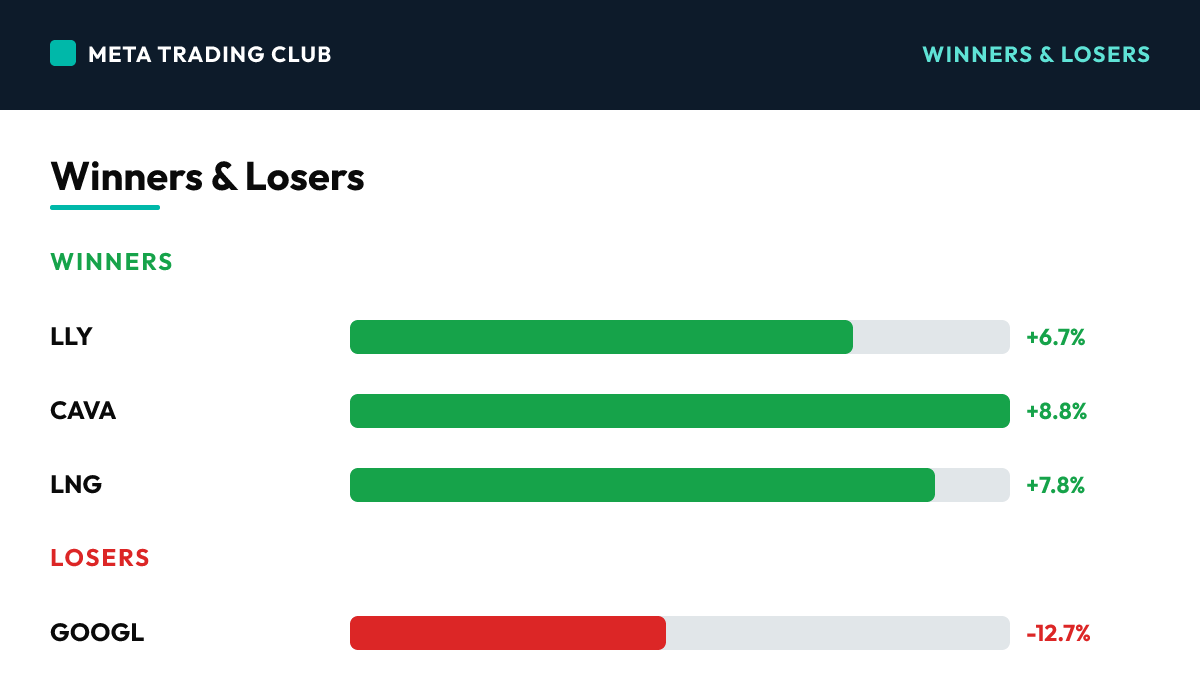
Winners
| LLY | +6.7% | Eli Lilly was the standout large-cap gainer, up about 6.7% on a strong quarter that pushed healthcare to the top of the sector board. On a day money rotated out of crowded mega-cap tech, Lilly is the clearest picture of where it went: toward durable, quality earnings in a defensive group. Its surge was a major reason the equal-weight tape stayed green even as Alphabet dragged the cap-weighted index red, and it is a textbook example of the rotation that defined the session. | |
| CAVA | +8.8% | CAVA jumped about 8.8%, one of the stronger mid-cap movers on the day as the broad risk appetite under the red index headline lifted names outside the mega-cap tech drag. On a session defined by rotation, CAVA’s gain is part of the green breadth story: with yields falling back below 5% and eight of eleven sectors higher, the money leaving crowded tech found its way into a wide range of names, not just the defensive leaders. | |
| LNG | +7.8% | Cheniere Energy rose about 7.8%, riding the energy sector’s strength as WTI crude held firm above $102 a barrel. As a leading US LNG exporter, Cheniere is a direct play on firm global energy demand, and its surge added to the broad green breadth that defined the tape beneath the mega-cap drag. On a day the rotation favored rate-sensitive and energy names, Cheniere was one of the clean winners outside the tech complex. |
Losers
| GOOGL | -12.7% | Alphabet was the single most important decliner on the board, falling about 12.7% as its overnight capex scare carried straight into the regular session. Because it is one of the heaviest weights in the cap-weighted index, that one slide was enough to drag the entire S&P headline red even as eight of eleven sectors closed green. Alphabet is the whole illusion of the day: the market looked weak on the screen, but under the surface the tape was broadly higher. The capex bill, not the business, did the damage. | |
| NOW | -26.5% | ServiceNow was the worst performer among the large software names, collapsing about 26.5% on a disappointing report and outlook. A drop of this size in a single session shows how brutally this tape is pricing any stumble in high-multiple tech. On a green-breadth day, ServiceNow’s crash is the clearest sign that the weakness was concentrated and severe inside the crowded AI-levered and software complex, exactly the group the market was rotating out of. | |
| MRVL | -13.0% | Marvell fell about 13%, among the weakest semiconductor names as the AI-capex worry spread through the chip complex. Like Alphabet and ServiceNow, Marvell’s slide shows that the red under the surface was concentrated in the crowded, AI-levered corner of the market. The contrast between the defensive and rate-sensitive winners rising and the high-multiple tech losers getting crushed is the whole character of the day: a rotation, with the money moving out of exactly these names. |
What It Sets Up For Tomorrow
Levels Into Tomorrow
- S&P 500 7,700 – THE LINE THAT DECIDES IT. Price closed at 7,706.63, holding the 7,700 shelf by about six points. This is the single most important level on the page. Hold 7,700 through the overnight Amazon reaction and Friday’s month-end flows and today’s rotation story holds together, with the broad green breadth and the yield relief under 5% enough to absorb the mega-cap drag. Lose 7,700, especially on a deep Amazon slide into month-end selling, and the AI-capex worry now hitting two mega-caps starts to outweigh the strong breadth underneath. The first clean move relative to 7,700 after the open is the signal to trade, not the Amazon headline itself.
- S&P 500 7,650 – THE SHELF BELOW. The next real support if 7,700 gives way. A loss of 7,650 would confirm the pullback has legs and open a path toward 7,600 and the larger gap-fill zone beneath it. This is the level that separates a healthy rotation from a genuine de-risking out of equities. If Amazon’s drop drags the futures and price slices through both 7,700 and 7,650 without a fight, respect it and stand aside rather than trying to catch it.
- S&P 500 7,760 – THE RECLAIM LEVEL. The first ceiling on any push higher. Today’s close sat below where the index traded before the Alphabet drag, so a decisive move back above 7,760 on a contained Amazon reaction would say the market is shrugging off the mega-cap capex scare and the broad green breadth is pulling the index back up with it. Until price clears that level with conviction, the cap-weighted tape stays vulnerable to the next mega-cap headline. Watch whether buyers can reclaim it on the first attempt Friday, or whether it caps the move.
Bull case: The bull case is that today was a healthy rotation, not a sell-off, and the red index is a cap-weight illusion. Eight of eleven sectors rose, small caps led, real estate led, and the 10-year finally fell back below 5% on a cooling PCE print, all of which is the goldilocks backdrop a broadening tape needs. The entire red headline came from two mega-caps being repriced for capex while the rest of the market moved higher. If Amazon’s after-hours reaction stays contained, the yield relief holds, and 7,700 holds through month-end, then this is the market doing exactly what a healthy market should: rotating money out of the crowded AI trade and into the rate-sensitive and quality names that have lagged. In that scenario, the mega-cap drag gets absorbed and the leadership simply broadens.
Bear case: The bear case is that the broad green breadth was the last leg standing and the second straight mega-cap capex miss just kicked it. Alphabet fell Wednesday, Amazon fell Thursday, and the market’s two heaviest cloud names are both being punished for the spending that was supposed to be the whole growth story. If Amazon’s after-hours slide drags the futures into a month-end that favors selling, the 10-year reverses back above 5%, and the rotation flips into broad de-risking, then 7,700 breaks and the index opens a path toward 7,650 and 7,600. The strong breadth that looked like health today would then look like the last group to sell, and the AI-payoff worry would become the theme of the week rather than a two-name event.
Risks Into Tomorrow
- A red index with green breadth is a rotation, not a sell-off, so read the whole board — Today is the mirror image of yesterday, and the same lesson in reverse: the index headline alone will fool you. The S&P closed down 0.49%, the Nasdaq down 1.57%, and a trader glancing only at those numbers would call it a risk-off day and reach for hedges. But eight of the eleven S&P sectors closed green, the Russell 2000 rose 0.79%, real estate led, and the 10-year yield fell back below 5%. Strip out Alphabet, down 12.7%, and the handful of other mega-cap tech names, and most of the market was broadly higher. That is not broad weakness, it is a rotation: money leaving the crowded, AI-levered trade and moving into the rate-sensitive and quality names that have been held down all month. The lesson is to always read the breadth and the sector board, not just the index print. A red close driven by two or three heavy names is a very different market than a red close with broad participation, because the first is a repricing of a specific group and the second is a repricing of risk itself. Today was clearly the former. When the rotation is this clean, with small caps and real estate leading on falling yields, the healthy response is to look for where the money is going, not to assume the whole market is breaking. The breadth under the surface is telling you the tape is broadening, not failing, no matter how red the headline looks.
- The market just repriced a second mega-cap for capex, and that makes it a group story — The single most important thing that happened this week was not one earnings report, it was two. Alphabet fell on capex Wednesday, Amazon fell on capex Thursday, and in both cases the cloud growth was genuinely strong, AWS up 39.3%, Google Cloud up triple digits, and in both cases the stock got sold hard anyway. The reason was the same: the capital bill is now enormous, near $220 billion of spending at Amazon, enough that the market wants to see the return before it keeps funding the buildout. For two years the market gave the entire AI trade a blanket pass: spend whatever it takes, growth is all that matters. This week that changed, and it changed for the group, not just one name. For a trader, this is a regime signal worth respecting. When the two heaviest cloud names in the market both get sold on good growth because the cost is too high, the easy, indiscriminate phase of that trade is over. It does not mean the trade is dead, Eli Lilly ripping on real earnings and the broad tape rising on falling yields says there is plenty of healthy market left, but it does mean the money is now actively rotating out of the most capex-heavy mega-caps and into names where the payoff is clearer or the valuation is lower. That discrimination, after years of buying the whole complex, is the story to carry forward, and whether 7,700 holds through the Amazon reaction is the next test of it.
- You do not trade the earnings headline, you trade the reaction at your level — The temptation after a week like this is to form a hard opinion, the AI trade is breaking, or the rotation means everything else is a buy, and position for it ahead of Friday. That is a trap. The overnight Amazon reaction can gap and reverse, month-end flows can move the tape independent of any news, and the futures can tell a completely different story by the open than they do tonight. The disciplined approach is the one the MTC framework is built on: identify the level that matters, which today is clearly 7,700, and let price show you its hand after the open. If the S&P absorbs the Amazon miss, holds 7,700, and the small-cap and real estate leadership continues, that is a confirmed signal the rotation is healthy and the broad tape is intact. If it slices through 7,700 and 7,650 with the mega-caps dragging and yields reversing back above 5%, that is a confirmed signal the rotation has flipped into broad de-risking and the right move is to stand aside. Either way, the trade comes from the reaction at the level, not from a prediction about what Amazon’s capex means for the future. The market will tell you what it wants to do; your job is to wait for it to confirm before you commit a dollar of risk. No alignment yet into Friday. No trade yet.
Frequently Asked Questions
How did the S&P 500 close today?
On Thursday, October 29, 2026, the S&P 500 closed at 7,706.63 (-0.49%), with the VIX at 16.91. Here is the stock market today in one line: the index closed red and the tape underneath it was green.
What drove the market today?
ALPHABET FALLS 12.7% AND DRAGS THE INDEX RED (Day) – The headline event. Alphabet’s overnight capex scare carried straight into the regular session, and the stock dropped about 12.7%. Because it is one of the heaviest weights in the cap-weighted S&P, that single slide was enough to pull the index headline negative even though eight of eleven sectors closed green. This is the whole illusion of the day: the market looked red on the screen, but under the surface the tape was broadly higher. One name did the damage.
What levels matter for tomorrow?
S&P 500 7,700 – THE LINE THAT DECIDES IT. Price closed at 7,706.63, holding the 7,700 shelf by about six points. This is the single most important level on the page. Hold 7,700 through the overnight Amazon reaction and Friday’s month-end flows and today’s rotation story holds together, with the broad green breadth and the yield relief under 5% enough to absorb the mega-cap drag. Lose 7,700, especially on a deep Amazon slide into month-end selling, and the AI-capex worry now hitting two mega-caps starts to outweigh the strong breadth underneath. The first clean move relative to 7,700 after the open is the signal to trade, not the Amazon headline itself. S&P 500 7,650 – THE SHELF BELOW. The next real support if 7,700 gives way. A loss of 7,650 would confirm the pullback has legs and open a path toward 7,600 and the larger gap-fill zone beneath it. This is the level that separates a healthy rotation from a genuine de-risking out of equities. If Amazon’s drop drags the futures and price slices through both 7,700 and 7,650 without a fight, respect it and stand aside rather than trying to catch it. S&P 500 7,760 – THE RECLAIM LEVEL. The first ceiling on any push higher. Today’s close sat below where the index traded before the Alphabet drag, so a decisive move back above 7,760 on a contained Amazon reaction would say the market is shrugging off the mega-cap capex scare and the broad green breadth is pulling the index back up with it. Until price clears that level with conviction, the cap-weighted tape stays vulnerable to the next mega-cap headline. Watch whether buyers can reclaim it on the first attempt Friday, or whether it caps the move.
How does Meta Trading Club prepare for the next session?
We wrap every session and carry the read forward through the MTC Alignment Engine — bias, level, reaction, confirmation, execution, targets. No alignment, no trade. Learn the full process inside the MTC Incubator.
New to this? Start with the free training.
Learn how we read the market before you risk a dollar — our free education library and ebook break down the fundamentals step by step.
Free education → Get the free ebookThe session’s over. The prep isn’t.
This is how MTC members close each day — wrap what happened, mark the levels, and carry one clean read into tomorrow. If you want to build that habit and qualify your own A+ setups instead of chasing alerts, the MTC Incubator is mentorship and a repeatable process. It’s application-based — see if it’s a fit.
Explore the MTC Incubator → Apply nowSources: Yahoo Finance, CNBC, Investing.com, TheStreet, StockTitan, 24/7 Wall St., and Chartmill closing and after-hours coverage for October 29, 2026.. For educational purposes only. Not financial advice.