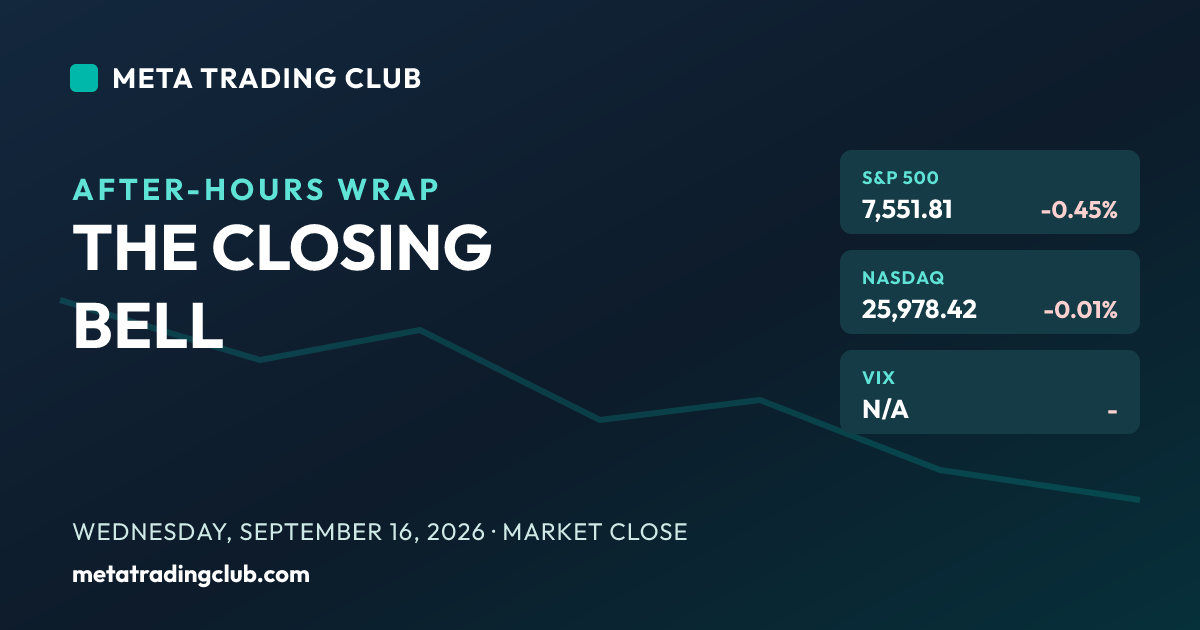
Wednesday, September 16, 2026 · 4:30 PM ET · MTC Market Close
The stock market today got the rate hike it was bracing for, and then got the one thing it feared more: a Fed that is not done. In a unanimous 12-0 vote the Federal Reserve raised its target range a quarter point to 3.75%-4%, its first hike in three years, and the fresh dot plot penciled in one more hike in 2026 before a hold in 2027. Stocks were actually green into the 2:00 PM decision. It was Chair Kevin Warsh’s press conference that broke the tape: framing the economy as strong, inflation as the problem, and offering no hint the hiking is over, he sent the major indexes from modest gains to outright losses in real time. The Dow closed down 631.21 points, or 1.21%, at 51,461.90, with the banks leading the way lower as Goldman Sachs, Wells Fargo, Bank of America and Citigroup all fell more than 3%. The S&P 500 slipped 0.45% to 7,551.81 and the Nasdaq finished essentially flat, down 0.01% at 25,978.42, held up by a handful of chip and optical names. The Russell 2000 lagged again, down about 0.76%. The real story was in the bond market, exactly where it has been all week: the 10-year yield closed back above 5% near 5.01%, its highest since 2007, and the 2-year rose to about 4.72%, because a Fed forecasting another hike is a Fed the curve has to keep pricing tighter. This is the same tension the September 11 bounce set up and it just got resolved the hard way. Price sliced clean through the 7,700 line the bounce needed to reclaim, through the 7,600 shelf beneath it, and closed at 7,551.81, now sitting right on top of 7,500. That round number is the whole ballgame into tomorrow: hold 7,500 and this is an orderly digestion of a hawkish Fed; lose it and the next shelf is 7,400. No alignment between a tape that wanted a dovish hike and a Fed that delivered a hawkish one, so no trade until price picks a side of 7,500.
The Closing Bell
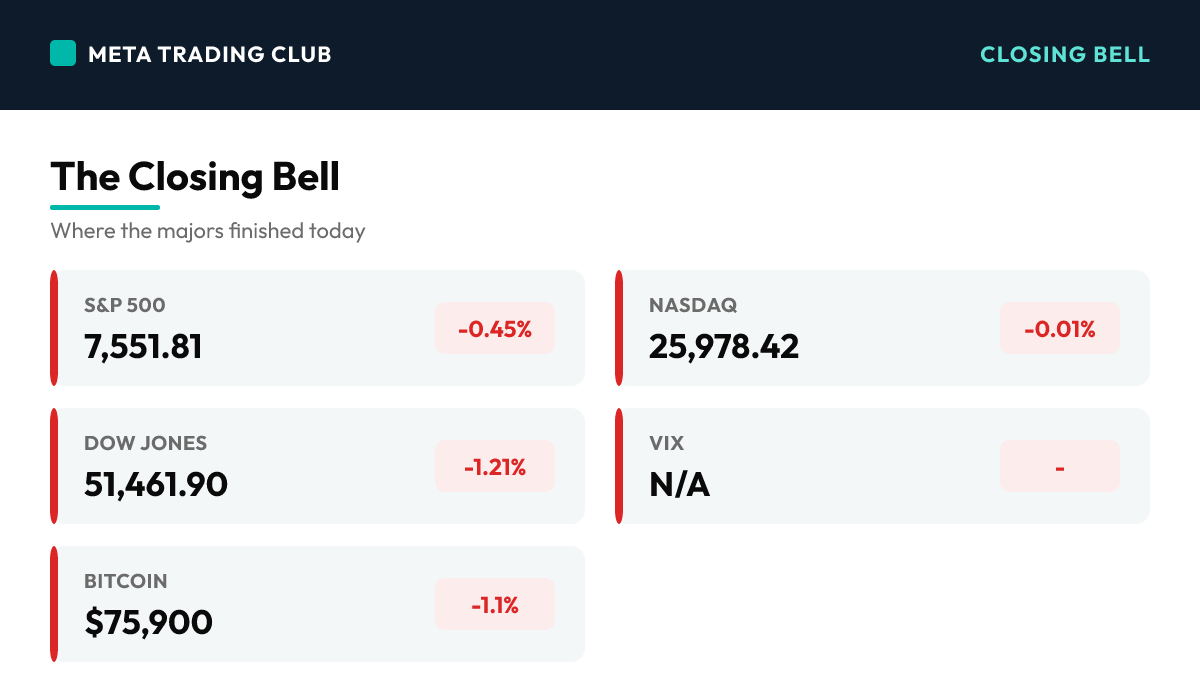
| Instrument | Close | Change | Note |
|---|---|---|---|
| S&P 500 | 7,551.81 | -0.45% | Green into the 2:00 PM Fed decision, then rolled straight over during Warsh’s press conference to close at 7,551.81. Price has now sliced through the 7,700 line the September 11 bounce needed to reclaim and the 7,600 shelf beneath it, and it settled right on top of 7,500. That round number is the entire forward read: hold 7,500 and this is an orderly digestion of a hawkish hike; lose it and the door opens to 7,400. The index closed sitting on the level heading into the first post-Fed session. |
| Nasdaq | 25,978.42 | -0.01% | The relative outperformer, closing essentially flat as a handful of chip and optical names cushioned the tech tape while the rest of the market fell. Intel jumped on the SK Hynix memory-partnership talks and optical names like Coherent and Lumentum rallied, keeping the Nasdaq near unchanged even as breadth was ugly, with roughly 61% of all issues declining by the close. Flat on a hawkish-Fed day is strength, but it was carried by very few names. |
| Dow Jones | 51,461.90 | -1.21% | The clear loser of the three majors, down 631.21 points as the banks it leans on got hit hardest. Goldman Sachs led the way lower and Wells Fargo, Bank of America and Citigroup all fell more than 3% as a Fed forecasting another hike and a 10-year back above 5% pressured the group. When the rate-sensitive, financial-heavy index leads the tape down on a hike day, that is the market telling you it heard the hawkish message clearly. |
| Russell 2000 | — | -0.76% | Lagged again, the same story it has told all week. Small caps are the most rate-sensitive corner of the market, and with the Fed hiking, forecasting more, and the 10-year closing back above 5%, the group had no room to participate. The Russell was down out of the gate and never recovered. When the most rate-sensitive index is the weakest on a day the whole curve pushes higher, it is the tape agreeing with the bond market. Exact closing level approximate into the settle. |
| VIX | — | – | Fear ticked higher as stocks rolled over into the close, though an exact settle was not confirmed in the closing window. The move that mattered was not the size of the VIX but the character of the reversal: an intraday gain that flipped to a loss during a Fed presser is the kind of session that leaves hedges underpriced going in. Level unconfirmed into the settle; treat the reversal, not a headline VIX print, as the tell. |
| 10-Year Yield | 5.01% | flat-to-up | The single most important number on the page, closing back above 5% near a fresh high since 2007. This is why the hike stung: a Fed that just forecast another increase gives the bond market every reason to keep pricing tighter policy, and Warsh’s list of reasons yields are rising, economic strength, capex competition and geopolitics, read as a chair comfortable with rates here or higher. The curve has led this entire move, and it just got validated. |
| 2-Year Yield | 4.72% | +5 bp | Rose to about 4.72% as the market absorbed a dot plot pointing to one more hike in 2026. The 2-year is the purest read on the expected policy path, and it moved exactly the way a hawkish surprise should: up. This is a bond market bracing for tighter policy, not a pause, and it is the reason the equity reversal has teeth rather than being a one-day headline wobble. |
| WTI Crude | $102.31 | -3.3% | Eased but held above $100 as reports that Saudi Arabia was routing additional crude via Oman calmed fears of a larger Middle East supply disruption. Oil coming off its highs was one of the few things working in the bulls’ favor early, and it is why stocks were green pre-Fed, but crude remains elevated and headline-driven with the U.S.-Iran conflict still live. Level approximate into the settle. |
| Gold | $4,338 | +1.1% | Firmed as the safe-haven and inflation-hedge bid returned with the equity reversal and a 10-year pinned above 5%. Gold has been the quiet beneficiary of a market caught between hot inflation and geopolitical risk, and on a day the Fed confirmed inflation is its problem, the metal did its job. Level approximate into the settle. |
| Bitcoin | $75,900 | -1.1% | Slipped and stayed under $76,000, pressured on two fronts: the Senate’s failure to advance the CLARITY Act crypto-regulation bill and the risk-off tone into and after the Fed hike. Bitcoin traded like the high-beta risk asset it is, leaking lower with equities while a specific regulatory disappointment added its own weight. A weak tape, not a crash, but no bid to be found. Level approximate into the settle. |
Today’s Charts
Daily candlestick charts with 20/50/200-day moving averages — the index majors, the day’s biggest mover on each side, and the leading sector ETF.

Charts: Finviz (daily). Levels and overlays update through the next session.
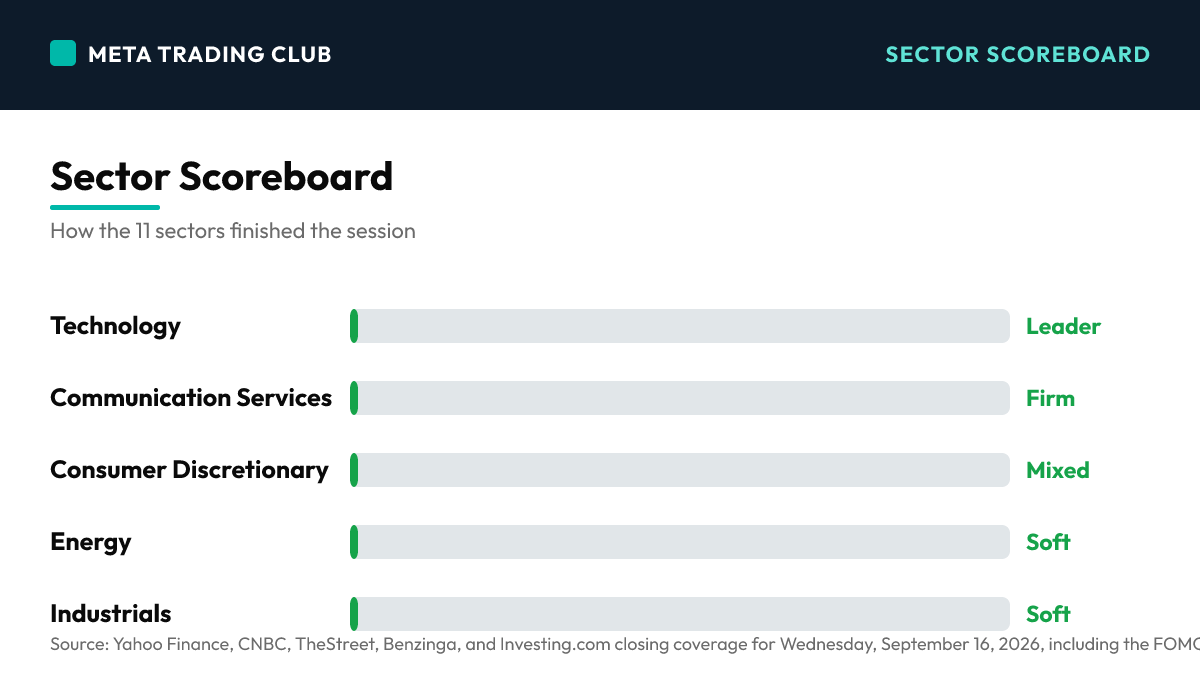
Sector Scoreboard
What Drove The Day
This was a session decided in a single afternoon, and it turned on the difference between a hike and a hawkish hike. Stocks spent the morning higher, with the S&P up about 0.4% into the decision as oil eased off its highs and the market treated the quarter-point move as fully priced at 92.5% odds. At 2:00 PM the Fed delivered exactly that, a unanimous 12-0 hike to 3.75%-4%, the first in three years, but the accompanying projections showed officials expect one more hike in 2026 before holding in 2027. Then Chair Kevin Warsh took the podium at 2:30 and did the damage. Framing the economy as strong and inflation as the core problem, and pointing to economic strength, a surge in capital-expenditure competition and geopolitics as the reasons yields have climbed, he gave the market no signal the tightening ends here. The tape unwound in real time: the Dow flipped from a gain to close down 631.21 points, or 1.21%, at 51,461.90; the S&P 500 gave back its advance to finish at 7,551.81, down 0.45%; and the Nasdaq held flattest, down just 0.01% at 25,978.42, propped up by Intel’s jump on SK Hynix memory-partnership talks and a rebound in optical names. Breadth told the real story, with roughly 61% of all issues declining. The banks were the epicenter, as Goldman Sachs, Wells Fargo, Bank of America and Citigroup all fell more than 3% and the SPDR S&P Bank ETF dropped 2.6%. Meanwhile the 10-year yield closed back above 5% near a 2007 high and the 2-year rose to about 4.72%, the bond market’s way of saying it believed every hawkish word. Price closed at 7,551.81, having cut through the 7,700 and 7,600 levels that defined last week’s failed bounce, now resting directly on 7,500 heading into the first post-Fed session.
MAJOR HEADLINES AND CATALYSTS
Top Market-Moving Stories
- THE FED HIKED AND FORECAST MORE (Day) – The Federal Reserve raised its target range a quarter point to 3.75%-4% in a unanimous 12-0 vote, its first hike in three years, and the fresh dot plot penciled in one additional hike in 2026 before a hold in 2027. The hike itself was fully priced at 92.5% odds; the forecast of more tightening was not, and it is the reason a widely expected move still moved the market hard.
- WARSH’S PRESS CONFERENCE BROKE THE TAPE (Day) – Stocks were green into the 2:00 PM decision and rolled over during Chair Kevin Warsh’s 2:30 press conference. Framing the economy as strong and inflation as the core problem, and citing economic strength, capex competition and geopolitics as the reasons yields are rising, he offered no signal the hiking ends here. The Dow flipped from a gain to close down 631 points as the market interpreted the tone as clearly hawkish.
- THE 10-YEAR CLOSED BACK ABOVE 5% (Day) – The benchmark 10-year Treasury yield finished back above 5% near 5.01%, its highest since 2007, and the 2-year rose to about 4.72%. This is the whole week in one number: a Fed forecasting more hikes gives the bond market every reason to keep pricing tighter policy, and the curve that has led this entire move just got the validation it was waiting for.
- BANKS LED THE SELLOFF, CHIPS CUSHIONED IT (Day) – Financials were the epicenter as Goldman Sachs, Wells Fargo, Bank of America and Citigroup all fell more than 3% and the S&P Bank ETF dropped 2.6%, anchoring the Dow’s 631-point loss. On the other side, Intel jumped on SK Hynix memory-partnership talks and optical names Coherent and Lumentum rallied about 6%, which is the only reason the Nasdaq closed flat while the rest of the market fell.
AFTER-HOURS EARNINGS SPOTLIGHT
A Light Post-Close Slate After the Fed
- A THIN POST-CLOSE DOCKET (AH) – The after-hours earnings slate was light, with no market-moving mega-cap reports on the docket the evening of the Fed decision. That leaves Warsh’s hawkish message, the 10-year back above 5%, and tomorrow’s jobless-claims and housing data as the drivers into Thursday, not tonight’s earnings. The story the tape has to digest is the Fed, and it closed sitting right on 7,500.
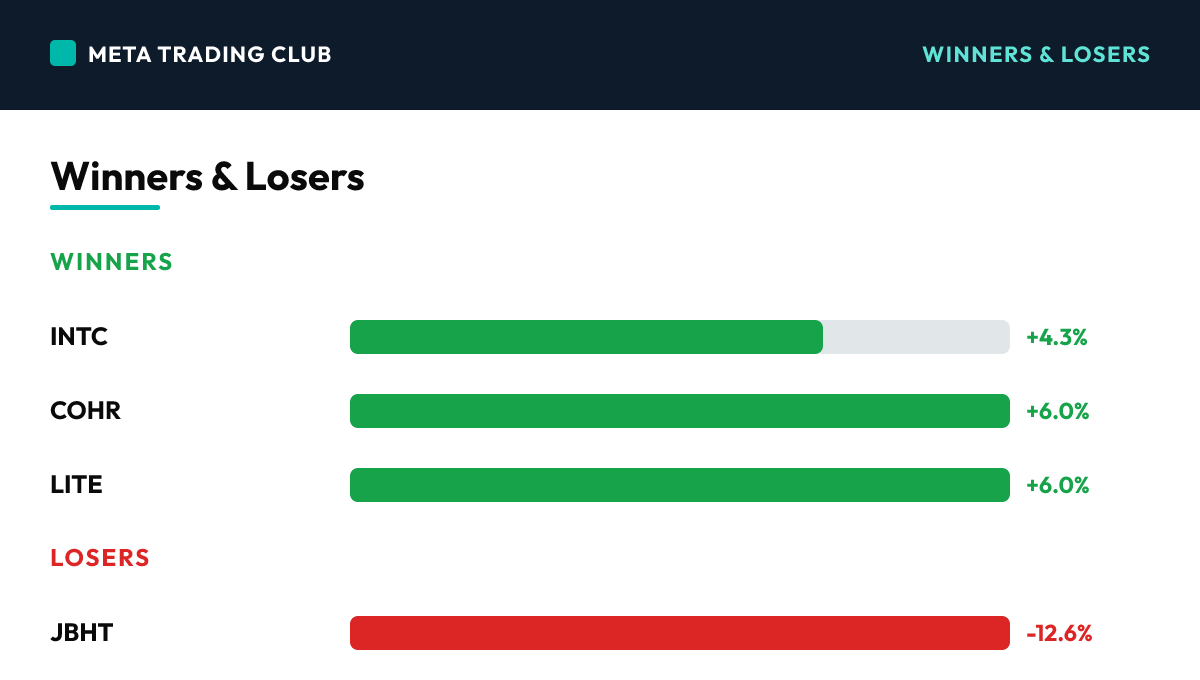
- INTEL AND THE OPTICALS WERE THE DAY’S ENGINE (Day) – The session’s standout moves were Intel up about 4.3% on reports of a high-bandwidth-memory partnership with SK Hynix to manufacture chips on U.S. soil, and a roughly 6% rally in optical and photonics names Coherent and Lumentum on a sector rebound. These were the names that kept the Nasdaq flat and tech at the top of the board while the broad market absorbed the hawkish Fed.
- TRANSPORTS AND BANKS WERE THE DRAG (Day) – J.B. Hunt cratered about 12.6% after warning on earnings and rising operating costs, Diamondback Energy fell about 8% on the oil and rate backdrop, and the big banks all dropped more than 3%. The weakness was concentrated in the rate- and growth-sensitive corners, exactly where a hawkish Fed forecasting more hikes does the most damage.
WHAT IT SETS UP FOR TOMORROW
Does 7,500 Hold the First Post-Fed Session?
- THE FIRST POST-FED SESSION IS THE TELL (Tomorrow) – Thursday is the market’s first full chance to digest a hawkish hike, and the read is simple: whether the S&P can defend 7,500. A hold that stabilizes the tape says the reversal was a one-day repricing of the dot plot; a break below 7,500 that follows through says the higher-for-longer message is still being priced and the next shelf is 7,400. The level, not the noise, tells you which.
- JOBLESS CLAIMS AND HOUSING DATA HIT AT 8:30 (Tomorrow) – Weekly initial jobless claims, last at 206,000 against expectations near 205,000, print Thursday alongside housing-market data, with homebuilder sentiment already sitting at multi-year lows. Any sign of labor-market softening would complicate a Fed that just doubled down on inflation, and with the 10-year at 5% the bond market’s reaction to the data matters as much as the equity tape’s.
Winners & Losers
Winners
| INTC | +4.3% | Intel led the tape on reports of exploratory talks with SK Hynix to manufacture high-bandwidth memory chips in the U.S. for the first time. A clean, company-specific catalyst on a beaten-down chipmaker, and a big part of why the Nasdaq closed flat while the rest of the market fell under the weight of the Fed. | |
| COHR | +6.0% | Coherent climbed as buyers returned to optical and photonics names following a recent sector-wide pullback. The rebound in the optical complex was one of the few pockets of strength on a red day and helped cushion the tech tape against the hawkish-Fed selloff hitting the rest of the market. | |
| LITE | +6.0% | Lumentum Holdings rose alongside Coherent as the optical and networking group staged a broad rebound. On a day defined by rate fears and a banks-led selloff, the AI-adjacent optical names were a rare bright spot, part of the narrow leadership that kept the Nasdaq near unchanged. |
Losers
| JBHT | -12.6% | J.B. Hunt Transport Services cratered after warning of a decline in earnings and rising operating costs. The day’s ugliest large-cap move, a profit warning from a transport bellwether that dragged the industrials and underscored the growth worries lurking beneath a hawkish Fed. | |
| FANG | -8.0% | Diamondback Energy dropped as crude fell more than 3% and the combination of rising Treasury yields, inflation and geopolitical risk weighed on the energy complex. A big single-name decline that fit the day’s rate-sensitive selloff and led the energy group lower. | |
| GS | -3.0% | Goldman Sachs led the Dow lower as the banks bore the brunt of the hawkish hike, with Wells Fargo, Bank of America and Citigroup also down more than 3% and the S&P Bank ETF off 2.6%. The financials were the epicenter of the selloff and the single biggest reason the Dow shed 631 points. |
What It Sets Up For Tomorrow
Levels Into Tomorrow
- S&P 500 7,500 – THE LINE THAT DECIDES IT. Price closed at 7,551.81, sitting directly on top of the round number after slicing through the 7,700 and 7,600 levels that framed last week’s failed bounce. This is the single most important number on the page. Hold 7,500 on the first post-Fed session and the hawkish hike gets digested as an orderly repricing; lose it and follow through lower and the market is still absorbing higher-for-longer, with 7,400 the next shelf. The first clean move relative to this line sets the tone into the end of the week.
- S&P 500 7,400 – THE DOWNSIDE TARGET. If 7,500 gives way and the bond market keeps grinding, with the 10-year pushing further above 5%, 7,400 is the next real support and the level that separates a controlled pullback from a deeper reset. A yield that keeps climbing on a Fed that just forecast more hikes is the combination that pulls price down to test it. This is the bear’s objective if the hawkish message keeps getting priced.
- S&P 500 7,600 – THE RECLAIM LEVEL. The shelf that just broke becomes the first overhead hurdle. If the market decides the hawkish reaction was overdone and buyers step back in, 7,600 is the level bulls have to reclaim to argue the post-Fed flush was a shakeout rather than the start of a new leg down. Getting back above it, ideally on stabilizing yields, is what turns a bounce into something worth trusting. Until then, the burden of proof is on the buyers.
Bull case: The hawkish reaction was an overshoot and the tape stabilizes. Stocks were green into the decision for a reason: the hike was fully expected, oil is coming off its highs, and the economy Warsh described is genuinely strong. If the first post-Fed session holds 7,500 and yields stop climbing, the argument is that the market front-loaded all the bad news in one afternoon and a single quarter-point hike with maybe one more to come is not enough to break an economy this resilient. The relative strength in tech, with Intel and the optical names leading, shows buyers will still step into quality on weakness. Reclaim 7,600 with the 10-year stalling below its highs and the post-Fed flush becomes a shakeout, not a trend change.
Bear case: The bond market was right all along and this is just the start. The 10-year closed back above 5% at a 19-year high and the 2-year jumped because the Fed just told the market it expects to hike again, and the curve believes it. When the most rate-sensitive groups, small caps, utilities and real estate, lead the tape lower and the banks that anchor the Dow fall more than 3%, that is a market repricing higher-for-longer in real time, not a one-day wobble. Breadth was ugly at roughly 61% declining, the VIX reversal left hedges underpriced, and oil is still elevated with a live geopolitical risk. If 7,500 gives way on the first post-Fed session, the higher-for-longer trade takes price to 7,400, and the failed bounce from last week becomes the first lower high of a larger move.
Risks Into Tomorrow
- When stocks and bonds disagree, the bond market usually wins — This week was a clean, brutal case study, and today it resolved. All week equities tried to argue the worst was over while the 10-year yield kept grinding to fresh highs. Today the Fed hiked, forecast another, and the curve closed back above 5% at a 19-year high, and the stock market finally capitulated to the message the bond market had been sending for days. The lesson is the one traders relearn every cycle: the bond market prices the cost of money, which is the thing that actually drives equity multiples, so when a rallying tape refuses to be confirmed by yields, treat the rally as suspect until price proves otherwise. The September 11 bounce happened while yields made new highs, and it turned out to be a lower high. Believe the curve.
- A widely expected event can still move the market, because the reaction is what’s priced — The hike itself was a 92.5% probability going in, fully baked. Yet the Dow still fell 631 points. The mistake is thinking a known outcome cannot be a catalyst. What moves markets is not the event, it is the gap between the event and expectations, and today that gap was the guidance: not the quarter point, but the dot plot forecasting more and Warsh refusing to signal an end. The discipline is to separate the decision from the reaction function. Size down into a binary event no matter how certain the base case looks, because the part that moves you is never the part everyone already agrees on. Traders who were positioned for a dovish hike got run over by a hawkish one, even though the hike itself was a lock.
- Trade the level, not the story you want to be true — It was tempting to buy the green open today on the logic that the hike was priced and stocks would relief-rally through it. The tape said otherwise, and the level was the tell the whole time. Price had already failed to reclaim 7,700, then lost the 7,600 shelf, and it closed sitting on 7,500 after cutting straight through both. A trader anchored to the story, that a priced-in hike is bullish, fought the tape all afternoon. A trader anchored to the level watched price reject resistance and respected it. The setups that failed this week did not fail because the macro thesis was wrong, they failed because they ignored what price was actually doing at the key lines. Into tomorrow the discipline is the same: let 7,500 decide the direction before you commit, because no alignment between your thesis and the tape means no trade.
Frequently Asked Questions
How did the S&P 500 close today?
On Wednesday, September 16, 2026, the S&P 500 closed at 7,551.81 (-0.45%), with the VIX at N/A. The stock market today got the rate hike it was bracing for, and then got the one thing it feared more: a Fed that is not done.
What drove the market today?
THE FED HIKED AND FORECAST MORE (Day) – The Federal Reserve raised its target range a quarter point to 3.75%-4% in a unanimous 12-0 vote, its first hike in three years, and the fresh dot plot penciled in one additional hike in 2026 before a hold in 2027. The hike itself was fully priced at 92.5% odds; the forecast of more tightening was not, and it is the reason a widely expected move still moved the market hard.
What levels matter for tomorrow?
S&P 500 7,500 – THE LINE THAT DECIDES IT. Price closed at 7,551.81, sitting directly on top of the round number after slicing through the 7,700 and 7,600 levels that framed last week’s failed bounce. This is the single most important number on the page. Hold 7,500 on the first post-Fed session and the hawkish hike gets digested as an orderly repricing; lose it and follow through lower and the market is still absorbing higher-for-longer, with 7,400 the next shelf. The first clean move relative to this line sets the tone into the end of the week. S&P 500 7,400 – THE DOWNSIDE TARGET. If 7,500 gives way and the bond market keeps grinding, with the 10-year pushing further above 5%, 7,400 is the next real support and the level that separates a controlled pullback from a deeper reset. A yield that keeps climbing on a Fed that just forecast more hikes is the combination that pulls price down to test it. This is the bear’s objective if the hawkish message keeps getting priced. S&P 500 7,600 – THE RECLAIM LEVEL. The shelf that just broke becomes the first overhead hurdle. If the market decides the hawkish reaction was overdone and buyers step back in, 7,600 is the level bulls have to reclaim to argue the post-Fed flush was a shakeout rather than the start of a new leg down. Getting back above it, ideally on stabilizing yields, is what turns a bounce into something worth trusting. Until then, the burden of proof is on the buyers.
How does Meta Trading Club prepare for the next session?
We wrap every session and carry the read forward through the MTC Alignment Engine — bias, level, reaction, confirmation, execution, targets. No alignment, no trade. Learn the full process inside the MTC Incubator.
New to this? Start with the free training.
Learn how we read the market before you risk a dollar — our free education library and ebook break down the fundamentals step by step.
Free education → Get the free ebookThe session’s over. The prep isn’t.
This is how MTC members close each day — wrap what happened, mark the levels, and carry one clean read into tomorrow. If you want to build that habit and qualify your own A+ setups instead of chasing alerts, the MTC Incubator is mentorship and a repeatable process. It’s application-based — see if it’s a fit.
Explore the MTC Incubator → Apply nowSources: Yahoo Finance, CNBC, TheStreet, Benzinga, and Investing.com closing coverage for Wednesday, September 16, 2026, including the FOMC rate decision and updated Summary of Economic Projections, Chair Kevin Warsh’s press conference, CME FedWatch odds, and Treasury, commodity and crypto market data. Some after-hours and cross-asset levels approximate into the settle; the VIX close was unconfirmed in the closing window.. For educational purposes only. Not financial advice.