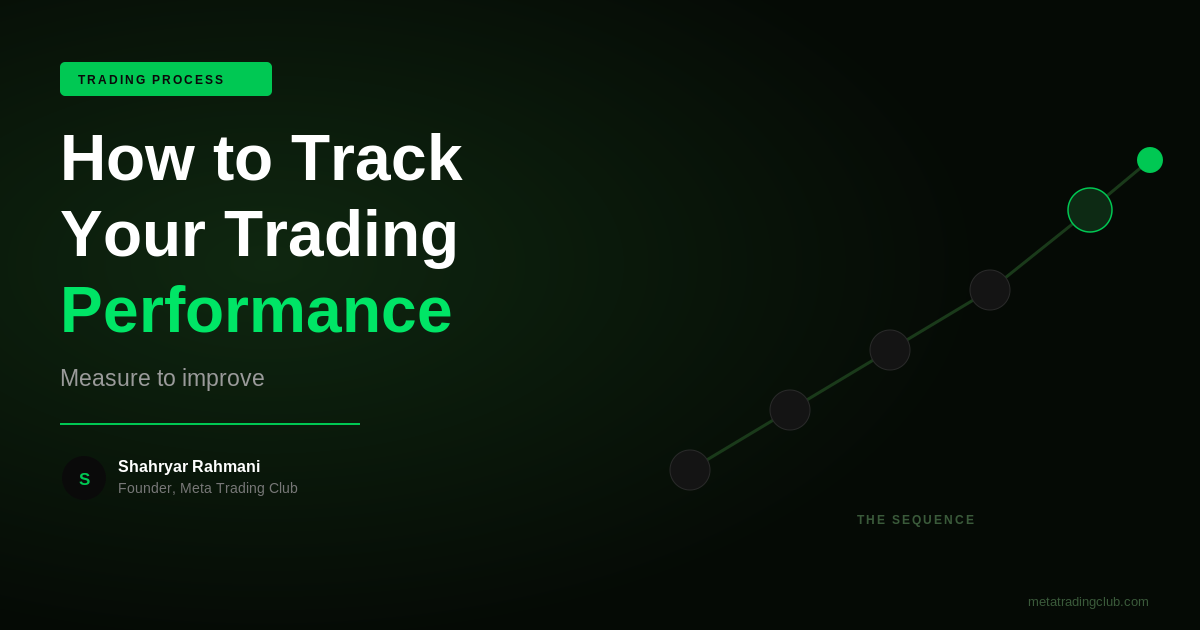
Most traders have no real idea why they win or lose. They have a vague sense — ‘I had a good week’ or ‘I keep getting stopped out’ — but no data, no patterns, no diagnosis. This is like trying to improve at a sport you never watch yourself play. Tracking and reviewing your trading performance is the single most underrated path to getting better, because it turns a blur of trades into specific, fixable information. The traders who improve are almost always the ones who measure; the ones stuck for years usually aren’t.
You can’t improve what you don’t measure
Most traders have no real idea why they win or lose. Tracking turns a blur of trades into specific, fixable information.
Why P&L Is Not Enough
The instinct is to track one thing: did I make money? But profit and loss alone tells you almost nothing useful, because it’s heavily influenced by luck over any short stretch. You can make money with a bad process (and get punished later) or lose money with a good process (and get rewarded later). Judging yourself only by P&L means you’ll reinforce lucky bad habits and abandon unlucky good ones. To actually improve, you need to measure the things that drive results, not just the results.
MTC Analysis
Measure What Drives Results
P&L alone is dominated by luck. Pair these numbers with an honest journal, then run the loop: track, review, adjust. That’s how experience becomes skill.
The Metrics That Actually Matter
A few numbers, tracked consistently, reveal far more than your account balance.
Win rate — the percentage of trades that are profitable. Useful, but meaningless alone (a 40% win rate can be highly profitable, and a 70% win rate can lose money).
Average win vs average loss — this is the crucial partner to win rate. If your average win is much larger than your average loss, you can be very profitable even with a low win rate. If your losses are bigger than your wins, even a high win rate bleeds money. Win rate and win/loss size together tell the real story.
Expectancy — combining the above into the average amount you can expect to make (or lose) per trade. Positive expectancy means your process makes money over time; negative means it doesn’t, regardless of recent results. This is the single most important number.
Risk per trade and consistency of risk — are you actually sizing consistently, or sneaking in oversized trades? Tracking this exposes the discipline failures that erratic risk hides.
Adherence to process — what percentage of your trades followed your plan? This connects your behavior to your results and is often the most revealing metric of all.
Keep a Trading Journal (The Real Tool)
Numbers tell you what’s happening; a journal tells you why. For every trade, record the essentials: the setup, your reasoning for entering, where you placed your stop and target, the outcome, and — critically — an honest note on your execution and emotional state. Did you follow your plan? Did you hesitate, chase, or revenge trade? Were you calm or tilted?
Over time, this journal becomes a mirror. Patterns emerge that you’d never notice trade-to-trade: maybe you lose most on a specific setup, or in a specific market condition, or after a loss when you’re emotional, or in the midday chop you should be avoiding. These patterns are invisible without records and obvious with them — and each one is a specific, fixable leak.
The Review Habit
Tracking is only half of it. The other half is reviewing — regularly sitting with your data and journal and asking what it’s telling you. A simple cadence works: a quick daily review of each trade while it’s fresh, and a deeper weekly review of the patterns across the week. Weekly, look for the recurring themes: What’s working that I should do more of? What’s the costliest mistake I keep repeating? What’s one thing I’ll change next week? This loop — track, review, adjust — is how raw experience converts into actual skill. Without it, you can trade for years and learn almost nothing.
Measurement Turns Trading Into a Skill You Can Improve
Here’s the deeper point: tracking and reviewing is what makes trading a learnable skill rather than a slot machine. When you measure, your mistakes become diagnosable, your edge becomes verifiable, and your improvement becomes deliberate instead of accidental. The trader who tracks and reviews is running a feedback loop; the one who doesn’t is just hoping. Over years, that difference compounds into the gap between getting good and staying stuck.
This disciplined measurement and review is hard to sustain alone — it’s tedious, and it’s easy to skip the honest self-assessment when no one’s holding you to it. That accountability and structured review is a core part of the MTC Incubator: not just building a process on the MTC Alignment Engine, but the journaling and performance review that turn each trade into a lesson and each week into measurable progress.
Proprietary Framework
The MTC Alignment Engine™ — Applied Every Live Session
Every trade runs the same five checkpoints — consistency over gut reaction. Inside the MTC Incubator, members build their own system on top of this framework.
Frequently Asked Questions
How do I track my trading performance?
Track the metrics that drive results, not just profit and loss: win rate, average win versus average loss, expectancy (expected profit per trade), consistency of your risk per trade, and how often your trades follow your plan. Pair these numbers with a trading journal that records your reasoning, execution, and emotional state for each trade, then review them regularly.
What metrics should I track as a trader?
Key metrics include win rate, the ratio of average win to average loss, expectancy (the most important single number, showing whether your process makes money over time), your risk per trade and how consistently you size, and your adherence to your plan. Together these reveal far more than your account balance, which is heavily influenced by short-term luck.
Why isn’t profit and loss enough to judge my trading?
Because P&L over any short stretch is dominated by luck. You can make money with a bad process or lose money with a good one, so judging only by P&L reinforces lucky bad habits and discourages unlucky good ones. To improve, you need to measure the underlying drivers — expectancy, risk consistency, and process adherence — not just the noisy result.
What should I include in a trading journal?
For each trade, record the setup, your reasoning for entering, your stop and target, the outcome, and an honest note on your execution and emotional state — whether you followed your plan or hesitated, chased, or revenge traded. Over time this reveals patterns invisible trade-to-trade, like specific setups, conditions, or emotional states that consistently cost you.
How often should I review my trading?
A simple, effective cadence is a quick daily review of each trade while it’s fresh, plus a deeper weekly review of the patterns across the week. In the weekly review, identify what’s working to do more of, the costliest repeated mistake, and one specific change for next week. This track-review-adjust loop is how experience converts into skill.
Does tracking performance actually make you a better trader?
Yes — it’s one of the most reliable paths to improvement, because it turns a blur of trades into specific, fixable information. Measurement makes mistakes diagnosable, your edge verifiable, and improvement deliberate rather than accidental. Traders who track and review run a real feedback loop and tend to improve; those who don’t often stay stuck for years despite plenty of experience.
Related reading
Meta Trading Club Community
Start Your 7-Day Free Trial
Daily live sessions. Real-time market prep — not signals. The MTC Alignment Engine™ applied in front of you. Trade alongside Shahryar from day one.
Cancel anytime. No contracts. Built for Canadian traders.
Already trading and want to build your own system?
The MTC Incubator is an application-based mentorship — 1-on-1 work building a personalized system on the Alignment Engine™.