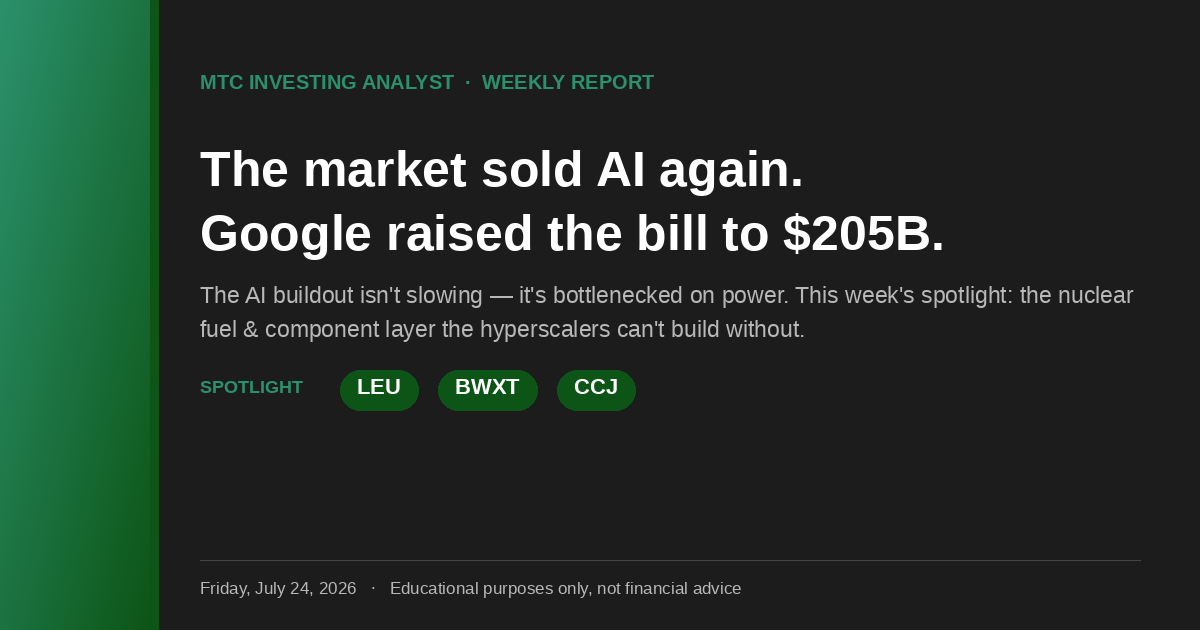
The market sold AI again this week. Google answered by raising the bill to $205 billion. If you want to know where the real opportunity is hiding, stop watching the stock everyone sells and start watching who gets paid when the buildout keeps spending. Right now, that means nuclear stocks for AI — the fuel and reactor-component layer three floors down from Nvidia.
Here’s the setup. Alphabet reported a monster quarter — revenue $119.8B (+24%), Google Cloud up 82% to $24.8B, backlog swelling to $514B — and the stock fell. Why? Because it raised 2026 capex guidance to $195–205B (up from $180–190B) and admitted it’s still “supply-constrained.” Wall Street read that as “AI spending is out of control.” We read it as a supply-chain map.
Why the AI bottleneck moved from chips to power
For two years the AI trade was about chips. That constraint is easing. The new one is electricity. A hyperscaler can order all the GPUs it wants, but if it can’t power the data center, the chips sit in a box. That’s why every major hyperscaler has now signed a nuclear power deal — 13+ announced projects and roughly 9.8 GW of committed capacity. Microsoft restarted Three Mile Island. Google backed Kairos Power. Amazon and Oracle are building next to reactors.
But here’s the part the crowd misses: a reactor is useless without fuel and parts. Every one of those reactors has to buy enriched fuel, specialized components, and the uranium underneath it all — before it can power a single GPU. That’s the layer we want.
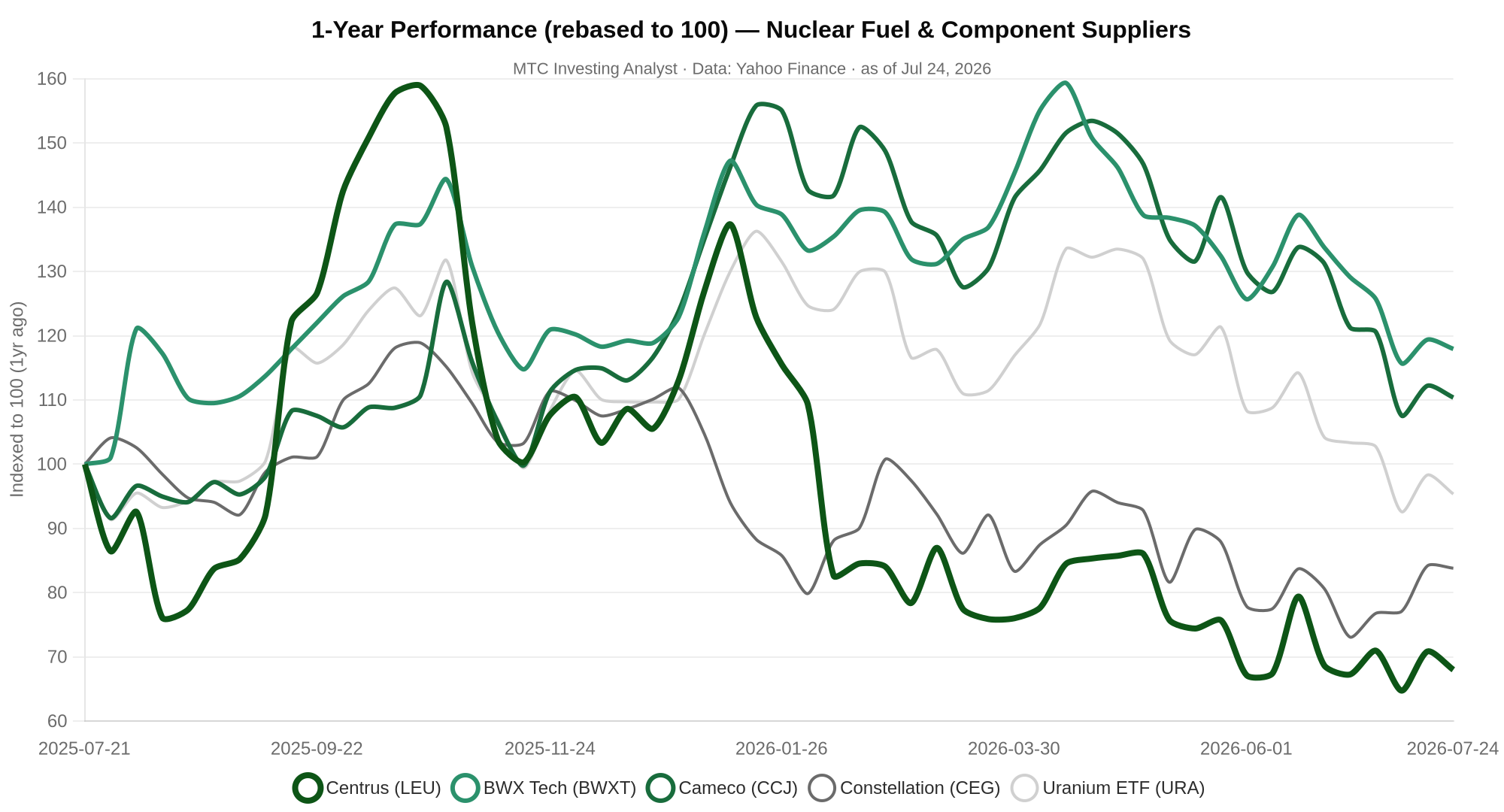
The Silent Supplier layer: 3 nuclear stocks for AI power
Our whole method at Meta Trading Club is to trace the demand. The crowd buys the reactor operators (CEG, VST, OKLO) — already crowded, volatile, and priced for perfection. The edge is one layer down, in the names that sell into that buildout and trace a named, verified contract. Here are three, from highest-beta to steadiest.
Nuclear Fuel — HALEU Enrichment · Layer 3
The only U.S.-owned enricher — and SMRs can’t run without it
Nearly every advanced reactor the hyperscalers are funding — Oklo’s Aurora, X-energy’s Xe-100, TerraPower’s Natrium, Kairos’ Hermes — runs on HALEU (high-assay low-enriched uranium), a fuel Russia has historically dominated. Centrus is the only U.S.-owned company enriching it, at its Piketon, Ohio plant. It’s the choke point of the entire domestic SMR story.
Nuclear Components — TRISO Fuel & SMR Parts · Layer 3
The pick-and-shovel of the reactor buildout
BWXT makes the things reactors are built from: it has manufactured TRISO fuel for 20+ years at Lynchburg, VA, builds components for multiple SMR developers, and is the sole manufacturer of U.S. naval nuclear reactors. Where LEU is a bet on one fuel, BWXT is a diversified supplier with an installed customer base and a government backlog — the lower-beta way to own the theme.
Nuclear Fuel — Uranium + 49% Westinghouse · Layer 2-3
The uranium under everything — plus a reactor stake
Cameco is one of the world’s largest uranium producers and owns 49% of Westinghouse (with Brookfield). That’s two ways to win: it sells the raw fuel every reactor consumes, and it owns the reactor technology — the AP1000 and the eVinci microreactor — being financed to power industry and data centers. It’s the most semi-known name here, which is why it’s Layer 2-3, but still under-owned versus the operators.
What we’re avoiding right now
- Crowded reactor operators at the highs (OKLO): great theme, but the front-page SMR names are priced for perfection. The fuel suppliers are the cleaner risk/reward.
- Fading the whole AI complex on sentiment: capex guidance went up this week. Shorting the buildout because the mood soured is the crowded, lazy trade.
- Long-duration Treasuries here: with the 10Y backing up to ~4.68% on heavy supply and oil, duration is fighting the tape. Stay in the front end.
The bottom line
Follow the bill, not the mood. The market spent another week deciding AI spend is unsustainable; Alphabet answered by raising it to $205B and admitting it still can’t get enough capacity. That’s not a top signal — it’s a supply-chain map. The trade is migrating from the chip to the socket, and the least-crowded way to own it is the nuclear fuel and component layer. When the crowd sells the buyer while the buyer spends more, you write down who gets paid.
FAQ: Nuclear stocks and the AI power trade
Why are nuclear stocks tied to AI?
AI data centers need enormous, reliable, 24/7 power. Renewables are intermittent and the grid can’t add gigawatts fast enough, so hyperscalers like Microsoft, Google and Amazon have signed nuclear deals — 13+ projects and ~9.8 GW committed — to power their AI buildouts.
What is a “Silent Supplier” stock?
It’s an under-covered company that sells a critical input into a hot theme, rather than being the front-page name itself. It has to pass four filters: it sells into the hot name, it’s off retail’s radar, it has pricing power, and it traces a verifiable demand link — a named contract, LOI, or capex line.
What is HALEU and why does it matter?
HALEU (high-assay low-enriched uranium) is the fuel most advanced small modular reactors need. Russia has historically dominated its supply, so a domestic source is strategically critical. Centrus (LEU) is the only U.S.-owned company currently enriching it.
Is this financial advice?
No. This is educational analysis from MTC Investing Analyst. Every idea names a level so you can think for yourself — but you should do your own research and consult a licensed professional before investing.
Want to learn how we find these before they’re on the front page?
The MTC Incubator teaches you the exact system — market alignment, supply-chain mapping, and disciplined entries — so you become an independent investor, not a signal-follower.
Disclaimer — Educational purposes only, not financial advice. This article is produced by MTC Investing Analyst for educational and informational purposes. It is not investment advice, a recommendation, or an offer to buy or sell any security. All prices are as of the Friday close on July 24, 2026 and are subject to change. Investing involves risk, including possible loss of principal; past performance does not guarantee future results. Verified demand links reference publicly reported contracts, LOIs and filings as of the report date and may change. Do your own research and consult a licensed financial professional before making any investment decision. MTC and its team may hold positions in securities mentioned.