The S&P just printed a record and closed its best week since April — up 2.07% — while the July jobs report came in at minus 23,000. The crowd is buying the AI headline names again: NVDA +8.4% on the week, AVGO +9%, the SMH chip ETF +6.8%. But the real tell isn’t the chips everyone owns. It’s the boring companies that test those chips — and the memory supercycle quietly funding all of them.
Every AI accelerator now ships with a stack of high-bandwidth memory (HBM) glued next to it. More HBM means more layers, more test time, and more of one thing almost nobody on retail Twitter is watching: the probe cards and test systems that verify every die before it ever reaches a data center. That’s this week’s Silent Supplier story — the pick-and-shovel layer under the memory boom.
The market this week: record highs on a weak jobs print
The indexes all pushed higher into Friday’s close. The S&P 500 finished around 7,757 (+2.07%), a fresh record and its strongest week since April. The Dow closed near 54,037, the Nasdaq Composite around 26,691 (+3.0%), and the small-cap Russell 2000 near 3,034.
What makes it interesting is why. July nonfarm payrolls came in at -23,000 — the first outright monthly job loss of the cycle, against expectations of +83,000. Unemployment ticked to 4.1%. Normally a weak labor print rattles stocks. This time the market read it as cover for the Fed to eventually ease, even though Chair Kevin Warsh held the funds rate at 3.50–3.75% on July 29 and signaled no cuts in 2026. The 10-year sits near 4.66%. Gold ripped to roughly $4,400 (+9.2%) as the hedge of choice; WTI slipped to ~$77.
Why memory is the real AI trade right now
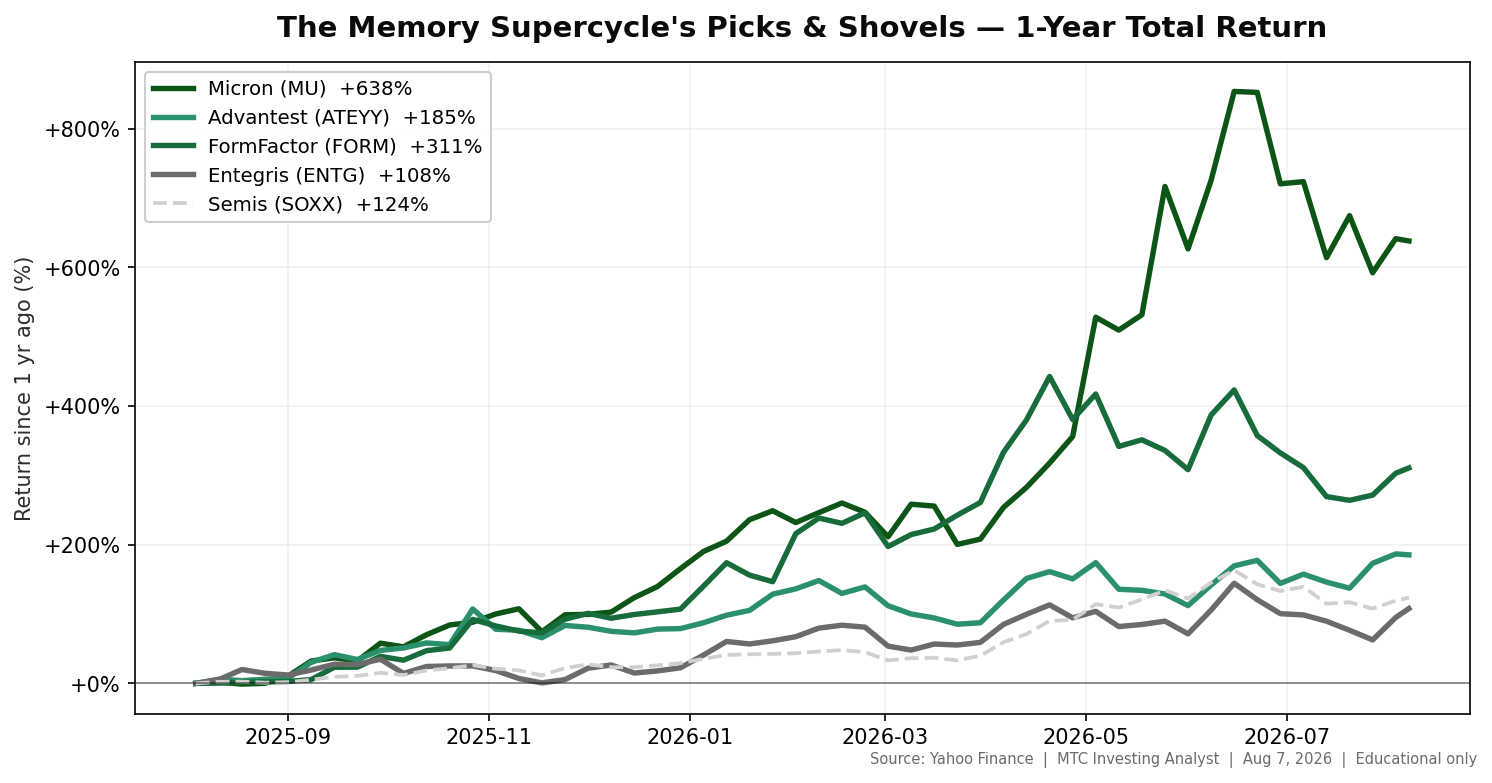
Here’s how it actually works. An AI GPU is only as fast as the memory feeding it. As models get bigger, the bottleneck moves from raw compute to memory bandwidth — which is why every new accelerator stacks more HBM. Micron (MU) guided HBM essentially sold out through 2026. That’s the front-page name, and it’s already run.
The edge isn’t Micron. It’s the layer underneath: every one of those memory dies has to be tested, probed, and built from ultra-pure materials. More HBM layers means exponentially more test complexity. That demand flows straight to a handful of under-covered suppliers — and unlike the chipmakers, they don’t carry a 30x forward multiple.
The three Silent Supplier picks
The company that tests the chips everyone else is buying
Advantest is the dominant maker of automated test equipment (ATE) for semiconductors — the machines that verify every high-end logic and memory chip works before it ships. It’s effectively a two-player market with Teradyne, and Advantest owns the high end where AI and HBM testing lives.
The probe cards that touch every memory die
FormFactor makes the probe cards — the precision interface that connects test equipment to the wafer. You literally cannot test an HBM die without one, and HBM’s stacked architecture needs more advanced probe cards than legacy memory.
The ultra-pure materials layer — with a softer demand link (flagged)
Entegris supplies the ultra-high-purity materials, filters, and chemistries that every advanced fab consumes. More wafer starts and more advanced nodes mean more Entegris content per chip. It’s the “consumables” play on the whole buildout, not just memory.
The anchor: Micron (MU)
If you want the front-page way to play the same theme, MU is the anchor — HBM guided effectively sold out through 2026, and it’s the clearest beneficiary of the memory shortage. It’s also the most crowded and the most volatile. Entry discipline: accumulate under ~$840 (last ~$877.57). The suppliers above give you the same tailwind with less consensus positioning.
How last week’s calls are doing (the scorecard)
We grade our own calls out loud — that’s the whole point of this report. Across 40 logged picks, the system is running a 62.5% win rate with an average return of +2.48% since inception. Best pick: ADBE +35.9%. Worst: MOD -30.1%. We own the losers as plainly as the winners — ORCL -20.2%, ALAB -16.5%, BANB -13.4%, SMH -11.7%. No track record, no authority.
Frequently asked questions
What is the “memory supercycle”?
It’s the current surge in demand for high-bandwidth memory (HBM) driven by AI accelerators. Every AI GPU needs stacks of HBM, and supply is tight — Micron guided HBM sold out through 2026. That demand cascades to the companies that test and supply materials for memory chips.
What are “Silent Supplier” stocks?
They’re the under-covered companies that sell into the hot names — the picks-and-shovels layer. Instead of buying the crowded front-page stock, you buy the verifiable supplier three layers down that has better margins and less hype. This week: chip-test and materials names feeding the memory boom.
Are ATEYY, FORM, and ENTG buy recommendations?
No. This is educational analysis, not financial advice. Each name has a named entry level and a stated risk so you can do your own work. The goal at MTC is to build independent investors, not signal-followers.
The MTC Incubator is where we teach the full Alignment framework — how to read market structure, map a supply chain, and build entries with real risk discipline. We build independent traders and investors, not signal-followers.
Disclaimer: This content is for educational purposes only and is not financial advice. Nothing here is a recommendation to buy or sell any security. Investing involves risk, including the possible loss of principal. Do your own research and consult a licensed financial professional before making any investment decision.