Everybody loves a trending market. Price moves in one direction, your setups work, and trading feels easy. Then the trend ends and the market goes sideways — chopping back and forth in a range, faking out breakouts, stopping out trend traders in both directions. This is where most of the year actually lives, and it’s where most traders bleed their gains back. Choppy markets aren’t a bug to wait out. They’re a condition you either trade differently or step aside from entirely. Here’s how to handle them without getting chopped to pieces.
Chop is where gains go back
Everybody can trade a trend. Sideways chop — failed breakouts, whipsaws — is where most traders give back what the trend gave them.
First: Recognize That You’re in Chop
The most expensive mistake isn’t trading chop badly — it’s trading chop as if it were a trend. Trend strategies (buying breakouts, riding momentum) are designed for directional markets and get systematically destroyed in a range, because every ‘breakout’ fails and every momentum push reverses. Step one is recognition: are we trending or ranging?
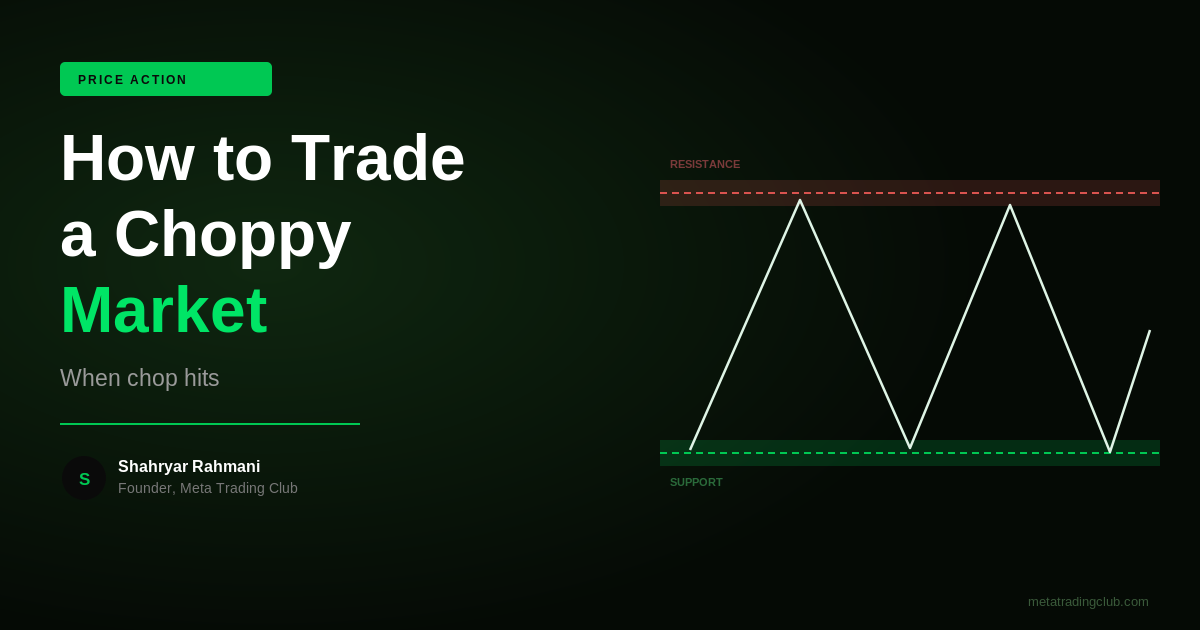
The signs of a range: price bouncing between a clear ceiling (resistance) and floor (support) without making sustained new highs or lows, lots of overlapping candles, failed breakouts in both directions, and falling volume. If you see those, your trend playbook is the wrong tool, and using it anyway is how good traders give back good months.
MTC Analysis
Trade the Range, or Don’t Trade
In a range, invert your instincts: fade the edges (buy support, sell resistance) instead of buying breakouts — or recognize the highest-EV move is often no trade at all.
Strategy 1: The Best Trade Is Often No Trade
This is the hardest and most valuable thing to internalize: in choppy conditions, sitting out is frequently the highest-EV decision. Not every market is tradeable for your edge. If your strategy is trend-based and the market isn’t trending, forcing trades just feeds the chop your capital. There is no rule that you must trade every day. Professionals dramatically reduce activity in conditions that don’t suit them — preserving capital and patience for when the trend returns. Doing nothing is a position.
Strategy 2: Trade the Range (If You Must)
If you do trade chop, trade it as a range, not a trend. That means inverting your instincts: instead of buying breakouts, you fade the edges. Buy near support (the floor), sell near resistance (the ceiling), and take profits in the middle. The key is that you’re betting on the range holding, not breaking — the opposite of breakout trading.
This requires a clearly defined range with edges that have already held a few times, tight risk just beyond the edge (if support breaks, you’re wrong and out fast), and modest profit targets — you’re scalping the range, not swinging for a trend. Range trading is lower-reward and requires precision, which is exactly why many traders prefer to simply sit out instead.
Strategy 3: Cut Size and Widen Your Filters
If you stay active in choppy conditions, do it smaller and pickier. Reduce position size, because the whipsaw risk is high. Tighten your setup criteria so only the very best, cleanest setups qualify — chop punishes marginal trades hardest. Fewer trades, smaller size, higher standards. The goal in a range isn’t to make a lot; it’s to not give back what you made in the trend.
The Mindset That Survives Chop
Here’s the reframe that saves accounts: your job isn’t to make money every day — it’s to not lose money in conditions that don’t suit you, so you’re intact and confident when conditions do. Most traders do the opposite. They make money in the trend, then give it all back overtrading the chop because they can’t tolerate inactivity. The trader who simply steps aside in choppy conditions outperforms the one who forces trades, without needing a better strategy — just better discipline about when to use it.
That discipline — reading the condition and adjusting, including the discipline to do nothing — is exactly what the MTC Alignment Engine builds in: market bias comes first, and if there’s no clean bias and no clean level, there’s no trade. At Meta Trading Club, members watch a full-time trader navigate chop live every market day, including the days the best call is to sit on their hands.
Proprietary Framework
The MTC Alignment Engine™ — Applied Every Live Session
Every trade runs the same five checkpoints — consistency over gut reaction. Inside the MTC Incubator, members build their own system on top of this framework.
Frequently Asked Questions
How do you trade a choppy sideways market?
First, recognize you’re in a range rather than a trend. Then either step aside (often the best decision if your edge is trend-based) or trade the range — fading the edges by buying near support and selling near resistance with tight risk and modest targets. If you stay active, cut your size and only take the cleanest setups.
Should I trade in a choppy market or wait?
For many traders, especially trend-based ones, waiting is the higher-probability choice. Forcing trend strategies into a range gets systematically punished by failed breakouts and reversals. There’s no requirement to trade every day, and reducing activity in unsuitable conditions preserves capital and discipline for when the trend returns. Doing nothing is a legitimate position.
How do I know if the market is choppy or trending?
A choppy range shows price bouncing between a clear ceiling and floor without sustained new highs or lows, lots of overlapping candles, breakouts that fail in both directions, and often declining volume. A trend shows sustained directional movement with higher highs and higher lows (or lower lows and lower highs). Misreading chop as a trend is a common, costly error.
What is range trading?
Range trading is trading a sideways market by betting the range holds rather than breaks — buying near support, selling near resistance, and taking profits toward the middle. It’s the opposite of breakout trading. It requires a well-defined range, tight risk just beyond the edges, and modest targets, since you’re scalping the range rather than catching a trend.
Why do I keep losing money in choppy markets?
Usually because you’re applying trend strategies — like buying breakouts or chasing momentum — to a market that isn’t trending. In a range, breakouts fail and momentum reverses, so those tactics get repeatedly stopped out. The fix is to recognize the choppy condition and either trade it as a range or step aside entirely.
Is it okay to not trade some days?
Absolutely. Not trading when conditions don’t suit your edge is a sign of discipline, not weakness. Professional traders dramatically reduce activity in unfavorable conditions to preserve capital and patience. The trader who sits out choppy markets often outperforms the one who forces trades, simply by not giving back gains in conditions that don’t fit their strategy.
Related reading
Meta Trading Club Community
Start Your 7-Day Free Trial
Daily live sessions. Real-time market prep — not signals. The MTC Alignment Engine™ applied in front of you. Trade alongside Shahryar from day one.
Cancel anytime. No contracts. Built for Canadian traders.
Already trading and want to build your own system?
The MTC Incubator is an application-based mentorship — 1-on-1 work building a personalized system on the Alignment Engine™.