Every trader hits losing streaks. Even a genuinely profitable strategy goes through stretches where the losses pile up — that’s not a malfunction, it’s statistics. What separates traders who survive from those who quit (or blow up) is how they handle the drawdown.
The danger of a drawdown isn’t the losses themselves. It’s the emotional reaction to them: revenge trading, over-sizing to ‘win it back,’ abandoning the plan at the worst moment. The math of recovery is unforgiving, which is exactly why protecting capital comes first.
The asymmetry that matters
Losses and the gains needed to recover them are not symmetric. A 50% loss needs a 100% gain just to get back to even. Avoiding the deep hole is far easier than climbing out of it.
What a Drawdown Is
A drawdown is the drop from a peak in your account to a subsequent low, usually measured as a percentage. Every strategy has them. The question is never whether you’ll face a drawdown — you will — but how deep you let it get and how you behave inside it.
MTC Analysis
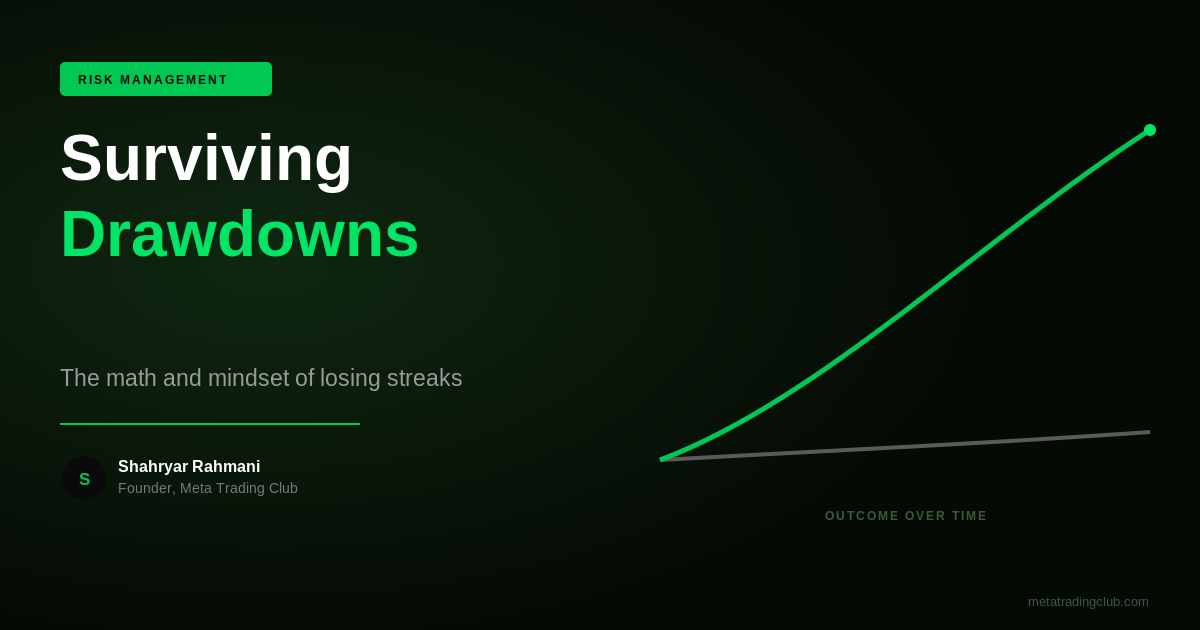
A Normal Equity Curve Includes Drawdowns
Even a profitable account doesn’t rise in a straight line. The dips are drawdowns — expected, survivable, and recoverable when risk per trade is controlled.
The Brutal Math of Recovery
Here’s why protecting capital matters more than chasing returns: the bigger the loss, the disproportionately bigger the gain you need just to break even. Small losses are recoverable; deep ones can be mathematically and psychologically fatal.
MTC Analysis
The Gain Needed to Recover a Loss
Lose 20% and you need +25% to recover. Lose 50% and you need +100%. Lose 70% and you need +233%. The hole gets exponentially harder to climb out of.
| Loss taken | Gain needed to break even |
|---|---|
| -10% | +11% |
| -20% | +25% |
| -33% | +50% |
| -50% | +100% |
| -70% | +233% |
How to Survive a Losing Streak
Surviving a drawdown is mostly about behaviour, not brilliance. The traders who come through reduce risk, slow down, and protect the account so they’re still in the game when conditions turn — rather than doubling up to force a recovery, which is how a drawdown becomes a blow-up.
- Cap risk per trade so no streak can ruin you (many use ~1%)
- Set a max daily/weekly loss and honour it
- Reduce size during a drawdown — don’t increase it
- Never revenge trade to ‘win it back’ quickly
- Step away when emotional; the market will be there tomorrow
The Mindset That Keeps You In the Game
A drawdown is a test of temperament, not a verdict on your ability. If your strategy has positive expectancy and your risk per trade is small, a losing streak is a storm to weather, not a reason to abandon ship. The single most important thing is to still have an account when the edge reasserts itself.
Proprietary Framework
The MTC Alignment Engine™ — Applied Every Live Session
Every trade runs the same five checkpoints — consistency over gut reaction. Inside the MTC Incubator, members build their own system on top of this framework.
Frequently Asked Questions
What is a drawdown in trading?
A drawdown is the decline from a peak in your account value to a later low, usually expressed as a percentage. Every trading strategy experiences drawdowns; they’re a normal part of the process, not necessarily a sign that anything is broken.
Why is recovering from a large loss so hard?
Because losses and recovery gains aren’t symmetric. A 50% loss requires a 100% gain to break even, and a 70% loss requires a 233% gain. The deeper the drawdown, the disproportionately larger the return needed — which is why avoiding deep losses matters so much.
How do I survive a losing streak?
Protect capital and behaviour first: cap risk per trade so no streak can ruin you, set and honour a maximum daily or weekly loss, reduce size during the drawdown rather than increasing it, and never revenge trade. The aim is to still be in the game when conditions improve.
Are drawdowns normal even for good traders?
Yes. Even strategies with a real edge go through stretches of clustered losses — that’s ordinary statistical variance. What distinguishes good traders is controlled risk and disciplined behaviour during the drawdown, not the absence of drawdowns.
How much should I risk per trade to handle drawdowns?
Many traders limit risk to around 1% of their account per trade. Small, consistent risk means even a long losing streak only dents the account rather than threatening it, keeping both your capital and your decision-making intact.
Related reading
Meta Trading Club Community
Start Your 7-Day Free Trial
Daily live sessions. Real-time market prep — not signals. The MTC Alignment Engine™ applied in front of you. Trade alongside Shahryar from day one.
Cancel anytime. No contracts. Built for Canadian traders.
Already trading and want to build your own system?
The MTC Incubator is an application-based mentorship — 1-on-1 work building a personalized system on the Alignment Engine™.