Before you risk real money on a strategy, you should have evidence it works. Backtesting is how you gather that evidence — testing your rules against historical data to see whether the edge is real or just a story you like.
Done well, backtesting builds justified confidence and surfaces a strategy’s weaknesses before they cost you. Done badly, it produces beautiful results that fall apart live. The difference is mostly about honesty.
What a backtest is for
A backtest doesn’t predict the future. It tells you whether your rules had an edge in the past — and, just as usefully, where and when they didn’t.
What Backtesting Is — and Isn’t
Backtesting means applying a defined set of trading rules to historical price data and recording how they would have performed. It is not a crystal ball and it is not proof of future profit. It’s a structured way to pressure-test an idea so you’re not discovering its flaws with live money.
The Backtesting Process
A useful backtest follows a clear sequence. The most important and most-skipped step is the first one: your rules must be specific enough that two people would take the same trades. Vague rules can’t be tested honestly.
MTC Analysis
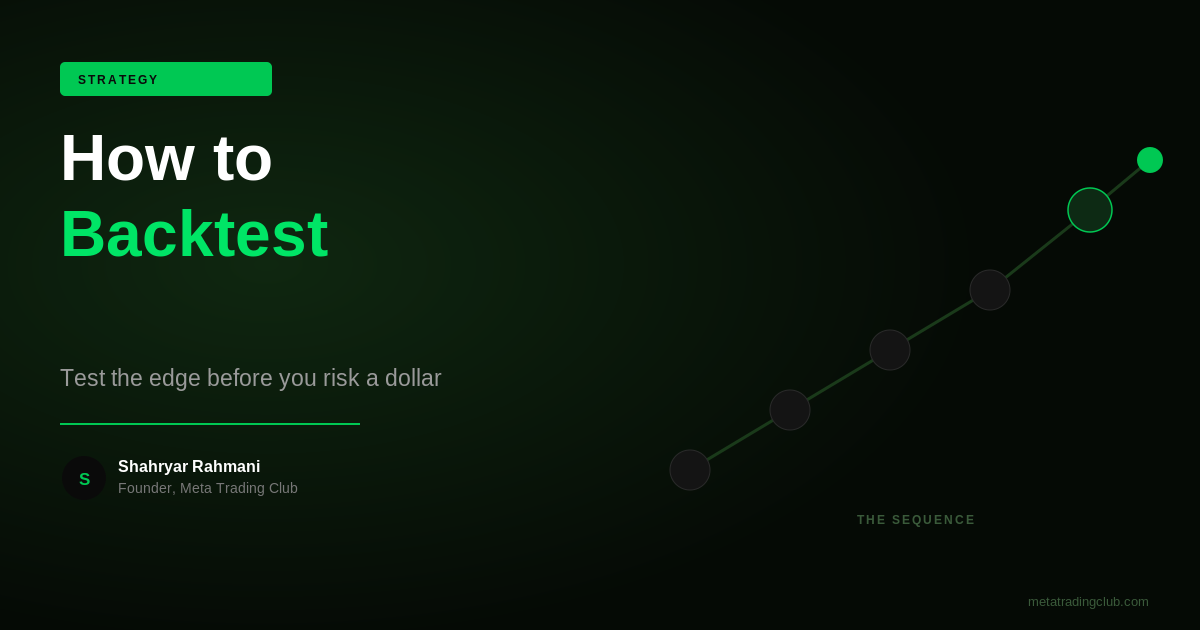
The 4-Step Backtest
Define rules precisely, run them across a large sample, record every trade honestly, then read what the statistics say — including the losers.
What to Measure
Profit alone is a shallow read. To know whether a strategy is tradeable — and survivable — you need the fuller picture: how often it wins, how big wins are versus losses, its expectancy, and crucially its worst drawdown.
| Metric | What it tells you |
|---|---|
| Win rate | How often the rules win |
| Avg win vs avg loss | The size relationship |
| Expectancy (R) | Average result per trade |
| Max drawdown | The worst stretch you’d endure |
| Sample size | Whether results are meaningful |
MTC Analysis
A Backtest Equity Curve — Read the Dips
A backtest’s equity curve shows not just the ending profit but the drawdowns along the way. A strategy you can’t sit through emotionally is one you won’t trade through live.
The Traps That Fool Beginners
Most bad backtests share the same handful of errors. Avoiding them matters more than any single metric, because a flattering-but-flawed backtest is worse than none — it gives false confidence.
- Curve-fitting: tuning rules until past data looks perfect (and future fails)
- Tiny samples: ten trades prove nothing; aim for many
- Hindsight: using information you wouldn’t have had live
- Ignoring costs: spreads, commissions, and slippage are real
- Cherry-picking the period: test across different conditions
From Backtest to Live
A promising backtest is a beginning, not a verdict. The honest next step is forward testing — paper trading the rules in current conditions — before committing real capital, then starting small. Markets change; a backtest tells you a strategy had an edge, and live results tell you whether it still does.
Proprietary Framework
The MTC Alignment Engine™ — Applied Every Live Session
Every trade runs the same five checkpoints — consistency over gut reaction. Inside the MTC Incubator, members build their own system on top of this framework.
Frequently Asked Questions
What is backtesting in trading?
Backtesting is applying a defined set of trading rules to historical price data to see how they would have performed. It’s a structured way to gather evidence about whether a strategy had an edge, and to find its weaknesses before risking real money.
How do I backtest a trading strategy?
Define your rules precisely enough that they’re unambiguous, apply them across a large sample of historical trades, record every result honestly, then analyze the statistics — win rate, average win versus loss, expectancy, and maximum drawdown.
What metrics matter in a backtest?
Beyond total profit: win rate, the size of average wins versus losses, expectancy per trade, maximum drawdown, and the sample size. Drawdown and sample size are especially important — they tell you what you’d have to endure and whether the results are meaningful.
What is curve-fitting and why is it bad?
Curve-fitting is tuning a strategy’s rules until it looks perfect on past data. The problem is that it optimizes for history that won’t repeat exactly, so the strategy often fails live. A simpler strategy that works across many conditions is more trustworthy than a perfect-looking fitted one.
Is a good backtest enough to trade a strategy live?
No. A good backtest is a starting point. The honest next step is forward testing — paper trading the rules in current market conditions — and then starting with small size live, because markets change and past performance doesn’t guarantee future results.
Related reading
Meta Trading Club Community
Start Your 7-Day Free Trial
Daily live sessions. Real-time market prep — not signals. The MTC Alignment Engine™ applied in front of you. Trade alongside Shahryar from day one.
Cancel anytime. No contracts. Built for Canadian traders.
Already trading and want to build your own system?
The MTC Incubator is an application-based mentorship — 1-on-1 work building a personalized system on the Alignment Engine™.