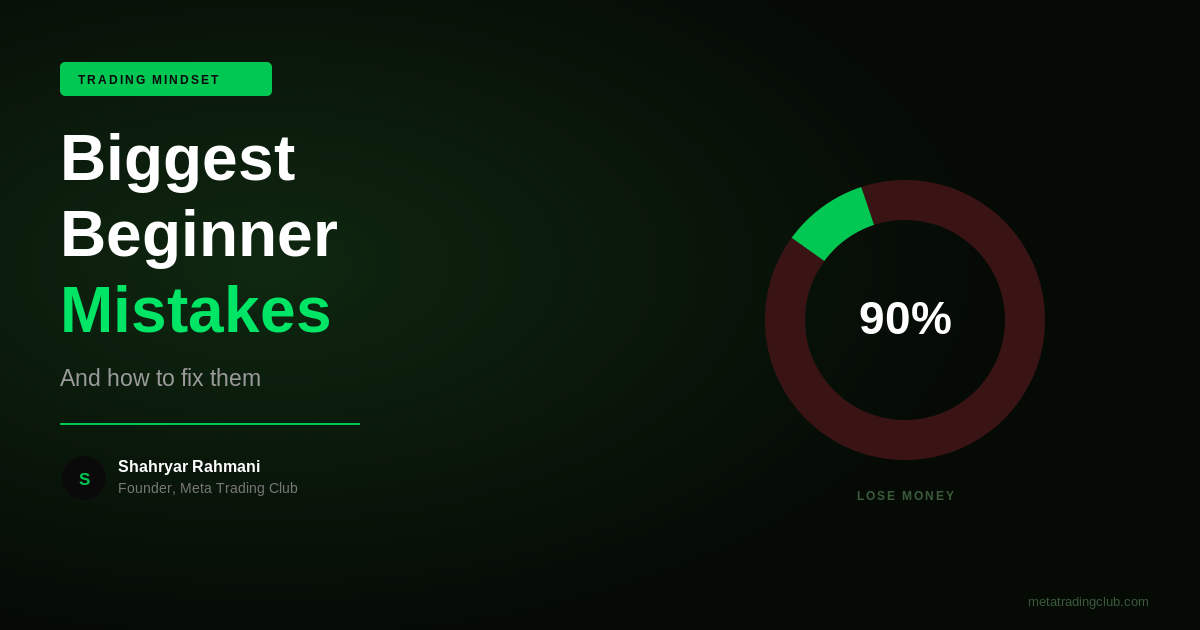
Beginner traders are remarkably consistent — not in their results, but in their mistakes. Watch a thousand new traders and you’ll see the same handful of errors over and over, in different costumes. The encouraging part is that this means losing isn’t a mystery. Most beginners aren’t failing because trading is impossibly hard; they’re failing because they’re making predictable, fixable mistakes. Here are the biggest ones and exactly how to fix each.
Same mistakes, different costumes
Beginners are remarkably consistent — in their mistakes. Losing isn’t a mystery; it’s a handful of predictable, fixable errors.
Mistake 1: No Risk Management
The number one account killer. Beginners trade with no stop loss, oversized positions, and no rule for how much they’ll risk. One bad trade — or one bad streak — wipes out weeks of gains or the whole account. They focus entirely on entries and ignore the only thing that determines survival.
The fix: risk a fixed, small percentage (1–2%) per trade, always define your stop before entering, and set a maximum daily loss. This single change keeps you alive long enough to get good, which is the entire game in the early years.
MTC Analysis
The Mistakes (and the Fix)
Plus chasing, overtrading, and ignoring psychology. The root of all of them is the same: emotion overriding process — which is why the fix is never just more knowledge.
Mistake 2: Trading Too Big
Closely related, and worth its own entry because it’s so common. Beginners size positions based on how much they want to make, not how much they can afford to lose. They ‘go big’ on a setup that feels certain — and certainty is exactly when the market humbles you. The oversized position turns a normal loss into a catastrophic one.
The fix: size every trade so that hitting your stop costs only your fixed 1–2%. Position size comes from your stop distance, not your excitement. Stay small, especially when you feel sure.
Mistake 3: No Plan, Just Vibes
Beginners trade on impulse, gut feeling, and whatever looks good in the moment. There’s no defined setup, no rules, no consistency — which makes it impossible to know what’s working, improve, or even repeat a good result.
The fix: write a simple trading plan that defines your setups (as a checklist), your risk rules, and your exits. Trade only what fits the plan. A one-page plan turns random gambling into a process you can actually review and improve.
Mistake 4: Revenge Trading
After a loss, the urge to immediately ‘make it back’ overrides all judgment. Beginners pile into the next trade emotionally, bigger and sloppier, turning one manageable loss into a spiraling disaster. More accounts die in the hour after a loss than at any other time.
The fix: a hard daily loss limit. If you’re down your maximum for the day, you stop — close the platform, walk away. The spiral can’t happen if you’re not at the screen.
Mistake 5: Chasing and FOMO
Beginners chase stocks that have already moved, terrified of missing out. They buy the top of a run because it’s exciting and obvious, right when the risk is highest and a reversal is most likely. FOMO makes you enter at the worst possible price.
The fix: wait for setups to come to you — a pullback to a level, a reaction, confirmation. There’s always another trade. The fear of missing one move costs far more than the move itself ever would.
Mistake 6: Overtrading
Trading too often, on marginal setups, out of boredom or the need to feel productive. The constant stream of low-quality trades bleeds the account through costs and losses even when no single trade is a disaster.
The fix: define what a valid setup is, cap your trades per day, and accept that doing nothing is often the most profitable action. Patience is the skill; activity is usually the enemy.
Mistake 7: Ignoring Psychology
Beginners think trading is a technical problem — find the right indicator, the right setup — when it’s mostly a psychological one. They have the knowledge and still can’t execute, because fear, greed, and impatience override their plan in real time.
The fix: treat psychology as a core skill, not an afterthought. Build discipline through structure, journaling, and repetition. The gap between knowing and doing is the whole challenge, and it closes through reps, not more information.
The Pattern Behind All of Them
Look closely and almost every mistake on this list is the same root problem: emotion overriding process. Risk failures, oversizing, revenge trading, chasing, overtrading — they’re all what happens when impulse beats discipline. That’s why the fix is never just more knowledge. You can know every item on this list and still make all of them, because knowing isn’t the constraint; executing under pressure is.
That gap — between knowing the mistakes and not making them when it’s live and emotional — is exactly what a structured environment closes. At Meta Trading Club, members watch these errors avoided in real time, with the MTC Alignment Engine enforcing process over impulse, every market day. Knowing the mistakes is the easy 20%. Building the discipline to not make them is the 80% — and it’s built through reps, with feedback, not alone.
Proprietary Framework
The MTC Alignment Engine™ — Applied Every Live Session
Every trade runs the same five checkpoints — consistency over gut reaction. Inside the MTC Incubator, members build their own system on top of this framework.
Frequently Asked Questions
What is the biggest mistake beginner traders make?
The single biggest one is poor risk management — trading with no stop loss, oversized positions, and no rule for how much to risk per trade. This is what turns normal losses into account-ending ones. Fixing it by risking a fixed small percentage per trade, defining stops before entry, and setting a daily loss limit is what keeps beginners in the game.
Why do most beginner traders lose money?
Not because trading is impossibly hard, but because they make the same predictable, fixable mistakes: no risk management, oversized positions, no plan, revenge trading, chasing, overtrading, and ignoring psychology. The common root is emotion overriding process. The losses come from behavior far more than from a lack of information.
How do I stop revenge trading?
Use a hard daily loss limit. If you reach your maximum loss for the day, stop trading — close the platform and step away. Revenge trading happens in the emotional window right after a loss, when the urge to make it back overrides judgment. Removing yourself from the screen prevents the spiral before it starts.
How can I avoid overtrading as a beginner?
Define exactly what a valid setup looks like, cap the number of trades you’ll take per day, and accept that doing nothing is often the most profitable choice. Overtrading is driven by boredom, impulse, and the urge to feel productive. Structure and clear criteria filter out the marginal trades that quietly drain accounts.
Is trading more about psychology or strategy?
Mostly psychology, especially for beginners. Many traders have adequate knowledge and strategy but still can’t execute because fear, greed, and impatience override their plan in real time. The gap between knowing what to do and doing it under pressure is the central challenge, and it closes through discipline, structure, and repetition rather than more information.
Can knowing these mistakes prevent me from making them?
Knowing helps, but it isn’t enough — you can know every common mistake and still make them, because the constraint isn’t knowledge, it’s executing under emotional pressure. Avoiding these errors when it’s live and stressful is a skill built through repetition and feedback, ideally in a structured environment that reinforces process over impulse.
Related reading
Meta Trading Club Community
Start Your 7-Day Free Trial
Daily live sessions. Real-time market prep — not signals. The MTC Alignment Engine™ applied in front of you. Trade alongside Shahryar from day one.
Cancel anytime. No contracts. Built for Canadian traders.
Already trading and want to build your own system?
The MTC Incubator is an application-based mentorship — 1-on-1 work building a personalized system on the Alignment Engine™.