If you day trade and you’re only watching one indicator, it should probably be VWAP. It’s the line institutions watch, the line algorithms reference, and the single most useful intraday reference point most traders never learn to use properly. VWAP isn’t flashy and it won’t predict the future, but it tells you something genuinely valuable in real time: who’s in control of the session, the buyers or the sellers. Here’s what it is and how to actually trade with it.
The line institutions watch
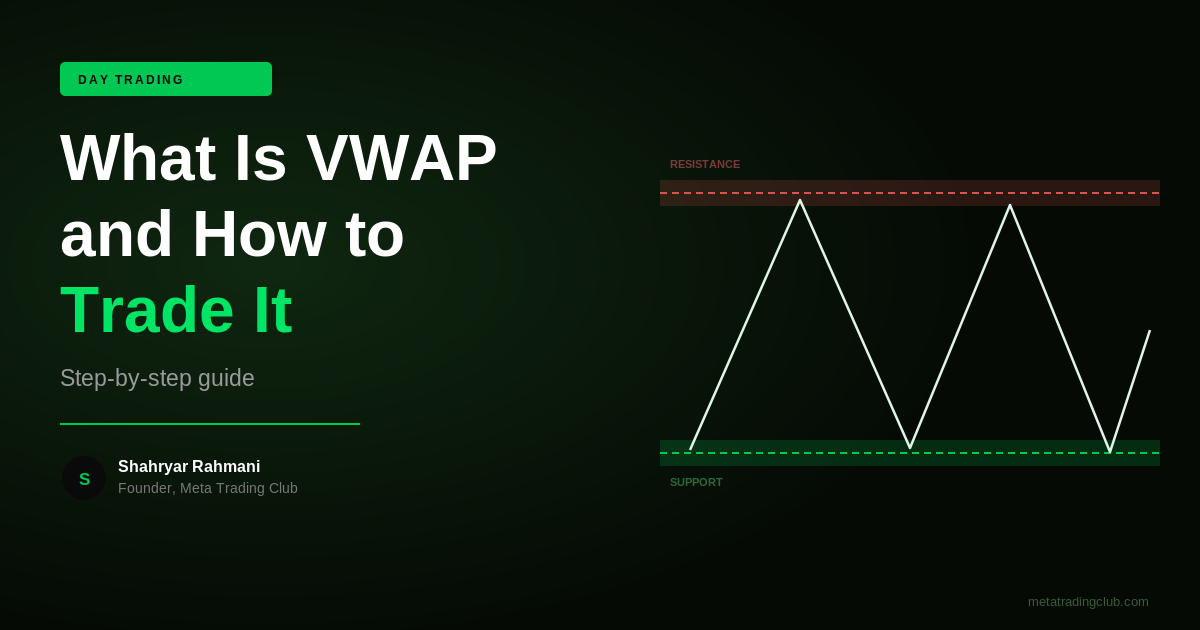
VWAP won’t predict the future, but it tells you something valuable in real time: who’s in control of the session, buyers or sellers.
What VWAP Actually Is
VWAP stands for Volume-Weighted Average Price. It’s the average price a stock has traded at over the session, weighted by volume — so prices where lots of shares changed hands count more than prices where few did. It resets at the start of each trading day and builds throughout the session.
That volume-weighting is what makes it special. A simple average treats every price equally. VWAP reflects where the real money actually transacted, which is why large institutions use it as a benchmark — they want to buy below VWAP and sell above it to get better-than-average fills. When you watch VWAP, you’re watching the same reference the biggest players use.
MTC Analysis
Trading VWAP, Step by Step
Above VWAP, buyers control the session; below it, sellers do. Trade the reaction at the line, not the touch.
Why VWAP Matters: The Line in the Sand
The core insight is simple. Price above VWAP means buyers are in control for the session — the average participant is in profit and the bias is bullish. Price below VWAP means sellers are in control — the bias is bearish. VWAP acts as a dividing line between bullish and bearish intraday conditions.
It also behaves like dynamic support and resistance. In an uptrending session, pullbacks to VWAP often find buyers and bounce. In a downtrending session, rallies to VWAP often find sellers and rejection. These reactions at VWAP are some of the highest-quality intraday decision points you’ll find.
How to Trade VWAP, Step by Step
Step 1: Establish the Session Bias
First thing: is price above or below VWAP? That’s your default bias for the day. Above, you’re looking for longs. Below, you’re looking for shorts. Fighting VWAP — shorting a stock holding firmly above it — is trading against the session’s control, and it’s a low-probability habit.
Step 2: Wait for a Pullback to VWAP
The cleanest VWAP trade isn’t chasing price away from the line — it’s waiting for price to come back to it. In an uptrend session (price above VWAP), wait for a pullback to VWAP. That’s your level, where buyers have been stepping in.
Step 3: Trade the Reaction, Not the Touch
Don’t buy just because price touched VWAP — watch how it reacts there. Does it reject and turn back up (buyers defending)? Wait for that confirmation — a bounce, a strong candle, a hold of the level — before entering. The touch is the setup; the reaction is the trigger.
Step 4: Define Risk Against VWAP
Your stop is clean: if price decisively breaks and holds on the wrong side of VWAP, your read on session control was wrong, and you’re out. A long off VWAP support gets stopped if price closes meaningfully below VWAP. This gives you a tight, logical invalidation point.
The Mistakes to Avoid
Two common ones. First, treating VWAP as a magic line that price must respect — it doesn’t always; it’s context, used with structure and confirmation, not a guarantee. Second, ignoring the bigger picture — a VWAP signal aligned with the daily trend and market bias is far stronger than one fighting it. VWAP is most powerful as the intraday ‘level’ and ‘reaction’ inside a larger read, which is exactly where it fits in the MTC Alignment Engine.
At Meta Trading Club, VWAP is part of the daily live session — members watch session bias, VWAP reactions, and confirmation come together in real time, which is how this line goes from a label on a chart to a tool you actually trade.
Proprietary Framework
The MTC Alignment Engine™ — Applied Every Live Session
Every trade runs the same five checkpoints — consistency over gut reaction. Inside the MTC Incubator, members build their own system on top of this framework.
Frequently Asked Questions
What does VWAP mean in trading?
VWAP stands for Volume-Weighted Average Price — the average price a stock has traded at during the session, weighted by volume so heavily-traded prices count more. It resets each day and is widely used by institutions as a benchmark for fair value, making it one of the most-watched intraday reference points.
How do you trade using VWAP?
First, use price’s position relative to VWAP to set session bias — above is bullish, below is bearish. Then wait for price to pull back to VWAP, watch for a reaction (a bounce or rejection that confirms the level is holding), enter on that confirmation, and place your stop on the wrong side of VWAP. Trade in the direction VWAP indicates control.
Is price above VWAP bullish or bearish?
Price above VWAP is generally bullish for the session — it means the average participant, weighted by volume, is in profit and buyers are in control. Price below VWAP is bearish, indicating sellers control the session. VWAP acts as a dividing line between bullish and bearish intraday conditions.
Is VWAP good for day trading?
Yes — VWAP is one of the most useful tools for day trading because it shows intraday control in real time and acts as dynamic support and resistance. Institutions benchmark against it, so its reactions tend to be meaningful. It’s most effective combined with structure and confirmation rather than used as a standalone signal.
Does VWAP work for swing trading?
VWAP is primarily an intraday tool because it resets each session, so it’s less central to multi-day swing trading. Some traders use anchored VWAP (anchored to a significant date or event) for longer-term reference, but standard daily VWAP is most valuable for day trading and intraday decision-making.
Why do institutions use VWAP?
Institutions use VWAP as a benchmark for execution quality — they aim to buy below VWAP and sell above it to achieve better-than-average prices on large orders. Because so much institutional activity references VWAP, it becomes a self-reinforcing level that many traders watch, adding to its usefulness as an intraday reference.
Related reading
Meta Trading Club Community
Start Your 7-Day Free Trial
Daily live sessions. Real-time market prep — not signals. The MTC Alignment Engine™ applied in front of you. Trade alongside Shahryar from day one.
Cancel anytime. No contracts. Built for Canadian traders.
Already trading and want to build your own system?
The MTC Incubator is an application-based mentorship — 1-on-1 work building a personalized system on the Alignment Engine™.