
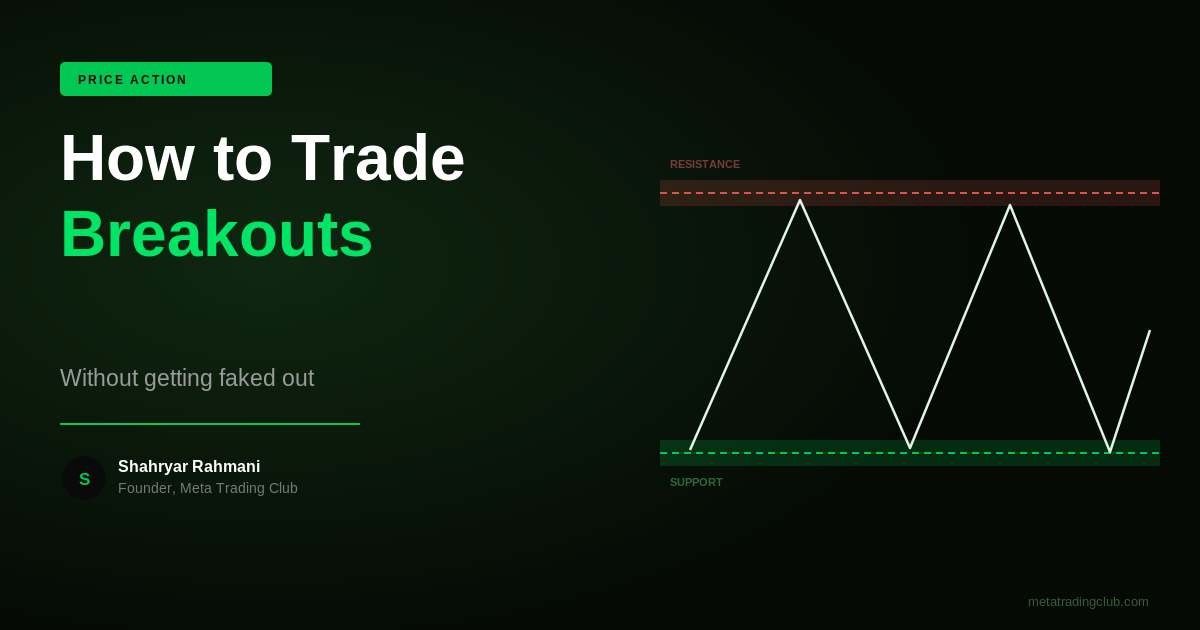
Breakouts are one of the most popular setups in trading and one of the most punishing for beginners. The pattern is seductive: price has been stuck under a level, it finally pops above, you buy the breakout — and then it immediately reverses and stops you out. You just got faked out, and it happens constantly. The fix isn’t to avoid breakouts. It’s to stop entering them the way 90% of traders do.
The level is the bait
A false breakout isn’t bad luck — it’s structural. Obvious levels are where stop orders cluster, and that liquidity is exactly what gets triggered then reversed.
Why Breakouts Fake Out So Often
A false breakout — price breaking a level then reversing — isn’t random bad luck. It’s structural. Obvious levels are where everyone’s stop orders sit. Above resistance, there’s a cluster of buy-stops (from short sellers and breakout buyers). That cluster is liquidity, and large participants are happy to push price just past the level to trigger those orders, fill their own positions, and then let it reverse. The ‘fakeout’ is often the market doing exactly what the order book incentivizes.
Understanding this changes how you trade breakouts: the level being broken isn’t the signal. It’s the bait.
MTC Analysis
Trade the Retest, Not the Break
Don’t buy the instant price crosses the level — that’s where the trap is set. Wait for the retest: price breaks, pulls back, and the old resistance holds as support.
The Beginner Mistake: Buying the Break Itself
Most beginners enter the instant price crosses the level. That’s the worst possible entry, because it’s exactly where the trap is set and where risk is highest — you’re buying into a cluster of orders that may be getting deliberately triggered. The break of a level is not confirmation that the move is real. It’s just a break.
How to Trade Breakouts the Right Way
The goal is to separate real breakouts (continuation) from false ones (traps). A few filters do most of the work.
1. Wait for Confirmation, Not Just the Break
Instead of buying the break, wait for evidence the break will hold. The cleanest confirmation is the retest: price breaks the level, pulls back to it, and the old resistance now acts as support — buyers step in at the level instead of sellers. Entering on a successful retest gives you a far better location, a tighter stop (just below the retested level), and confirmation that the breakout is being defended.
2. Demand Volume
Real breakouts usually come with a surge in volume — conviction behind the move. A breakout on thin, declining volume is suspect; there aren’t enough participants to sustain it. Volume is one of the best lie-detectors for a breakout. No volume, no trust.
3. Respect the Bigger Picture (Structure and Bias)
A breakout aligned with the higher-timeframe trend and overall market bias is far more likely to hold than one fighting it. A breakout to the upside in a clear uptrend, with the broad market supportive, is a different proposition than the same break in a downtrend. Context decides probability.
4. Define the Invalidation Before You Enter
If the breakout is real, price shouldn’t fall back below the level and stay there. So your stop is clear: below the broken level (or below the retest low). If price reclaims the other side, the breakout failed and you’re out small. Knowing exactly where you’re wrong is what makes a faked-out breakout a tiny loss instead of a painful one.
The Patience Trade-Off
Here’s the honest catch: waiting for confirmation means you’ll miss some breakouts that run without a retest. That’s fine. You’re trading for probability, not to catch every move. The trades you skip by demanding confirmation are exactly the low-quality breaks that fake out most often. Trading fewer, higher-quality breakouts beats chasing every break and donating to the traps.
This is precisely the kind of judgment — break versus confirmation, volume, bias — that the MTC Alignment Engine systematizes: market bias, key level, reaction, confirmation, then execution. At Meta Trading Club, breakout setups are walked through live, so members see the difference between the bait and the real move in real time, every market day.
Proprietary Framework
The MTC Alignment Engine™ — Applied Every Live Session
Every trade runs the same five checkpoints — consistency over gut reaction. Inside the MTC Incubator, members build their own system on top of this framework.
Frequently Asked Questions
Why do my breakout trades keep failing?
Most likely because you’re entering the instant price crosses the level — exactly where stop orders cluster and false breakouts are most common. Obvious levels attract liquidity that can be deliberately triggered before price reverses. Waiting for confirmation, like a successful retest with volume, dramatically improves breakout reliability.
What is a false breakout?
A false breakout is when price moves beyond a key level (like resistance or support) and then quickly reverses back, trapping traders who entered on the break. It often happens because the cluster of stop orders at obvious levels provides liquidity that larger participants trigger before the move reverses.
How do I confirm a breakout is real?
The strongest confirmation is a successful retest — price breaks the level, pulls back to it, and the old level now holds as support (or resistance), with buyers (or sellers) defending it. Supporting evidence includes a surge in volume on the break and alignment with the higher-timeframe trend and market bias.
Should I buy the breakout or wait for a retest?
Waiting for a retest generally gives a better entry, a tighter stop, and confirmation that the breakout is being defended. Buying the break itself is where risk is highest and fakeouts are most common. The trade-off is that you’ll miss some breakouts that run without retesting — but those skips avoid most of the traps.
Does volume matter for breakouts?
Yes, significantly. Real breakouts usually come with a surge in volume, signaling genuine participation and conviction. A breakout on thin or declining volume lacks the participants to sustain it and is much more likely to fail. Volume is one of the most reliable ways to gauge whether a breakout is trustworthy.
Where do I put my stop on a breakout trade?
Place it below the broken level (or below the retest low for a retest entry). If the breakout is real, price shouldn’t fall back below the level and stay there, so a move back through it cleanly signals failure. This keeps a faked-out breakout to a small, defined loss.
Some links below are affiliate links — if you sign up through them, MTC may earn a commission at no extra cost to you. We only recommend tools we’d use ourselves.
Want to practice this with real tools? You can get started with a charting platform like TradingView.
Related reading
Meta Trading Club Community
Start Your 7-Day Free Trial
Daily live sessions. Real-time market prep — not signals. The MTC Alignment Engine™ applied in front of you. Trade alongside Shahryar from day one.
Cancel anytime. No contracts. Built for Canadian traders.
Already trading and want to build your own system?
The MTC Incubator is an application-based mentorship — 1-on-1 work building a personalized system on the Alignment Engine™.