Choosing the right broker in Canada is one of the most underrated decisions a trader can make. Most beginners pick the first name they recognize and spend months fighting a platform that doesn’t fit their style.
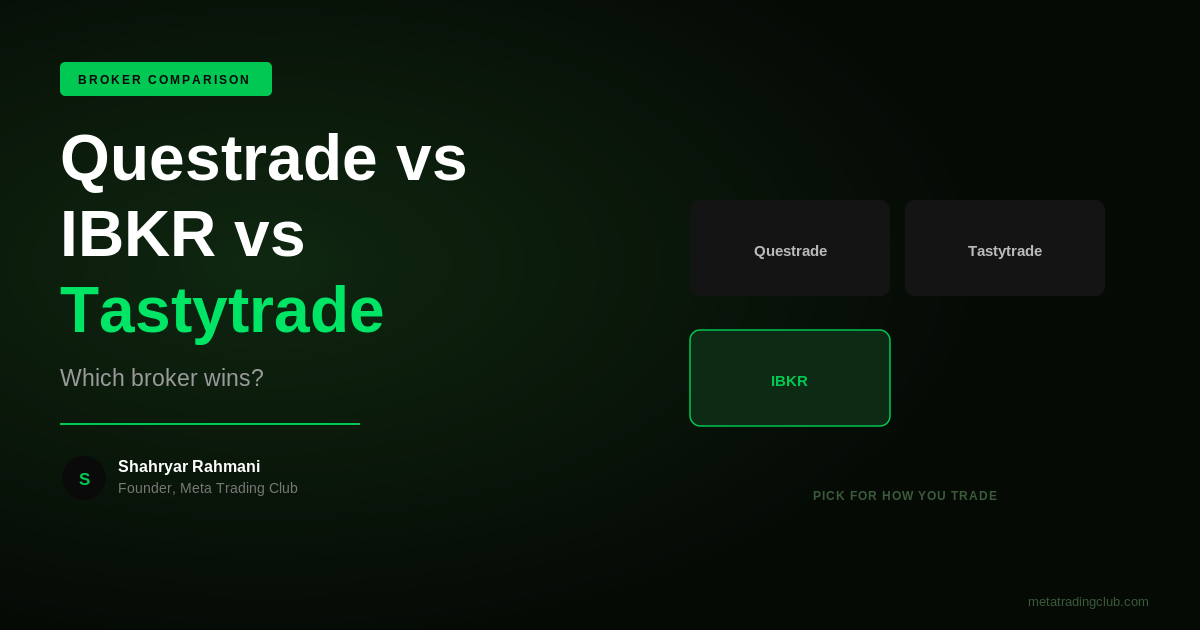
If you’re trading options in Canada, the broker conversation usually comes down to three names: Questrade, Interactive Brokers (IBKR), and Tastytrade Canada. They’re all legitimate. They all have real users. But they serve very different traders at different stages.
This isn’t a sponsored comparison. There’s no affiliate deal here. The goal is to give you an honest breakdown so you can make a decision based on your actual situation — not a marketing page.
Here’s what we’re covering: how each platform handles commissions, what the trading tools actually look like, where they fall short, and most importantly, which type of trader belongs on which platform.
Before we get into specifics, one thing worth saying: the broker matters less than most people think in the early stages. What kills most new options traders isn’t the commission structure — it’s the lack of a structured process, poor risk management, and emotional decision-making. The broker is the vehicle. You still need to know how to drive.
No single ‘best’ broker
The right broker depends on how you trade. Here’s the honest split between Questrade, IBKR, and Tastytrade for Canadian options traders.
Why Broker Choice Actually Matters for Options Traders in Canada
Stocks are simple. Buy, hold, sell. The platform experience is mostly irrelevant. Options are different.
Options trading involves multiple legs, expiry management, Greeks, assignment risk, and time-sensitive execution. A clunky platform can cost you real money — a slow fill, a confusing order entry, a missing tool. When you’re managing a spread and the market moves, you need the platform to get out of your way.
Beyond platform quality, there are a few Canada-specific issues that matter:
Currency and account type. Can you hold USD? Do they support TFSA and RRSP for options? These details matter for tax efficiency and flexibility.
Options approval. Canadian brokers vary in how easily they grant options trading permissions. Some require significant paperwork and income verification. Others are more straightforward.
Commissions add up. If you’re trading spreads regularly, even a $0.50/contract difference compounds over a full year of trading. It’s not trivial.
Platform quality affects execution. Especially for complex multi-leg strategies — iron condors, calendars, ratio spreads — the platform needs to handle the order properly.
Let’s look at each broker with those factors in mind.
MTC Analysis
Best-Fit by Trader Type
Match the broker to your stage. Most Canadian options traders graduate toward IBKR as volume grows.
Questrade: Canada’s Most Recognized Discount Broker
Questrade has been the go-to recommendation for Canadian self-directed investors for years. It’s Canadian-regulated, CIPF-protected, and the platform is genuinely accessible for beginners.
Account Setup and Access
Opening a Questrade account is straightforward. They support TFSA, RRSP, FHSA, and margin accounts. Options trading requires a separate application with approval, but it’s a fairly standard process.
They support USD and CAD accounts, which matters if you’re trading US-listed options (which most Canadian options traders are). The currency conversion fees are worth noting — Questrade charges a spread on conversions, so using Norbert’s Gambit to move funds is a common workaround among more active traders.
Commissions and Fees
Questrade charges $1 per contract with a $10 minimum per trade on options. For small lot sizes (1–3 contracts), that minimum is painful. For larger orders, the per-contract fee is competitive.
There’s also a CAD/USD conversion spread, ECN fees on some equity trades, and inactivity fees if your account drops below a threshold. Read the fine print before assuming it’s as cheap as their marketing suggests.
Platform Quality and Options Tools
Questrade’s standard web platform and the IQ Edge desktop app are functional but not exciting. For basic options buying and covered calls, it works fine. For more complex strategies — multi-leg spreads, rolling positions, visualizing P&L curves — the tools are limited compared to what active options traders expect.
Questrade IQ Edge has an options chain, but it’s not particularly intuitive. Greeks visibility is limited. Strategy analysis tools are basic.
Best For
Beginners who want a Canadian-regulated account with TFSA/RRSP support and aren’t yet doing complex multi-leg strategies.
Interactive Brokers (IBKR): The Professional-Grade Option
Interactive Brokers is the platform serious traders eventually find themselves on. It’s not the easiest to navigate at first, but it’s one of the most powerful trading platforms available to Canadian retail traders.
Account Setup and Access
IBKR Canada is fully regulated in Canada. They support TFSA, RRSP, and margin accounts. The account opening process is thorough — they ask detailed questions about experience and financial background. Options approval levels vary accordingly.
They support both CAD and USD seamlessly, and currency conversion within IBKR is far cheaper than Questrade — you can convert at near-interbank rates.
Commissions and Fees
IBKR’s tiered pricing for options starts around $0.25–$0.65 USD per contract depending on monthly volume. For active traders, this is significantly cheaper than Questrade.
There’s also a fixed pricing option at $0.65/contract flat. For most retail traders doing moderate volume, the fixed rate is simpler. IBKR also removed inactivity fees for most account types, which was a previous criticism.
Platform Quality and Options Tools
Trader Workstation (TWS) is IBKR’s flagship desktop platform. It’s powerful. Risk Navigator, OptionTrader, probability calculators, Greeks dashboards, multi-leg order entry — the tools are genuinely professional grade.
The learning curve is real. TWS can feel overwhelming at first. But IBKR also offers a simpler web-based and mobile interface (IBKR Portal) for traders who want cleaner access. Most serious options traders eventually migrate to TWS.
Best For
Intermediate to advanced traders who want low commissions, powerful tools, and don’t mind a learning curve.
Tastytrade Canada: Built Specifically for Options Traders
Tastytrade entered the Canadian market and brought their US reputation with them. The platform was built by options traders, specifically for options traders — and it shows.
Account Setup and Access
Tastytrade Canada supports margin accounts but TFSA and RRSP support is limited or not available depending on current account offerings — worth confirming directly with them before opening an account. If tax-advantaged account access is critical to you, verify this before committing.
They support USD accounts. CAD account support and integration is a consideration worth confirming with their team.
Commissions and Fees
Tastytrade’s model is built around capped commissions. Opening a position costs $1 per contract, but closing is $0 — no charge to close. This is significant for options traders who are frequently closing positions to manage risk or take profits. There’s also a cap of $10 per leg on multi-leg strategies.
For traders doing regular spread trading or defined-risk strategies, the zero-cost-to-close model can represent real savings.
Platform Quality and Options Tools
This is where Tastytrade shines. The platform was designed with options mechanics in mind. Visualized P&L curves, streamlined multi-leg order entry, rolling tools, position management dashboards — the experience is cleaner and more options-focused than either Questrade or IBKR.
For traders who run strategies like vertical spreads, iron condors, strangles, or straddles on a regular basis, Tastytrade’s workflow is noticeably smoother.
Best For
Options-focused traders who run defined-risk strategies frequently and want a platform built around that workflow.
Full Comparison Table
| Feature | Questrade | IBKR Canada | Tastytrade Canada |
|---|---|---|---|
| Best For | Beginners, long-term investors | Intermediate–Advanced, active traders | Options-focused traders, spread strategies |
| Commission Per Contract | $1.00 CAD (min $10/trade) | ~$0.25–$0.65 USD (tiered) | $1.00 USD to open / $0 to close |
| Platform Complexity | Low–Medium | High | Medium |
| Options Tools | Basic | Professional-grade | Options-native, excellent |
| TFSA Support | Yes | Yes | Limited — verify directly |
| CAD Accounts | Yes (CAD + USD) | Yes (CAD + USD, low conversion cost) | Primarily USD — verify CAD |
| Minimum Account | No hard minimum | No strict minimum | Varies — check current requirements |
| Currency Conversion | Spread-based (use Norbert’s Gambit) | Near-interbank rates | USD-focused |
| Mobile App | Good | Good (IBKR Mobile) | Good |
| Inactivity Fees | Possible below threshold | Removed for most accounts | Minimal |
Who Should Use Each Platform
If you’re just starting out: Questrade makes sense as a first account. The Canadian regulation, TFSA/RRSP support, and accessible interface give you a stable starting point. Just know you’ll likely outgrow the options tools.
If you’re actively trading options and want the lowest commissions: IBKR is hard to beat. The cost structure at higher volume is significantly better, the tools are professional-grade, and the platform can handle anything you throw at it. Accept the learning curve as a one-time investment.
If options strategies are your primary focus: Tastytrade Canada deserves serious consideration. The platform was built for exactly what you’re doing. The zero-cost-to-close model directly reduces friction on active strategy management. Just confirm account type availability before opening.
What MTC Members Use
At Meta Trading Club, our members use all three brokers depending on where they are in their trading journey. There’s no single right answer — and honestly, broker choice is rarely the limiting factor.
What we’ve seen consistently is this: traders who struggle tend to struggle regardless of which broker they’re on. The issues are usually process-related, not platform-related. No broker will fix a trading plan that doesn’t have clear rules for entry, risk, and exit.
What we teach in the MTC community is a structured approach to identifying setups, managing positions, and executing with discipline. The MTC Community includes daily premarket sessions where we walk through market structure, identify key levels, and apply the MTC Alignment Engine before the open. Members bring their own broker to the table.
If you’re looking to get started with options trading in Canada or want to understand how different trading platforms compare beyond just commissions, those resources are worth reading alongside this comparison.
Start Trading With a Better Process
The broker debate matters — but it’s step two. Step one is having a structured process that tells you when to trade, when to wait, and how to manage risk.
At Meta Trading Club, that’s exactly what we teach. Daily premarket sessions, live trade execution, and a structured framework that takes the guesswork out of setup identification. Members trade their own accounts, on their own brokers, with a clear method behind every decision.
Join the MTC Community — 7-day free trial, $99/month
No signals. No hype. Just a structured approach to trading that actually holds up.
Proprietary Framework
The MTC Alignment Engine™ — Applied Every Live Session
Every trade runs the same five checkpoints — consistency over gut reaction. Inside the MTC Incubator, members build their own system on top of this framework.
Frequently Asked Questions
Is Questrade good for options trading in Canada?
Questrade is a solid starting point for Canadian options traders, especially beginners. The platform is accessible and supports TFSA and RRSP accounts. The main limitations are the $10 minimum commission per trade (which hurts small lot sizes), and the options tools aren’t built for active multi-leg strategy management. If you’re just learning or doing basic options strategies like covered calls, Questrade works. If you’re actively trading spreads or complex strategies, you’ll likely want to move to IBKR or Tastytrade Canada eventually.
Is Interactive Brokers available in Canada?
Yes. IBKR Canada is fully regulated and available to Canadian residents. They support TFSA, RRSP, and margin accounts. The platform is one of the most comprehensive available to Canadian retail traders, with professional-grade options tools and some of the lowest commission structures available at volume. The learning curve on Trader Workstation (TWS) is real, but most serious traders consider it worth it.
Does Tastytrade operate in Canada?
Yes, Tastytrade has expanded into Canada. The platform is specifically designed for options trading and features a unique pricing model where closing a position costs nothing ($0 to close). This is especially valuable for traders who actively manage and close spreads regularly. Confirm current TFSA/RRSP availability directly with Tastytrade, as their Canadian account type offerings may evolve.
What is the best broker for options trading in Canada?
There’s no single best broker — it depends on your experience level, trading style, and what you value most. Questrade suits beginners who want a Canadian-regulated account with registered account support. IBKR suits intermediate to advanced traders who want low commissions and powerful tools. Tastytrade Canada suits options-focused traders who run defined-risk strategies like spreads and condors. Most serious options traders end up on IBKR or Tastytrade as they develop.
What are the commissions for options trading in Canada?
Commissions vary by broker. Questrade charges $1/contract with a $10 minimum per trade. IBKR charges approximately $0.25–$0.65 USD per contract depending on volume tier, with a fixed rate option around $0.65 USD. Tastytrade charges $1 USD per contract to open but $0 to close. For active traders, the differences compound significantly over a full year — especially the zero-cost-to-close model at Tastytrade, and the tiered pricing at IBKR for high volume.
Do Canadian brokers support options trading in a TFSA or RRSP?
Questrade and IBKR Canada both support options trading in registered accounts (TFSA, RRSP), though options approval within registered accounts typically allows only lower-risk strategies like covered calls and cash-secured puts. More complex strategies (spreads, naked positions) are generally restricted in registered accounts. Tastytrade Canada’s registered account support should be confirmed directly, as their Canadian offerings are newer and may vary.
Meta Trading Club Community
Start Your 7-Day Free Trial
Daily live sessions. Real-time market prep — not signals. The MTC Alignment Engine™ applied in front of you. Trade alongside Shahryar from day one.
Cancel anytime. No contracts. Built for Canadian traders.
Already trading and want to build your own system?
The MTC Incubator is an application-based mentorship — 1-on-1 work building a personalized system on the Alignment Engine™.
Related reading
- Best Trading Platforms in Canada 2026 (Options Traders Guide)
- How Much Money Do You Need to Start Options Trading in Canada?
- How to Start Options Trading in Canada (Complete Beginner’s Guide 2026)
- Options Trading in Canada: The Beginner’s Guide to Getting Started Right
Want to learn this live? Trade alongside us inside the MTC community — start your 7-day free trial.
Some links below are affiliate links — if you sign up through them, MTC may earn a commission at no extra cost to you. We only recommend tools we’d use ourselves.
If you’re opening an account to get started, moomoo is a commission-free broker worth comparing.